How Is Part-Time 4WD Activated?
Part-time 4WD is usually activated by slowing to the speed your manual allows, then moving the transfer-case selector from 2H to 4H, or to Neutral and 4L if required. Do it wrong and you can get binding, flashing shift lights, or damage on dry pavement. This guide explains the usual activation sequence, how to confirm the shift worked, and when part-time 4WD should stay off.
How the transfer case works
Part-time 4WD is a driver-selectable system that sends drive to both axles through a transfer case. It is common in body-on-frame SUVs and pickups. In 2H, many vehicles drive the rear axle only. In 4H and 4L, the transfer case locks front and rear output together because there is no center differential.
Transfer case and axle split
The transfer case is the mechanical unit between the transmission and the driveshafts. It splits torque to the front and rear axles when you select 4WD. Part-time systems generally do not let the front and rear axles turn at different average speeds the way AWD systems with a center differential can.
Why there is no center differential
Without a center differential, the front and rear driveshafts must stay matched on high-traction pavement. On dry asphalt, that creates driveline bind as the tires fight each other through turns. That is why part-time 4WD belongs on loose or slippery traction surfaces, not on dry roads with good grip.
2H, 4H, and 4L in plain terms
2H usually means two-wheel drive, high range. It is the normal road mode and is typically rear-wheel drive in many SUVs and pickups. 4H means four-wheel drive, high range. 4L means four-wheel drive, low range, which multiplies torque and lowers road speed for crawling, steep grades, recovery work, or deep mud.
How is part-time 4WD activated?
Activation depends on the control type, but the sequence is usually the same: meet the shift conditions, move the selector, then confirm the indicator. Many vehicles let you shift into 4H while rolling slowly. 4L may require a stop or Neutral. A few need the vehicle to creep a short distance before the transfer case finishes engaging.
Floor lever systems
A floor lever usually gives the most direct mechanical feel. Typical positions are 2H, 4H, N, and 4L. To engage 4H, the driver often lifts off the throttle and moves the lever firmly into the 4H gate. To select 4L, many systems require the vehicle to be stopped and the transmission in Neutral.
Rotary dial systems
A rotary dial is common on newer trucks and SUVs. You turn the knob from 2H to 4H, or to 4L after meeting the listed conditions. The change is usually electronic, so the shift may not complete instantly. Some systems move only after the vehicle rolls a few feet or after the transmission is placed in Neutral.
Push-button systems
Push-button systems use labeled buttons for 2H, 4H, and 4L. Pressing the button tells the transfer case control module to shift. The dash may flash until engagement finishes. If the vehicle asks for Neutral, brake pressure, or a near-stop, follow that sequence exactly. Do not force a second mode change while the first one is still pending.
What happens when the shift works
A clean shift usually shows up in three places: the dash indicator, the mode light, and the way the vehicle drives. The lamp may stop flashing and stay solid. The steering may feel a little heavier in 4WD on loose ground. In some systems, a small driveline change or faint engagement click is normal.
Indicator lights and dash symbols
The most common confirmation is a 4WD symbol or mode light that changes from flashing to steady. Some vehicles show the selected mode only after the transfer case fully locks in. If the light keeps flashing for longer than the owner’s manual says is normal, the shift may still be in progress or may not have completed.
What the vehicle should feel like
In 4H, traction should feel more secure on snow, gravel, or wet grass. In 4L, the vehicle should move much more slowly at a given engine speed, with stronger low-speed pull. Do not expect a dramatic jolt. A smooth engagement is common. Harsh grinding, clunking, or no change at all points to a problem.
Signs the shift is still in progress
A flashing indicator, repeated clicking, or a mode light that never settles are common signs the transfer case has not finished. Some vehicles will not complete the shift until the tires roll slightly. Others need the transmission moved to Neutral first. If the system is still searching for the right speed or gear condition, give it a brief moment rather than cycling the switch repeatedly.
Say your pickup is moving at 15 mph on a snowy road and you select 4H. If the dash light flashes for a few seconds and then turns solid, that is the kind of normal completion many systems use. If the light keeps flashing after the road straightens out, stop and check the manual before trying again.
When should you use each mode?
Use 2H on dry pavement for normal driving. Use 4H for snow, ice, mud, sand, gravel, and wet grass when you need more traction at road speed. Use 4L for steep grades, deep mud, rocks, crawling, and towing recovery. The right mode depends on both the surface and the speed you need to maintain.
2H for normal dry-road driving
2H is the default setting for most pavement driving. It avoids driveline bind and usually gives the smoothest steering, best tire wear, and lowest wear on the transfer case. If the road is dry and the tires have strong grip, 2H is the right choice.
4H for snow, dirt, gravel, mud, and ice
4H is the higher-speed traction mode. Use it when the surface is loose or slippery enough that both axles can help without fighting each other. Snow-covered roads, packed dirt, loose gravel, light mud, and wet grass are common examples. It is not for dry pavement, even if the route changes in and out of patches of grip.
4L for steep grades and crawling
4L gives more torque at lower speed. It is the mode for slow climbs, descents, rock steps, deep sand, deep mud, and recovery work. Many vehicles require a stop or a shift to Neutral before 4L will engage. If you need the lowest possible road speed and more control, 4L is the correct choice.
Suppose an SUV reaches the bottom of a muddy boat ramp, then needs to climb out with a trailer attached. 4L can help because it multiplies torque and lets the driver move slowly. The same vehicle on a dry parking lot should stay in 2H, even if the ramp is only a few yards away.
4WD activation checklist
Use this checklist as a quick guide, not a replacement for the owner’s manual. Exact conditions vary by vehicle. Some systems allow a shift at low road speed. Others require a stop. 4L often adds a Neutral requirement. If the shift light does not behave as expected, stop and verify the procedure before trying again.
| Control type | Usual shift conditions | Expected dash response | Common failure symptoms |
|---|---|---|---|
| Floor lever | Lift off the throttle; many allow 2H to 4H while rolling slowly; 4L often needs a stop and transmission in Neutral | Mode light flashes, then stays solid when engaged | Lever feels blocked, grinding sound, light keeps flashing, no change in driveline feel |
| Rotary dial | Slow to the listed speed; some shifts need a brief roll; 4L commonly requires Neutral and a stop | Selected mode flashes during shift, then confirms with a steady symbol | Repeated flashing, delayed shift, warning lamp, mode reverts to the previous setting |
| Push-button | Press the requested mode after meeting the speed, stop, or Neutral condition in the manual | Button light and dash symbol should match the requested mode after completion | Button press ignored, light flashes without settling, system asks for Neutral, no traction change |
Can you shift while driving?
Often yes, but only within the speed and mode limits listed for the vehicle. Many part-time systems allow 2H to 4H while moving slowly. 4L is more restricted and commonly needs a stop or Neutral. If a brief roll helps finish the shift, keep it slow and steady, not abrupt.
What moving shifts usually allow
Many drivers can go from 2H to 4H at low to moderate speed if the surface is loose or slippery. The exact limit varies by model. Some manuals say to back off the throttle, hold a steady speed, and wait for the indicator to settle. If the vehicle is on dry pavement, do not use that feature just because it exists.
Why some vehicles need Neutral for 4L
4L changes the gear ratio inside the transfer case, so the driveline needs to unload before the shift. Neutral removes torque load from the gears and makes the shift possible on many vehicles. If the manual says Neutral is required, the transmission selector and transfer case must both be in the correct positions before 4L will engage.
When a brief roll helps complete the shift
Some transfer cases finish engagement only after the shafts rotate a little. A few feet of slow rolling can line up the internal gears or clutches. Do not confuse that with forcing the system. If the light flashes for an extended period, or the vehicle grinds, stop and inspect the procedure instead of keeping pressure on the switch or lever.
What if it will not engage?
If the system resists shifting, the first clue is usually a flashing light or warning symbol. A second clue is driveline bind, a clunk, or no change in traction at all. Check the shift conditions first. Many failures are really missed steps: wrong speed, wrong gear, or trying to move into 4L without Neutral.
Flashing light or warning symbol
A flashing 4WD light often may mean the transfer case has not completed the shift. It can also point to a sensor issue or a mode request that does not match the vehicle state. The safest move is to hold steady, let the system finish if the manual allows it, then retry once under the proper conditions.
Driveline bind or binding feel
If the vehicle jerks tightly in turns, feels like the tires are scrubbing, or hops on dry pavement, that is driveline bind. Shift back to 2H as soon as conditions allow. Continuing to drive in 4WD on high-traction pavement can stress the transfer case, U-joints, and tires.
Simple checks before you retry
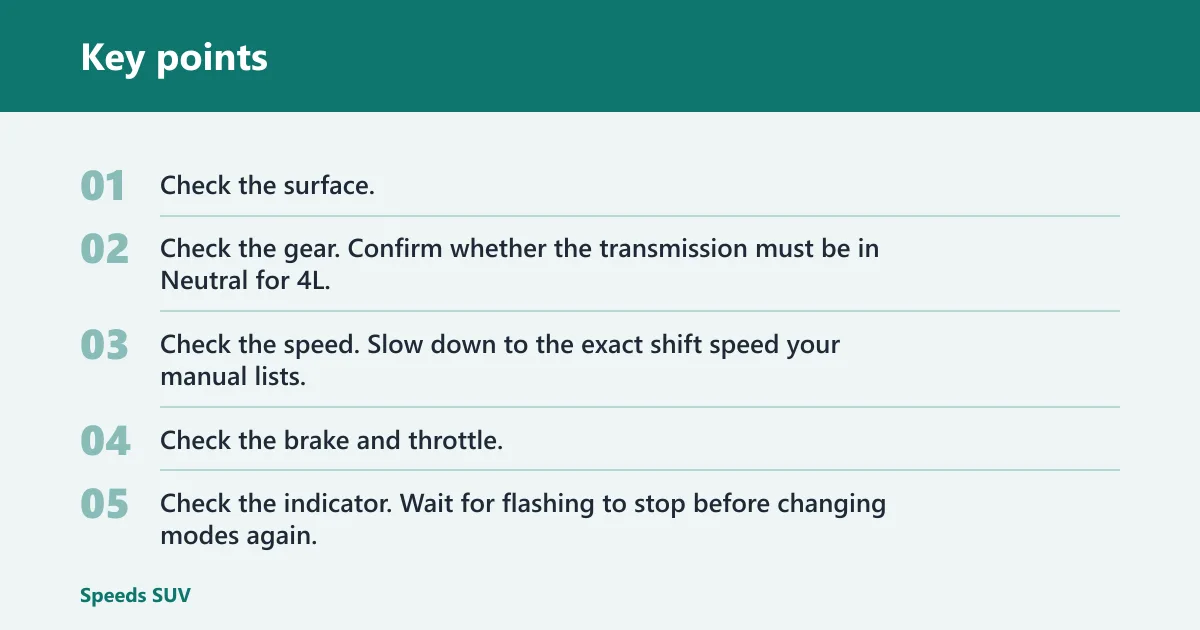
- Check the surface. Make sure the vehicle is on a traction surface that suits 4WD, not dry pavement.
- Check the gear. Confirm whether the transmission must be in Neutral for 4L.
- Check the speed. Slow down to the exact shift speed your manual lists.
- Check the brake and throttle. Ease off the throttle and follow any brake requirement in the manual.
- Check the indicator. Wait for flashing to stop before changing modes again.
A common first-timer mistake is trying to shift into 4L on level asphalt with the transmission still in Drive. The transfer case may refuse the request, the light may keep flashing, and the vehicle may feel unchanged. Moving to the correct surface and Neutral usually fixes the problem if the system itself is healthy.
Caution: surfaces to avoid
Do not use part-time 4WD on dry pavement, dry concrete, or any high-traction surface with good grip. It also should stay off dry parking lots, dry freeway lanes, and other surfaces where the front and rear axles cannot slip relative to each other. Use 2H there instead. Wet pavement can still have enough grip to cause bind in some situations, so treat it carefully.
Frequently asked questions
How does part-time 4WD work?
It works by using a transfer case to send power to both axles when engaged. Because there is no center differential, front and rear driveshaft speeds stay locked together. That gives extra traction on loose or slippery surfaces, but it also creates bind on dry pavement where the tires cannot slip enough.
What does 2H, 4H, and 4L mean?
2H means two-wheel drive high range and is the normal road setting. 4H means four-wheel drive high range for snow, dirt, gravel, mud, or ice at road speed. 4L means four-wheel drive low range for slow, controlled driving on steep grades, rocks, deep mud, or recovery work.
Can you use part-time 4WD on pavement?
Use it only on pavement that is genuinely low-traction, such as snow-covered or icy roads, and only if the manual allows that mode at the speed you are driving. Dry pavement is the wrong place for part-time 4WD because there is no center differential to absorb speed differences between the axles.
How do I know if my 4WD engaged correctly?
The best signs are a steady dash indicator, the correct mode symbol, and a normal change in vehicle feel. On many vehicles the light flashes first and then stops flashing when the transfer case finishes shifting. If the light never settles, or the vehicle feels unchanged, the shift may not be complete.
Do you have to stop to engage part-time 4WD?
Not always. Many vehicles allow 2H to 4H while moving slowly, but 4L often requires a stop and the transmission in Neutral. The exact rule depends on the transfer case design. If the owner’s manual calls for a stop, do not try to force the shift while rolling.