How to Check Tire Pressure Without a Gauge
Without a gauge, use sight, touch, and sound to spot a tire that looks visibly squashed, feels much softer than the others, or thumps while rolling; if you see that, drive only far enough to reach a real pressure gauge. Missing a low tire can damage the sidewall, hurt braking and steering, and turn a short trip into a flat or blowout. This guide shows quick no-gauge checks, the warning signs of dangerously low pressure, and when it is safe to drive for a proper reading.
What you can tell without a gauge
A no-gauge check tells you whether a tire looks unsafe, not the exact PSI. Use it to sort tires into three buckets: normal enough to drive to a gauge, soft enough to deserve immediate air from a built-in fill system, or bad enough to stop and inspect now.
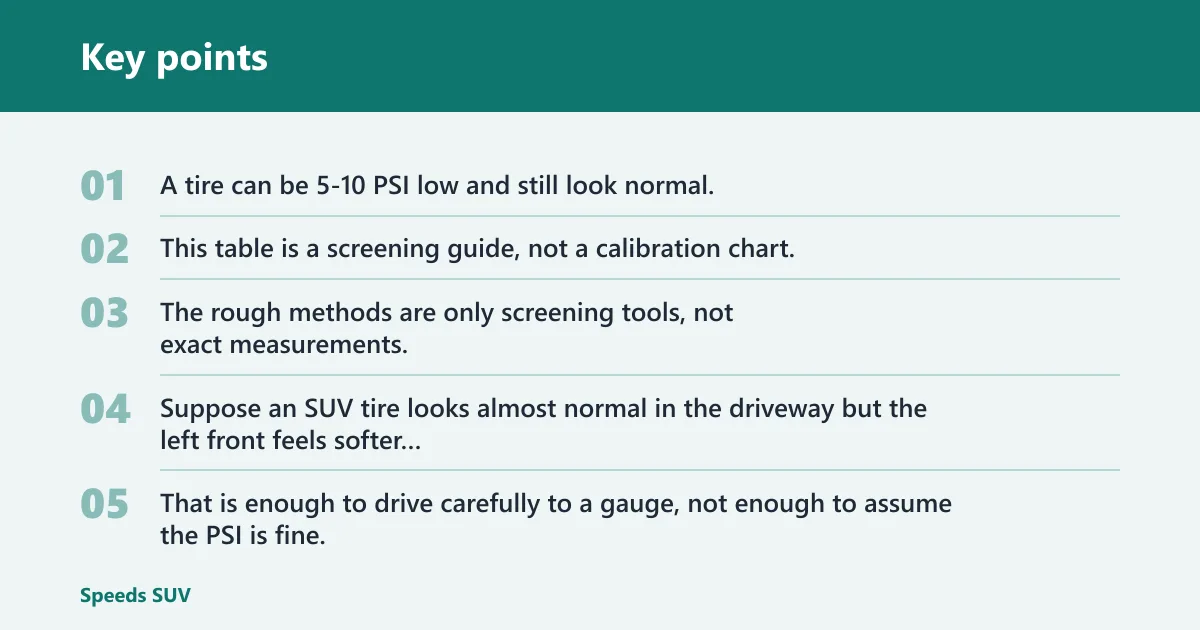
That limit matters. A tire can be 5-10 PSI low and still look normal, so a quick look can miss a problem that affects handling and tire wear. The goal here is triage, not measurement.
Tire pressure decision table
| Vehicle type | Visual check reliability | Thumb press test reliability | Thump test reliability | Next step if it looks off |
|---|---|---|---|---|
| Passenger cars | Moderate for obvious sagging; weak for small losses | Low to moderate, because sidewalls are shorter and stiffer | Low | Drive carefully to a real gauge or stop and inspect if the tire looks very flat |
| SUVs | Moderate, especially on taller sidewalls | Moderate, if you compare all four tires on the middle of the sidewall | Low to moderate | Drive to a gauge if the tire is only slightly soft; stop if the sidewall bulges oddly |
| Trucks | Moderate | Low, because heavy-duty tires can feel firm even when low | High only on higher-pressure truck tires | If a truck tire sounds dull and looks low, inspect before more driving |
| Low-profile tires | Low | Low | Very low | Stop and inspect if anything looks uneven; do not trust feel alone |
| Off-road tires | Moderate to low, depending on tread and sidewall shape | Low to moderate | Moderate on taller, higher-pressure setups | Use the visual check first, then verify with a gauge as soon as possible |
This table is a screening guide, not a calibration chart. The rough methods are only screening tools, not exact measurements.
One common pattern is easy to miss. Suppose an SUV tire looks almost normal in the driveway but the left front feels softer than the others when you press the sidewall. That is enough to drive carefully to a gauge, not enough to assume the PSI is fine.
Can you check tire pressure without a gauge at home?
Yes, but only as a rough screen. At home, compare tires by sight, press the sidewall, and listen for a dull or sharp sound when you tap the tread area. None of those gives exact PSI, and none replaces the driver’s door-jamb placard or a real gauge.
Visual inspection
Start with the easiest check. Look for bulging sidewalls, a tire that sits flatter than the others, or a contact patch that looks wider and more compressed than the rest. That is where visual inspection is strongest.
It can help spot a tire that is obviously underinflated, often about 10 PSI or more low, but it may miss smaller losses. A tire can still look normal even when it is several PSI low.
Thumb press test
Press the middle of the sidewall, not the tread, and compare all four tires. A softer sidewall than the other tires can suggest low pressure, but the feel is subjective and changes with tire size, sidewall height, and load.
Use this as a comparison tool only. A tire that feels a little firmer than its neighbors is not automatically correct, and a tire that feels soft does not tell you the exact PSI.
Thump test
Tap or kick the tire lightly and listen. A sharp thwack suggests more normal inflation, while a dull thud can point to low pressure. This method can be somewhat more useful on truck tires in the 80-100 PSI range, where sound changes are easier to hear.
It is much less dependable on passenger cars and low-profile tires. On those tires, tread pattern, tire construction, and vehicle noise can blur the sound enough to make the result misleading.
Picture a low-profile sedan tire on a cold morning. The sidewall can still look fine, the thump can sound similar across two tires, and the thumb press test can feel nearly the same on both. In that case, the safest move is to drive to a gauge rather than guess.
What does the TPMS light mean?
TPMS is a warning system, not a PSI number. It warns of significant pressure loss, but it does not give exact tire pressure, and it may not trigger until a substantial drop below recommended pressure. If the light is on and you do not have a gauge, treat the warning as urgent.
Driving can temporarily raise tire pressure 4-6 PSI, so a later check by sight or feel is less useful for deciding what happened. The best time to verify is when the tire is cold, after 3+ hours or overnight.
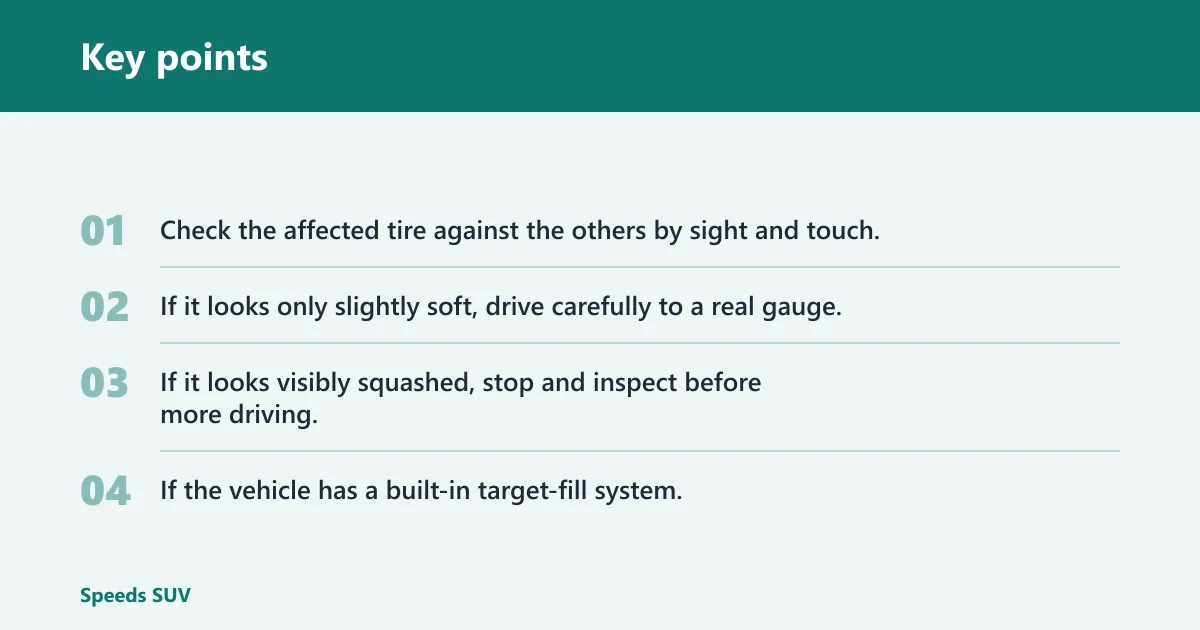
- Check the affected tire against the others by sight and touch.
- If it looks only slightly soft, drive carefully to a real gauge.
- If it looks visibly squashed, stop and inspect before more driving.
- If the vehicle has a built-in target-fill system, follow that system’s instructions and stop only at its clear signal.
When the light comes on, do not assume all four tires are equally low. A single tire can lose pressure first, and a visually normal tire can still be underinflated enough to affect handling.
Cold PSI and the door-jamb sticker
For exact pressure, use a tire pressure gauge on the valve stem and check the driver’s door-jamb placard for the recommended cold PSI. PSI means pounds per square inch, the unit used for tire pressure. The placard value is the target; the max PSI on the sidewall is not the recommended PSI.
Check tires when cold, after 3+ hours or overnight, because driving can raise tire pressure 4-6 PSI and distort later readings. A properly inflated passenger tire is often described as 30-35 PSI, but the exact target is the vehicle’s placard. Many fuel stations, service bays, portable inflators, and some vehicles can also show exact PSI without a separate handheld gauge.
A pencil gauge often costs under about $10, and many digital or analog gauges are commonly found in the roughly $5-$20 range. If you want exact PSI, that is the tool to use.
Honda Tire fill Assist
Some Honda models include Tire Fill Assist, a built-in target-fill system. Its exact signal behavior varies by vehicle and trim, so check the owner’s manual for your model before relying on it.
This is the one common case where adding air without a handheld gauge can make sense, because the vehicle gives a clear stop signal. Outside of that kind of system, do not guess at how much air to add.
When to stop and inspect
Stop and inspect now if the tire looks visibly squashed, the sidewall bulges, the contact patch looks flat and spread out, or the car pulls and feels unstable enough that you do not trust the steering. Those signs point to a tire that may be too low to drive any farther with confidence.
That is especially true for low-profile tires, where a small pressure drop can be harder to see but still easier to damage. If the tire looks obviously different from the others, do not treat it as a normal variation.
If you are choosing between “maybe drive a few blocks” and “inspect now,” choose inspect now when the tire shape has changed. A short stop can prevent sidewall damage and avoid turning a slow leak into a flat.
Emergency next step guide
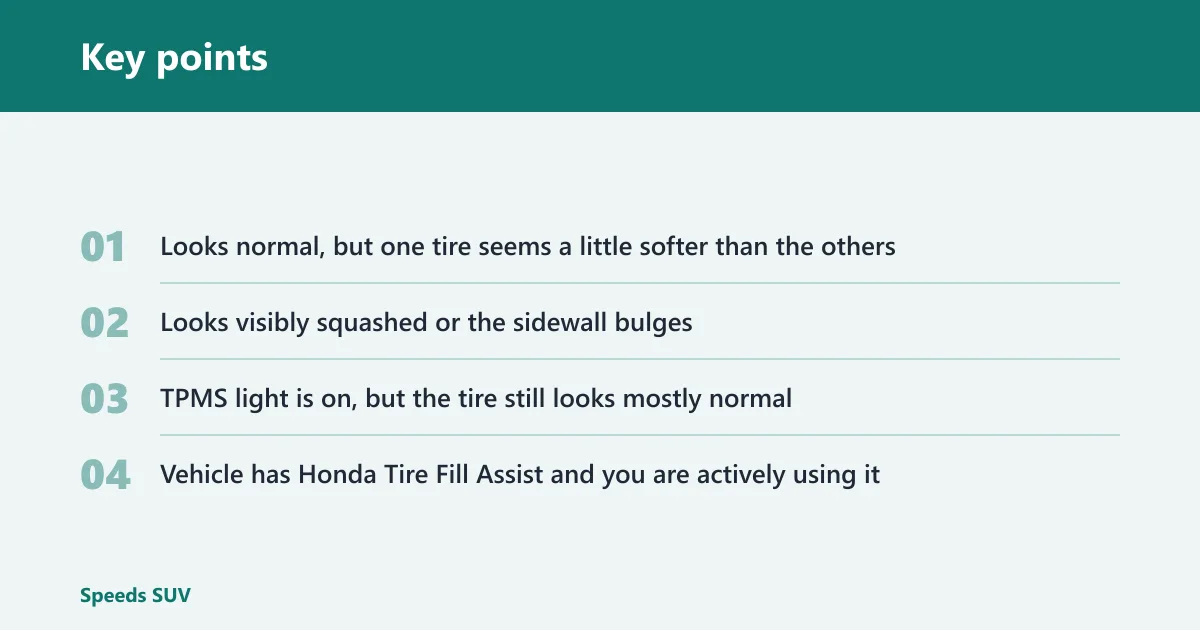
- Looks normal, but one tire seems a little softer than the others: drive carefully to a real gauge.
- Looks visibly squashed or the sidewall bulges: stop and inspect before more driving.
- TPMS light is on, but the tire still looks mostly normal: treat it as urgent and verify with a gauge as soon as possible.
- Vehicle has Honda Tire Fill Assist and you are actively using it: add air only until the built-in signal says stop.
Say your pickup has a rear tire that sounds dull when tapped and looks lower than the others at the driveway line. That is a strong sign to inspect before a longer drive. By contrast, if a sedan tire only feels slightly softer by hand, the safer next step is a slow trip to a gauge, not a long guess.
Frequently asked questions
How can I tell tire pressure without a gauge?
Use sight, touch, and sound to screen for a tire that looks squashed, feels softer than the others, or gives a dull thud. That can tell you whether the tire is unsafe to keep driving on, but it cannot give exact PSI. Get a real gauge as soon as possible.
How do I know if my tire is low just by looking at it?
Look for a flatter contact patch, a sidewall that bulges outward oddly, or one tire that sits lower than the others. Visual checks are best when the loss is large. Small losses can hide easily, so a tire can look normal and still be low.
Can I trust the tire pressure light if I don’t have a gauge?
Trust it as a warning, not as a measurement. TPMS alerts often happen at a substantial drop below recommended pressure, so the tire may already be low enough to matter. If the light is on, treat it as a reason to verify pressure soon and inspect the tire.
How do I check tire pressure with my hands or by tapping the tire?
Press the middle of the sidewall and compare all four tires, then tap or kick the tire lightly and listen for a sharp thwack versus a dull thud. These are subjective screens only. They are least useful on low-profile tires and most useful on higher-pressure truck tires.
What should I do if the tire looks soft but I have no gauge?
If it looks only a little soft, drive carefully to the nearest accurate gauge or service station. If it looks obviously squashed or the sidewall is bulging, stop and inspect instead of driving farther. Do not add air blindly unless the vehicle has a built-in target-fill system.