Which Tire Pressure Gauge Is Best for Off-Road Use?
The best tire pressure gauge for off-road use is a 0–60 psi digital gauge with 0.1 psi resolution and a lock-on chuck for 5–30 psi trail pressures; choose a pencil or dial gauge only as a simple backup. Poor accuracy can leave tires too soft or too hard, which hurts traction, heat control, sidewall support, and TPMS readings. This guide compares gauge types by accuracy, chuck style, durability, and the pressure range that fits 4x4s, trucks, and Jeeps.
Choosing between digital, dial, and pencil gauges
The trade-off is direct: digital gauges are easiest to read at low pressure, analog dial gauges are battery-free and tough, and pencil gauges are compact but least precise. For off-road use, the best choice comes down to how low you air down, how fast you need to check all four tires, and how cramped your valve stems are.
Digital tire pressure gauge
A digital tire pressure gauge is often the easiest default if you want easy reading in the 10–35 psi range and a target accuracy of about ±1 psi or better. A backlit display helps in early-morning trail checks, and a battery-powered display is useful when you are airing down in dust, rain, or low light.
The weak point is power dependence. If the battery is dead, the gauge is dead. That matters on long trail days, so a digital gauge works best when you keep a spare battery or treat it as part of a larger air-down kit.
Analog dial tire pressure gauge
An analog dial tire pressure gauge is a strong fit when you want a battery-free tool that can take rough handling and still stay readable in mud or dust. The mechanical face is easy to inspect at a glance, and there is no battery to lose or drain in cold weather.
Dial gauges are often a better match for drivers who value durability over extra features. The trade-off is usually bulk and a slightly slower read than a simple digital display, especially when you are checking multiple tires on uneven ground.
Pencil tire pressure gauge
A pencil or pen tire gauge is compact, cheap, and easy to stash in a glove box or recovery bag. It is fine for rough checks and for confirming that all four tires are in the same general zone, but it is not the best tool for precise airing down at low pressure.
Its short body and narrow scale make it less friendly for trail use, especially when you are wearing gloves or working quickly in dirt. For off-road tires, think backup tool, not primary gauge.
Off-road gauge comparison table
| Gauge type | Accuracy target | Pressure range | Chuck style | Glove-friendliness | Battery dependence | Durability | Best use case |
|---|---|---|---|---|---|---|---|
| Digital | About ±1 psi or better | 0–60 psi or similar, with clear reading below 20 psi | Straight or lock-on; clip-on on some models | High | Yes | Good to very good if the body is protected from impact | Mixed street/trail use, sand, technical trails, fast repeat checks |
| Analog dial | About ±1 to ±2 psi on quality models | Commonly 0–60 psi or 0–100 psi | Straight or clip-on | High | No | Very good in rough handling, dust, and mud | Weekend overlanding, harsh conditions, backup without batteries |
| Pencil | Rough check only; often less precise than digital or dial | Often broad, but low-pressure readings can be hard to judge | Straight push-on | Low to medium | No | Fair, but the small body can be easy to misplace | Emergency backup, quick street-pressure checks, compact storage |
How accurate does it need to be?
For airing down, about ±1 psi accuracy is a practical target. At around 12 to 18 psi, a 2 psi error can change sidewall support and footprint shape enough to matter, so a gauge that reads cleanly and repeatably matters more than a broad “close enough” number. That is why precision matters most in the low-pressure range.
Why ±1 psi matters when airing down
When you reduce pressure for sand or rock, a small error changes how the tire flexes. Too much pressure can reduce grip and ride comfort. Too little can increase sidewall flex, heat, and the chance of rim contact on sharp edges.
When a cheap gauge is good enough
A cheap gauge can be good enough for rough checks, topping off street pressure, or confirming that all four tires are in the same general range. It is not the best choice when you are trying to hit a specific low-pressure target for technical terrain.
Say your truck is set for highway travel at 36 psi and you only need to confirm that no tire is far off. A budget gauge can do that job. If you are trying to set all four to 14 psi for a sandy wash, the extra precision matters more.
Why consistency across all four tires matters
Consistency matters because uneven tire pressures can change steering feel, braking balance, and traction from corner to corner. A gauge that reads repeatably is valuable even if it is not the most expensive option on the shelf.
What psi range and chuck type matter?
A practical off-road gauge should read clearly below 20 psi and still be useful up through normal street pressures. A 0–60 psi scale is a practical match for many 4x4s because it covers low trail pressures and still leaves room for highway checks. Chuck style matters just as much as the scale.
Low-pressure reading below 20 psi
Off-road airing down often happens in the 10–20 psi range, with sand and technical rock work sometimes lower depending on tire size, vehicle weight, and wheel design. A gauge that is hard to read there is a poor fit, even if it looks accurate at 35 psi.
Straight, clip-on, and screw-on chucks
A straight chuck is simple and works well when valve stems are easy to reach. A clip-on or locking chuck is better when you want hands-free reading or when the wheel design leaves little room for fingers and eyes. A screw-on chuck can offer a secure seal, but it takes more time to attach and remove.
Valve stem fit, clearance, and seal quality
Schrader valve stems are standard on most off-road vehicles, but a poor chuck seal can leak if mud, sand, or a crooked angle keeps the chuck from seating fully. That leak can give a false low reading or bleed air while you are trying to measure, which is especially annoying on cramped wheels.
Picture a set of deep-dish wheels with a short valve stem and a layer of trail dust around the cap. A straight push-on chuck may work, but a lock-on or clip-on chuck often seals more cleanly and wastes less time.
Will it survive trail abuse?
Trail use exposes a gauge to drops, dirt, vibration, and temperature swings. A useful gauge should keep working after being tossed in a recovery bag, used with dirty gloves, or handled in cold weather. Durability is not a bonus feature here; it is part of the job.
Dust, mud, and impact resistance
Dust and mud matter because they can interfere with the chuck seal and contaminate the valve stem. Impact matters because a gauge with a drifting mechanism or a cracked body can read differently after a hard drop. A rugged case, protected display, or mechanical dial can reduce those risks.
Battery dependence and cold-weather use
Digital gauges depend on batteries, and batteries can be less reliable in cold conditions. That does not make digital gauges bad for winter trail use, but it does mean you should check power before heading out. Analog gauges avoid that failure point entirely.
Glove-friendly controls and display readability
Off-road gear should be usable with gloves on. Large buttons, a clear display, and a chuck that can be seated without tiny finger movements all help on the trail. If you cannot read the number fast, the gauge slows down the airing-down workflow.
Which gauge fits your off-road use case?
The best choice depends on how you drive. Mixed street/trail rigs benefit from a digital gauge with a clear low-pressure scale. Sand and repeated air-down cycles favor quick reading and a secure chuck. Hardcore crawling and hard-use trail rigs often benefit from a dial gauge or a digital gauge with a locking chuck and compressor compatibility.
Weekend overlanding and mixed street driving
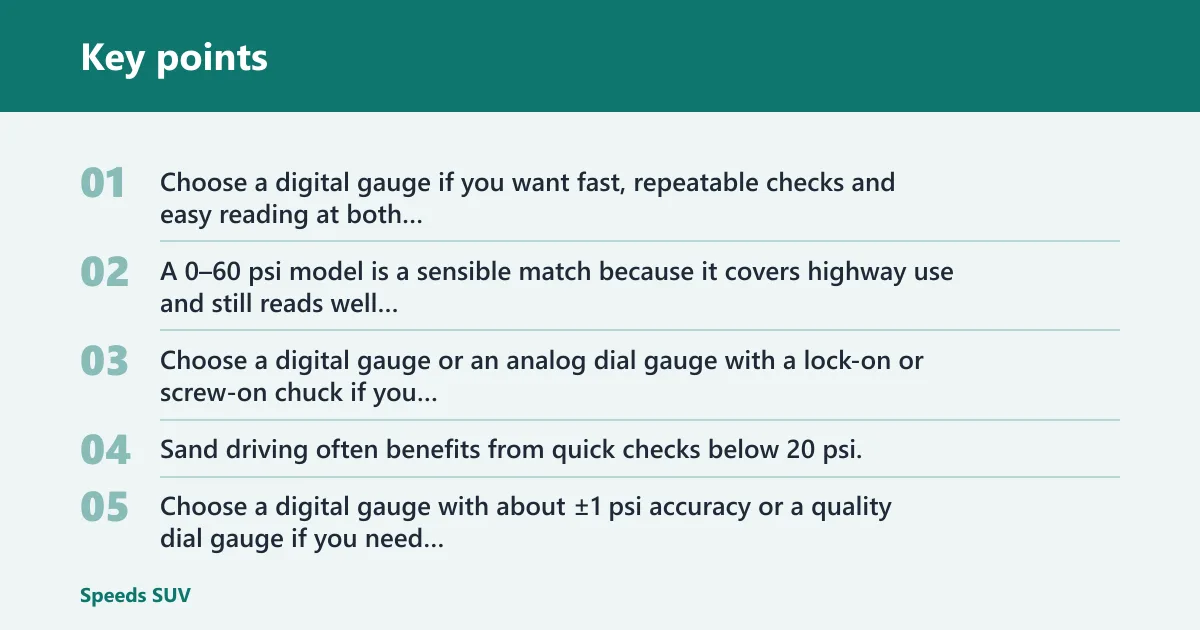
Choose a digital gauge if you want fast, repeatable checks and easy reading at both street pressure and trail pressure. A 0–60 psi model is a sensible match because it covers highway use and still reads well when you air down for dirt roads or mild trails.
Sand and frequent air-down changes
Choose a digital gauge or an analog dial gauge with a lock-on or screw-on chuck if you expect repeated pressure changes. Sand driving often benefits from quick checks below 20 psi, where legible low-pressure readings matter more than a broad upper range.
Rock crawling and low-pressure precision
Choose a digital gauge with about ±1 psi accuracy or a quality dial gauge if you need tighter control at very low pressure. Rock use is where a small error can change sidewall support and how the tire conforms to ledges and broken surfaces.
Hardcore trail use with compressor and deflator tools
Choose a gauge that pairs well with a locking chuck or inflator gauge if you want hands-free inflation measurement and a single tool flow from deflating to reinflating. That setup works well when the gauge needs to do double duty on the compressor hose and at the valve stem.
Choose digital if… / Choose analog if…
Choose digital if you want quick, easy low-pressure reads, a backlit screen, and a target accuracy of about ±1 psi. Choose analog if you want battery-free simplicity, strong tolerance for rough handling, and a gauge that stays useful in dust, mud, and cold mornings. Choose pencil only for compact backup use.
Choose digital if you air down often, care about repeatable numbers, or need a gauge that is easy to read in the 10–35 psi range. Choose analog if you value a tool that can ride in a trail bag without worrying about batteries or screen glare. Choose pencil if space is tight and precision is secondary.
Tire gauge decision table
| Use case | Accuracy target | Pressure range | Chuck style | Best fit |
|---|---|---|---|---|
| Mixed street/trail driving | About ±1 psi | 0–60 psi | Straight or clip-on | Digital |
| Weekend overlanding | About ±1 to ±2 psi | 10–40 psi | Clip-on or straight | Analog dial or digital |
| Sand driving | About ±1 psi | Below 20 psi, with clear low-end reading | Lock-on or screw-on | Digital |
| Rock crawling | About ±1 psi | 10–25 psi | Lock-on or screw-on | Digital or quality dial |
| Backup kit only | Rough check | General street and trail use | Straight push-on | Pencil |
How to check tire pressure accurately on the trail
Start with a cold tire when possible, because pressure rises after driving and heat can change the reading. Check each tire at the same point in your air-down workflow, use the same gauge for all four tires, and make sure the chuck is seated squarely on the Schrader valve before you read the number.
- Park safely and let the tire cool if you have been driving on pavement.
- Remove dirt or mud from the valve stem and cap area.
- Seat the chuck squarely to avoid a leak at the valve stem.
- Read the pressure and repeat the check if the number jumps or hisses.
- Adjust each tire to the same target unless your vehicle setup calls for a different split.
- Recheck all four tires after airing down or airing back up.
Troubleshooting bad readings on the trail
A bad reading usually comes from one of four causes: valve-stem debris, a leaking chuck, weak batteries, or impact drift. If the gauge reads inconsistently, clean the valve area, reseat the chuck, swap the battery in a digital unit, and compare the reading against another gauge if one is available.
Temperature can also mislead you. A cold morning reading may look lower than a hot tire after highway driving, so use the same temperature condition whenever possible. TPMS can warn you about a major drop, but it is not a substitute for a handheld gauge when you air down to a specific trail target.
What features matter most in a gauge for low-pressure off-road tires?
The most useful features are low-pressure readability, a secure chuck, a clear display or dial, and a body that survives dirt and impact. For off-road use, a lock-on chuck or inflator gauge is especially useful because it supports both deflating and reinflating without juggling extra tools.
Should you use a gauge with a bleed valve?
A bleed valve is useful if you want fine control while airing down or trimming pressure after a quick check. It is most helpful when you want repeatable measurements and small corrections, not when you only need a rough street-pressure read.
What about TPMS?
TPMS is helpful for warnings, especially if one tire loses pressure faster than the others. It should still be treated as a monitor, not a setting tool. Trail pressures can sit below the warning threshold, and that threshold is not the same thing as a safe off-road target.
Frequently asked questions
What tire pressure gauge is best for off-road use?
A common all-around off-road gauge is a 0–60 psi digital model with about ±1 psi accuracy, and a backlit display plus a lock-on or secure straight chuck can be useful. That combination works well for 10–35 psi trail pressures and still handles street checks without guesswork.
Are digital tire pressure gauges better than analog ones for off-roading?
Digital gauges are easier to read and usually the better choice if you want fast, precise low-pressure checks. Analog dial gauges are still excellent when you want a battery-free tool that can handle mud, dust, and rough use without depending on electronics.
How accurate does a tire pressure gauge need to be for airing down?
About ±1 psi is the practical target for airing down. That level of accuracy helps when you are setting 12 to 18 psi for sand or rocks, where a small error can change traction, ride feel, and sidewall support.
Can a cheap tire gauge be trusted for off-road tires?
A cheap tire gauge can be trusted for rough checks and basic street-pressure confirmation, but not as the only tool for precise off-road airing down. If the reading is hard to repeat, or if the chuck leaks at the valve stem, it is not a good primary gauge.
What psi range should an off-road tire gauge measure?
Look for a gauge that reads clearly below 20 psi and still covers normal street pressures, with 0–60 psi being a common and practical range. That span fits most mixed-use 4x4s and makes the low end readable enough for sand, rocks, and technical trails.
Should I use a gauge with a bleed valve for off-roading?
A bleed valve is useful if you want small, controlled pressure changes while airing down or fine-tuning a tire. It is not required, but it can speed up repeatable adjustments when you want to hit the same target pressure on all four tires.