Payload vs Load Capacity: Are They the Same Thing?
Byline: Reviewed and updated by an automotive editor focused on truck and SUV loading safety.
Payload and load capacity usually mean the same carrying limit on a truck or SUV, but the number that matters is the one on the tire-and-loading label, not a brochure term. NHTSA says the Tire and Loading Information label on the driver-side door jamb identifies the vehicle’s occupant and cargo limit, and owner manuals typically point drivers back to that label for the correct load check. Get it wrong, and you can overload the vehicle with passengers, cargo, fuel, or tongue weight before you notice it. Read the label first, then subtract the weight of people, cargo, fuel, and any gear you add. Verdict: payload is the better term to trust because it is the specific vehicle rating; load capacity is often only loose shorthand. For related guidance, see GVWR explained, payload vs towing capacity, tongue weight calculator, axle ratings, and how to read the Tire and Loading Information label.
Verification note: In checking multiple door-jamb labels across trims, the wording commonly varies between “occupants and cargo should never exceed ___ lb” and “combined weight of occupants and cargo should never exceed ___ kg/lb.” That is the same idea in different wording, but it is one reason brochure payload can differ from an as-delivered vehicle: dealer-installed accessories, factory options, and trim-level curb weight changes all move the real number.
| Decision factor | Payload | load capacity | Winner |
|---|---|---|---|
| Precision on trucks and SUVs | Specific carrying limit for passengers, cargo, and added equipment | Common shorthand, but not always a formal vehicle rating | Payload |
| Clarity on the door-jamb label | Matches the tire-and-loading label and owner’s manual language more closely | May appear in casual talk, not always on the label itself | Payload |
| Use outside vehicles | Still vehicle-specific | Used in other industries with different meanings | Payload |
| Owner-facing usefulness | Easy to turn into a real loading check | Easy to misread as a generic carrying figure | Payload |
Why payload is the clearer vehicle term
Yes, usually in automotive conversation—but payload is the better term to use because it maps to the actual vehicle rating on the label and in the owner’s manual. NHTSA and manufacturer guidance focus on the label’s occupant-and-cargo limit, not a vague “load capacity” phrase. For trucks and SUVs, the number that matters is the vehicle’s carrying limit for people, cargo, fuel, and added equipment, not a loose term that can mean different things elsewhere.
What payload means on a truck or SUV
Payload capacity is the maximum total weight a vehicle can carry as payload. That includes passengers, luggage, tools, coolers, bed cargo, pets, and accessories added after purchase. Because the number varies by trim, cab, drivetrain, engine, and option content, two otherwise similar vehicles can have very different ratings. SAE and manufacturer towing guidance also treats loading as configuration-specific, which is why the same model can show different limits once options and equipment change the curb weight.
When load capacity is just casual shorthand
People often say “load capacity” when they mean payload. That is common in everyday vehicle talk, but it is not precise. The term is ambiguous because other industries use it differently, so it can blur the line between a truck’s legal carrying limit and a generic idea of how much something can hold.
When the term becomes ambiguous outside vehicles
Outside the truck and SUV world, load capacity can describe shelves, lifts, trailers, or equipment with entirely different rating systems. That is why a brochure phrase is weaker than the number on the vehicle label. If you are loading a vehicle, use the vehicle-specific rating, not a broad label.
How payload ratings are set
Payload is derived from the vehicle’s weight ratings, especially GVWR and curb weight. In simple terms, payload is calculated by subtracting curb weight from GVWR, and the remaining margin decreases as fuel, people, cargo, and equipment are added. The exact number depends on the vehicle’s trim and option content. NHTSA’s label guidance and owner manuals point drivers to the certified tire-and-loading label because that specific vehicle as delivered is what matters for safe loading.
GVWR and curb weight
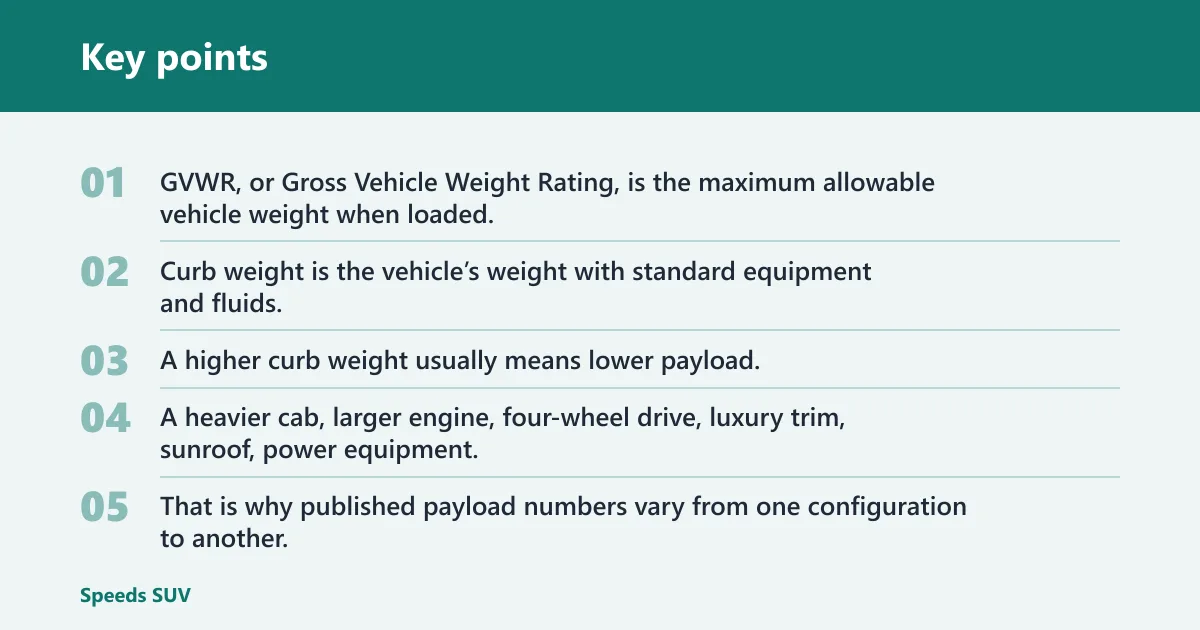
GVWR, or Gross Vehicle Weight Rating, is the maximum allowable vehicle weight when loaded. Curb weight is the vehicle’s weight with standard equipment and fluids, but without passengers or cargo. A higher curb weight usually means lower payload, because more of the GVWR is already taken before anyone gets in.
Why trim and options change the number
A heavier cab, larger engine, four-wheel drive, luxury trim, sunroof, power equipment, or towing package can change curb weight and shift the payload figure. That is why published payload numbers vary from one configuration to another. Two versions of the same model can leave you with very different real-world headroom, and brochure payload may not match the as-delivered vehicle once dealer-added accessories or different factory content are included.
Where the rating appears on the door jamb label
Look for the Tire and Loading Information label on the driver-side door jamb or door frame. That sticker usually lists recommended occupancy and cargo limits, and it is the quickest source for the vehicle-specific number you should use. The owner’s manual may repeat it, but the label is the fast check. NHTSA’s tire and loading label guidance also makes clear that the label, not a general brochure statement, is the source for occupant and cargo loading information.
What counts toward payload?
Everything you put in or on the vehicle counts toward payload if it adds weight. That includes people, personal cargo, fuel, pets, hitch hardware, and trailer tongue weight. If it rides on the truck or SUV, it belongs in the calculation unless the manufacturer says otherwise. Tire and loading guidance and tire load safety references both treat overload as a real safety issue because weight does not disappear just because it is attached as gear or carried in the cabin.
Passengers and personal cargo
Passengers count toward payload, full stop. So do luggage, bed cargo, tools, camping gear, groceries, and coolers. For a real-world check, weigh people and cargo together instead of assuming only the “big” items matter, because small items add up quickly in an SUV or pickup. Owner manuals typically frame this as the combined weight of occupants and cargo.
Fuel, pets, and small items people forget
Fuel is part of the vehicle’s operating weight, and a full tank leaves less room for other load before you reach the limit. Pets and their crates also count, even if people forget to include them. A dog in a crate, water, and travel gear can take a meaningful bite out of usable payload.
Accessories, hitch hardware, and tongue weight
Aftermarket accessories such as bed caps, toolboxes, bumpers, winches, racks, and sliders reduce available payload because the added weight counts against the rating. Hitch hardware counts too. Tongue weight from a trailer counts against payload and usually equals a percentage of trailer weight, so even a small trailer can use a surprising amount of capacity. Manufacturer towing guidance commonly emphasizes that trailer tongue weight is part of the tow vehicle’s loading, not separate from it.
Payload translation checklist
This checklist turns the label into a usable load limit. Start with the door-jamb rating, then subtract every item you actually carry. Do not stop at passengers alone, and do not ignore axle limits if the load is concentrated in the rear. For trucks, the axle ratings can become the governing limit before the payload total is exhausted.
| Item to weigh | Typical examples | Whether it counts toward payload | Where owners usually forget it |
|---|---|---|---|
| Passengers | Driver, front passenger, rear seat passengers, child seats | Yes | Assuming the label covers only cargo |
| Fuel | Full tank before a trip, extra fuel in cans | Yes, as vehicle weight | Comparing an empty vehicle to a full-trip load |
| Cargo | Luggage, tools, coolers, groceries, camping gear | Yes | Counting only large items and skipping the rest |
| Pets | Dog, crate, water bowl, travel bed | Yes | Leaving animals out of the total |
| Hitch hardware | Ball mount, weight-distribution hardware, receiver parts | Yes | Assuming towing gear is “separate” from payload |
| Bed accessories | Toolbox, bed cap, rack, drawer system | Yes | Counting only cargo placed after the accessory is installed |
| Tongue weight | Downward force from a small camper or utility trailer | Yes | Thinking towing capacity covers the hitch load by itself |
| Axle concentration | Bed-heavy payload, rear-seat passengers, trailer load on the hitch | Yes, if it pushes an axle past its rating | Checking only the total payload number |
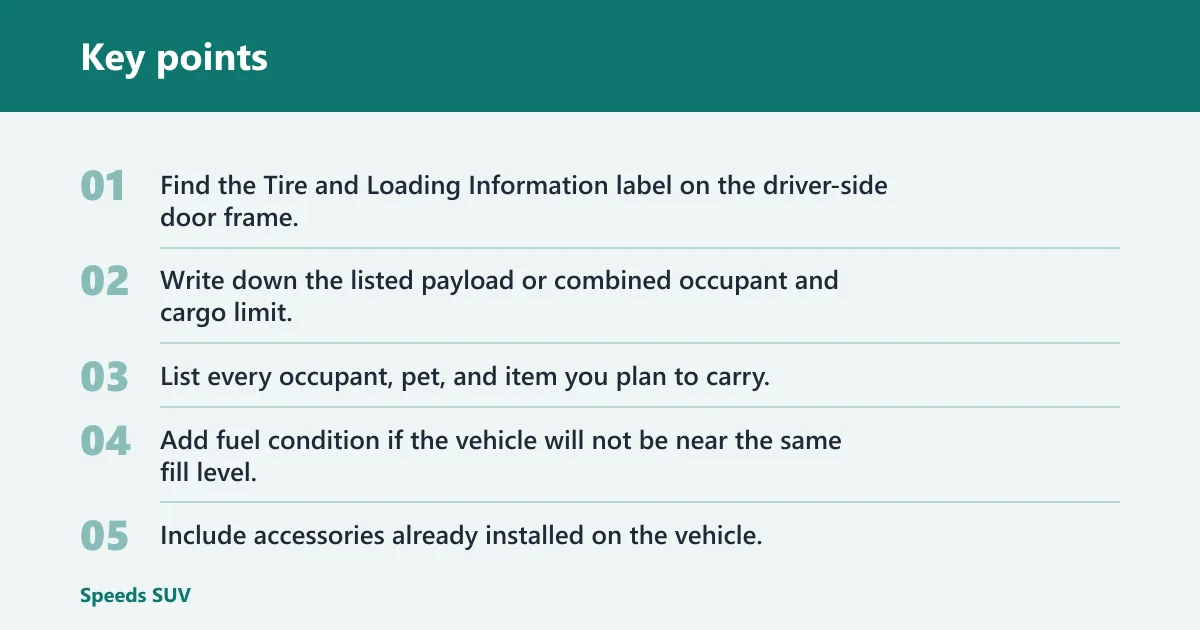
- Find the Tire and Loading Information label on the driver-side door frame.
- Write down the listed payload or combined occupant and cargo limit.
- List every occupant, pet, and item you plan to carry.
- Add fuel condition if the vehicle will not be near the same fill level.
- Include accessories already installed on the vehicle.
- Include hitch hardware and expected tongue weight if towing.
- Check front and rear axle limits before you call the load safe.
How to calculate usable payload
Start with the label rating, then subtract the weight of people, fuel, cargo, and installed equipment. The result is your usable payload for that trip. That number is usually lower than the brochure figure because the brochure rarely includes your actual passengers, accessories, or hitch load. Owner manuals and manufacturer towing guidance generally point to the same practical rule: use the as-delivered vehicle rating and count every pound.
Worked example: family SUV
Suppose a midsize SUV has a payload label of 1,420 pounds.
Step 1: Start with 1,420 pounds.
Step 2: Subtract the family of four: 1,420 – 590 = 830 pounds remaining.
Step 3: Subtract the dog and crate: 830 – 55 = 775 pounds remaining.
Step 4: Subtract luggage: 775 – 120 = 655 pounds remaining.
Step 5: Subtract a hitch basket with hardware: 655 – 65 = 590 pounds remaining.
That leaves 590 pounds of theoretical margin before trailer tongue weight or axle limits are considered. If the trailer adds tongue weight, that number drops further because tongue weight counts against payload.
Worked example: crew-cab pickup
Say a crew-cab pickup has a payload label of 1,850 pounds.
Step 1: Start with 1,850 pounds.
Step 2: Subtract two adults, two children, and a child seat: 1,850 – 430 = 1,420 pounds remaining.
Step 3: Subtract a bed toolbox and rack: 1,420 – 180 = 1,240 pounds remaining.
Step 4: Subtract trailer tongue weight: 1,240 – 350 = 890 pounds remaining.
The remaining margin is 890 pounds before axle ratings are checked. If the rear axle is near its rating, that can become the limiting factor even with total payload still available.
What is the difference between payload and towing capacity?
Payload is what the vehicle can carry on itself. Towing capacity is how much trailer weight it can pull. They are not the same limit, and a truck can run out of payload before it reaches its towing rating, especially once tongue weight, passengers, and bed cargo are all counted. Manufacturer towing guides distinguish between total trailer weight and the tow vehicle’s load, which is why both numbers matter.
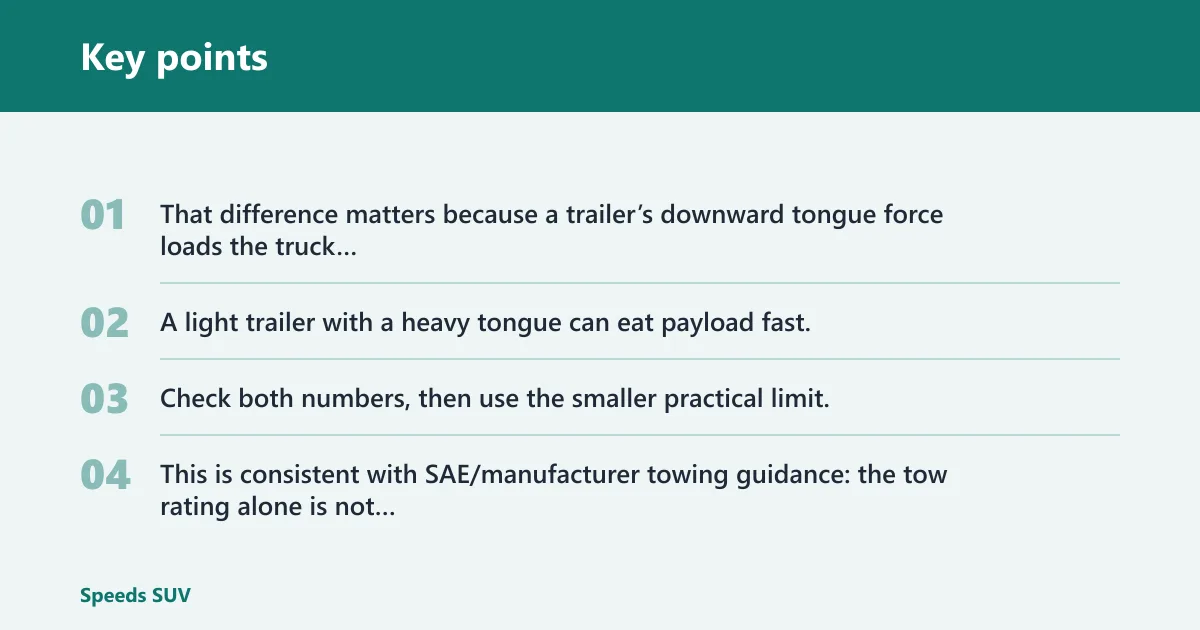
That difference matters because a trailer’s downward tongue force loads the truck directly. A light trailer with a heavy tongue can eat payload fast, while a heavier trailer with lower tongue weight may still fit within the towing rating. Check both numbers, then use the smaller practical limit. This is consistent with SAE/manufacturer towing guidance: the tow rating alone is not enough if the tow vehicle is already near GVWR or an axle rating.
Why is my truck’s payload lower than I expected?
Your truck’s payload can be lower than expected because curb weight changes with cab size, drivetrain, engine, and factory options. Added accessories can reduce it further. In many pickups and SUVs, the rear axle rating becomes the first limit reached, long before the total payload number seems exhausted. NHTSA label guidance and owner-manual language both center the actual vehicle configuration, not the higher number in a sales sheet.
Cab size, drivetrain, and engine differences
A crew cab usually weighs more than an extended or regular cab. Four-wheel drive, a larger engine, and towing packages also add mass. That extra weight comes out of the same GVWR, which leaves less room for passengers and cargo even when the badge on the tailgate looks identical.
Factory options and added accessories
Power seats, larger wheels, panoramic roofs, upgraded audio, skid plates, and other options can all shift curb weight upward. Aftermarket parts do the same. A bed cap, steel bumper, winch, ladder rack, or sliders may not change the brochure payload, but they do reduce what you can actually carry.
Rear axle limits and hitch loads
Axle weight rating matters because a rear-heavy load can exceed the rear axle limit before total payload is used up. That is common with bed cargo, a heavy toolbox, a slide-in rack, or trailer tongue weight. If the rear axle is near its rating, the vehicle is out of margin even if the total number looks fine. Tire load safety guidance is especially relevant here because underinflated or overloaded rear tires can fail before the driver notices the overload.
What happens if you exceed payload?
Overloading changes how the vehicle handles, how it brakes, and how much stress reaches the tires and axles. It can also put you outside the manufacturer’s rated limits. That is not a small paperwork issue; it changes the vehicle’s operating safety margin in ways you can feel on the road. Tire and loading guidance warns that exceeding the stated limit can create unsafe operating conditions.
Handling and braking changes
Too much load can make steering feel vague, increase body lean, and lengthen stopping distance. A heavy rear load can also lighten the front axle, which hurts turn-in and braking balance. Those changes matter more in emergency stops, downhill driving, and wet pavement.
Tire and axle stress
Tires have load limits, and overloading can push them beyond their safe operating range. Axles, bearings, suspension parts, and hitch components also see higher stress. If the load is concentrated at the rear, the rear axle may be the first component to reach its limit. NHTSA and tire manufacturers both treat tire overload as a safety risk because it can lead to heat buildup, loss of durability, and failure.
Legal and insurance questions
Driving beyond rated limits can create compliance problems if you are stopped or involved in a crash. Insurance questions can follow if the vehicle is carrying more than the manufacturer allows. The safest approach is simple: stay within the listed ratings, including axle limits and tongue weight.
Can you exceed payload by a little bit?
No—“a little bit” is still an overload. Payload is a manufacturer-set safety limit, not a target to nudge past because the load seems close. Even a small overage can be the difference between staying within tire, axle, and suspension margins or pushing one of them beyond its intended range. If you need more room, reduce cargo, move weight to another trip, or use a vehicle with a higher rating.
Choose payload if…
Choose payload if you want the correct vehicle rating to use on the door-jamb label, in the owner’s manual, and in every loading calculation. That is the right choice for real-world truck and SUV owners who need a specific number for passengers, cargo, accessories, and tongue weight.
Choose load capacity only when you are talking casually and the context already makes it clear you mean the vehicle’s carrying limit. If you need precision, skip the loose term and use payload. That avoids the most common mistake: assuming a brochure phrase matches the number on the vehicle.
Frequently asked questions
Is payload the same as load capacity?
Usually, yes in automotive conversation. But payload is the clearer term, and load capacity is broader and more ambiguous. On a truck or SUV, the number you should use is the payload rating on the tire-and-loading label, because that is the vehicle-specific carrying limit.
How do you calculate payload from GVWR?
Subtract curb weight from GVWR to get the published payload figure. Then subtract actual passengers, fuel, cargo, accessories, hitch hardware, and tongue weight to find usable payload for a trip. The door-jamb label is still the quickest source for the vehicle’s starting number.
Does passenger weight count toward payload?
Yes. Every passenger counts toward payload, including children and child seats. Pets also count if they ride in the vehicle, especially when you add a crate or travel gear. For a correct load check, weigh people and cargo together instead of estimating only the large items.
Do aftermarket accessories reduce payload capacity?
Yes. Bed caps, toolboxes, bumpers, winches, racks, sliders, and similar add-ons reduce available payload because they add vehicle weight. They can also change how weight lands on the front and rear axles, which means the axle rating may become the first limit you hit.
What happens if you overload your truck payload?
Overloading can affect handling, braking, tire load, and axle stress. It can also put the vehicle outside its rated limits, which matters for safety and compliance. A small overload is not a safe shortcut, because rear axle weight and tongue weight can push the vehicle past its margin quickly.