
Compact SUV vs Subcompact SUV: Which Is Better for You?
Choose a compact SUV if you carry adults often, want easier highway comfort, or need about 25 to 35 cubic feet or more behind the rear seat. Pick the smaller class for narrow garages and short commutes. Choose the larger class when rear-seat space and cargo room stop being optional. This guide maps body size, cargo needs, parking constraints, and commute length to the right SUV class.
| Decision factor | Compact SUV | subcompact SUV | Winner |
|---|---|---|---|
| Rear-seat room | Better for adults, child seats, and taller passengers | Works best for short trips and smaller passengers | Compact SUV |
| Cargo room | Usually the safer pick for strollers, airport bags, and family luggage | Enough for daily errands, but tighter with bulky gear | Compact SUV |
| Parking and maneuvering | Still easy by SUV standards, but less forgiving in tight garages | Best for narrow streets, compact spaces, and frequent curb parking | subcompact SUV |
| Fuel economy | Can be efficient, but the class usually carries a size penalty | Usually the better bet for lower fuel use | subcompact SUV |
| Starting price | Often above the low-$30,000 mark on current examples | Usually the lower entry point | subcompact SUV |
| AWD and winter use | Common on many models, useful for snow and slick roads | Available on many models, but not all | Compact SUV |
Compact vs subcompact at a glance
Compact SUVs sit one size up from subcompact SUVs in most market naming systems, though labels can vary by region and publisher. In plain terms, the larger class gives you more rear-seat room, more cargo space, and less crowding for adults; the smaller class gives you easier parking, lower entry pricing, and better fuel economy.
What changes when you move up a class
The move from subcompact to compact matters most when passengers or cargo become part of daily life. A compact SUV is usually the safer choice if the rear seat is used often, because the back row is less likely to pinch tall riders, child seats, or a second adult. A subcompact SUV is often enough when the rear seat is mostly a backup.
Current examples show the pricing spread clearly. The 2027 Honda CR-V starts at $33,070, and the 2026 Mazda CX-50 starts at $31,395, both above the round-number budget line many shoppers set near $30,000. On the smaller side, MotorTrend says modern subcompact crossovers are generally the least expensive SUVs, and many cheap ones are effectively raised hatchbacks.
📊 Car and Driver evaluates compact SUVs using roughly 200 data points. Source: Best Compact SUVs for 2026, Tested.
SUV decision table
This table turns the size gap into household use cases. Use it as a quick filter before you compare trims, engines, or option packages.
| Buyer scenario | Compact SUV | subcompact SUV | Pick |
|---|---|---|---|
| Solo commuter | Good if highway comfort matters more than parking | Better if you want easy city parking and lower fuel use | subcompact SUV |
| Urban couple | Better if both seats are used often and weekend bags matter | Good if the back seat is occasional and space is tight | Compact SUV |
| Small family | Better for child seats, strollers, and luggage | Possible, but tight if adults ride in back often | Compact SUV |
| Road-trip driver | Better for long-distance comfort and cargo flexibility | Works if the load is light and the route is mostly solo use | Compact SUV |
| Winter driver | Better if AWD is high on the list and roads get messy | Works if you want AWD on a smaller footprint | Compact SUV |
| Budget-first shopper | Good only if the higher purchase price is worth the room | Usually the smarter starting point | subcompact SUV |
Compact SUV vs subcompact SUV scorecard
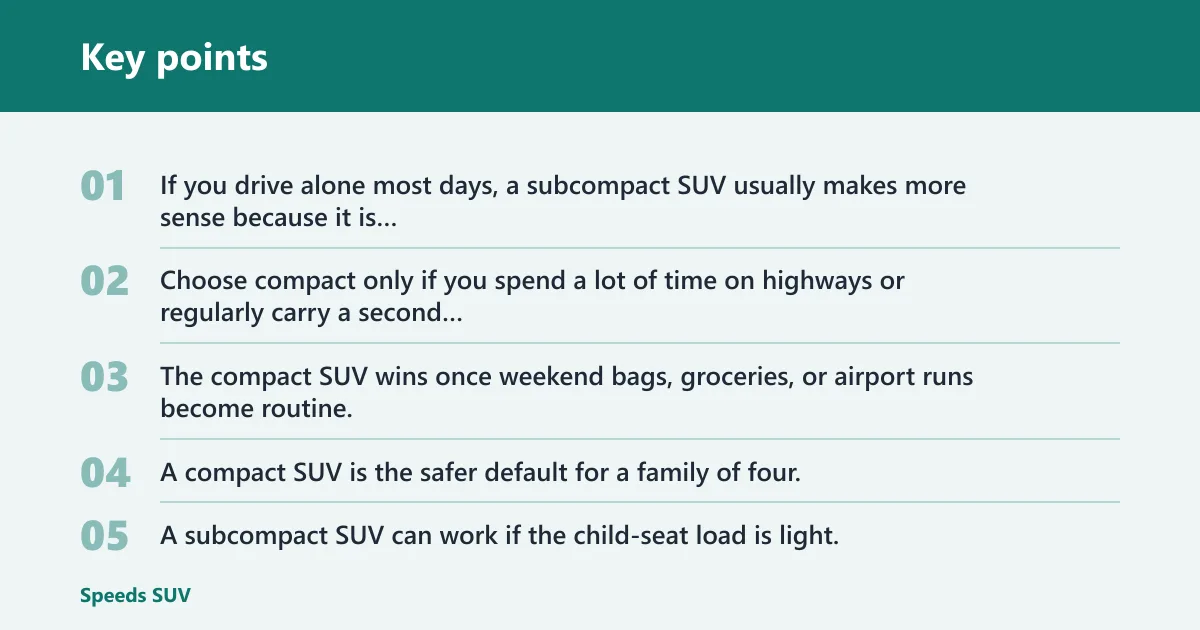
If you drive alone most days, a subcompact SUV usually makes more sense because it is easier to park and often cheaper to fuel. Choose compact only if you spend a lot of time on highways or regularly carry a second adult and their gear.
Compact SUV vs subcompact SUV scorecard
For two adults, either class can work. The compact SUV wins once weekend bags, groceries, or airport runs become routine, because the extra rear-room and cargo margin reduces the need to fold seats just to carry normal life.
Compact SUV vs subcompact SUV scorecard
A compact SUV is the safer default for a family of four. A subcompact SUV can work if the child-seat load is light, the rear seat is not used for adults, and the family can live with less cargo room behind the second row.
Compact SUV vs subcompact SUV scorecard
Road trips expose the limits of a small body shell quickly. Compact SUVs usually ride and pack better for long days, while subcompact SUVs can feel fine for two people with modest luggage but cramped once the back seat and cargo area are both in play.
Compact SUV vs subcompact SUV scorecard
AWD helps in snow, slush, and light unpaved use, but it is not universal in either class. Compact SUVs are the safer bet if you want AWD widely available and expect winter driving to happen often; subcompact SUVs fit better if you want the smallest footprint that still offers AWD on some models.
Compact SUV vs subcompact SUV scorecard
If the purchase price matters most, the subcompact SUV usually wins. That lower entry cost can leave room in the budget for winter tires, maintenance, or a higher trim, while a compact SUV often asks you to spend more before you add options.
How much space do you need?
Use rear-seat use and cargo volume first, because those are the limits you feel every week. A subcompact SUV is usually enough if you want about 18 to 25 cubic feet of cargo room and the back seat is mostly for kids or occasional passengers. A compact SUV is the better call if you want about 25 to 35 cubic feet or more behind the second row.
Rear-seat room for adults and child seats
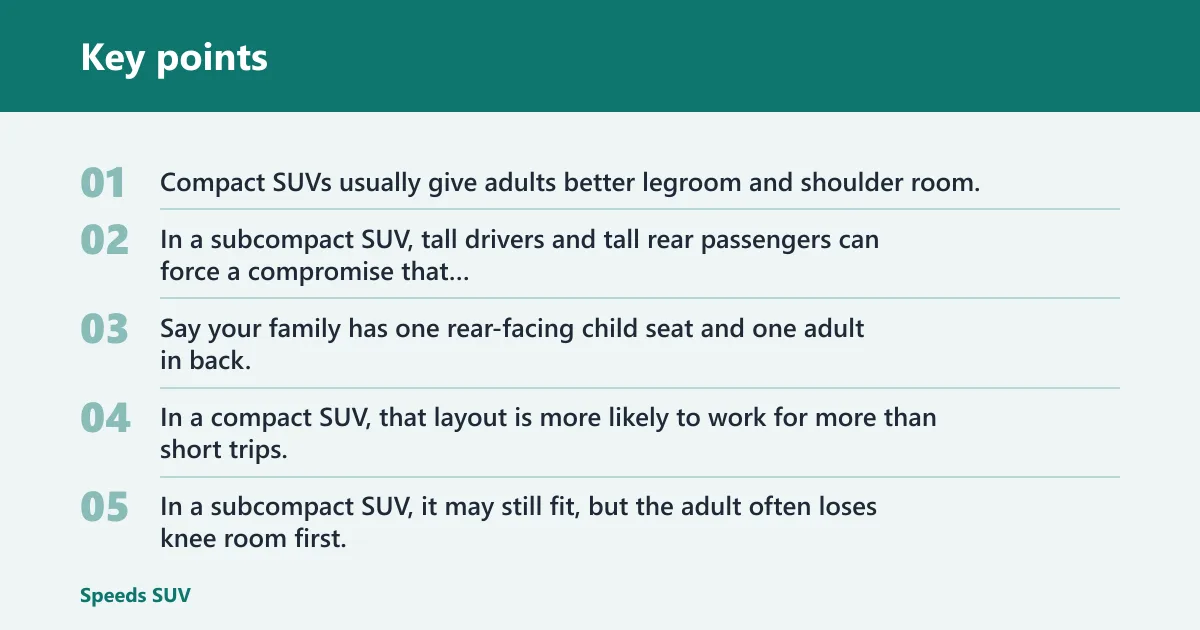
Compact SUVs usually give adults better legroom and shoulder room, and they make child-seat installation less annoying because there is more working space around the anchors and front seats. In a subcompact SUV, tall drivers and tall rear passengers can force a compromise that shows up as knee contact, limited recline, or less front-seat adjustment.
Say your family has one rear-facing child seat and one adult in back. In a compact SUV, that layout is more likely to work for more than short trips. In a subcompact SUV, it may still fit, but the adult often loses knee room first.
Cargo volume behind the second row
Behind-the-second-row cargo space is where the class difference becomes obvious. The compact class is usually the better fit for a stroller, a Costco run, or two airport suitcases without folding the back seat; the subcompact class often forces a choice between cargo and rear passenger comfort.
Fold-flat cargo for strollers and luggage
With the rear seats folded, compact SUVs are more likely to handle bulky luggage, a folded stroller, or sports gear without a puzzle of bags and angles. Subcompact SUVs can still carry a lot when the rear seat is down, but the smaller opening and shorter cargo bay make large boxes or stroller frames harder to manage.
A common first-timer mistake is buying for the weekday commute and ignoring the school run or airport trip. A small SUV can feel fine until a stroller, two carry-ons, and a weekend bag need to fit at once.
Which type is easier to park and maneuver?
Subcompact SUVs are usually easier to park and thread through tight streets because they take up less space and feel less bulky at low speeds. Compact SUVs are still easy compared with many three-row vehicles, but they ask more from a narrow garage, a crowded curb, or a short parking space.
Parking-space limits
If your garage is tight, your parallel parking skills are average, or your apartment lot leaves little room to open doors, the smaller class reduces daily friction. A compact SUV is still manageable, but it becomes the right answer only if you truly need the extra room inside.
Urban driving and tight turns
In dense city use, the smaller body can matter more than badge prestige. A subcompact SUV is often simpler in narrow lanes, cramped drive-throughs, and quick curbside stops, while a compact SUV pays you back only when the extra interior room is used often enough to justify the footprint.
Visibility and low-speed use
Both classes sit high enough to give a better view than many sedans, but neither eliminates blind spots or parking stress. Choose the smaller class if you value quick low-speed maneuvers and easy door clearance more than rear-seat stretch-out room.
Which class is better for fuel economy?
Subcompact SUVs usually win on fuel economy, but hybrid compact SUVs can narrow or even erase the gap. The right answer depends on the powertrain, not just the size badge, so compare EPA combined mpg and not just the sticker on the window.
EPA combined mpg by class
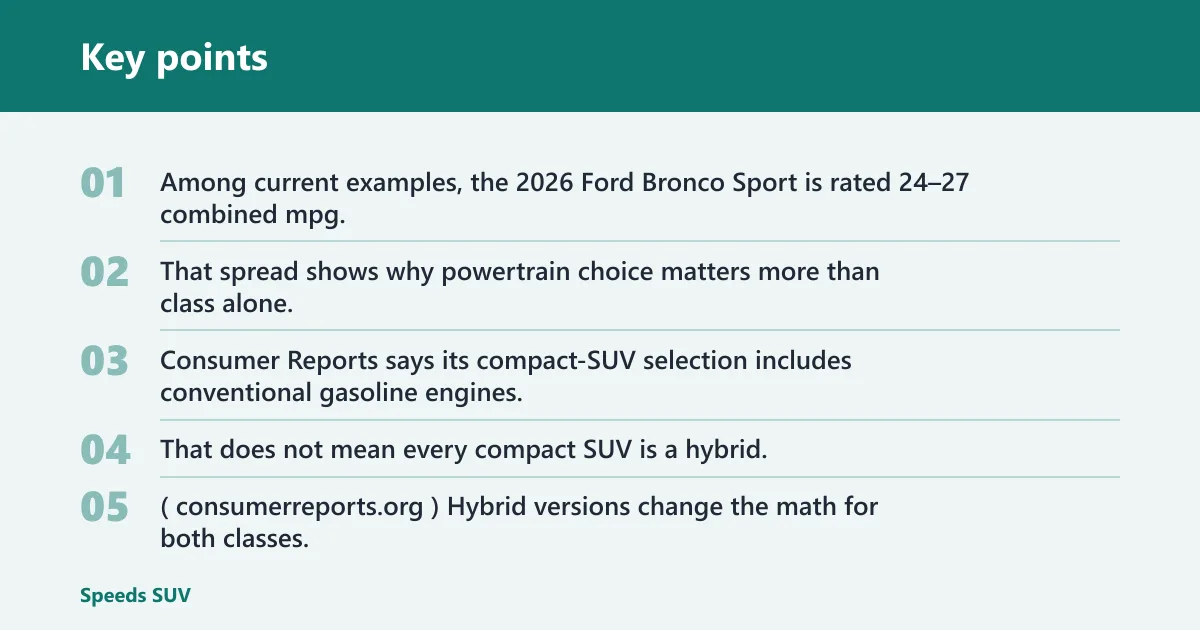
Among current examples, the 2026 Ford Bronco Sport is rated 24–27 combined mpg, while the 2026 Toyota RAV4 is rated 38–43 combined mpg. That spread shows why powertrain choice matters more than class alone; the compact class can be very efficient when a strong hybrid is part of the lineup.
Consumer Reports says its compact-SUV selection includes conventional gasoline engines, hybrids, and PHEVs, and that every model in the list gets 28 mpg overall or better. That does not mean every compact SUV is a hybrid, but it does show that the class can include efficient choices. (Consumerreports)
Hybrid and non-hybrid powertrains
Hybrid versions change the math for both classes. The Kia Niro Hybrid gets 49–53 combined mpg, which is a strong reminder that a smaller SUV with the right powertrain can beat many larger, non-hybrid models on fuel cost.
Transmission choice also matters. Many small SUVs use a CVT, while others use a conventional automatic transmission; check the manufacturer’s listing for your model because transmission type varies by trim and engine. A CVT can help keep fuel use down, but it is not the only automatic setup in this segment.
Monthly fuel cost trade-off
For a long commute, the difference in monthly fuel cost can matter almost as much as the sticker price. If you drive mostly solo and do not need the larger cabin, a subcompact SUV or an efficient hybrid can save enough fuel over time to make the larger class hard to justify.
What do you get for the price?
Subcompact SUVs usually start lower, and that matters when the budget is fixed around $30,000 or less. Compact SUVs often ask for more money up front, but the extra spend can make sense if the added space prevents you from stepping up again later.
Starting MSRP and budget thresholds
Those prices show why many shoppers treat $30,000 as a practical dividing line: above it, the compact class can still be a strong value, but it is no longer the easy low-cost choice.
Standard features versus optional equipment
Base trim lists vary by model, so do not assume the cheaper class gives you the same equipment at a lower price. Some compact SUVs may include more cabin space or stronger powertrains at the base level, while some subcompact SUVs keep the price down by trimming features to the bone.
Value after moving up a class
The extra money only pays off when you use the extra room. If your rear seat stays empty and your cargo needs are modest, the compact SUV can become an expensive answer to a simple commute. If you routinely carry people or gear, the added size is easier to defend.
Choose Compact SUV if… / Choose subcompact SUV if…
Choose Compact SUV if you carry adults in the back seat often, need more than about 25 cubic feet behind the second row, want a better road-trip fit, or expect AWD to matter in winter and light off-pavement use. It is also the better call if you are already near the limit of a small car and want more room without jumping to a midsize SUV.
Choose subcompact SUV if you mostly drive alone or with one passenger, park in tight spaces, want the lower starting price, or can live with about 18 to 25 cubic feet of cargo room. It is the smarter pick when city use and budget matter more than rear-seat stretch-out room.
Suppose you commute 12 miles each way, park on-street, and carry only a backpack and gym bag. A subcompact SUV fits that routine well. If the same driver adds weekly airport pickups, two child seats, or ski trips, the compact SUV starts to pay for itself in daily convenience.
Frequently asked questions
Is a compact SUV bigger than a subcompact SUV?
Yes. In the usual U.S. market naming scheme, a compact SUV sits one class above a subcompact SUV, so it generally offers more rear-seat room and cargo space. Naming can vary by market and source, so the safest comparison is interior room, not just the badge on the tailgate.
How much more cargo space does a compact SUV have than a subcompact SUV?
Think in bands rather than exact class-wide numbers. A compact SUV often has about 25 to 35 cubic feet or more behind the second row. Folded-seat space also tends to be larger in the compact class.
Which is better for city driving, a compact SUV or subcompact SUV?
For dense city driving, the subcompact SUV usually wins because it is easier to park, easier to turn in tight spaces, and less stressful in crowded lots. A compact SUV is still manageable, but it makes more sense if you need the extra cabin room enough to accept the bigger footprint.
Which SUV class is more fuel efficient: compact or subcompact?
The subcompact SUV usually has the edge, but hybrids can change the answer. A small hybrid like the Kia Niro Hybrid can post very strong combined mpg, and some compact hybrids are efficient enough to narrow the gap. Compare EPA combined mpg, not class names alone.
Is a subcompact SUV too small for a family of four?
Not always, but it can be tight. A subcompact SUV can work for a family of four if rear-seat use is light and the cargo load stays modest, yet a compact SUV is usually the better fit once you add child seats, grocery runs, strollers, or road-trip luggage.
Do compact SUVs ride better on long road trips?
Often, yes, because the extra size can improve rear-seat comfort and cargo flexibility. That said, the ride still depends on the specific model, wheel size, and suspension tuning. The larger class is the safer default for long trips with adults in back and bags in the cargo area.
Should I choose a compact SUV if I want AWD?
Choose compact if AWD is a high priority and you want more models to choose from, because AWD is common in many compact SUVs. It is not universal, and it is not universal in subcompact SUVs either, so check the exact trim list before you decide.