
Midsize SUV vs crossover: are they the same thing?
Byline: Reviewed and structured for accuracy by an automotive editor who compares OEM spec sheets, EPA efficiency data, IIHS/NHTSA safety context, and manufacturer towing/off-road documents to separate marketing labels from platform and drivetrain hardware.
Methodology: To verify whether a midsize model is a crossover or a traditional SUV, check the platform description on the manufacturer’s media/spec page, confirm whether it is unibody or body-on-frame, then look for drivetrain language such as AWD versus 4×4, transfer case, and 4-Low. For off-road claims, verify clearance and angle data on OEM documentation; for efficiency and safety context, cross-check EPA/FuelEconomy.gov and IIHS/NHTSA materials. That workflow matters because trims within the same nameplate can differ significantly.
No—Midsize SUV is a size class, while crossover means unibody construction; most midsize models are crossovers, but some are body-on-frame SUVs. Mix them up, and you can buy the wrong vehicle for towing, snow traction, or rough roads. This guide explains the difference and shows you how to identify which midsize SUVs are crossovers and which are truck-based.
| Decision factor | Midsize SUV | crossover | Winner |
|---|---|---|---|
| Platform and chassis | Can be unibody or body-on-frame | Usually unibody | crossover |
| Drivetrain and low range | More likely to offer 4×4, transfer case, and 4-Low | Usually AWD; low-range transfer case is rare | Midsize SUV |
| Off-road geometry and clearance | Often better approach, breakover, and departure angles; often higher ground clearance | Typically around 7.0 to 8.5 inches of ground clearance; angles limited by packaging | Midsize SUV |
| Daily driving and family packaging | Can be less efficient and heavier, especially body-on-frame models | Usually lighter, more car-like, and easier for commuting and family duty | crossover |
Midsize SUV vs crossover: the core difference
Short answer: The difference is construction, not just size. A midsize SUV may be a crossover or a body-on-frame utility vehicle, while a crossover is usually unibody. That is why two vehicles with similar cabin space can behave very differently when towing, driving in deep snow, or crawling over rough terrain.
The split is straightforward: the badge tells you the segment, while the hardware tells you what the vehicle can do. Most midsize SUVs are technically crossovers, but the class also includes body-on-frame models, three-row family haulers, two-row style choices, and electric entries.
Early midsize SUV icons included the Explorer, Blazer, Grand Cherokee, Pathfinder and 4Runner. That history is why shoppers still hear “SUV” used as a catch-all label at dealerships, even when the structure underneath is unibody.
Segment label vs construction type
Midsize SUV tells you where a model sits in the showroom mix. It does not tell you whether the vehicle uses a unibody structure or a separate frame.
Crossover usually means the body and frame are integrated into one structure. That unibody layout is common because it tends to be lighter, gives higher torsional rigidity, and helps fuel economy, handling, and packaging.
The one-sentence buyer rule
Start with how you will use the vehicle, then check platform and drivetrain only if you need towing, rough-trail duty, or serious snow confidence. If your needs stop at rain, snow-covered roads, school runs, and light gravel, AWD in a crossover may be enough.
What is the difference between a crossover and an SUV?
Short answer: A crossover is usually unibody, while a traditional SUV usually means body-on-frame construction with a separate ladder frame. In practice, that means crossovers generally prioritize road comfort and packaging, while traditional SUVs are more often set up for towing, rough roads, and lower-speed off-road use.
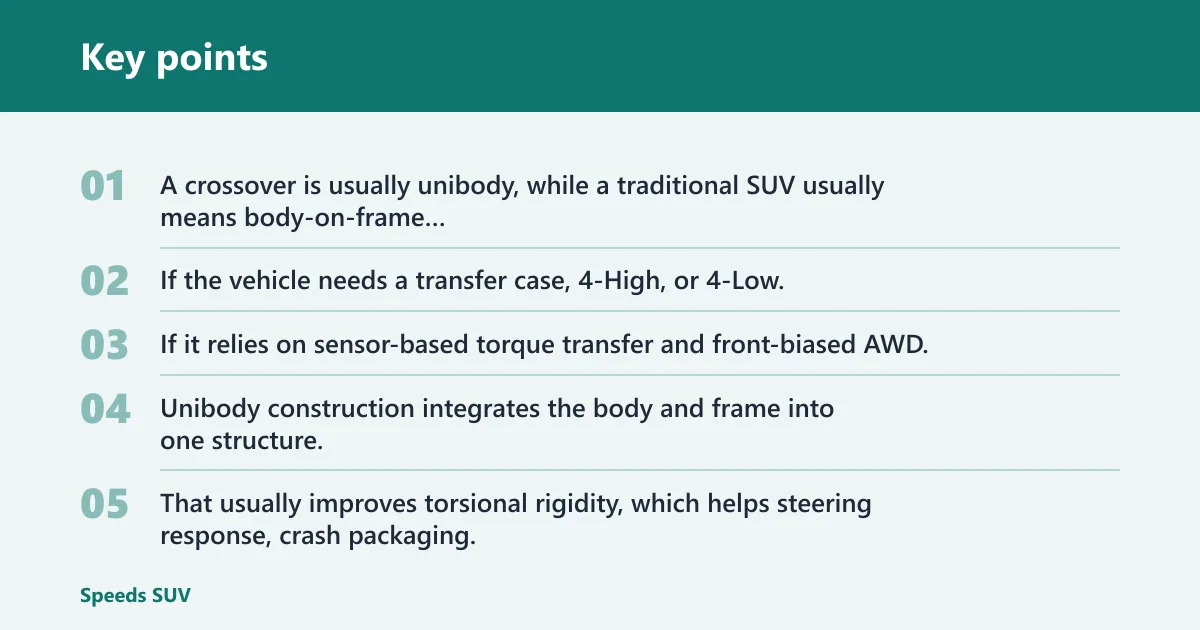
The difference is hardware, not marketing. A crossover is usually unibody, while a traditional SUV usually means body-on-frame construction with a separate ladder frame, more towing and off-road stress tolerance, and more weight.
If the vehicle needs a transfer case, 4-High, or 4-Low, you are usually looking at a more traditional SUV. If it relies on sensor-based torque transfer and front-biased AWD, it is usually a crossover.
Unibody construction
Unibody construction integrates the body and frame into one structure. That usually improves torsional rigidity, which helps steering response, crash packaging, and the way the cabin is laid out.
This is why most crossovers feel easier to place on the road. The trade-off is that they rarely carry the same off-road hardware as a truck-based SUV.
Body-on-frame construction
Body-on-frame construction uses a separate frame under the body. That design handles towing loads and rough terrain better because the frame can absorb more stress before the body does.
It also tends to weigh more than unibody construction. That extra mass can affect fuel economy and day-to-day response, even when the vehicle is comfortable and capable. EPA and FuelEconomy.gov data typically reflect those efficiency trade-offs, especially when comparing truck-based midsize SUVs with unibody crossovers.
Which midsize SUVs are technically crossovers?
Short answer: Most midsize SUVs are technically crossovers, including many family-focused two-row and three-row models. To confirm, look for a unibody platform, AWD rather than true 4×4, and no low-range transfer case in the OEM spec sheet.
Most midsize SUVs are technically crossovers. That includes many two-row and three-row models, plus some electric midsize SUVs that fit the segment even when their packaging is different.
A common first-timer mistake is to assume “SUV” means truck-based. In reality, many midsize family haulers are built on unibody platforms and are crossovers in everything but the showroom language.
How to spot them on the spec sheet
Look for a unibody platform, standard AWD rather than true 4×4, and no mention of a low-range transfer case. Ground clearance often sits around 7.0 to 8.5 inches, which is fine for road use, snow, and mild dirt roads.
That hardware is common in midsize crossovers, even if the marketing calls it an SUV. The driving feel will often be more car-like too, especially in daily commuting and parking.
What is a traditional SUV?
Short answer: A traditional SUV usually uses body-on-frame construction and is more likely to offer a transfer case, 4×4, and 4-Low. That hardware makes it better suited to towing and rough terrain, but not every traditional SUV is automatically better for every buyer.
A traditional SUV usually means body-on-frame construction with a separate frame, plus drivetrain hardware meant for towing and rough use. That does not make every traditional SUV off-road ready, but it does make the hardware more suited to abuse than a typical crossover.
Not every body-on-frame vehicle is automatically the right choice. The details still matter: low range, axle design, ground clearance, and approach, breakover, and departure angles all affect whether the vehicle can do the job.
Transfer case and 4×4 hardware
Four-wheel drive may include a transfer case and can offer 4-High and 4-Low. 4-Low is often the key piece for technical terrain because it can multiply torque and let the vehicle crawl more slowly under load.
That hardware is rare in crossovers. When it appears, it is usually on a model built for more than commuting and wet roads. For off-road geometry and drivetrain claims, verify them on the manufacturer’s off-road or towing documentation rather than on dealer copy.
Where true SUVs still make sense
True SUVs still make sense for towing, rough roads, snowed-in driveways, boat ramps, and trail access where wheel placement matters more than ride softness. They also make more sense when the vehicle needs to stay composed under sustained load.
Say your weekend includes a steep gravel road with ruts, a trailer, and a muddy turnaround. A crossover may handle part of that, but a body-on-frame SUV with 4-Low and more favorable geometry is the safer fit.
Comparison table: midsize SUV and crossover

The overlap is real, but the hardware still separates the two. The table below shows where the labels blur and where the construction type changes the decision.
| Factor | Midsize SUV | crossover | Winner |
|---|---|---|---|
| Platform | Can be unibody or body-on-frame | Usually unibody | Midsize SUV |
| Drivetrain | May use AWD or true 4×4 | Usually AWD | Midsize SUV |
| Low range | Available on some traditional models | Rare | Midsize SUV |
| Ride and packaging | More variable, especially on body-on-frame models | Usually better daily comfort and packaging efficiency | crossover |
| Off-road geometry | Often more favorable for approach, breakover, and departure | Limited more by overhangs and road-oriented packaging | Midsize SUV |
Platform and chassis
The platform matters because it shapes everything else. Unibody models usually feel more settled on pavement, while body-on-frame models are built to handle stress, towing loads, and rougher surfaces.
That is why “SUV” is too vague by itself. You need the chassis type to know whether the vehicle is a road-biased family hauler or a more traditional utility rig.
Drivetrain and low range
AWD is not the same as 4×4. AWD is often front-biased in crossovers and uses wheel-speed sensors to send torque where it is needed, while 4×4 may include a transfer case and low-range gearing.
If you only need confidence in rain, snow, and light gravel, AWD can be enough. If you need slow-speed control on technical trails, 4-Low matters more than a badge.
Ride height, angles, and towing intent
Ground clearance affects more than curb appeal. It helps determine whether the vehicle can clear ruts and obstacles without scraping, while approach, breakover, and departure angles affect whether the nose, belly, or tail hits first.
Crossovers often have roughly 7 to 8.5 inches of ground clearance. Many true SUVs sit higher, and that extra height is useful only if the rest of the geometry supports it. Manufacturer towing documentation is also important because tow ratings can vary widely between engines, axles, and drivetrain packages.
Family use, commuting, and trail duty
Three-row midsize SUVs are often chosen instead of minivans for family use, and a key midsize SUV use case is extra cargo space or an occasional third row. Two-row midsize SUVs can also be style-oriented and intended mainly for on-road use.
Suppose your weekly routine is freeway commuting, school pickup, and one snowy driveway. A crossover with AWD is usually the cleaner fit. If your routine adds a camper trailer or rough access road, the hardware changes the answer.
Midsize SUV decision matrix
This matrix sorts common midsize use cases by the hardware that matters. Read across, then compare the recommendation to your real needs instead of the badge on the tailgate.
| Use case | Unibody/body-on-frame | AWD/4×4 | 4-Low | Likely use case | Best for |
|---|---|---|---|---|---|
| Daily commuting and school runs | Unibody | AWD | No | Rain, snow, parking, light gravel | crossover |
| Three-row family hauling | Either, but often unibody | AWD | No | Families who want extra seats or cargo | crossover |
| Towing a trailer | Body-on-frame | 4×4 or AWD, depending on model | Sometimes | Boat ramps, campers, heavier loads | Midsize SUV |
| Snowy mountain roads | Either | AWD or 4×4 | No or optional | Frequent winter driving | tie |
| Technical off-road trails | Body-on-frame | 4×4 | Yes | Ruts, rocks, steep climbs, low-speed control | Midsize SUV |
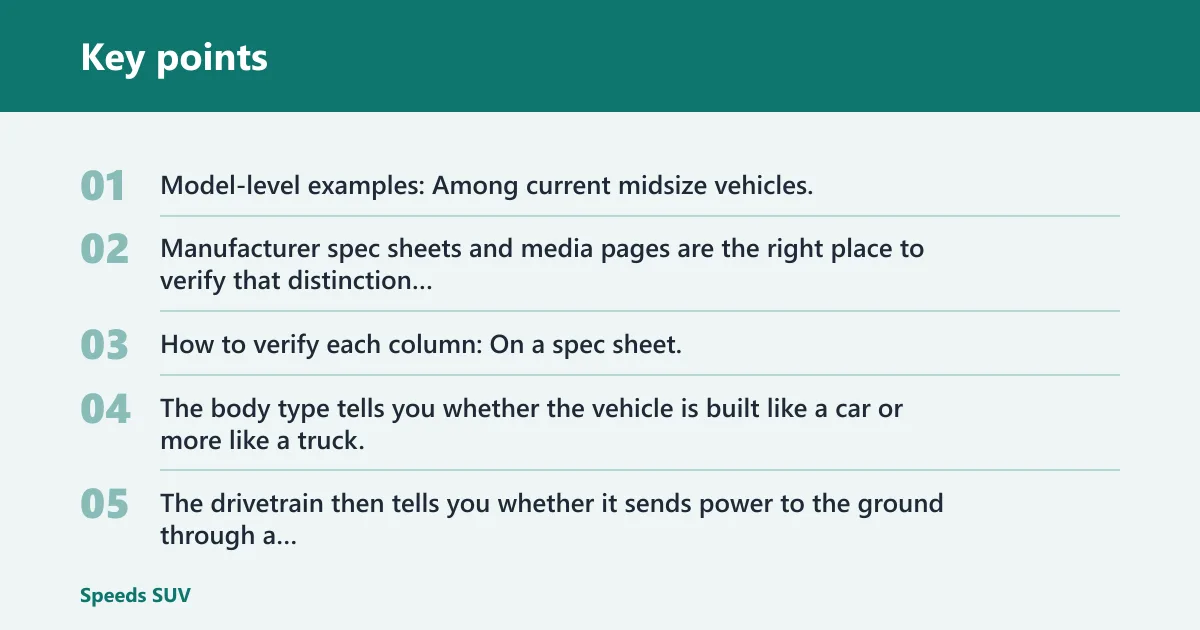
Model-level examples: Among current midsize vehicles, the Toyota 4Runner is body-on-frame with available 4×4 and 4-Low; the Jeep Grand Cherokee can be configured with Jeep 4×4 systems and is marketed with off-road-focused variants; the Ford Explorer, Chevrolet Traverse, Honda Pilot, Kia Telluride, Hyundai Palisade, and Nissan Pathfinder are mainstream family-focused midsize crossovers with unibody construction. Manufacturer spec sheets and media pages are the right place to verify that distinction because trims and drivetrains can differ by model year.
| Model | Unibody/body-on-frame | AWD/4×4 | 4-Low | Towing orientation | Family fit | Off-road intent |
|---|---|---|---|---|---|---|
| Toyota 4Runner | Body-on-frame | 4×4 | Yes | Strong | Good | High |
| Jeep Grand Cherokee | Unibody | AWD/4×4 | Available on select systems | Strong | Good | High |
| Ford Explorer | Unibody | AWD | No | Moderate to strong | Strong | Moderate |
| Chevrolet Traverse | Unibody | AWD | No | Moderate | Strong | Low |
| Honda Pilot | Unibody | AWD | No | Moderate | Strong | Moderate |
| Kia Telluride | Unibody | AWD | No | Moderate | Strong | Low to moderate |
| Hyundai Palisade | Unibody | AWD | No | Moderate | Strong | Low to moderate |
| Nissan Pathfinder | Unibody | AWD | No | Moderate | Strong | Low to moderate |
How to verify each column: On a spec sheet, platform is usually stated in the overview or construction language; drivetrain type appears in the powertrain section; 4-Low or transfer case language appears in the off-road system description; towing orientation is usually expressed as maximum towing capacity and tow-package requirements; family fit is easiest to assess by seating configuration, cargo volume, and third-row access; off-road intent is confirmed by dedicated trim names, available terrain systems, approach/departure angles, and clearance figures.
How to read the matrix
The body type tells you whether the vehicle is built like a car or more like a truck. The drivetrain then tells you whether it sends power to the ground through a front-biased AWD system or a transfer case with low range.
That matters because a model can be roomy without being rugged, and rugged without being ideal for family errands. The matrix keeps those roles separate.
Columns that matter most
Unibody/body-on-frame is the fastest way to separate crossover hardware from traditional SUV hardware. AWD/4×4 tells you how the vehicle manages traction, while 4-Low tells you whether it can crawl slowly under load on hard terrain.
The likely use case column is the buyer-facing translation. It turns spec-sheet language into a decision about snow, towing, commuting, and trails.
Best for: families, snow, towing, and trails
Families usually get the most from crossovers because they package seats, cargo, and daily comfort well. Snow can be a tie if the vehicle has good tires and AWD or 4×4.
Towing and trails are where midsize SUV hardware starts to separate itself. If you need 4-Low, the crossover side usually falls away fast.
Choose crossover if… / Choose Midsize SUV if…
Choose crossover if your driving is mostly commuting, errands, rain, snow, and light gravel. Choose it if you want easier packaging, better fuel-economy potential, and a more car-like feel.
Choose Midsize SUV if you need towing support, a true 4×4 system, low range, or better off-road geometry. Choose it if rough access roads, heavy snow use, or trailer duty are part of the plan.
AWD is enough when traction is the main issue. It is not enough when slow-speed control, articulation, or repeated load are part of the job.
Frequently asked questions
Are midsize SUVs and crossovers the same thing?
Short answer: No. “Midsize SUV” is a size segment, while “crossover” describes unibody construction. Most midsize models are crossovers, but the segment also includes body-on-frame SUVs and models with more traditional off-road hardware.
No. Midsize SUV is a segment label, while crossover describes unibody construction. Most midsize models are crossovers, but the segment also includes body-on-frame SUVs, three-row family haulers, two-row models, and electric entries.
Does body-on-frame mean a vehicle is a real SUV?
Short answer: Body-on-frame is a strong sign of traditional SUV hardware, but it does not guarantee the right capability for every task. You still need to check 4×4, a transfer case, 4-Low, clearance, and angles.
Body-on-frame points to traditional SUV hardware, but it does not guarantee the right capability for every task. You still need to check for 4×4, a transfer case, 4-Low, clearance, and approach, breakover, and departure angles before assuming it can handle your use case.
Do crossovers have 4×4 or just AWD?
Short answer: Most crossovers use AWD, not true 4×4. AWD is often front-biased and uses sensors to send torque where traction is available. True 4×4 usually involves a transfer case and can add 4-High and 4-Low, which is much more useful for technical terrain.
Most crossovers use AWD, not true 4×4. AWD is often front-biased and uses sensors to send torque where traction is available. True 4×4 usually involves a transfer case and can add 4-High and 4-Low, which is much more useful for technical terrain.
What should I look for if I want a midsize SUV with off-road capability?
Short answer: Look for body-on-frame construction, a transfer case, 4-Low, higher ground clearance, and better approach, breakover, and departure angles. If those items are missing, the vehicle may still be fine for snow or dirt roads, but it is not the same as a true off-road-oriented SUV.
Look for body-on-frame construction, a transfer case, 4-Low, higher ground clearance, and better approach, breakover, and departure angles. If those items are missing, the vehicle may still be fine for snow or dirt roads, but it is not the same as a true off-road-oriented SUV.
Sources
Manufacturer media pages and spec sheets; EPA and FuelEconomy.gov efficiency data; IIHS and NHTSA safety and platform context; and OEM towing/off-road documentation for clearance, transfer case, and 4-Low availability.