How Does Full-Time 4WD Work?
Full-time 4WD uses a center differential or coupling to send power to both axles while letting them turn at different speeds, which generally makes it suitable for dry pavement. Lock the center diff only on loose, slippery surfaces or off-road. Using the wrong mode can cause driveline bind, tire wear, and tight steering. Toyota owner manuals describe this open-versus-locked behavior, and driveline references explain why tire scrub and bind happen when the front and rear shafts cannot differentiate speed.
How the center differential makes it road-friendly
Full-time 4WD sends torque to all four wheels all the time. The key detail is not the number of driven wheels; it is the center differential or similar coupling that lets the front and rear axles rotate at different speeds during turns. That speed difference is what makes the system usable on pavement when it is not locked.
That is why full-time 4WD can stay engaged on pavement. Without a center diff, the front and rear axles would fight each other every time the vehicle turned, especially on high-traction roads where tire slip is limited. Toyota’s owner manuals for full-time 4WD systems describe this as the reason the center diff must stay open for normal road use and only be locked when traction conditions call for it.
How it differs from part-time 4WD
Part-time 4WD usually locks the front and rear driveshafts together. That helps on loose surfaces, but it creates driveline stress on dry pavement because the axles need to travel different distances in a turn. In practice, that means part-time systems are generally better treated as off-road or low-traction tools, not all-surface systems.
Full-time 4WD avoids that conflict when the center diff is open or not locked. Part-time 4WD does not, unless the vehicle is on a surface where the tires can slip enough to release the stress.
Where the center differential fits
The transfer case splits torque front to rear. In many full-time 4WD systems, the center differential sits inside the transfer case. Some use a mechanical differential; others use a coupling that manages the torque split electronically or with a clutch pack. A clutch-based system can mimic some of the same torque-management behavior, but its control strategy and hardware are not the same as a traditional locking transfer case.
That layout is the reason full-time 4WD can behave like a street-friendly system and still offer a locked mode for rough ground.
How the torque split works
Torque flows from the engine through the transmission into the transfer case, then to the front and rear driveshafts. The center differential or coupling decides how much speed difference is allowed between those shafts as the vehicle moves through a turn, climbs a hill, or crosses a surface with uneven grip. In Toyota full-time 4WD systems, the operating idea is simple: open for normal driving, locked for low-traction situations, and low range only where equipped and appropriate.
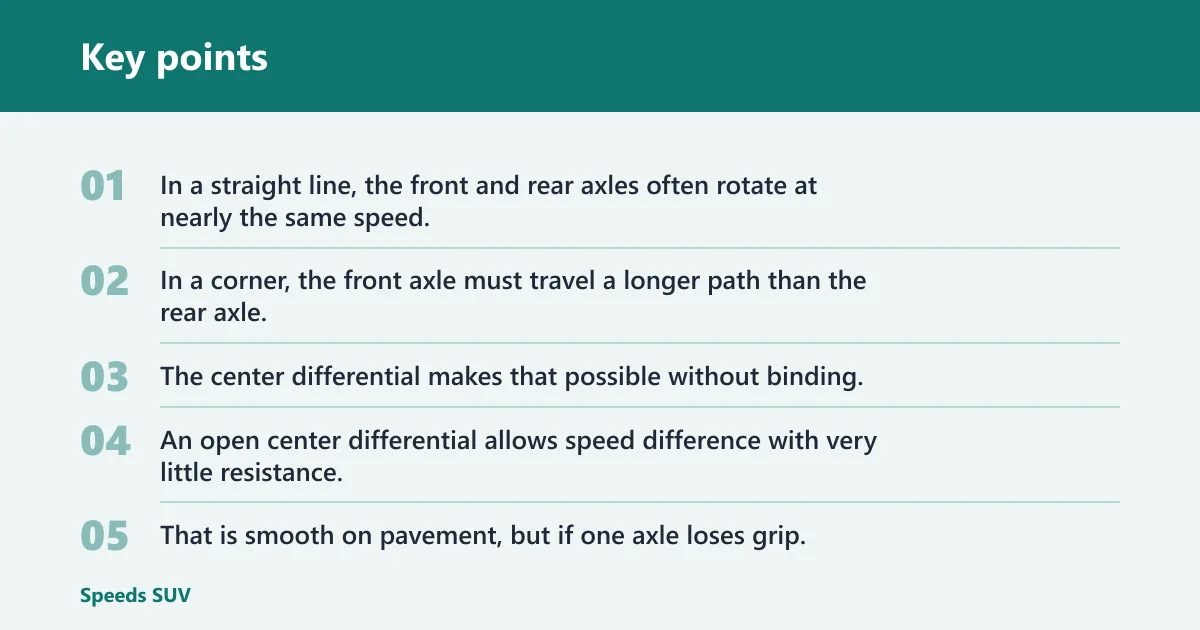
In a straight line, the front and rear axles often rotate at nearly the same speed. In a corner, the front axle must travel a longer path than the rear axle, so it needs to spin faster. The center differential makes that possible without binding.
Open, limited-slip, and lockable layouts
An open center differential allows speed difference with very little resistance. That is smooth on pavement, but if one axle loses grip, torque can drift toward the axle with less resistance. Some systems use limited-slip action to bias more torque toward the axle with better grip. This is why some full-time systems feel more secure in mixed-traction weather than a simple open center diff would.
A lockable center differential can force the front and rear axles to turn together. That is useful when one end of the vehicle is on slick ground and the other end has traction, but it should stay open on dry, high-traction pavement. Toyota manuals consistently frame the lock as a low-traction aid, not a normal street mode.
What changes in a turn
When you turn left or right, the outside wheels travel farther than the inside wheels. The front axle also usually travels a different distance than the rear axle. The center differential absorbs that speed mismatch. That is why a full-time 4WD vehicle can make tight turns without the same stress you would get from a locked system.
If the center diff is locked on pavement, the tires must scrub to make up the difference. That is the source of binding, hopping, and steering effort that feels heavier than normal. Drivetrain references describe this as driveline wind-up or binding, and it becomes most noticeable as speeds drop and steering angles increase.
When should you lock the center differential?
Lock the center differential when traction is loose or uneven and you want both axles to share torque more directly. Snow, mud, wet grass, loose gravel, and technical off-road driving are the usual cases. Leave it open on dry pavement and on most normal wet-road driving. If the vehicle has a lock indicator, the owner’s manual is the final authority on when that indicator should be used and when it should be cleared.
Loose surfaces where lock helps
On gravel, mud, deep snow, or a rutted trail, a locked center diff can help keep momentum if one axle starts to slip. It reduces the chance that the vehicle sends too much speed to the axle that has less grip. That is especially helpful when the surface changes quickly and the vehicle needs consistent pull from both ends.
Suppose one front wheel is on ice and the rear tires are on packed snow. A locked center diff can keep torque from being wasted at the axle pair with the weaker bite.
Why dry pavement is the wrong place to lock
Dry pavement has enough grip to expose the difference in wheel path length during turns. With the center diff locked, the front and rear axles cannot release that difference, so the driveline stores stress instead of moving freely. That is why Toyota manuals and drivetrain references warn against using locked 4WD on high-traction pavement.
The result can be tire scrub, hopping in tight turns, heavy steering, and long-term wear in driveline parts. That is the same reason many owner manuals warn against using locked 4WD on high-traction pavement. See dry pavement guidance for the practical version of that rule.
Signs the system is binding
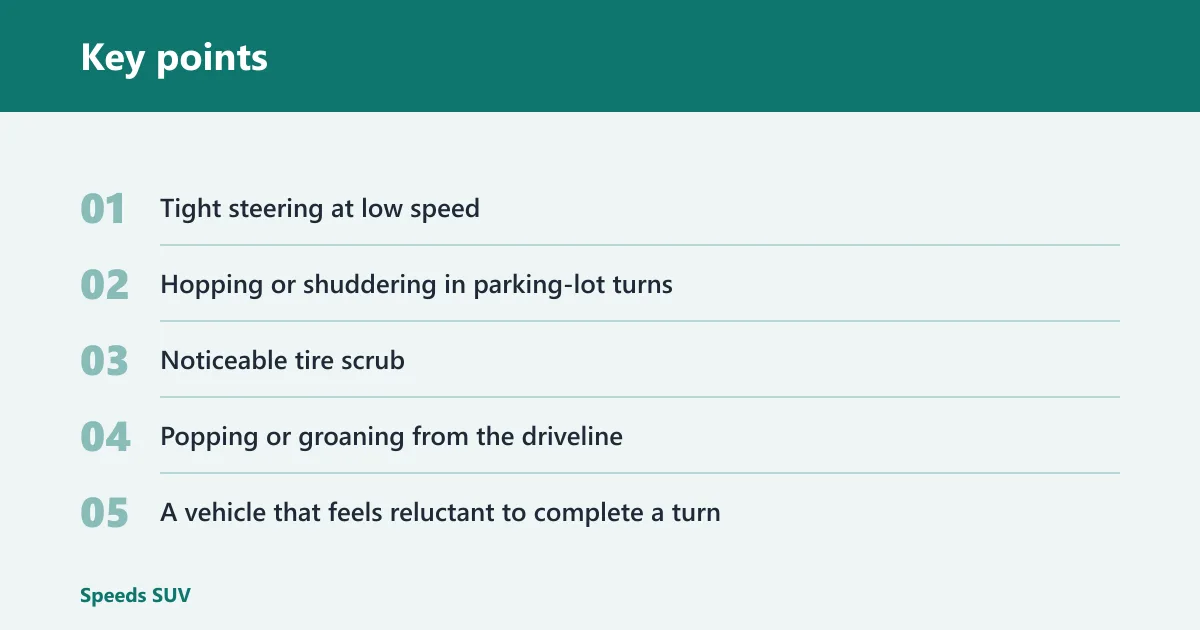
- Tight steering at low speed
- Hopping or shuddering in parking-lot turns
- Noticeable tire scrub
- Popping or groaning from the driveline
- A vehicle that feels reluctant to complete a turn
A common first-timer mistake is leaving the center diff locked after leaving a snowy road and then pulling into a dry parking lot. The first symptom is often a tighter-than-normal turn, followed by hopping as the tires fight for relief.
Full-time 4WD scenario table
This table shows what full-time 4WD is doing in common conditions, how the center diff is set, and whether binding risk is low, medium, or high.
| Scenario | Center diff state | What the system is doing | Likely traction behavior | Binding risk |
|---|---|---|---|---|
| Dry highway | Open / not locked | Front and rear axles can rotate at different speeds during turns | Stable, quiet road behavior with normal turn-in | Low |
| Wet cornering | Open / not locked or limited-slip | Allows speed difference while helping manage small grip changes | Better stability than a locked system if one axle briefly slips | Low |
| Snow-covered road | Open; lock if deeper snow or uneven traction | Shares torque to both axles while allowing turn-speed difference | Good forward motion with less wheelspin than rear-drive only | Low to medium |
| Loose gravel | Open or locked, depending on grip | Open for easy steering; locked for stronger front-to-rear coupling | Predictable drive on washboard or loose climbs | Low open, medium locked |
| Low-speed off-road | Often locked; low range if equipped | Maximizes torque sharing and wheel control at crawl speeds | Best for steep climbs, ruts, and uneven traction | Low on loose ground, high on dry pavement |
Full-time 4WD vs part-time 4WD vs AWD vs real-time 4WD
This comparison helps separate systems that can stay engaged on pavement from systems that are meant for limited-traction use. The biggest differences are the center device, whether the system is pavement-safe, and whether low range is available. In Toyota and other manufacturers’ literature, the labels may sound similar even when the hardware is very different.
| System | Center device | Pavement suitable? | Lock capability | Low range | Binding risk |
|---|---|---|---|---|---|
| Full-time 4WD | Center differential or similar coupling | Yes, when open | Often yes | Sometimes | Low when open; high if locked on dry pavement |
| Part-time 4WD | No center differential; front and rear are mechanically tied when engaged | No on dry pavement | Usually the system itself is effectively locked when engaged | Often yes in truck-based systems | High on high-traction pavement |
| AWD | Coupling, clutch pack, or center differential | Yes | Rare or model-dependent | Usually no | Low in normal use |
| Real-time 4WD | Usually a front-biased system that adds rear drive as slip is detected | Yes | Usually no manual lock, or limited by design | Usually no | Low in normal use; depends on calibration |
Where low range fits
Low range is a separate gearset in some full-time 4WD transfer cases. It multiplies torque and reduces vehicle speed at the same engine rpm, which gives the driver finer control during crawling, steep descents, towing at very low speed, or careful rock work. Toyota full-time 4WD models that include low range use it as part of a low-speed control package, not as a substitute for the center differential.
Low range does not replace the center differential. It works with the transfer case, and in some vehicles it can be used with the center diff locked. Other full-time 4WD systems are single-speed and skip low range entirely.
When low range helps most
Low range is most useful when speed needs to stay low and wheel control matters more than road speed. That includes steep climbs, deep ruts, technical trails, and controlled descents where engine braking is useful. It gives the driver more usable torque at crawl speeds and can reduce the need for throttle input.
It is not a cure for poor traction on pavement. It is a mechanical tool for slow, demanding terrain.
Why some systems skip it
Some full-time 4WD systems are built for road use first. They may include a center diff and a lock, but no low range, because the vehicle is not meant for severe off-road crawling or heavy-duty trail work. That design choice is common in systems intended to balance winter traction, comfort, and packaging efficiency.
That difference is one reason full-time 4WD varies so much by manufacturer and trim.
How Toyota full-time 4WD works
Toyota full-time 4WD varies by model and trim, but the common theme is the same: the transfer case sends drive to both axles all the time, and a center differential or clutch-based system manages front-to-rear speed difference. Some Toyota systems add a lock mode; some add low range; some add both. Hardware and mode names also vary by generation and trim, so the badge alone is not enough to identify the transfer-case layout.
4Runner full-time 4WD behavior
On 4Runner trims that offer full-time 4WD, the system is designed to run in a mode that can stay engaged on pavement because the center differential lets the axles turn at different speeds. Many versions also offer a center diff lock for loose surfaces, and some trims include low range. In practical terms, that gives the driver a road-safe open mode, a traction-focused locked mode, and, where equipped, a crawl-oriented low range.
That means the driver usually has a road mode, a locked mode for slippery terrain, and, on some versions, a low-range mode for slow off-road work.
Land Cruiser full-time 4WD behavior
Land Cruiser full-time 4WD is typically aimed at broader terrain use, so Toyota often pairs full-time drive with a lockable center differential and low range. The exact controls vary by generation and trim, but the operating logic stays the same: open for pavement, locked for loose surfaces, low range for slow, difficult terrain. Toyota’s owner information for Land Cruiser models typically emphasizes this same distinction between normal-road operation and traction-aid operation.
That setup gives the driver more control when the surface changes from dry road to snow, gravel, or trail.
Why Toyota trims and modes vary
Not every Toyota-branded full-time 4WD system is built the same way. Some trims prioritize road comfort and all-weather use. Others add more off-road hardware, including low range and additional lock settings. Even within the same nameplate, the transfer case, center diff logic, and available drive modes can change across generations.
Before relying on any mode, check the transfer case label, the owner’s manual, and the mode indicator on the dash. The names can be similar while the hardware is different. Toyota manuals are the best source for the exact behavior of a specific model year and trim.
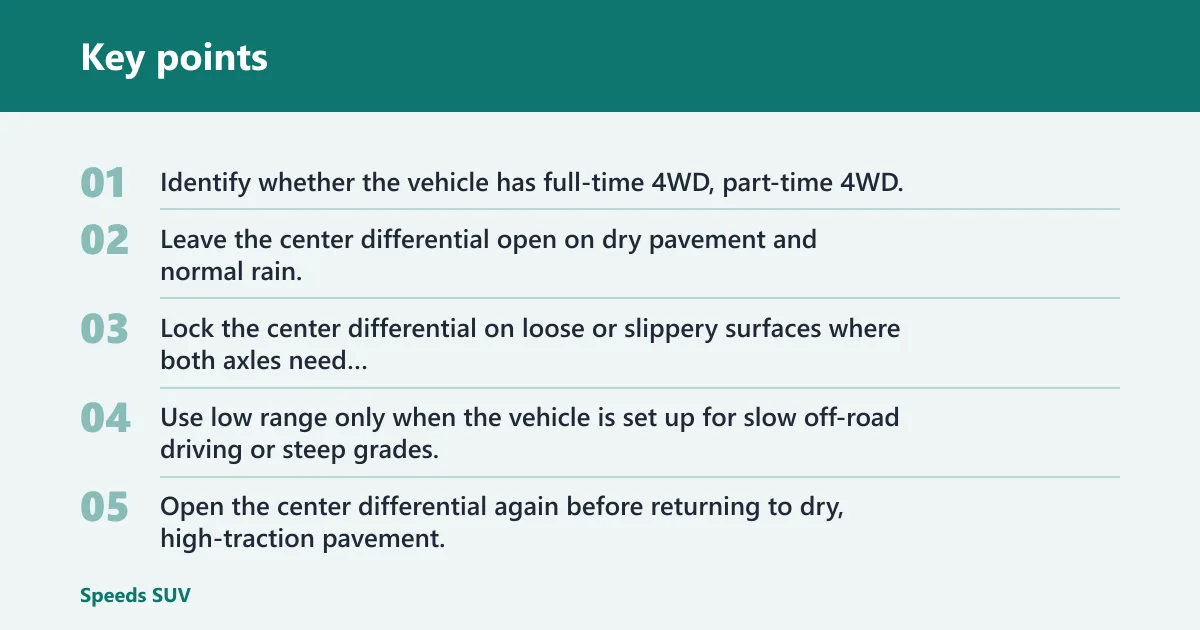
- Identify whether the vehicle has full-time 4WD, part-time 4WD, or a selectable full-time mode.
- Leave the center differential open on dry pavement and normal rain.
- Lock the center differential on loose or slippery surfaces where both axles need stronger coupling.
- Use low range only when the vehicle is set up for slow off-road driving or steep grades.
- Open the center differential again before returning to dry, high-traction pavement.
Wrong mode symptoms and what to do
If the steering feels heavy, the vehicle hops in tight turns, or the driveline groans on a dry surface, the most likely problem is that the center diff is locked when it should be open. Straighten the wheels if needed, switch to the open mode, and move to a looser surface if the system needs a little rolling slack to disengage cleanly.
Frequently asked questions
How does full time 4WD work?
Full-time 4WD sends torque to both axles all the time and uses a center differential or coupling so the front and rear can rotate at different speeds. That lets the vehicle stay in 4WD on pavement without constant driveline stress, as long as the system is open. When locked, it behaves more like a traction aid for loose surfaces.
What is full time 4WD?
Full-time 4WD is a four-wheel-drive layout that stays engaged continuously rather than being switched on only for slippery conditions. Its main feature is the center differential or similar device that allows normal turning on dry roads while still keeping all four wheels driven. In many vehicles, it also adds a lock mode and, sometimes, low range.
How does all time 4WD work?
“All-time 4WD” usually means the same thing as full-time 4WD: power goes to both axles continuously, and the transfer case manages the difference in axle speed. The exact hardware can vary, so one vehicle may use a mechanical center diff while another uses a clutch-based coupling. The label matters less than the center device and the available modes.
How does part time 4WD work?
Part-time 4WD locks the front and rear driveshafts together when engaged, which is useful on loose surfaces but not on dry pavement. Because it lacks the same speed difference management as full-time 4WD, it can create driveline bind if you use it on high-traction roads. It is best treated as a surface-specific mode rather than an always-on system.
Is full time 4WD good?
Yes, if you want all-weather traction and the ability to stay in 4WD on pavement. It is especially useful in snow, rain, gravel, and light to moderate off-road use. The tradeoff is more mechanical complexity and, often, lower fuel economy than a simpler two-wheel-drive layout. It is a strong fit when the vehicle needs both road manners and off-road flexibility.
How does Toyota full time 4WD work?
Toyota full-time 4WD typically sends drive to both axles through a transfer case with a center differential, plus a lock mode on many models. The details vary by vehicle and trim, so a 4Runner, Land Cruiser, or another Toyota system may differ in whether it includes low range, a lock, or both. Always check the owner’s manual for the exact generation and trim.