When Should You Use Part-Time 4WD?
Use part-time 4WD only on low-traction surfaces like snow, ice, mud, gravel, loose dirt, and sand, and keep it in 2H on dry pavement; if the surface has grip, 4WD can bind the driveline. Ignore that rule and you can get tire scrub, hard steering, and transfer case or axle wear. This guide shows when to use 4H or 4L, when 2H is the better choice, and how to avoid driveline binding.
Part-time 4WD basics
Part-time 4WD is a driver-selectable system. You shift it with a knob, button, or lever, and it locks the front and rear driveshafts together so the front and rear axles turn at the same speed. That makes it suited to off-road or very slippery surfaces, not paved roads.
Think of it as a traction tool, not a default road mode. In many SUVs and trucks, 2H is the normal road mode, 4H is the higher-range four-wheel-drive mode for slippery surfaces, and 4L is the low-range mode for slow, difficult terrain.
How part-time 4wd works
In a part-time layout, the transfer case sends power to both axles and locks them together. Because the front and rear axles cannot rotate at different speeds, the system works best when tire slip is available to relieve that difference. Snow, ice, dirt, and mud provide that slip; dry pavement does not.
AWD is different. AWD is built for on-road use, can send power to all four tires all of the time, and usually uses a center differential so the front and rear axles can rotate at different speeds. That difference is why AWD can be used on pavement, while part-time 4WD should not be. (UTI)
4H and 4L at a glance
4H is the normal slippery-surface mode. Use it at moderate speeds when you need extra traction on snow, gravel, dirt, slush, or light off-road surfaces. It is not a crawl gear.
4L is for slow driving where torque multiplication matters. Use it for steep grades, deep mud, deep sand, or technical obstacles that need controlled wheel speed and extra pull.
📊 4WD systems are part-time setups intended only for off-road or extremely slippery surfaces. Source: AWD vs. 4WD Explained.
When should you use part-time 4WD?
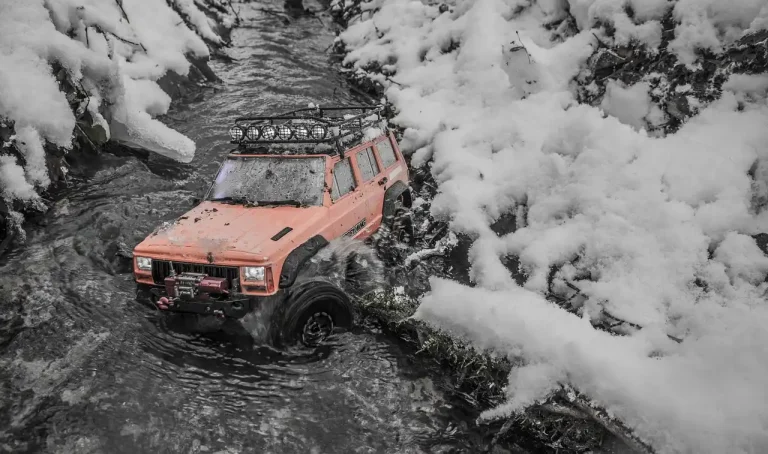
Use part-time 4WD when the surface is loose or slippery enough that tire slip is expected. Snow, ice, mud, gravel, dirt, and sand are the classic cases. The real question is not “is it cold or messy?” It is “will the tires need slip to rotate at different speeds without binding?”
Snow and packed snow
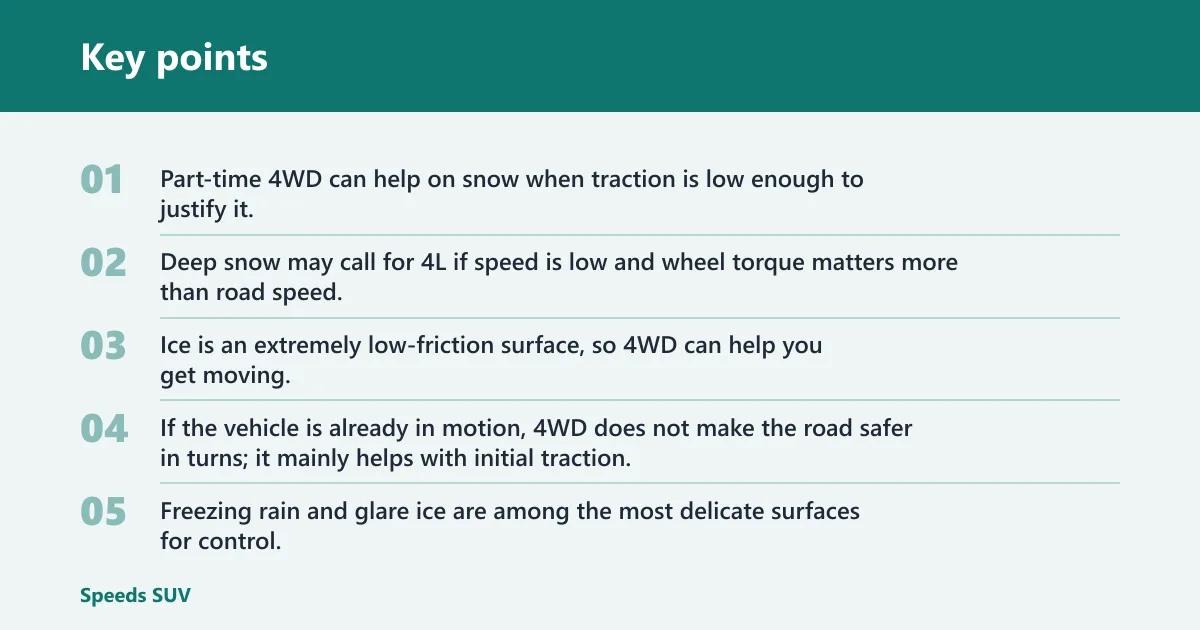
Part-time 4WD can help on snow when traction is low enough to justify it. Packed snow is often the cleanest fit for 4H, because it gives enough slip to reduce bind risk while improving pull away from a stop. Deep snow may call for 4L if speed is low and wheel torque matters more than road speed.
Mixed-surface snow is different. A plowed road with wet asphalt in the wheel tracks, or a lane with patchy snow and dry edges, can create a bind risk because the tires see different grip levels as you turn. That is when you should plan to return to 2H sooner rather than later.
Ice and freezing rain
Ice is an extremely low-friction surface, so 4WD can help you get moving. It does not improve braking or cornering the way some drivers assume. If the vehicle is already in motion, 4WD does not make the road safer in turns; it mainly helps with initial traction.
Freezing rain and glare ice are among the most delicate surfaces for control. Use only the mode the owner’s manual allows for that situation, and keep speed low enough that steering corrections stay gentle.
Mud, dirt, gravel, and sand
Mud is a classic use case for part-time 4WD because the locked front and rear driveline helps keep momentum when one axle starts to slip. Gravel and loose dirt often call for 4H, while deeper mud or softer sand may need 4L if you must crawl through at low speed.
Sand often needs steady throttle rather than sudden surges. In deeper or softer sand, 4L can help maintain controlled wheel speed and reduce the need to rev the engine for pull. In shallower, firmer sand, 4H may be enough.
When should you stay in 2H?
Stay in 2H whenever the road has normal dry grip. Dry pavement, dry highways, parking lots, and routine commuting belong here. If the tires cannot slip enough to relieve the speed difference between the front and rear axles, part-time 4WD is the wrong mode.
Dry pavement and dry highways
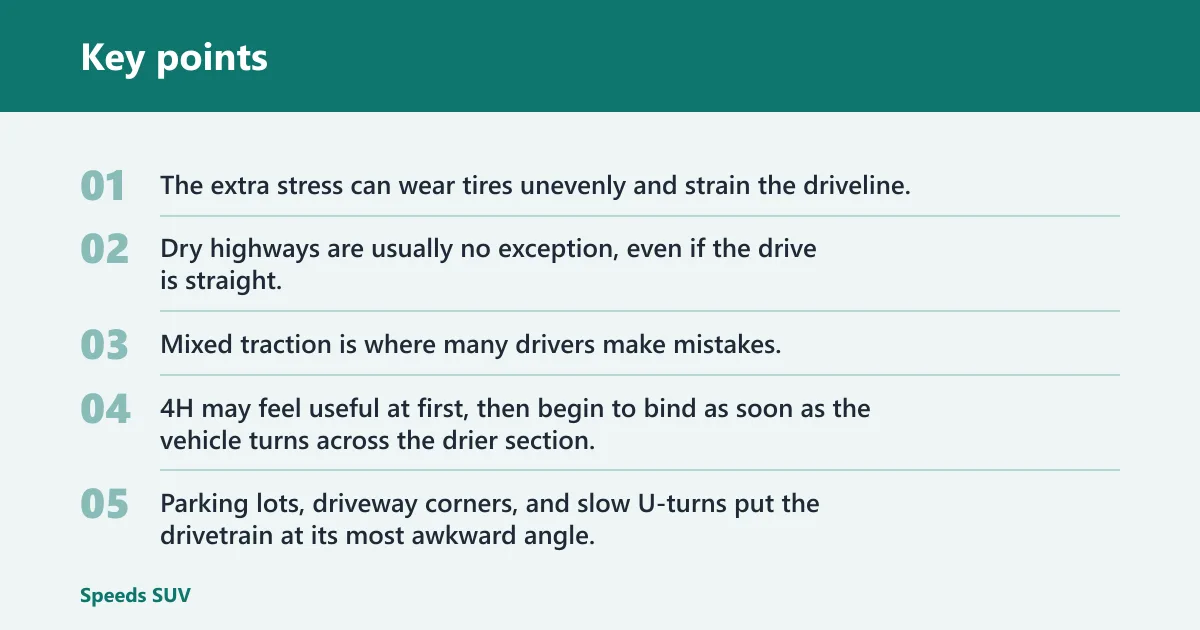
Dry pavement is the clearest no-go. Using 4WD on pavement can create shudder in tight circles, front tires may hop and chirp, and the vehicle can feel harder to steer. The extra stress can wear tires unevenly and strain the driveline.
Dry highways are usually no exception, even if the drive is straight. The problem appears most clearly in turns, parking maneuvers, and other moments when the front and rear axles want to rotate at different speeds.
Mixed-traction roads with dry patches
Mixed traction is where many drivers make mistakes. A road that is half slush and half dry asphalt can still be a bad place for locked 4WD, because the dry sections pull the axles out of sync. That is why “slippery enough” is not the same as “sometimes slippery.”
Suppose a street has packed snow in the center but dry patches near the curb. 4H may feel useful at first, then begin to bind as soon as the vehicle turns across the drier section. That is a cue to shift back to 2H before the surface changes again.
Tight turns, parking lots, and regular commuting
Tight turns reveal binding fastest. Parking lots, driveway corners, and slow U-turns put the drivetrain at its most awkward angle. If the vehicle shudders, resists steering, or feels like it is dragging a tire, 2H is the safer choice.
Regular commuting should usually stay in 2H unless the road surface has truly dropped into low-grip territory. AWD is the better on-road setup for everyday mixed weather because it is built for pavement use.
4WD decision table
This table gives a surface-and-speed rule you can use quickly. Read across the row, then check the warning sign before you keep 4WD engaged. If the warning sign shows up, switch back to 2H before the surface changes again.
| Surface condition | Traction level | Approximate speed | Recommended mode | Warning sign to disengage 4WD |
|---|---|---|---|---|
| Dry pavement | High traction | Any road speed | 2H | Shudder, hopping, or chirping tires in turns |
| Mixed dry and wet pavement | Uneven traction | Low to moderate | 2H | Steering feels tight or the truck resists turning |
| Packed snow | Low grip | Moderate | 4H | Dry patches appear in the lane or parking area |
| Fresh deep snow | Very low grip | Low | 4H or 4L, depending on depth | Speed rises above the safe crawl for the route |
| Ice | Extremely low friction | Low | 4H | Road opens onto dry pavement or hard-packed dry patches |
| Freezing rain on pavement | Very low grip, uneven | Low | 2H or 4H only if the manual allows and traction is uniformly low | Dry strips, painted lines, or cleared edges appear |
| Gravel road | Low grip | Moderate | 4H | Surface firms up into dry pavement or hard asphalt |
| Loose dirt trail | Low grip | Low to moderate | 4H | Steering is fine but the ground turns hard and grippy |
| Deep mud | Very low grip | Low | 4L | Wheel speed is high enough to spin instead of crawl |
| Soft sand | Low to very low grip | Low | 4L if deep, 4H if firm | Sand becomes firmer and the vehicle starts to bind in turns |
| Steep rocky climb | Variable, low at the wheels | Very low | 4L | Route opens to faster ground or requires normal road speed |
| Slushy side street | Low but mixed | Low | 4H only if the slush is continuous | Dry asphalt starts showing through the slush |
Can you use part-time 4WD on pavement?
Generally, no. Part-time 4WD is not designed for paved roads, and pavement can create binding because the front and rear axles are locked to the same speed. On dry pavement, that can lead to shudder, tire hop, steering difficulty, and extra wear.
Mixed pavement can still be a problem. If one side is wet and the other side is dry, or if snow patches sit on top of asphalt, the system may feel fine until you turn sharply. Then the speed mismatch shows up fast.
What binding feels like
Binding often feels like the vehicle is fighting itself in a turn. The steering may get heavy, the tires may chirp, and the body may lurch slightly in a parking-lot corner. On some vehicles, the truck may feel as if one end is skipping across the pavement.
Signs you should disengage
- Straighten the wheels. Ease off the turn and reduce throttle if the vehicle starts to hop or shudder. That lowers stress while you decide whether the surface still justifies 4WD.
- Shift back to 2H. If the road has dry pavement, long clear patches, or a parking-lot surface, disengage 4WD before the next turn. That restores normal differential action for on-road driving.
- Recheck the surface. If the road changes again to packed snow, mud, or gravel, reselect 4H only when the grip has clearly dropped back into low-traction territory. Do not leave it engaged through mixed dry sections.
Why mixed surfaces are still a problem
Mixed surfaces are tricky because the tire contact patches never see the same grip for long. A wet shoulder, a dry lane, and a snowy center strip can all exist in the same corner. That is enough to create the axle-speed mismatch that causes bind in a part-time system.
When to use 4H vs 4L
Use 4H for slippery surfaces at ordinary driving speeds. Use 4L when the route is slow, steep, or soft enough that you need more torque multiplication than 4H can provide. 4L is about control and pull, not speed.
Moderate-speed traction needs
4H fits packed snow, icy roads at low speeds, gravel roads, and light off-road surfaces where you still need to move at normal trail or road speeds. It is the mode most drivers reach for first when traction drops but the vehicle does not need a crawl gear.
Slow climbs and deep-soft surfaces
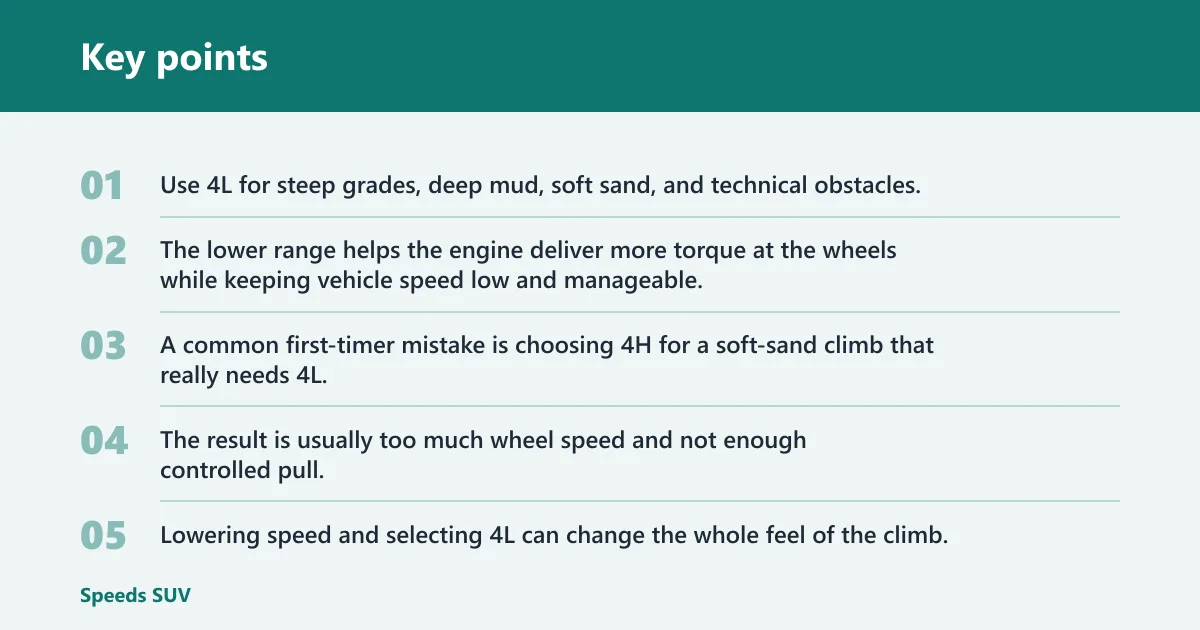
Use 4L for steep grades, deep mud, soft sand, and technical obstacles. The lower range helps the engine deliver more torque at the wheels while keeping vehicle speed low and manageable. That is the point where 4L matters more than traction alone.
A common first-timer mistake is choosing 4H for a soft-sand climb that really needs 4L. The result is usually too much wheel speed and not enough controlled pull. Lowering speed and selecting 4L can change the whole feel of the climb.
Choosing the right mode by speed and load
If you can roll through the surface at a moderate pace, 4H is usually the better fit. If you need slow crawling, careful throttle, or extra pull under load, 4L is the stronger choice. Tow weight, grade, and softness all push the answer toward 4L.
What the owner’s manual should confirm
The owner’s manual is commonly the primary source for vehicle-specific limits. It tells you whether the vehicle is part-time 4WD or AWD, what surfaces are allowed, what speeds are permitted, and whether the system includes extra modes such as Auto or 4Auto. Never assume all 4×4 systems behave the same.
Mode limits and road-surface limits
Some vehicles allow 4H only below certain speeds, and some allow 4L only when stopped or nearly stopped. The manual also spells out which surfaces are acceptable and which are not. That matters because a mode that feels similar on the dashboard can still have different limits underneath.
Shift-in and shift-out rules
Follow the shift rules exactly. Some systems want the vehicle rolling slowly, some want the transmission in Neutral for 4L, and some want the wheels pointed straight. Those details are vehicle-specific, so the manual beats general advice every time.
Vehicle-specific exceptions
Some trucks and SUVs offer Auto or 4Auto alongside locked 4H. In those cases, Auto may be the better everyday choice when the vehicle is on mixed pavement, while locked 4H remains the tool for true low-grip terrain. The manual should make that difference clear.
Frequently asked questions
When to use part time 4wd on snow or ice?
Use 4H on packed snow or continuous icy surfaces when the road is uniformly slippery. Switch back to 2H when the route includes dry patches, plowed pavement, or parking-lot turns. 4WD can help you get moving, but it does not improve braking or cornering on ice.
What surfaces are safe for part-time 4WD?
Snow, ice, dirt, mud, gravel, and sand are the common safe surfaces because they are low grip and allow some slip. The safe answer still depends on the owner’s manual. Mixed pavement, dry patches, and tight parking-lot turns can make a surface unsafe even if part of it is slippery.
How does part time 4wd work?
It works by locking the front and rear driveshafts together with the transfer case. Drivers shift into 4H or 4L with a knob, button, or lever. Because the axles turn at the same speed, the system is meant for surfaces where tire slip is available.
Part time 4WD vs AWD: what is the difference?
AWD is built for on-road use and can send power to all four tires all of the time, usually through a center differential that allows different axle speeds. Part-time 4WD is a locked setup intended for off-road or very slippery surfaces, so it should not be used on dry pavement.
When should 4WD be used?
Use 4WD when the road surface is low grip enough that traction is the main problem, not speed. That includes packed snow, ice, mud, gravel, loose dirt, and soft sand. If the route returns to dry pavement or mixed dry patches, shift back to 2H.