What Is Considered a Midsize SUV? Size, Seats, Cargo
A midsize SUV usually seats five, sometimes seven with an optional third row, and sits between compact and full-size models in passenger room and cargo space. If you misread the label, you can end up with the wrong cabin size, parking footprint, towing limit, or rental class. This guide explains how shoppers and renters separate midsize from compact, standard, and full-size SUVs across brand brochures and fleet listings.
How to identify a midsize SUV
A midsize SUV sits in the middle of the SUV lineup. It is usually larger than a compact SUV and smaller than a full-size model, with enough cabin space for family use without moving into the longest, heaviest body styles. The label depends on seating, footprint, and how the vehicle is set up for daily use.
That is why two vehicles with similar price tags can land in different classes. One may be a two-row family hauler with five seats. Another may add a third row and move into the midsize bracket even if its exterior dimensions overlap with a larger or smaller class from another brand.
How to spot a midsize SUV
Start with seating. A midsize SUV can top out at five passengers in some models, commonly seat seven in three-row versions, and in some cases seat eight. Many models come as either two-row or three-row versions, which is one reason the class is easy to blur with other SUV types.
Then check the use case. iSeeCars says midsize SUVs help maximize passenger space, cargo space, and towing capacity. That practical balance is the real clue. If a model is built to carry a family, hold luggage, and still tow more than a compact SUV usually can, it likely belongs in this class.
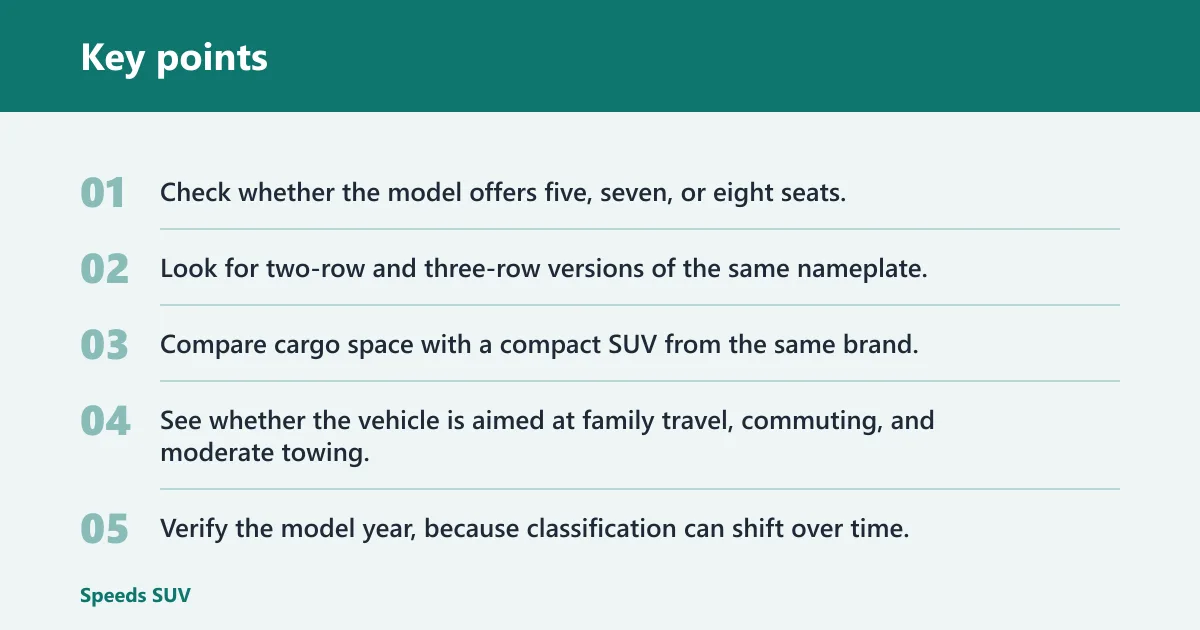
- Check whether the model offers five, seven, or eight seats.
- Look for two-row and three-row versions of the same nameplate.
- Compare cargo space with a compact SUV from the same brand.
- See whether the vehicle is aimed at family travel, commuting, and moderate towing.
- Verify the model year, because classification can shift over time.
Suppose a shopper sees a three-row SUV with room for seven people, but the second row is tight and cargo space behind the third row is limited. That vehicle may still be called midsize, yet its real-world layout tells you more than the label alone.
Midsize SUV classification table
This table gives a simple way to place SUVs by size. Use it as a shopper’s rule of thumb, not a hard law, because brands and rental fleets do not all use the same naming system.
| Segment label | Typical seating | Common rows | Common use case | Examples |
|---|---|---|---|---|
| Compact SUV | 5 | 2 rows | City driving, light cargo, easier parking | Toyota RAV4, Honda CR-V, Mazda CX-5 |
| Midsize SUV | 5, 7, or 8 | 2 rows or 3 rows | Family hauling, more cargo room, moderate towing | Toyota Highlander, Kia Telluride, Honda Pilot |
| Standard SUV | 7 or 8 | Usually 3 rows | More passenger room than a midsize two-row model | Ford Explorer, Chevrolet Traverse |
| Large SUV | 7 to 8+ | 3 rows | Maximum cabin space, larger towing and cargo needs | Chevrolet Suburban, Ford Expedition |
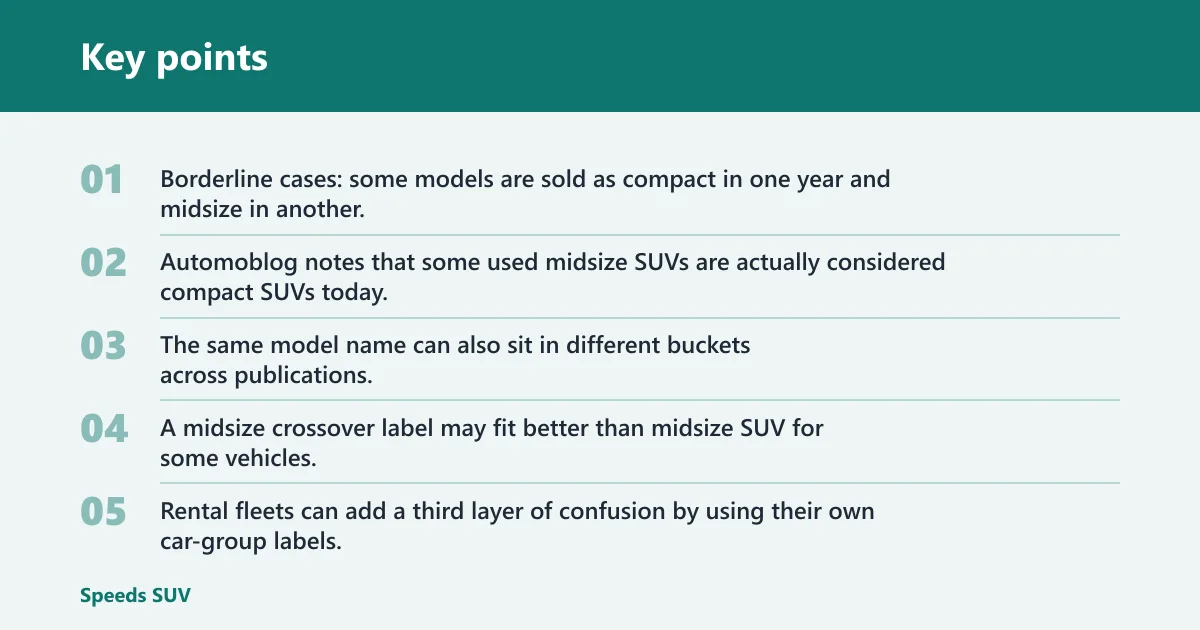
Borderline cases: some models are sold as compact in one year and midsize in another, or they move from midsize SUV to midsize crossover or standard SUV depending on body redesigns, trim changes, or how a data source groups them. Automoblog notes that some used midsize SUVs are actually considered compact SUVs today, which is a warning sign for older nameplates and older classification charts.
The same model name can also sit in different buckets across publications. A midsize crossover label may fit better than midsize SUV for some vehicles. Rental fleets can add a third layer of confusion by using their own car-group labels, which are often driven by luggage room and fleet availability rather than a consumer brochure category.
What vehicles are considered midsize SUVs?
Shoppers will usually find midsize SUVs among nameplates that balance family space with a manageable footprint. The class includes many two-row and three-row models, and iSeeCars lists 31 models in the category. It also has enough data to rank 17 of those 31 models, which shows how broad the class is in the market.
One concrete reference point is the Toyota Highlander. iSeeCars identifies it as the best midsize SUV, gives it a Quality Score of 8.3 out of 10, says it seats up to 7 people, and lists fuel economy at up to 24 mpg. iSeeCars also lists its new MSRP range as $46,270 to $53,925 and its used price range as $26,196 to $45,985.
That does not mean every midsize SUV looks like the Highlander. Some are smaller two-row models with five seats. Others add a third row and aim at larger families. The category is wide enough that price, seating, and body style vary a lot from one nameplate to the next.
Across the broader category data set, iSeeCars lists new midsize SUV prices from $32,390 to $83,440 and used prices from $17,749 to $69,617. That spread shows why a label alone is not enough. You need the specific model, year, and trim before you compare size or value.
Midsize SUV or standard SUV?
The practical difference is usually cabin priority. A midsize SUV gives you more room than a compact model, but a standard SUV usually gives you a clearer step up in third-row space or overall passenger comfort. If your main goal is seven-seat flexibility, a standard SUV may fit better. If you want a smaller footprint with family utility, midsize often makes more sense.
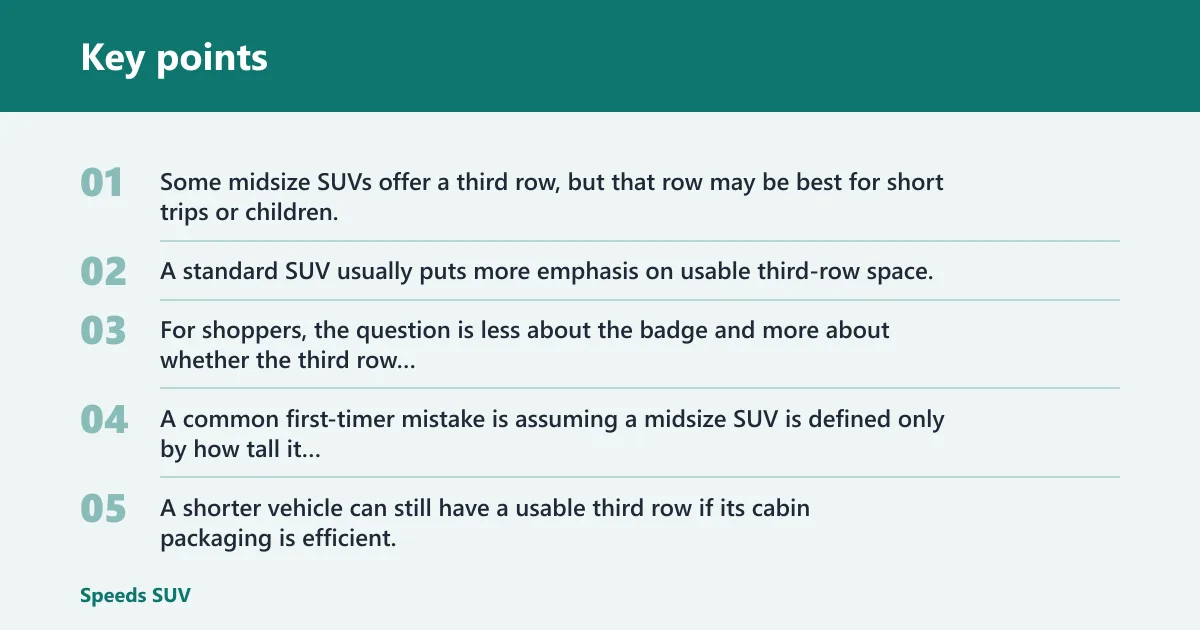
The decision boundary is not exact. Some midsize SUVs offer a third row, but that row may be best for short trips or children. A standard SUV usually puts more emphasis on usable third-row space, while a large SUV pushes farther toward maximum room and towing. For shoppers, the question is less about the badge and more about whether the third row will actually work.
A common first-timer mistake is assuming a midsize SUV is defined only by how tall it sits, not by its passenger and cargo space. A shorter vehicle can still have a usable third row if its cabin packaging is efficient, while a longer one can still feel cramped if the body design favors cargo over people. Check headroom, legroom, and cargo space together.
2-row versus 3-row layouts
Two-row midsize SUVs usually prioritize cargo and rear-seat comfort for five passengers. Three-row midsize SUVs trade some cargo space for extra seats, and many use the third row as an occasional space rather than a full-time adult seat. That tradeoff is normal. It is also the main reason the same class can satisfy very different buyers.
If you need daily room for six or seven people, a three-row midsize model may be enough. If you only need five seats but want more cargo volume and a calmer ride, a two-row midsize SUV can be the better fit.
What is a midsize SUV rental?
A midsize SUV rental is a rental-company size class, not always the same as a retail SUV label. Fleet companies group vehicles by cabin space, luggage capacity, and availability, so the name on the booking page may not match what a consumer brand calls the same vehicle. Enterprise and Hertz can also use different inventory mixes.
That matters because a rental search for “midsize SUV” may return a vehicle that feels closer to a compact crossover or, in some fleets, something closer to a standard SUV. Before booking, verify the listed passenger count, luggage capacity, and exact vehicle examples shown by the rental company.
What is considered a midsize SUV at Enterprise?
At Enterprise, midsize SUV usually means a rental class, not a fixed consumer segment. The exact model can change by location and availability, so you should check the listed passenger count and cargo room rather than assuming a retail midsize SUV label will match the rental counter. The same class can vary by region and fleet mix.
What is considered a midsize SUV at Hertz?
At Hertz, the midsize SUV label is also fleet-based. Hertz may group vehicles by similar interior room and luggage capacity, which means the vehicle you receive can vary from one airport or neighborhood branch to another. If you need a third row or extra bags space, confirm those details before you reserve.
What is considered a midsize SUV rental car?
A midsize SUV rental car is the vehicle class you book when you want more room than a compact rental but do not need a full-size SUV. The label is best treated as a size promise, not a specific model promise. Always check the actual seating and luggage rating on the booking page.
Midsize SUV data table
The category data set gives a useful snapshot of the class. It shows how wide the price spread is, how many models belong to the segment, and how often the best-known rankings cover the full field. It also helps explain why shoppers should check reliability and safety data before making a short list.
| Data point | Figure | What it means for shoppers |
|---|---|---|
| Category size | 31 models | The segment is broad, so one label covers many body styles and price points. |
| New price range | $32,390 to $83,440 | New midsize SUVs span mainstream and premium pricing. |
| Used price range | $17,749 to $69,617 | Used-market values vary enough that model year matters a lot. |
| Ranked models | 17 of 31 models | Not every midsize SUV has enough data for a full ranking. |
For shopping research, check NHTSA, J.D. Power, IIHS, and Kelley Blue Book. Those sources help with safety scores, ownership ratings, crash information, and value trends. They do not replace a size check, but they help you sort the midsize field after you narrow the cabin layout and body style you want.
If a family wants a three-row option with strong value retention, safety data and price range matter as much as the badge. If a commuter wants a two-row SUV with simpler parking and lower running costs, reliability and fuel economy become more important than third-row capacity.
Frequently asked questions
What is considered a midsize SUV?
A midsize SUV is usually a vehicle that sits between compact and full-size SUVs in passenger space and cargo room. It often seats five, seven, or eight depending on the model, and it may come as a two-row or three-row vehicle. The exact label can shift by brand and model year.
What is the difference between a midsize SUV and a standard SUV?
A midsize SUV usually aims for a balance of cabin space, cargo room, and easier parking, while a standard SUV more often leans toward greater third-row use and a larger overall footprint. The line is not exact. Seating layout and usable cargo space matter more than the badge.
What is considered a compact SUV?
A compact SUV is usually smaller than a midsize SUV, often with two rows and seating for five. It is built for easier parking, lighter weight, and lower running costs, though cargo space and rear-seat room are usually more limited. Some older models now get grouped differently than they once did.
What is a midsize SUV awd?
A midsize SUV AWD is a midsize SUV with all-wheel drive. AWD is a drivetrain choice, not a size class, so it does not change whether the vehicle is compact, midsize, or standard. Some midsize SUVs are FWD, some offer AWD, and some offer both depending on trim.