Midsize SUV vs Standard SUV: Key Differences
A midsize SUV is smaller than a standard SUV, and that usually means less third-row room, less cargo space, better fuel economy, and easier parking. Shopping terminology varies by source, though: “standard SUV” often overlaps with “full-size SUV” in rental and retail listings, while “intermediate SUV” often overlaps with “midsize SUV.” If you do not need the third row and towing often, the smaller class usually makes more sense. (EPA FuelEconomy.gov; OEM specs)
Midsize SUV vs standard SUV comparison
| Factor | Midsize SUV | standard SUV | Winner |
|---|---|---|---|
| Exterior size | Smaller overall, easier to place in tight spaces | Bigger overall, with more body length and width | Midsize SUV |
| Third-row usefulness | Often limited, and many models do not get a usable third row | Comfortably accommodates adults in the third row | standard SUV |
| Daily driving and parking | Usually easier to maneuver in cities and garages | Harder to thread through tight parking and narrow streets | Midsize SUV |
| Towing | Decent, but smaller towing capacity overall | Usually stronger, with more towing headroom | standard SUV |
| Fuel economy | Usually better | Usually worse | Midsize SUV |
| Cargo with all seats up | Less space, especially when a third row is in use | More usable cargo room behind the third row | standard SUV |
Size decides the daily feel
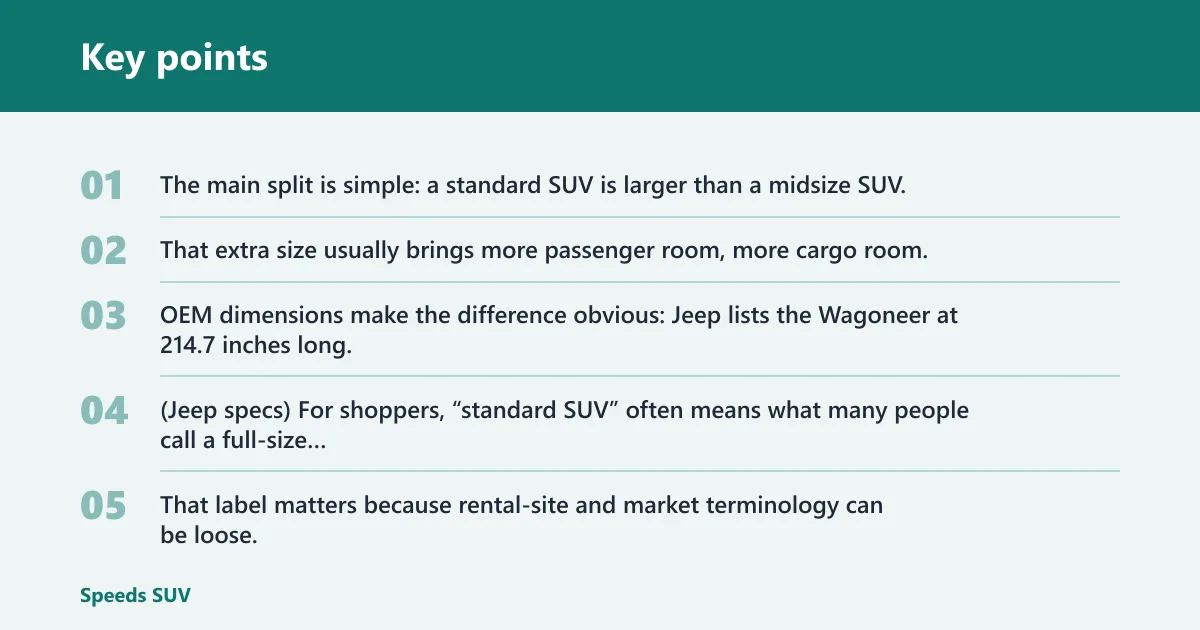
The main split is simple: a standard SUV is larger than a midsize SUV. That extra size usually brings more passenger room, more cargo room, and more towing capacity, but it also means more bulk in traffic, more work in parking, and a larger footprint in a garage. OEM dimensions make the difference obvious: Jeep lists the Wagoneer at 214.7 inches long, 83.6 inches wide, and 75.6 inches tall, while the Grand Cherokee is 193.5 inches long, 77.5 inches wide, and 70.8 inches tall. (Jeep specs)
For shoppers, “standard SUV” often means what many people call a full-size SUV. That label matters because rental-site and market terminology can be loose, and a listing may not match the way buyers use the term in conversation. In practical shopping terms, standard means the larger class; midsize or intermediate means the smaller one. (Rental/retail segment naming varies by source; OEM naming conventions)
Passenger space changes the whole purchase
The seating question matters more than the badge on the liftgate. Standard SUVs are the better fit when adults need a usable third row, while most intermediate SUVs, which are treated the same as midsize SUVs here, do not get a truly comfortable third row. That difference decides whether the extra size is useful or wasted. (OEM seating layouts; IIHS vehicle-size context)
When a midsize SUV has a third row, it is often best suited for children, and cargo space usually shrinks once that row is raised. That is the tradeoff many buyers miss. A vehicle that looks “big enough” on paper can feel cramped once all seats are in use. (OEM cargo specs; consumer test publications such as Edmunds and Car and Driver)
Towing and construction follow the use case
Standard SUVs usually tow more because they are built for heavier-duty work. Many use body-on-frame construction, which is commonly associated with towing-oriented design, while midsize SUVs are often unibody, which usually helps steering feel and city use. Body-on-frame is not required for towing, but it is common in the larger class and often paired with higher ratings. (OEM specs; Edmunds; Car and Driver)
That does not make a midsize SUV weak. It means the class is aimed more at everyday use than repeated heavy towing. If your trailer is part of the regular routine, the standard SUV has the clearer advantage. (OEM towing ratings; J.D. Power segment guidance)
Fuel use and maintenance add up
Midsize SUVs are often more fuel efficient than standard SUVs, and EPA ratings generally reflect that smaller vehicles tend to use less fuel than larger ones with bigger engines and more mass. Standard SUVs are also typically more expensive to buy and maintain, so the cost difference is not limited to the window sticker. It continues through ownership, especially if the larger size is used mostly for solo commuting or short errands. (EPA FuelEconomy.gov; J.D. Power)
Say your family needs seven seats twice a month but spends the rest of the week in school pickup and grocery runs. In that case, the larger SUV may spend most of its life carrying extra mass you do not need. The smaller class usually makes more sense for that pattern. (OEM seating/cargo specs; EPA FuelEconomy.gov)
What is the difference between these SUVs?
A midsize SUV is the smaller, easier-to-manage choice, while a standard SUV is the larger option built around more passenger room, more cargo room, and more towing ability. Intermediate SUV is often used as another name for midsize SUV in consumer shopping, so those two labels should usually be treated the same. Segment naming varies by source, so always compare actual dimensions, seating, and ratings instead of relying on the label alone. (OEM specs; J.D. Power)
What buyers usually mean by standard SUV
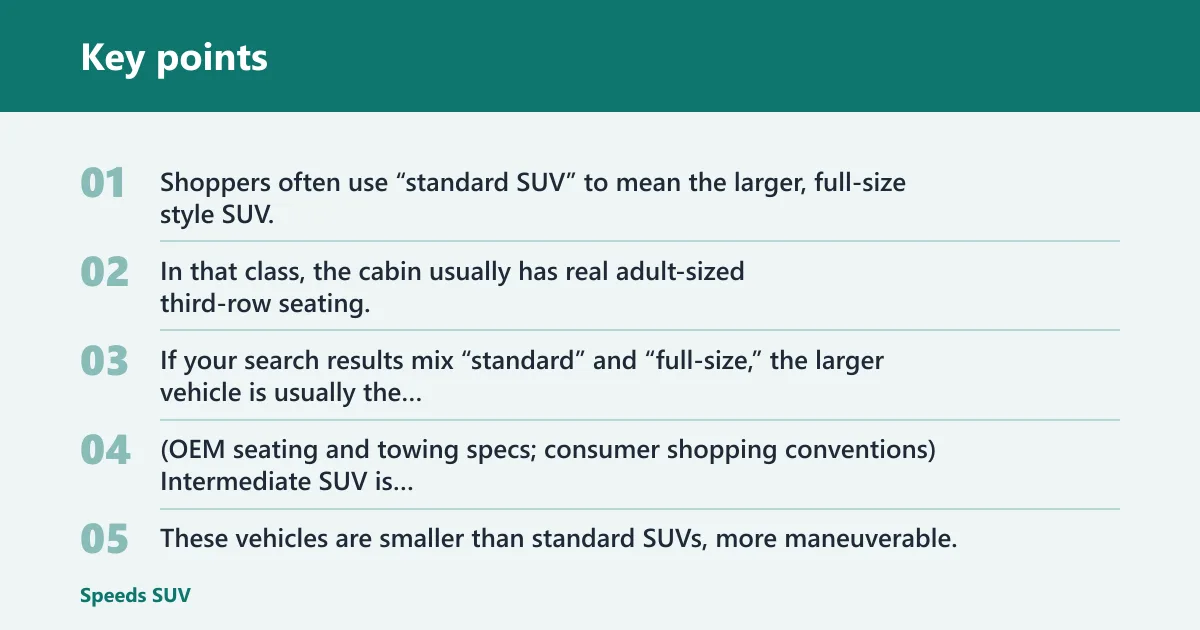
Shoppers often use “standard SUV” to mean the larger, full-size style SUV. In that class, the cabin usually has real adult-sized third-row seating, and the vehicle is commonly designed around heavier loads. If your search results mix “standard” and “full-size,” the larger vehicle is usually the one being discussed. (OEM seating and towing specs; consumer shopping conventions)
What buyers usually mean by midsize or intermediate SUV
Intermediate SUV is treated as the same as midsize SUV in the source comparison. These vehicles are smaller than standard SUVs, more maneuverable, and often cheaper to buy and maintain. Their third rows, when offered, are usually limited and can quickly cut into cargo room. (J.D. Power; OEM cargo specs)
How big is each segment?
The size gap is visible before you open a door. Using the provided example pair, the Jeep Wagoneer is 214.7 x 83.6 x 75.6 inches, while the Grand Cherokee is 193.5 x 77.5 x 70.8 inches. That makes the Wagoneer about 21.2 inches longer, 6.1 inches wider, and 4.8 inches taller, which is why standard SUVs feel larger in daily use. (Jeep specs)
Exterior size and parking fit
Those numbers explain why standard SUVs feel larger in daily use. More length means more overhang to fit into a parking space, and more width means less margin in a narrow garage or a tight city lane. Even when the steering is light, the body still has to fit where you point it. (Jeep specs; IIHS/consumer guidance on vehicle size and visibility)
Example models from each class
For midsize SUVs, common examples include the Grand Cherokee, Ford Explorer, Toyota Highlander, and Honda Pilot. For standard SUVs, examples include the Wagoneer, Chevrolet Tahoe, GMC Yukon, and Ford Expedition. The point is not the nameplate list itself; it is that the larger class usually prioritizes room and towing over compactness. (OEM specs; Edmunds class listings)
Picture a shopper comparing a 2-car garage with a narrow driveway. The midsize SUV usually leaves more room to open doors, walk around the vehicle, and avoid mirror contact with walls or another car. The standard SUV may still fit, but the margin for error gets much smaller. (OEM dimensions; consumer parking guidance)
Passenger space and third rows
Passenger space is where the categories separate most clearly. Standard SUVs are the better choice when the third row needs to work for adults, while midsize SUVs are more likely to treat that row as occasional seating for children. If the third row stays folded most of the time, the bigger vehicle may not earn its footprint. (OEM seating/cargo specs; IIHS vehicle-size context)
Adult third-row comfort in standard SUVs
Standard SUVs can accommodate adults in the third row more comfortably than midsize SUVs because the larger body shape usually allows more legroom and easier access to the back row. If you regularly carry six or seven people, the larger body shape starts to make sense. (OEM interior specs; consumer test publications such as Car and Driver and Edmunds)
Child-only third rows in many midsize SUVs
Many midsize SUVs have a third row only in name. The seat may work for short trips or younger passengers, but it usually is not the place to put adults for long periods. Once you use that row, cargo space behind it can become very limited. (OEM cargo specs; Consumer Reports-style usability guidance)
How a third row affects the rest of the cabin
The problem is easy to miss: a midsize SUV with a third row can lose the very cargo room that made it appealing. With all seats up, groceries, strollers, sports bags, and travel luggage have to fit around the raised third row. Standard SUVs are better at keeping usable cargo space after the whole cabin is filled. (OEM cargo-volume specs; Edmunds)
Which is easier to drive in the city?
Midsize SUVs are usually easier to drive in the city because they are smaller, easier to maneuver, and simpler to park. Standard SUVs can still be manageable, but the extra length and width make them more demanding in tight streets, crowded lots, and narrow garages. Visibility, turning radius, and parking stress all tend to improve as the vehicle gets smaller. (OEM dimensions; IIHS visibility/size context)
Turning, parking, and daily commuting
Unibody construction is common in midsize SUVs, and that setup is often linked with easier steering feel in everyday use. Standard SUVs are often body-on-frame, which fits their towing-oriented role, but the extra mass and size usually make city driving less convenient. The difference shows up most in parking, not in a straight line. (OEM specs; Edmunds; Car and Driver)
Why midsize SUVs feel easier in tight spaces
The advantage is not about prestige or power. It is about inches. Smaller width helps in drive-through lanes, school pickup lines, and parking garages, while shorter length makes it easier to judge the front and rear corners. (OEM dimensions; IIHS visibility guidance)
Towing, cargo, and fuel economy
Standard SUVs usually tow more, carry more with all seats up, and give more room for passengers who need the third row. Midsize SUVs usually use less fuel and are easier to live with day to day. The right answer depends on whether your use case is mostly transport, or transport plus heavy hauling. (OEM towing/cargo specs; EPA FuelEconomy.gov)
Why standard SUVs usually tow more
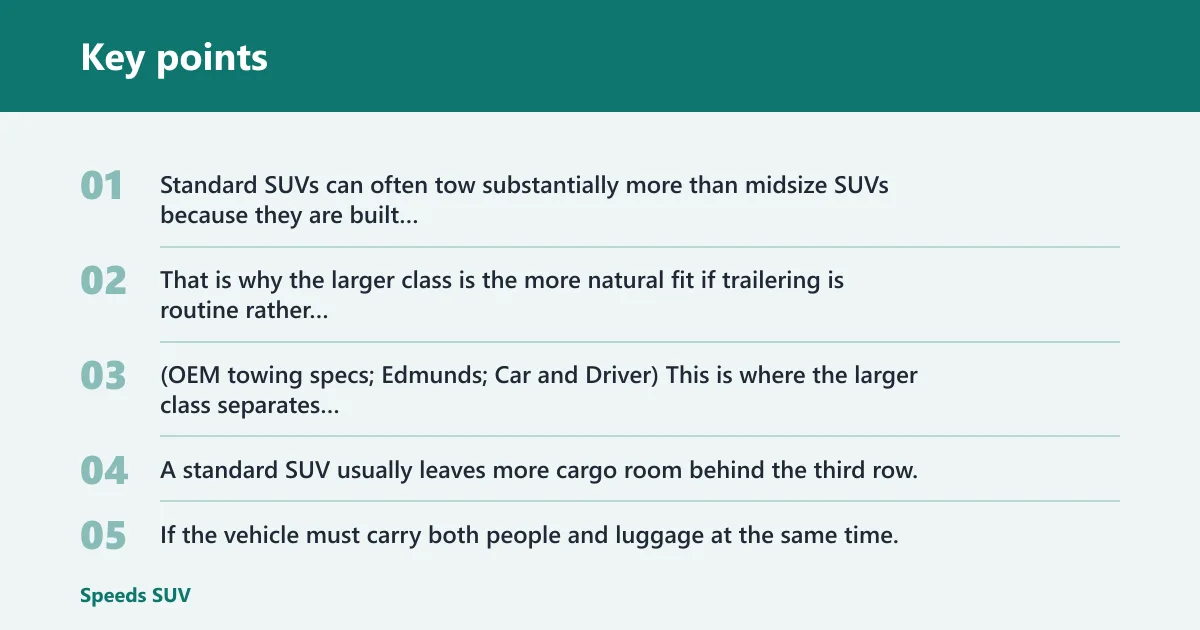
Standard SUVs can often tow substantially more than midsize SUVs because they are built with stronger frames, higher-output powertrains, and heavier-duty cooling and hitch hardware. That is why the larger class is the more natural fit if trailering is routine rather than occasional. (OEM towing specs; Edmunds; Car and Driver)
Cargo room with all seats up
This is where the larger class separates itself most clearly. A standard SUV usually leaves more cargo room behind the third row, while a midsize SUV can become cargo-starved once the third row is raised. If the vehicle must carry both people and luggage at the same time, the larger body pays off. (OEM cargo-volume specs)
Fuel economy and long-trip comfort
Midsize SUVs are generally more fuel efficient, and EPA ratings usually reflect that lighter, smaller SUVs consume less fuel than larger ones. Off-road capability is a separate question from size: iSeeCars’ off-road midsize rankings show the Ford Bronco at 13.1 inches of ground clearance and the Jeep Wrangler Unlimited at 12.9 inches, which are strong examples of tall midsize vehicles without changing the category’s overall efficiency advantage. (EPA FuelEconomy.gov; iSeeCars; OEM specs)
Long-trip comfort depends on who is riding and what the cargo situation looks like. A standard SUV often feels better when several adults are aboard, because the cabin is less cramped. A midsize SUV can be perfectly comfortable for fewer passengers, and it usually asks less at the fuel pump. (OEM seating and fuel-economy ratings; EPA FuelEconomy.gov)
Example models: seating, construction, towing, and cargo
| Model | Seating | Construction type | Typical towing range | Cargo behind third row |
|---|---|---|---|---|
| Jeep Grand Cherokee | Up to 7, depending on configuration | Unibody | Up to about 6,200 lb | Limited when equipped with a third row; often best viewed as occasional-use space |
| Ford Explorer | Up to 7 | Unibody | Up to about 5,600 lb | Modest behind the third row |
| Chevrolet Tahoe | Up to 9 | Body-on-frame | Up to about 8,400 lb | More usable behind the third row than most midsize SUVs |
| Ford Expedition | Up to 8 | Body-on-frame | Up to about 9,300 lb | More usable behind the third row than most midsize SUVs |
Those examples show the core tradeoff: midsize models usually keep dimensions and running costs in check, while standard SUVs trade size for stronger towing and better three-row usability. Exact ratings vary by trim and drivetrain, so buyers should verify the specific model year they are considering. (OEM specs; EPA FuelEconomy.gov)
SUV decision table
The table below turns the size tradeoff into actual shopping decisions. Scores run from 1 to 5, with 5 meaning the segment fits the scenario best. The recommendation is a direct yes/no answer on whether the standard SUV is the better choice in that scenario. (OEM specs; EPA FuelEconomy.gov; IIHS context)
| Buyer scenario | Midsize SUV score | standard SUV score | Standard SUV? yes/no | Reason |
|---|---|---|---|---|
| City parking | 5 | 2 | No | Smaller footprint is easier in tight lots and garages. |
| Garage fit | 5 | 2 | No | Shorter and narrower bodies leave more clearance. |
| Adult third-row use | 2 | 5 | Yes | The larger class is built to seat adults in back. |
| Child third-row use | 4 | 3 | No | Child-only occasional use can work without buying extra bulk. |
| Towing | 2 | 5 | Yes | More towing capacity and stronger hardware suit frequent trailering. |
| Cargo with all seats up | 2 | 5 | Yes | More usable cargo room remains when the cabin is full. |
| Fuel cost | 5 | 2 | No | Smaller SUVs are usually more fuel efficient. |
| Long-trip comfort | 3 | 5 | Yes | Extra room helps when several adults and bags ride together. |
Choose Midsize SUV if… / Choose standard SUV if…
Choose Midsize SUV if you want easier city parking, a better chance of fitting in a normal garage, lower fuel use, and simpler daily driving. It is also the better fit if your third row would be used only rarely, or mainly for children on short trips. (EPA FuelEconomy.gov; OEM dimensions and seating specs)
Choose standard SUV if you regularly carry adults in the third row, tow often, or need cargo room even when all seats are occupied. It is the better choice when the extra size will be used often enough to justify the daily cost in parking, fuel, and maneuverability. (OEM towing and cargo specs; EPA FuelEconomy.gov)
Frequently asked questions
What is the difference between a midsize SUV and a standard SUV?
A midsize SUV is smaller, easier to maneuver, and usually more fuel efficient. A standard SUV is larger, usually has more cargo room, can tow more, and is more likely to give adults usable space in the third row. The extra size matters only if you will use it often. (OEM specs; EPA FuelEconomy.gov)
Is a standard SUV bigger than a midsize SUV?
Yes. A standard SUV is bigger than a midsize SUV in overall length, width, and height. That difference changes parking, garage fit, and cabin space. (Jeep specs)
Which is better for families: midsize or standard SUV?
The better family SUV depends on how often you need the third row. A midsize SUV works well for smaller families or for occasional child seating, while a standard SUV makes more sense for families that regularly carry adults in back or need space for both passengers and luggage. (OEM seating and cargo specs)
Do midsize SUVs usually have a third row?
Some midsize SUVs offer a third row, but many do not get a usable one. Even when the seat is present, it is often best for children and short trips, and it can cut sharply into cargo room. If the third row is a must-have, standard SUVs are the safer bet. (OEM specs; Edmunds; Car and Driver)
Are standard SUVs better for towing than midsize SUVs?
Yes, generally. Standard SUVs usually tow more because they are built with stronger hardware and often use body-on-frame construction. Midsize SUVs can still tow respectably, but they usually have smaller limits. If towing is frequent, standard is the clearer choice. (OEM towing specs; Edmunds)
Which is easier to drive in the city, a midsize SUV or a standard SUV?
A midsize SUV is usually easier to drive in the city. It is smaller, easier to park, and less demanding in tight spaces. A standard SUV can still work for urban driving, but the extra size tends to be more noticeable in parking lots, garages, and narrow streets. (OEM dimensions; IIHS visibility context)