Compact SUV vs Midsize SUV: Which Size Should You Buy?
Choose a Compact SUV if you usually carry four people or fewer and only light cargo. Move to a midsize SUV if you need easier rear-seat space, more luggage room, or regular use of a third row. Pick the wrong size, and you end up with cramped trips, poor cargo fit, or extra bulk you never use. This guide compares passenger space, cargo room, city driving, and family use so you buy the smallest SUV that actually fits.
| Decision factor | Compact SUV | midsize SUV | Winner |
|---|---|---|---|
| City parking and manoeuvring | Smaller footprint, easier in tight parking, better for narrow streets. | More body to place and swing through small gaps. | Compact SUV |
| Rear-seat room | Usually fine for two adults or two children, but can feel tight with child seats. | More legroom and more width for child seats and adult passengers. | midsize SUV |
| Cargo and boot space | Often enough for daily use, but fills quickly with a stroller or holiday bags. | More boot storage and a better fit for larger luggage loads. | midsize SUV |
| Fuel use and running cost | Usually the easier class to keep efficient, especially with smaller petrol, hybrid, plug-in hybrid, diesel, or EV powertrains. | Often costs more to fuel and run because of size and weight. | Compact SUV |
| Family flexibility | Works for smaller households and light gear, but space runs out sooner. | Better for growing families, regular trips, and five- to seven-seat needs. | midsize SUV |
| Towing and load margin | Can tow light loads if the exact trim allows it. | Often the stronger choice on paper, but the exact trim and payload still decide the limit. | midsize SUV |
Compact vs midsize at a glance
The trade-off is straightforward: a Compact SUV is easier to park, simpler to handle in town, and often more efficient, while a midsize SUV gives you more rear-seat room, more boot space, and more room to grow. The better buy is the smallest class that fits your normal load.
Size and space trade-off
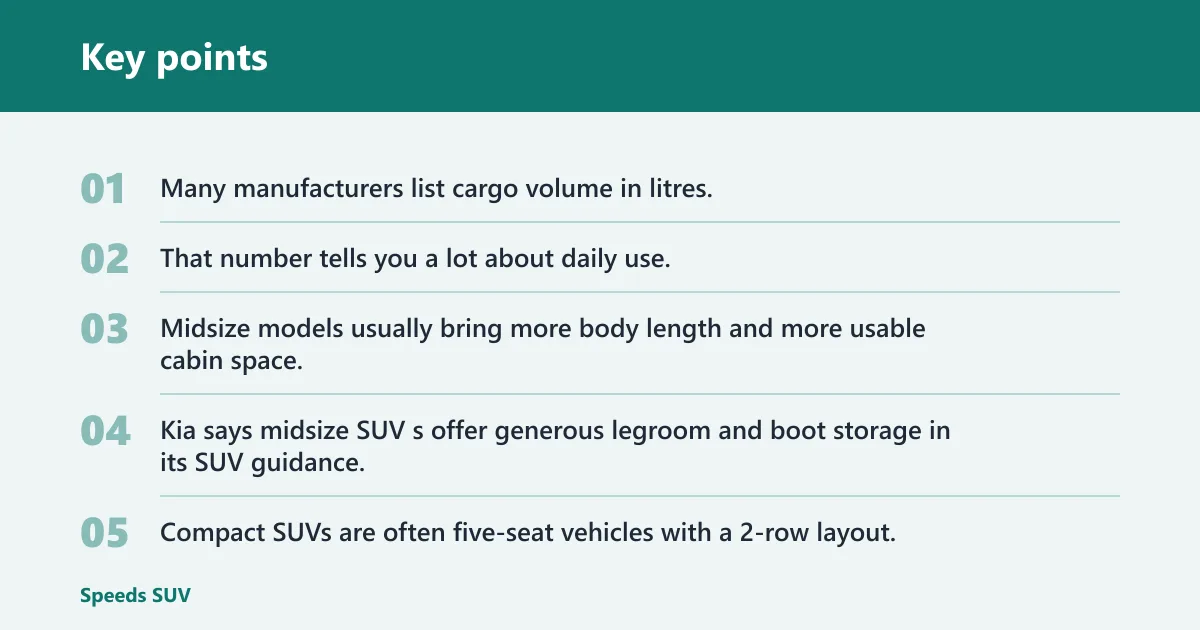
Many manufacturers list cargo volume in litres, and some also publish it in cubic feet depending on market. That number tells you a lot about daily use, and a compact model can still run out of room once you add a stroller, groceries, or sports kit.
Midsize models usually bring more body length and more usable cabin space. Kia says midsize SUVs offer generous legroom and boot storage in its SUV guidance, and that matters more than the badge on the tailgate when you load luggage or fit a child seat.
Typical seating and cargo differences
Compact SUVs are often five-seat vehicles with a 2-row layout. The same source says midsize SUVs typically seat five to seven people, and Kia also notes that 2-row SUVs maximize boot space while 3-row SUVs offer more flexibility.
That flexibility sounds attractive, but a third row can still be a short-trip solution rather than a full-time adult seat. If your routine is school runs and weekend bags, the smaller class can still be enough.
City driving and running costs
Compact SUVs are described as ideal for narrow streets and tight parking spaces. That makes them the better choice if your driving is mostly urban, with parking garages, supermarket lots, and narrow kerbside spots.
Midsize SUVs can still be manageable, but the extra room usually costs more in fuel use, tyres, and purchase price. Auto Express says in its midsize-SUV buying guide that midsize SUVs are generally less expensive to buy than large SUVs, but that does not make them cheap to run. They are simply a different size class.
| Use case | Compact SUV | midsize SUV | Recommended minimum size |
|---|---|---|---|
| Solo commuter | Yes. Easy to park, efficient, and enough space for one person and daily bags. | Yes, but usually more car than you need. | Compact SUV |
| Couple | Yes. Works well if luggage stays light and rear-seat use is rare. | Yes. Better if you often travel with bulky gear. | Compact SUV |
| Family of 3-4 | Maybe. Fine for smaller children and lighter cargo; tight once bags grow. | Yes. More rear-seat room and better boot space. | midsize SUV |
| Two car seats | Maybe. Check rear-seat width, ISOFIX placement, and front-seat legroom. | Yes. Usually easier to fit two seats without pinching the front row. | midsize SUV |
| Road trips | Maybe. Fine for light packing, but luggage can crowd the cabin fast. | Yes. Better for comfort, bags, and longer journeys. | midsize SUV |
| Frequent airport runs | Maybe. Works for one or two travelers with disciplined packing. | Yes. Better for multiple suitcases and last-minute extras. | midsize SUV |
| Towing-light gear | Maybe. Only if the exact trim rating supports the load. | Yes. Still trim-specific, but usually the safer bet for payload and trailer margin. | midsize SUV |
How much bigger is a midsize SUV?
A midsize SUV is usually bigger where it matters most: rear-seat room, boot space, and cabin comfort. The exact gap changes by model, but you feel it quickly when you try to fit adults in the back or load luggage for a full trip.
Footprint and parking
Compact SUVs are usually easier to fit into a parking bay and easier to thread through traffic. That suits drivers who spend a lot of time in dense city areas or older neighbourhoods with narrow streets.
Midsize SUVs take more room on the road and in car parks. The difference may look modest on a spec sheet, but it can matter every day if you park in tight urban spaces or reverse into narrow driveways.
Rear-seat room
The rear seat is where class size starts to matter. If the people in the back are adults, or if child seats sit behind taller front passengers, the extra room in a midsize SUV is usually worth paying for.
ISOFIX child-seat anchors are essential, but anchor points alone do not guarantee comfort. Rear-seat width, door opening shape, and front-seat travel all affect whether two car seats fit without forcing the front row into a cramped position.
Boot space in litres
Boot space should be treated as a number, not a guess. Manufacturers list cargo volume in litres, and that figure is one of the clearest clues to whether a vehicle will handle family gear without daily compromise.
Usable third-row space
Some midsize SUVs offer a third row, but that does not mean every third row suits every passenger. The same source says midsize SUVs typically seat five to seven people, and Kia says 3-row SUVs offer more flexibility. That flexibility is useful, but a third row can still be better for children or short trips than for adults on long journeys.
Is a compact SUV big enough for a family of four?
A compact SUV can be big enough for a family of four if the children are young, luggage stays modest, and the rear seat does not have to work hard every day. It starts to feel tight when the family needs two child seats, a stroller, and regular trip luggage at the same time.
Two adults plus two children
For school runs, short commutes, and light shopping, a compact SUV can work for four people. The catch is space planning. Once the children grow or the adults in front need more legroom, the rear bench can feel short on width and knee room.
Say your family has two adults, one booster seat, and one forward-facing child seat. A compact SUV may still work, but the front passenger seat may need to move forward more than you want. That is often the first sign you should move up.
Two car seats and a stroller
Two ISOFIX child seats can be where many compact SUVs start to feel small. The car seat shells, base units, and the space needed to reach the belts can cut deeply into usable rear width. Add a stroller and the boot can become the limiting factor quickly.
A midsize SUV can be the safer pick if you want a calmer daily setup with less seat-juggling. More rear-seat room gives you more space to fit the seats correctly and still leave enough boot depth for prams and bags.
School runs and day trips
If your trips are short and local, a compact SUV can still be the better fit. It is easier to park outside schools, easier to turn in tight streets, and often less stressful in stop-start traffic.
For longer day trips, though, a midsize SUV usually wins because the extra cabin room cuts clutter. Fewer bags end up on laps, and rear-seat passengers have more space to settle in.
When compact starts to feel tight
The warning signs are the same: knees touching the front seat, luggage filling the footwells, and constant seat-slide adjustments. At that point, the class label is no longer a theory. You need more room.
A common first-timer mistake is choosing a compact SUV for the occasional two-child trip, then finding that the stroller plus bags plus weekend luggage leaves no spare boot space. If that sounds familiar, a midsize SUV is the more sensible floor.
What cargo space do you actually need?
You should size cargo around your usual luggage, not a rare best-case day. Compact SUVs can be enough for everyday life, but the boot can run out fast when you mix groceries, a stroller, sports bags, or airport cases. Midsize SUVs give you a larger safety margin.
Boot space and luggage
Look at boot litres first, then look at the load floor shape. A long, flat boot is easier to use than a taller but awkward one, especially when you are loading bags or a folded pram.
Body length and trim can change usable cargo volume, so class alone does not tell the full story. That is why you should compare the stated boot litres of the exact model and trim, not the family name on the brochure.
Fold-flat rear seats
Fold-flat rear seats matter when you need more space only some of the time. They let a compact SUV stretch for a hardware store run or a midsize SUV turn into a better holiday hauler.
Check how flat the floor becomes and whether the seatbacks split in a useful way. A seat that folds down awkwardly is less helpful than the spec sheet makes it sound.
Stroller, sports kit, and grocery loads
These are the loads that expose weak cargo planning. A stroller can use a surprising amount of space, and sports kit often arrives in odd shapes that do not stack cleanly.
If those items are regular, not occasional, a midsize SUV is the safer choice. If they are rare, a compact SUV may still suit you as long as the boot opening is easy to use.
Airport and holiday packing
Frequent airport runs push buyers toward midsize. Multiple suitcases, carry-on bags, and last-minute extras can swallow the rear cargo area of a compact SUV before you even account for passengers.
Suppose you travel as four people with two large suitcases, two carry-ons, and a folded stroller. That load is exactly the kind of routine that makes midsize ownership feel easier, because you do not have to pack with precision every time.
Compact SUV strengths and limits
A compact SUV is strongest when you want the smallest vehicle that still covers daily life. It is often easier to park, simpler to place in traffic, and can still offer AWD, advanced safety tech, and efficient powertrains. The limit is space, especially in the rear seat and boot.
Urban parking and manoeuvring
Compact SUVs are ideal for narrow streets and tight parking spaces. That makes them a good match for city dwellers, apartment garages, and anyone who spends a lot of time in crowded lots.
This advantage is practical, not cosmetic. A smaller footprint reduces the stress of daily driving in tight places.
Fuel economy and powertrain choice
Smaller SUVs often use less fuel than larger ones, though the result depends on engine, hybrid system, drivetrain, and weight. Petrol, hybrid, plug-in hybrid, diesel, and EV options all change the running-cost picture.
If you want efficiency without moving to a larger vehicle, a compact SUV is usually the place to start. It gives you more chance of finding a powertrain that fits your commuting pattern without adding unnecessary bulk.
AWD and safety tech availability
AWD or four-wheel drive can be available on compact SUVs, and advanced safety tech is common across the class. The point is not that every compact SUV has these features, but that the smaller class does not automatically mean fewer choices.
Check trim by trim. AWD availability varies, and the feature list can change fast between lower and higher versions.
Where compact SUVs run out of room
The failure case is usually not the front row. It is the rear seat and cargo area together. Two child seats can crowd the bench, and the boot may run out once you add a stroller or several travel bags.
If you are constantly folding, shifting, and repacking, the vehicle is too small for your routine. That is the point where moving up makes daily life easier.
Midsize SUV strengths and limits
A midsize SUV is the better pick when passenger space and cargo space both matter. It usually gives you more rear-seat comfort, more luggage room, and sometimes a 3-row option. The trade-off is higher purchase cost and often higher running cost than a compact SUV.
Passenger comfort on longer trips
The same source says compact crossovers offer greater comfort for longer journeys, and midsize SUVs also target long-trip use with more legroom. The practical difference is that midsize models generally make it easier for adults to sit in the back without compromise.
That matters most on motorway trips, family holidays, and weekend drives with a full cabin. More space lowers fatigue and gives passengers room to move.
More flexible cargo room
A midsize SUV is the class to look at when luggage is a regular concern. More boot storage means fewer forced choices between passenger comfort and cargo fit.
That extra room is also what makes midsize SUVs useful for growing families. The vehicle can absorb more change before daily life starts to feel cramped.
2-row vs 3-row layouts
Two-row midsize SUVs usually maximize boot space, which is useful if you rarely carry more than five people. Three-row versions offer more flexibility, but the third row should be checked for actual usability, not only its presence in the brochure.
The same source says midsize SUVs typically seat five to seven people, which is helpful if your household or carpool needs change. For occasional extra passengers, a 3-row model can make more sense than going to a larger class.
Higher purchase and running costs
Midsize SUVs often cost more to buy and run because they are larger and heavier. That can affect fuel use, tyre costs, and sometimes insurance, depending on the model and trim.
If you do not need the extra space, those costs buy little value. If you do, they are easier to accept because the added room solves a real problem.
Choose Compact SUV if… / Choose midsize SUV if…
Choose a Compact SUV if your usual load is one or two adults, a family of four with light luggage, or city driving with limited parking. It is also the better fit if you want smaller outside dimensions, easier manoeuvring, or efficiency-first powertrain choices without extra bulk.
Choose a midsize SUV if you regularly carry two car seats, fuller luggage loads, longer-trip passengers, or need a 3-row option. Move up a size if the compact class forces you to choose between rear-seat comfort and cargo space on a normal week.
When to move up a size
If your compact SUV would need careful packing every time you leave town, you are already at the edge of the class. That is the clearest sign to buy a midsize SUV instead.
Passenger count should lead the decision, then cargo, then road type. If any of those three regularly push past the compact class, the midsize model is the safer minimum.
When a 3-row SUV makes more sense
The same source says full-size SUVs are for regularly transporting six or more passengers. That is the point at which a 3-row SUV may make more sense than a midsize model without a third row, especially if the third row will be used often rather than only occasionally.
If the extra seats are for children only, a midsize 3-row can still be enough. If the third row needs to handle adults often, step up carefully and check actual seat access and cargo space behind it.
Frequently asked questions
Should I buy a compact SUV or a midsize SUV?
Buy a compact SUV if you mostly carry four people or fewer, want easier parking, and do not need much luggage room. Buy a midsize SUV if rear-seat space, boot volume, or regular family travel matters more than easy manoeuvring. The smallest class that fits your routine is the better choice.
How much bigger is a midsize SUV than a compact SUV?
The difference is usually most obvious in the rear seat and boot, not just the exterior dimensions. A midsize SUV gives you more legroom, more cargo volume in litres, and sometimes a third row. Exact size gaps vary by model, so compare the numbers for the exact trim.
Do midsize SUVs get worse fuel economy than compact SUVs?
Often, yes, because midsize SUVs are usually larger and heavier. That said, powertrain choice matters a lot. A hybrid or EV version can change the gap, so compare petrol, hybrid, plug-in hybrid, diesel, or EV options before assuming the larger class will always use more fuel.
Which is better for city driving, compact or midsize SUV?
A compact SUV is usually better for city driving. It is easier to park, easier to place in tight traffic, and better suited to narrow streets. A midsize SUV can still work in town, but the added bulk is harder to justify if your driving is mostly urban.
What cargo space do compact SUVs usually have?
Compact SUVs vary widely, so the boot should be checked in litres, not guessed from the body shape. Some are fine for weekly shopping and a few bags, while others run short once a stroller or sports kit is added. Fold-flat rear seats can help, but they do not erase the size limit.