Does My SUV Have a Timing Chain or a Timing Belt?
Your SUV may use a timing chain or a timing belt, and the correct answer comes from the exact engine code, not the model name. Get it wrong and you can miss a service interval, face a large repair bill, or damage the engine if a belt is left in too long. This guide shows the quickest ways to confirm the timing system on your exact SUV using the VIN, underhood labels, owner literature, and factory parts data.
What the timing system does
The timing system keeps the crankshaft and camshafts synchronized. In many SUVs, that job is handled by a timing chain inside the engine, usually lubricated by engine oil and often intended to last the life of the engine. A timing belt is a rubber composite part that typically needs scheduled replacement and can cause major engine damage if it fails.
Model name alone is not enough. The same SUV badge can hide several engines, and those engines may not share the same timing hardware or service schedule. That is why the engine code matters more than the trim badge when you are trying to answer, “Does my SUV have a timing chain or a timing belt?”
Why failure matters on an SUV
A failed timing belt or chain can leave the engine unable to run. On an interference engine, failure can also let valves and pistons occupy the same space at the wrong time, which can bend valves and damage the cylinder head. That is why the correct maintenance interval matters even more than the part name.
A common first-timer mistake is confusing the timing belt with the serpentine belt. The serpentine belt is outside the engine and drives accessories such as the alternator and air-conditioning compressor. It does not control camshaft timing.
How to identify your exact engine
Start with the engine, not the SUV nameplate. The same model year can ship with different engines, and those engines can use different timing systems. Your goal is to identify the engine code first, then confirm whether that code uses a chain or a belt.
Look for the engine code on the under-hood label, the build sheet, or a VIN-based lookup. If those sources disagree, use the VIN to confirm the configuration and then ask for a dealer parts lookup by VIN.
Find the engine code
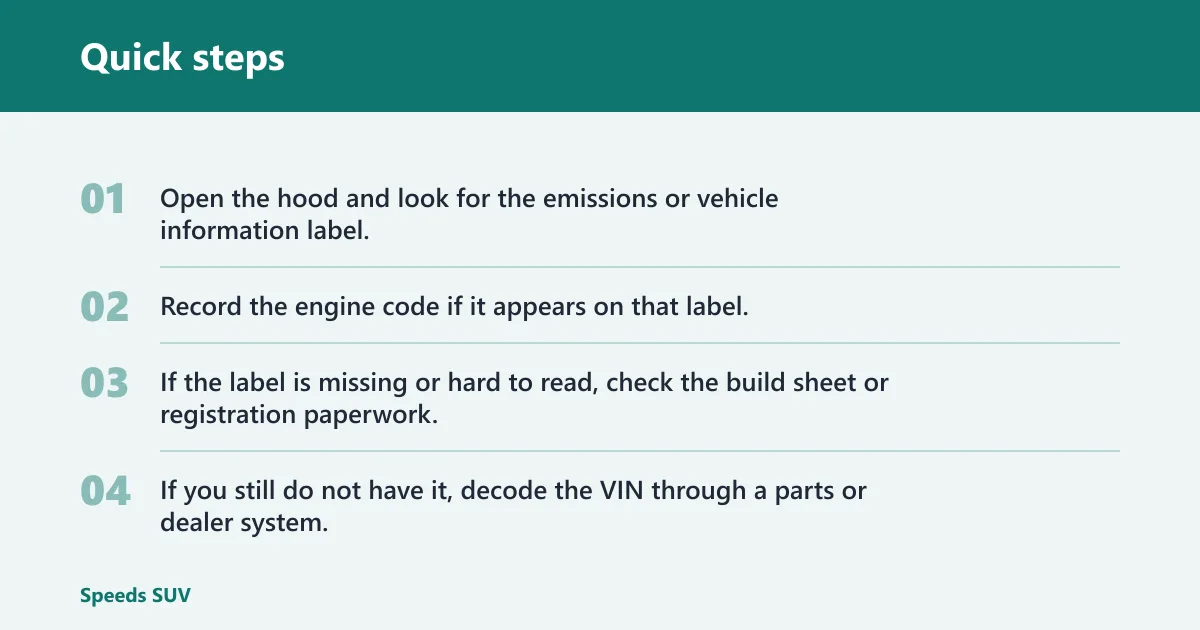
- Open the hood and look for the emissions or vehicle information label.
- Record the engine code if it appears on that label.
- If the label is missing or hard to read, check the build sheet or registration paperwork.
- If you still do not have it, decode the VIN through a parts or dealer system.
Engine code matters because one SUV model may be sold with more than one powertrain. A 3.5-liter V6 and a 2.4-liter four-cylinder in the same nameplate family may not share the same timing design. The code is the shortcut that separates those possibilities.
Use the VIN to confirm configuration
The VIN identifies the exact engine and drivetrain configuration. It is especially useful when you are checking a used SUV, when the owner manual is missing, or when online forum answers conflict. A dealer parts desk can use the VIN to verify the exact timing system that belongs in your vehicle.
Say your 2013 SUV has a V6 on the window sticker, but the engine bay shows a different code than the one in the listing. In that case, trust the VIN and the engine code, not the listing title. The trim name can be wrong. The VIN usually is not.
Does your owner’s manual list a belt interval?
The owner’s manual is the factory maintenance schedule source, and it should be your first paper check. If the SUV is equipped with a timing belt, the manual often lists the replacement interval by mileage, age, or both. If the engine uses a chain, the schedule may list no routine replacement interval at all.
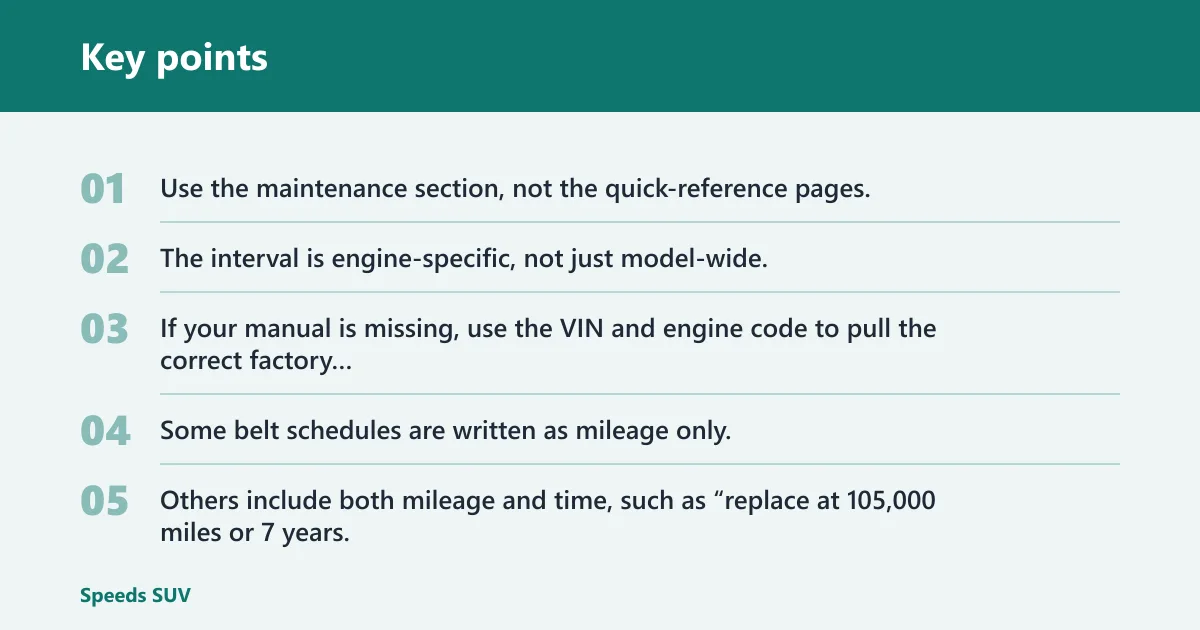
Use the maintenance section, not the quick-reference pages. The interval is engine-specific, not just model-wide. If your manual is missing, use the VIN and engine code to pull the correct factory schedule from a dealer or OEM information source.
How to read mileage and age intervals
Some belt schedules are written as mileage only. Others include both mileage and time, such as “replace at 105,000 miles or 7 years, whichever comes first.” That second part matters on low-mileage SUVs, because rubber ages even when the odometer is low.
Do not confuse timing belt intervals with serpentine belt intervals. Those are separate service items. The serpentine belt may need attention for cracking or squeal, while the timing belt schedule is about preventing internal engine failure.
What to do if the manual is missing
If the manual is missing, use the VIN and engine code to request the maintenance schedule from a dealer parts desk or factory literature source. Forum answers can help you narrow the search, but they are not enough when the same model year came with several engines.
Can you verify it by VIN?
Yes. A VIN lookup can confirm the engine configuration, and a dealer parts lookup can verify the exact timing system by part application. This is the best fallback when the manual is gone, the under-hood label is unreadable, or the SUV has conflicting service records.
When you call or visit a dealer parts desk, give them the full VIN and ask for the timing system application for your engine code. Ask whether the engine uses a timing belt or chain, and ask for the scheduled replacement interval if a belt is fitted.
What information to give a dealer parts desk
- Full 17-character VIN
- Year, make, and model
- Engine code or engine size
- Whether you are asking about the timing belt, timing chain, or both
- Current mileage and known service history
How VIN lookup tools help
VIN lookup tools can narrow the engine and drivetrain before you speak to a dealer. That helps prevent a common mistake: ordering parts or assuming service intervals based on the wrong engine family. If the VIN lookup and the owner manual disagree, use the VIN-confirmed parts application as the tie-breaker.
Suppose a used SUV listing says “timing chain,” but the manual in the glove box lists a 90,000-mile belt replacement. That conflict should stop the guesswork. Confirm the engine code, then verify the timing system through the VIN with the dealer parts desk.
Timing system check worksheet
Use this 5-minute timing system check to verify the timing system on your exact SUV before you schedule service.
| Make/model/year | Engine code | VIN source | Manual interval | Dealer confirmation | Final verdict |
|---|---|---|---|---|---|
| 2013 Honda Pilot | J35Z4 | VIN decoded through dealer parts lookup | 105,000 miles or 7 years | Timing belt confirmed | Belt |
| 2018 Toyota RAV4 | 2AR-FE | VIN decoded through OEM parts catalog | No scheduled timing belt interval listed | Timing chain confirmed | Chain |
| 2014 Jeep Grand Cherokee | 3.6L Pentastar | VIN on registration and parts desk lookup | No routine timing belt service listed | Timing chain confirmed | Chain |
| 2011 Mazda CX-9 | 3.7L V6 | Under-hood label matched to VIN | No scheduled timing belt interval listed | Timing chain confirmed | Chain |
Error-check notes for common misreads
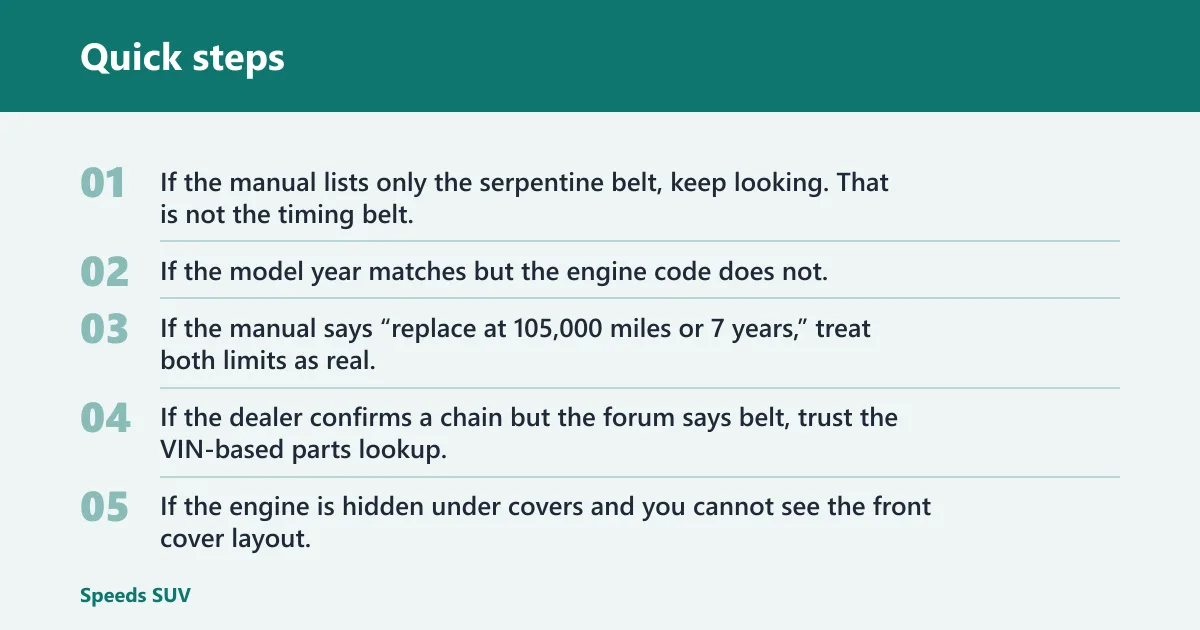
- If the manual lists only the serpentine belt, keep looking. That is not the timing belt.
- If the model year matches but the engine code does not, the timing system may be different.
- If the manual says “replace at 105,000 miles or 7 years,” treat both limits as real.
- If the dealer confirms a chain but the forum says belt, trust the VIN-based parts lookup.
- If the engine is hidden under covers and you cannot see the front cover layout, do not guess.
Final verdict: chain, belt, or unknown
Use three outcomes only. If the VIN and engine code point to a chain and the manual lists no routine belt replacement, mark it chain. If the manual lists a replacement interval tied to mileage or age, mark it belt. If the engine code is unclear or the sources conflict, mark it unknown until you verify through the dealer parts desk.
Where the timing components sit
The timing components sit behind the timing cover at the front of the engine. That cover helps protect the belt or chain and keeps oil inside the engine where it belongs. On many SUVs, you cannot see the timing system directly without partial disassembly.
The external belt you can see in the engine bay is usually the serpentine belt. It wraps around accessories. It does not control valve timing.
Why you may not be able to see the system directly
Many engines hide the timing setup behind plastic or metal covers. That is normal. If you are trying to identify the system visually, do not confuse accessory pulleys and belts with the timing drive. The front cover layout can hint at the design, but it is not a substitute for engine-code verification.
Is your SUV an interference engine?
An interference engine raises the stakes when the timing system is unknown. If the engine uses a belt and the service interval is overdue, or if a chain has stretched enough to cause timing errors, internal damage can follow quickly. That makes correct identification urgent, not optional.
Confirm the engine design through the owner’s manual, factory service data, or a dealer parts lookup by VIN. If you cannot confirm it, treat the maintenance status as unresolved until you can. That is especially important on a used SUV with missing records.
What to do if the timing system is unknown
- Stop assuming the SUV follows the model-wide service interval.
- Record the VIN and engine code.
- Check the owner’s manual maintenance schedule.
- Ask a dealer parts desk for a VIN-based timing system lookup.
- Review the maintenance history for any belt replacement or timing service.
Picture a 10-year-old SUV with 98,000 miles and no records. If the engine is an interference design and the timing belt interval is near or past due, the cost of guessing is much higher than the cost of verification. Do the VIN check first.
Frequently asked questions
Does my SUV have a timing chain or a timing belt?
It depends on the exact engine code, not the SUV name alone. The fastest way to answer it is to check the owner’s manual, read the under-hood engine label, and confirm the VIN with a dealer parts lookup. If those sources point to a belt, expect a replacement interval; if they point to a chain, expect no routine belt change.
How can I tell if my SUV uses a timing chain or belt?
Start with the engine code, then check the maintenance schedule for the specific engine. If the manual lists a replacement interval by mileage or age, it usually indicates a timing belt. If the manual lists no routine replacement and the VIN-based parts lookup confirms chain application, you likely have a timing chain.
Which SUVs have timing chains instead of timing belts?
Many modern SUVs use timing chains, but there is no model-wide rule you can trust blindly. One year of the same SUV name can include both chain and belt engines. The only safe way to know is to verify the exact engine code through the VIN, then confirm the parts application.
Where do I find the timing chain or belt on my SUV?
The timing components sit behind the timing cover at the front of the engine. You usually cannot see them directly because they are enclosed for protection and oil control. The serpentine belt is the visible external belt in the engine bay, and it is not the timing belt.
Can I check my SUV’s timing system by VIN?
Yes. A VIN can identify the engine and drivetrain configuration, and a dealer parts desk can use it to verify the exact timing system. This is the best method when the manual is missing, the service history is incomplete, or online sources disagree about the same SUV.
How often should a timing belt be replaced on an SUV?
The interval depends on the engine, but many factory schedules tie replacement to mileage, age, or both. A common format is a mileage limit plus a time limit, such as 105,000 miles or 7 years. Use the owner’s manual for the exact engine, and do not confuse that schedule with the serpentine belt.