Full-time 4WD vs Part-time 4WD: Which Is Better?
Full-time 4WD is the better pick if you drive year-round in mixed weather, because it can stay engaged on dry pavement; part-time 4WD is better if you want simpler, cheaper hardware and only need 4WD on low-traction surfaces. Choose wrong, and you can pay in extra fuel use, driveline wear, or a system that misses the conditions you face most. This guide compares both systems for commuting, snow, towing, and off-road use, so you can match the drivetrain to your driving.
| Decision factor | Full-time 4WD | part-time 4WD | Winner |
|---|---|---|---|
| Pavement use | Can stay engaged on dry pavement because a center differential or similar torque-management device lets the front and rear axles turn at different speeds. | Should stay out of 4WD on dry pavement because the front and rear axles are locked together without a center differential. | Full-time 4WD |
| Driver effort | Less input in changing weather; the system is built to stay in play while traction changes. | More driver involvement; you need to switch modes when the surface changes. | Full-time 4WD |
| Hardware and efficiency | Usually heavier and can add friction; some systems add more than 200 pounds. | Usually simpler, and there is no center differential to manage on-road rotation differences. | part-time 4WD |
| Low-traction and slow work | Can include low range, which helps with steep climbs and heavy loads. | Often includes 4L in a 2H/4H/4L transfer case, which is useful for slow, steep, or slippery work. | Tie |
| Flat towing potential | Some models allow it if the transfer case has neutral. | Some models allow it if the transfer case has neutral. | Tie |
How the three drivetrains differ in daily use
AWD is usually the easiest on-road choice, full-time 4WD is the truck-style answer for mixed pavement and traction changes, and part-time 4WD is the most direct system for low-traction work. The big split is whether the drivetrain can handle dry pavement without bind and whether it has low range for slow, high-torque driving.
| System | Daily driving | Snow | Low range | Towing | Off-road control | Fuel economy | Flat towing |
|---|---|---|---|---|---|---|---|
| AWD | Best for normal pavement use and changing weather. | Strong on mixed winter roads. | Usually no. | Good for some light-duty setups, but not a substitute for truck 4WD features. | Moderate. | Usually better than 4WD, though AWD can still reduce combined mpg versus 2WD by 1-3 mpg in comparable front-drive-based designs. | Rare. |
| Full-time 4WD | Works well on dry pavement because it can manage front-to-rear speed differences. | Excellent for roads that alternate between packed snow, slush, and bare pavement. | Often yes. | Good where low range and steady traction matter. | Strong. | Usually lower than 2WD because the system adds mass and friction. | Sometimes, if the transfer case has neutral and the owner manual allows it. |
| part-time 4WD | Best avoided on dry pavement in 4WD mode. | Good when roads stay low-traction for long stretches. | Often yes. | Very good for many truck and SUV towing jobs. | Strong to very strong. | Usually the most efficient when left in 2H. | Sometimes, if the transfer case has neutral and the owner manual allows it. |
For a broader drivetrain breakdown, see AWD vs 4WD differences. For the dry-road warning that separates full-time systems from part-time ones, see why part-time 4WD binds on dry pavement.
What is the difference between full-time 4WD and part-time 4WD?
The main difference is the center of the drivetrain. Full-time 4WD uses a center differential or an equivalent torque-management device, so it can send power to both axles without bind on dry pavement. Part-time 4WD usually has no center differential, so it is meant for surfaces where tire slip can relieve the strain.
How a center differential changes the way full-time 4WD works
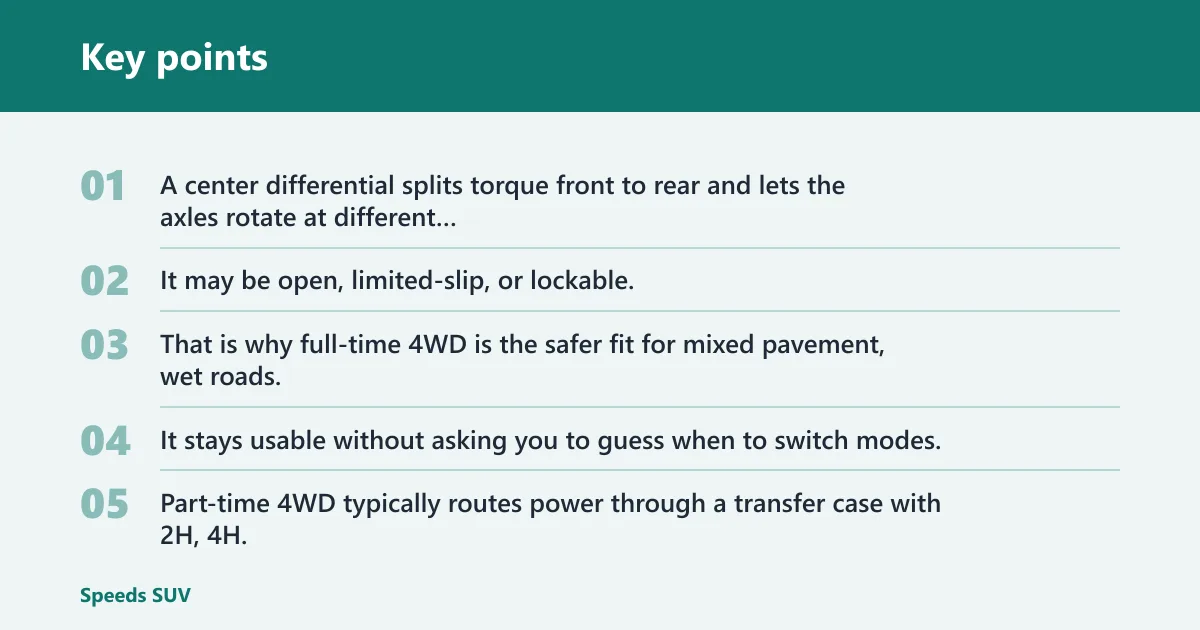
A center differential splits torque front to rear and lets the axles rotate at different speeds in corners. It may be open, limited-slip, or lockable, which means you can often choose more traction when conditions get worse.
That is why full-time 4WD is the safer fit for mixed pavement, wet roads, and roads that alternate between snow and bare asphalt. It stays usable without asking you to guess when to switch modes.
Why part-time 4WD uses a transfer case without a center differential
Part-time 4WD typically routes power through a transfer case with 2H, 4H, and 4L positions. Without a center differential, the front and rear axles are tied together in 4WD, which works well for low-traction surfaces but is wrong for dry pavement.
That setup is simple and effective, especially in trucks and body-on-frame SUVs. It also keeps the system direct, which is one reason many buyers still prefer it for work use.
What 2H, 4H, 4L, and neutral mean in real driving
2H is rear-wheel drive or front-wheel drive through the transfer case, depending on the vehicle layout. 4H adds four driven wheels for normal off-pavement or slippery-road use, 4L adds low range for slow-speed torque multiplication, and neutral disconnects both axles from the powertrain.
That neutral position matters for flat towing in some vehicles. It also explains why not every 4WD model is towable with all four wheels on the ground.
Full-time 4WD vs part-time 4WD at a glance
Full-time 4WD wins for pavement-safe traction and mixed weather. Part-time 4WD wins for simpler hardware and better efficiency when you only need extra traction off pavement or in short bursts. If your driving is mostly bare roads with frequent weather changes, full-time 4WD is the cleaner fit.
Pavement use and driveline bind
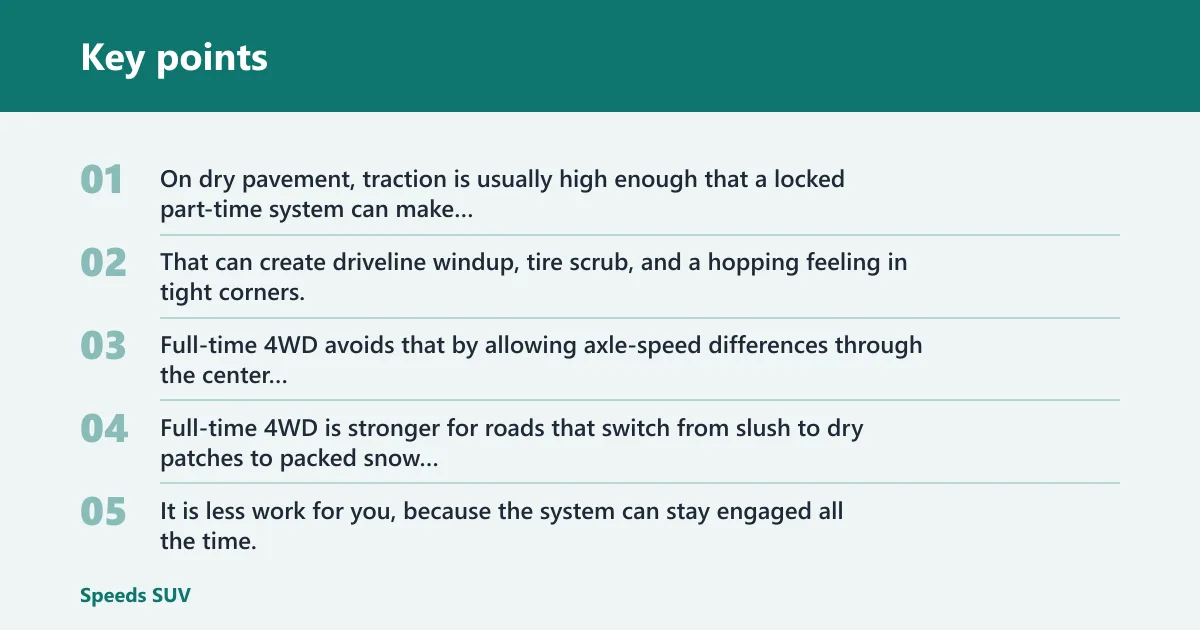
On dry pavement, traction is usually high enough that a locked part-time system can make the tires scrub or hop in tight turns. That can create driveline windup, tire scrub, and a hopping feeling in tight corners.
Full-time 4WD avoids that by allowing axle-speed differences through the center differential or torque-management device.
Snow, rain, and changing traction
Full-time 4WD is stronger for roads that switch from slush to dry patches to packed snow in the same trip. It is less work for you, because the system can stay engaged all the time.
Part-time 4WD is still useful in winter, but it works best when the whole route stays low traction. If a road gets plowed clean, you should leave 4WD mode.
Towing, low range, and steep grades
Low range matters when the vehicle needs more torque at the wheels and less speed. That helps on steep trails, slow climbs, and a boat ramp where the tires may be on wet concrete or submerged pavement.
Some 4WD systems also include transfer case neutral, which can allow flat towing with all four wheels on the ground. That is an uncommon but real advantage for RV owners and some utility setups.
Fuel economy, weight, and driver effort
AWD is usually lighter than 4WD, and front-drive-based AWD can reduce combined fuel economy by 1-3 mpg versus a comparable 2WD setup. Some 4WD systems add more than 200 pounds, which adds mass and friction before you even count the extra hardware. EPA fueleconomy.gov also notes that drivetrain losses increase as vehicles gain rotating components and weight, which is why 4WD and AWD trims often return lower mpg than 2WD versions.
Part-time 4WD often wastes less energy when you are not using 4WD, because the system can stay in 2H. Full-time 4WD trades some efficiency for constant readiness.
Say your 3/4-ton SUV spends weekdays on dry interstate pavement and weekends on snowy county roads. Full-time 4WD avoids constant mode changes and stays ready when the pavement turns from wet to bare every few miles.
Suppose a half-ton pickup only sees dirt access roads, muddy job sites, and winter storms that last all day. Part-time 4WD is the cleaner fit, because you can use 4H when traction is poor and return to 2H on dry stretches.
Which is better for snow and daily commuting?
Full-time 4WD is usually better for snow and commuting because it can stay engaged on dry pavement, wet pavement, and patchy snow without driver input. Part-time 4WD can be enough for winter driving, but only if the route stays consistently slippery and you switch out of 4WD on cleared roads.
Why full-time 4WD works well on mixed-traction roads
Winter commuting rarely stays uniform. You may start on dry pavement, hit slush at an intersection, and then find bare asphalt in the same block.
That mixed surface profile is where a center differential helps. The system can keep traction available without the bind that locked part-time systems can create.
When part-time 4WD is enough for winter driving
If you live where roads stay snow-covered for long periods, part-time 4WD can work well. It gives you extra traction when you need it and simple operation when the route is consistent.
The catch is discipline. If the road starts clearing, you need to leave 4WD mode before dry pavement dominates the trip.
How dry pavement changes the answer
Dry pavement is the line that changes the choice. Once the road has strong grip, a locked part-time system can start to scrub tires and strain the driveline in turns.
That is why full-time 4WD usually wins for suburban winter driving, while part-time 4WD still fits rural winter routes better.
Can you drive part-time 4WD on dry pavement?
No. In the simplest part-time systems, the front and rear axles are locked together, so dry pavement can cause tire scrub or skid in turns. Over time, that misuse can raise tire wear, add stress to driveline parts, and make the vehicle feel bound up in parking lots and tight corners. OEM owner manuals commonly warn against 4WD use on dry pavement for this reason.
What driveline windup
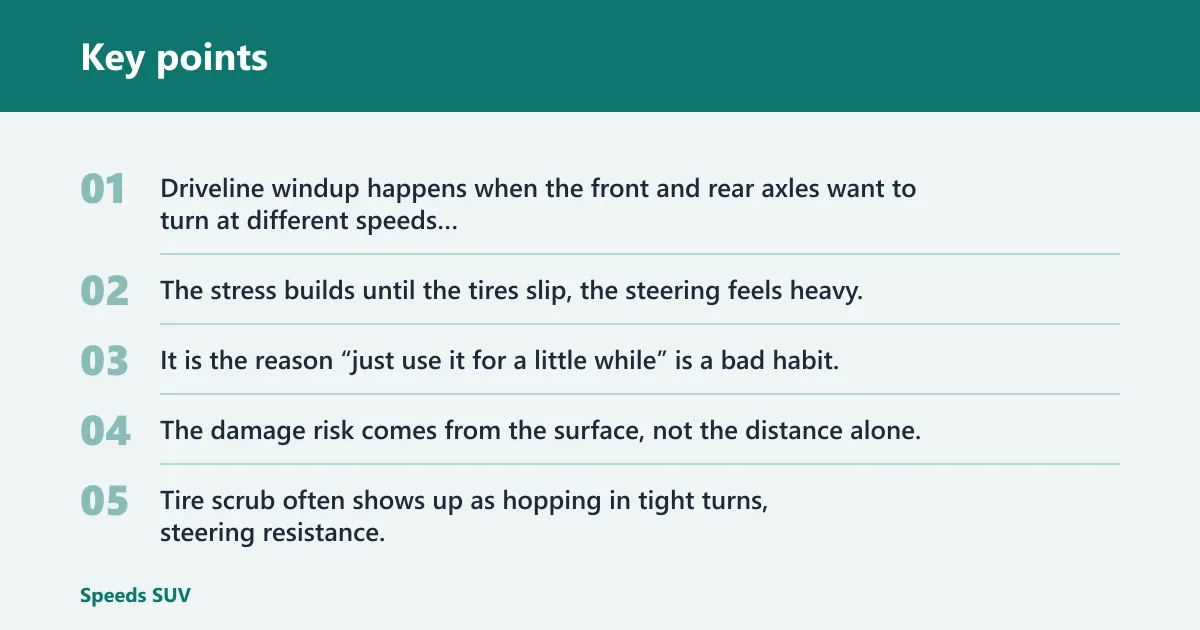
Driveline windup happens when the front and rear axles want to turn at different speeds but the system forces them to stay matched. The stress builds until the tires slip, the steering feels heavy, or the drivetrain releases tension in a hop.
It is the reason “just use it for a little while” is a bad habit. The damage risk comes from the surface, not the distance alone.
What tire scrub feels like and why it matters
Tire scrub often shows up as hopping in tight turns, steering resistance, or a chattering feel while parking. In some cases the vehicle may track fine in a straight line but feel awkward in a U-turn.
That symptom matters because it signals the axles are fighting each other. The tires are the first part to pay for that mistake, but they are not the only parts at risk.
How long-term misuse can affect tires and hardware
Long-term misuse can accelerate shoulder wear on tires and stress U-joints, chain drive parts, or gears in the transfer case. The exact repair bill depends on the vehicle, but the pattern is simple: the system is being forced to do something it was not built to do.
A common first-time mistake is assuming 4H is safe whenever the road looks wet. Wet is not the same as low traction, and a clean, wet freeway can still create bind in a part-time system.
4WD decision table
| Scenario | Recommended system | Why | Tradeoffs | Avoid if conditions |
|---|---|---|---|---|
| Daily commuting | Full-time 4WD | Works on dry pavement, wet pavement, and mixed traction without mode changes. | More weight and some fuel economy loss. | You want the lowest running cost and rarely see changing traction. |
| Snowbelt suburb | Full-time 4WD | Handles plowed streets, slush, and bare patches in one trip. | More friction and usually more cost than a simpler setup. | Your winter roads stay snow-covered all day and you do not mind shifting modes. |
| Mountain towing | Full-time 4WD | Low range and stable traction help on steep grades and poor surfaces. | Heavier system to carry year-round. | You tow only on dry highways and never need low range. |
| Boat ramp | part-time 4WD | 4L can help pull a heavy boat up a steep, wet launch. | You must return to 2H before dry pavement driving. | You want a system that can stay engaged on the road to and from the ramp. |
| Mixed off-road | part-time 4WD | Simple, direct, and effective for dirt, mud, sand, and trail use. | Not for dry pavement in 4WD mode. | Your route alternates between trail, asphalt, and parking lots. |
| Long highway trips | Full-time 4WD | Better when weather changes mid-route and the pavement stays in play. | Usually less efficient than a lighter drivetrain. | You care most about simplicity and fuel use, not constant readiness. |
Choose Full-time 4WD if… / Choose part-time 4WD if…
- Choose Full-time 4WD if… you drive on dry pavement and low-traction roads in the same week, want fewer mode changes, or need a winter-ready SUV that stays engaged on roads with changing grip.
- Choose Full-time 4WD if… your towing route includes steep grades, mixed weather, or frequent starts and stops.
- Choose part-time 4WD if… you want simpler hardware, spend most of your time in 2H, and only need 4WD on dirt, mud, deep snow, or other low-traction surfaces.
- Choose part-time 4WD if… you want low range for trail work or boat ramps and can manage the switch back to 2H on dry pavement.
- If flat towing matters, check for a transfer case neutral before you buy.
- If daily commuting matters more than trail work, start with full-time 4WD and confirm whether the trim has a lockable center diff or a similar torque-management feature.
Which SUVs and trucks come with true 4WD?
Availability depends on model and trim. Many body-on-frame pickups and traditional SUVs offer part-time 4WD, while some trims add full-time 4WD or a selectable system with a center differential.
Do not assume the badge tells the whole story. The same model can offer rear-drive, part-time 4WD, full-time 4WD, or AWD depending on engine, trim, and package.
How do you check the drivetrain on a real vehicle?
Look for a transfer case selector with 2H, 4H, 4L, and sometimes 4A or AUTO. A 4A or AUTO setting often points to a system that can send drive to the front axle while still allowing normal road use.
Owner’s manuals are the best source because they describe whether the system has a center differential, a lock function, neutral, and any pavement limits. If the owner’s manual warns against dry pavement in 4H, it is commonly treated as a part-time system.
Frequently asked questions
Which is better for snow: full-time 4WD or part-time 4WD?
Full-time 4WD is usually better for snow if your roads change from packed snow to bare asphalt in the same drive. Part-time 4WD is fine for deeper, steadier winter conditions, but it should be switched out of 4WD when the surface clears.
Does full-time 4WD hurt fuel economy?
Usually, yes, compared with a simpler 2WD setup. Some 4WD systems add more than 200 pounds, and front-drive-based AWD can reduce combined fuel economy by 1-3 mpg. Full-time 4WD trades some efficiency for constant traction readiness.
Do I need full-time 4WD for towing a boat?
Not always. If the route is mostly dry pavement and the launch is the only slippery part, part-time 4WD with low range can work well because low range can help pull a heavy boat up a steep, wet launch. Full-time 4WD helps more if the whole trip involves changing road grip.
How do I know if my vehicle has a center differential?
Check the owner’s manual, the transfer case selector, and the drivetrain description for terms like center differential, lockable center diff, or 4A. If the manual says 4WD can be used on dry pavement, that is a strong sign the system is full-time or torque-managed rather than plain part-time 4WD.
Is AWD better than 4WD for daily driving?
Often, yes, if your daily driving is mostly pavement and changing weather. AWD is generally lighter and more convenient for road use, while 4WD is better when you need low range, stronger trail use, or a system built around truck-style towing and driver control.
Sources
- EPA fueleconomy.gov: drivetrain, 2WD vs 4WD/AWD fuel economy listings and model fuel-economy comparisons.
- OEM owner’s manuals for representative part-time and full-time 4WD vehicles: transfer case mode definitions, dry-pavement cautions, and flat-towing instructions.
- SAE/engineering references on driveline windup, transfer cases, center differentials, and tire scrub behavior in locked drivetrains.