Why Is Ground Clearance Important Off-road?
Ground clearance matters off-road because it keeps the frame, differential housing, exhaust, skid plates, and lower body parts from hitting rocks, ruts, and ledges. For many trail rigs, 8 to 10 inches is a practical starting range, but wheelbase, overhangs, tire size, and load can change how far that number actually goes. In manufacturer spec sheets and owner manuals, clearance is only one part of the trail-geometry picture; the real test is whether the vehicle can pass the obstacle without the lowest point, bumper, or underbody making contact.
What is vehicle ground clearance?
Vehicle ground clearance is the distance from the vehicle’s lowest fixed point to the ground, usually measured with the vehicle at curb weight or a specified test condition. That lowest point is not always the bumper. On many SUVs and trucks, it may be the differential housing, exhaust, skid plate, pinch weld, or a suspension arm, depending on the design.
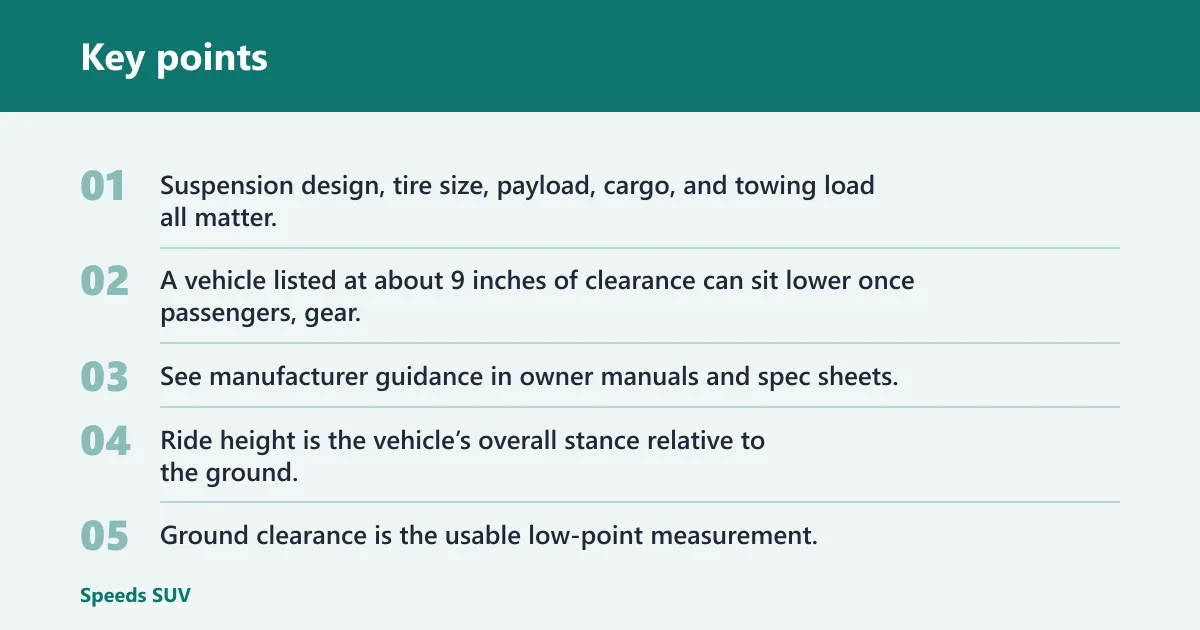
What changes the number? Suspension design, tire size, payload, cargo, and towing load all matter. A vehicle listed at about 9 inches of clearance can sit lower once passengers, gear, or trailer tongue weight are added, which is why owner manuals typically define loading limits separately from ride height and clearance. See manufacturer guidance in owner manuals and spec sheets, such as Ford’s towing information and Toyota/Subaru geometry specs, for how these measurements are presented in context.
Ground clearance vs. ride height
Ride height is the vehicle’s overall stance relative to the ground. Ground clearance is the usable low-point measurement, so the two are related but not identical. A truck can sit high yet still have a low-hanging differential or exhaust section that becomes the first contact point.
Why the number changes
Suspension compression under load is a major reason clearance changes. Rear sag is common with passengers, cargo, and towing, and it can reduce clearance at the rear axle and bumper corners. Tire diameter can add effective clearance, while a soft suspension can lose some of that gain when loaded. Tire-size math sources commonly show the diameter change is based on tire section width, aspect ratio, and wheel diameter; the practical result is usually about half the diameter increase in added axle clearance.
How does ground clearance affect off-road driving?
Clearance matters because off-road contact usually starts below the body, not on the hood or roof. Rocks, ruts, crests, and snow berms can scrape the differential, exhaust, skid plates, or bumper corners long before the vehicle runs out of engine power. Higher clearance gives you more room, but it does not fix every obstacle by itself.
Where scraping starts
The first damage point is often the lowest hard part under the vehicle. Common contact points include the exhaust, differential pumpkin, pinch welds, skid plates, and lower bumper edges. If the tires fit over an obstacle but the middle of the vehicle drags, ground clearance is the limit that has been reached.
A common first-timer mistake is to judge a trail by bumper height alone. Suppose a crossover has plenty of front bumper clearance but only modest clearance under the rear exhaust. It may clear a parking curb at the nose and still drag hard when the rear axle drops into a rut.
What higher clearance cannot fix
More clearance does not guarantee better trail fit. A long vehicle with a tall stance can still high-center on a crest if the wheelbase is long and the breakover angle is poor. High clearance also cannot make a low approach angle or departure angle suddenly generous if the bumpers hang far past the axles.
How does ground clearance work with trail angles?
Ground clearance works with three trail geometry checks: approach angle, departure angle, and breakover angle. These angles tell you whether the bumpers and belly can pass an obstacle without touching. Trail fit depends on all three together, not on one number alone.
Approach angle
Approach angle is the front obstacle angle metric. It helps avoid bumper contact on steep climbs, ledges, and sharp driveway breaks. More clearance helps, but a shorter front overhang often matters just as much because the bumper reaches the obstacle later.
Departure angle
Departure angle is the rear obstacle angle metric. It reduces rear bumper scraping on drop-offs and steep exits. Rear overhang is the usual limiter, so a vehicle with decent ground clearance can still drag the rear bumper if the tail extends too far behind the axle.
Breakover angle
Breakover angle is the middle clearance metric for crests, humps, and deep ruts. It improves with higher ground clearance and a shorter wheelbase. This is the angle that decides whether the vehicle can straddle a ridge or belly out across the top.
When does wheelbase matter more than clearance?
Wheelbase is the distance between the front and rear axles. On crests and rutted trails, a long wheelbase can matter as much as, or more than, raw clearance because the center of the vehicle can touch before the axles do. Short wheelbase often gives a useful breakover advantage.
Crests and high centers
On a sharp crest, the lowest point may be under the middle of the vehicle. If the wheelbase is long, the body can hang up even with decent clearance at the axles. In that case, the tires keep climbing while the belly gets stuck on the high point.
Rutted trails
Ruts create a different problem. The wheels drop into the grooves, which lowers the vehicle in relation to the trail surface and increases the chance of belly contact. A shorter wheelbase reduces the span across the rut, which can help the vehicle avoid high-centering.
Picture a 118-inch-wheelbase SUV with 8.3 inches of ground clearance trying to cross two deep ruts after rain. The tires may stay on the edges, but the center section can still touch. A shorter wheelbase with the same clearance may pass more easily because the body spans less of the gap.
Can bigger tires add clearance?
Yes. Bigger tires can increase effective ground clearance because a larger tire radius lifts the axles and differentials higher from the ground. The gain comes from tire diameter, not from the factory suspension number, so modified clearance and stock clearance are not the same thing.
Tire diameter and sidewall height
Tire sidewall height contributes to the total diameter. A taller tire can add about half the diameter increase in clearance under the axle. For example, moving from a 31-inch tire to a 33-inch tire can add about 1 inch of axle clearance if there is enough space for the larger tire to fit. Tire diameter calculators and sizing charts from tire makers and retailers can help verify the math before you compare vehicles or trim levels.
What changes beyond clearance
Larger tires also change gearing, speedometer accuracy, and ride feel. The taller effective gearing can soften acceleration. Speedometer readings can become inaccurate unless corrected. A taller sidewall can improve compliance on rough roads, but it can also change steering feel and increase scrub if the tire is too large for the wheel well.
Factory size vs. modified size
Factory ground clearance is usually measured with the original tires. Once you change tire diameter, you are no longer comparing the same setup. That is why a spec sheet alone can be misleading if a truck on 35-inch tires is compared with a stock SUV that still wears its factory size.
How does load change ground clearance?
Payload can reduce ground clearance through suspension compression. Passengers, cargo, and towing all push the suspension down, and rear sag is the usual result. The reduction is often most visible at the back of the vehicle, where tongue weight and cargo sit closest to the rear axle.
Passengers and cargo
Extra weight from people and gear lowers the body closer to the ground. That can cut into clearance at the rear bumper, exhaust, and hitch area first. A vehicle that clears a ditch empty may scrape once the second row and cargo area are full.
Towing and tongue weight
Tongue weight compresses the rear suspension and can reduce departure angle at the same time. On a truck or SUV with a rear hitch, the hitch receiver may become the first point of contact on a steep exit. If the rear settles enough, the exhaust or spare tire can also lose margin. That is why towing guides and owner manuals usually specify tongue-weight limits along with payload and axle ratings.
Suspension compression under load
Load does more than drop ride height. It changes how the vehicle sits on uneven ground, which can make one wheel tuck upward while the opposite corner sags. That shift can reduce clearance at the low corner even if the published number looked adequate on paper.
What obstacles should you inspect before attempting them?
This checklist shows how common trail obstacles fail a vehicle, which geometry metric is involved, and what setup factor changes the result most. It is a trail-fit tool, not a scoring system. Use it with wheelbase, tire size, and load together, and inspect the low points, overhangs, and rear exit path before committing.
| Obstacle | Likely failure point | Geometry metric | Setup factor that changes it most | What the driver should inspect before attempting it |
|---|---|---|---|---|
| Speed bump | Front bumper lip or undertray scraping on the climb | Approach angle | Front overhang | Front air dam height and the break in pavement ahead |
| Rut | Belly or differential dragging on the center ridge | Breakover angle | Wheelbase | Rut depth, ridge width, and whether the low point will straddle the middle |
| Ledge | Front bumper or pinch weld contact at the face | Approach angle | Ride height and front overhang | Step height, tire placement, and whether the bumper reaches before the tire climbs |
| Snow berm | Front air dam, skid plate, or differential plowing snow | Ground clearance | Tire diameter | Packed-snow depth and whether the snow is soft or frozen underneath |
| Creek crossing | Center section or rear bumper touching the entry or exit bank | Breakover angle and departure angle | Wheelbase and rear overhang | Water depth, bank angle, traction on the exit, and whether the rear will scrape on departure |
| Crest | Belly pan or exhaust hanging on the top of the ridge | Breakover angle | Wheelbase | Ridge sharpness and whether the centerline will high-center before the axle crests |
Underbody protection matters
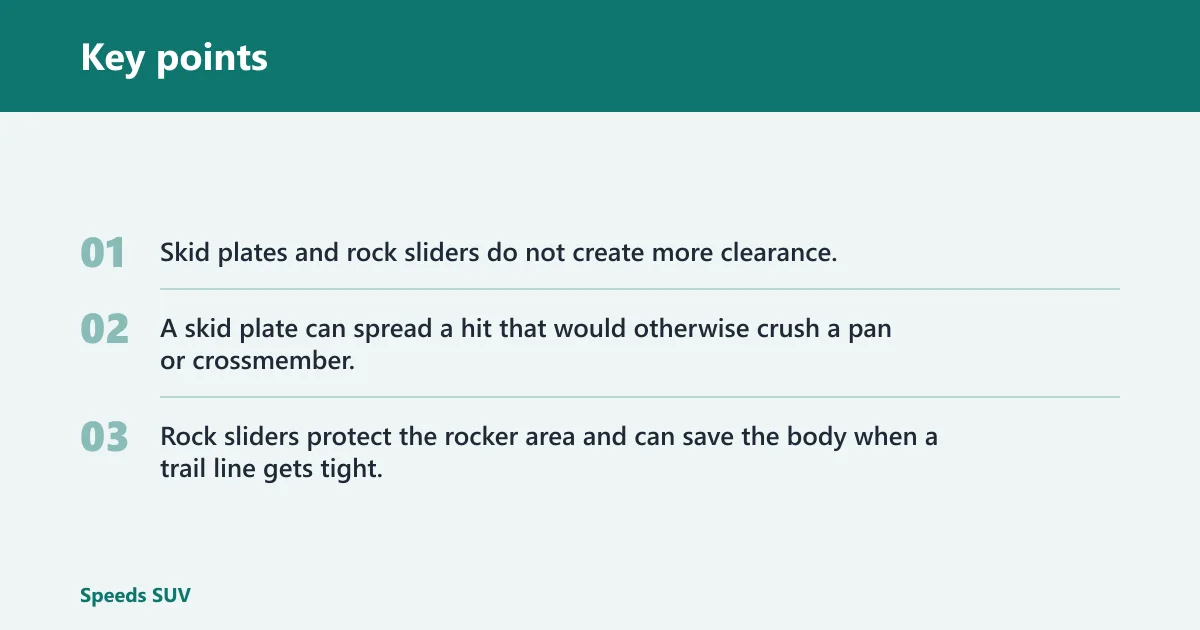
Skid plates and rock sliders do not create more clearance, but they reduce damage risk when clearance is limited. A skid plate can spread a hit that would otherwise crush a pan or crossmember. Rock sliders protect the rocker area and can save the body when a trail line gets tight.
How much ground clearance do you need for light off-roading?
For light off-roading, a common starting range is about 8 to 10 inches of ground clearance for many SUVs and trucks. That is enough for dirt roads, mild ruts, shallow snow, and light trail use when the angles are reasonable. For rocks, ledges, and deeper ruts, you need to judge the whole geometry package, not only the clearance figure.
This 8 to 10 inch guidance is a practical rule of thumb rather than a universal requirement. Some light-trail vehicles work below that if they have short overhangs and modest load, while others need more clearance because their bumpers, wheelbase, or suspension sag reduce real-world trail fit. Manufacturer spec sheets and owner manuals are the best way to verify the published baseline before you compare trim levels or tire sizes.
Light off-roading
Dirt roads, forest roads, and mild trail sections usually reward balanced setup more than extreme lift. A moderate clearance number with decent tires and acceptable approach and departure angles is often enough. Long bumpers or a low exhaust can still limit progress, so check the low points before you call the vehicle trail-ready.
Snow and ruts
Snow and ruts punish low clearance because they reduce effective space under the vehicle. Snow can pack under the front bumper and undertray, while ruts can drop the axles into lower channels. In these conditions, tire diameter and breakover angle often matter more than a small difference in published clearance.
Rocky trails and ledges
Rock obstacles ask for more than lift. You need enough ground clearance, but you also need useful approach, departure, and breakover angles. If a vehicle has the clearance to sit above a rock but the bumper reaches first, the obstacle still stops forward motion.
Say a midsize SUV is fitted with 265/70R17 tires and has 8.7 inches of stock clearance. On a gravel road, that may feel sufficient. On a rocky shelf road with a short ledge, the same SUV can still scrape its rear bumper if the departure angle is poor.
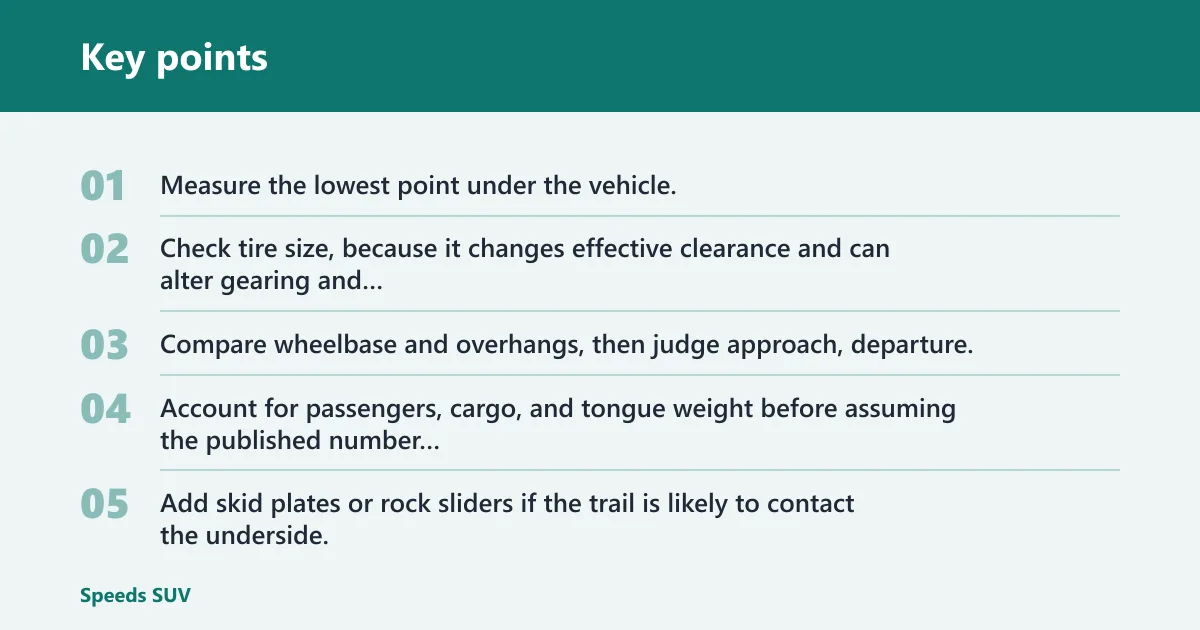
- Measure the lowest point under the vehicle, not the body panel that looks lowest from the side.
- Check tire size, because it changes effective clearance and can alter gearing and speedometer readings.
- Compare wheelbase and overhangs, then judge approach, departure, and breakover angles together.
- Account for passengers, cargo, and tongue weight before assuming the published number still applies.
- Add skid plates or rock sliders if the trail is likely to contact the underside.
How do you measure vehicle ground clearance at home?
Park on level ground, then measure from the ground to the vehicle’s lowest hard point with a tape measure or ruler. Do this with the vehicle loaded the way you actually drive it if possible, because passengers, cargo, and fuel level can change the reading. Always identify the true low point first.
Measurement checklist
- Park on level pavement and straighten the wheels.
- Find the true lowest fixed point under the vehicle.
- Measure from the ground to that point in inches or millimeters.
- Repeat with normal cargo and passengers if you want a real-world number.
- Compare the result with approach, departure, and breakover needs, not clearance alone.
| Term | What it measures | Why it matters |
|---|---|---|
| Ground clearance | Lowest fixed point to the ground | Shows what is most likely to hit first |
| Ride height | Overall stance of the vehicle | Suggests suspension posture, but not the real low point |
Frequently asked questions
What is the difference between ground clearance and ride height?
Ride height is the vehicle’s overall stance relative to the ground. Ground clearance is the lowest-point measurement that matters for trail contact. A vehicle can sit tall and still have a low exhaust or differential that becomes the first part to scrape on rough ground.
Does bigger tire size increase ground clearance?
Yes, bigger tires can increase effective ground clearance by lifting the axles and differential higher off the ground. The gain depends on tire diameter, not the suspension number alone. A larger tire can also change gearing, speedometer accuracy, and the amount of room left in the wheel wells.
Does payload reduce ground clearance?
Yes. Payload reduces clearance by compressing the suspension, especially at the rear. Passengers, cargo, and towing tongue weight can make the rear sag, which lowers departure angle and can bring the exhaust, hitch, or bumper corners closer to the ground.
Is higher ground clearance always better off-road?
No. Higher clearance can help, but a long wheelbase, poor approach angle, or poor departure angle can still cause contact. More height can also raise the center of gravity, which affects stability on uneven ground and steep side slopes. Trail fit depends on the full geometry package.
How do you measure ground clearance at home?
Park on level ground, then measure from the ground to the vehicle’s lowest hard point with a tape measure or ruler. Do this with the vehicle loaded the way you actually drive it if possible, because passengers, cargo, and fuel level can change the reading. Always identify the true low point first.