Payload Rating vs Towing Capacity: What Is the Difference?
Payload rating usually hits first in a loaded truck or SUV, because passengers, cargo, and trailer tongue weight all count against the same number before towing capacity does. Ignore it, and you can overload the vehicle, reduce braking margin and stability, and blow past the safe limit printed on the door-jamb sticker. This guide explains the difference, shows which limit matters first, and gives you a quick check before you pack or hitch.
Payload is what goes in or on the vehicle; towing capacity is what it pulls. When you tow with people and gear aboard, payload often runs out first. That’s why the door label and axle ratings matter as much as the trailer brochure rating, and why the owner’s manual should be checked alongside safety guidance from SAE J2807 context, NHTSA towing basics, and tire-and-loading standards such as TRA guidance for inflation and load carrying. See the vehicle maker’s owner’s manual and tire/loading label guidance, plus towing references such as the SAE J2807 framework and NHTSA’s towing and loading advice.
| Decision factor | Payload rating | towing capacity | Winner |
|---|---|---|---|
| What the number limits | Weight carried in and on the vehicle, including passengers and cargo. | Weight pulled behind the vehicle. | Payload rating |
| Which one usually binds first in a loaded SUV | Often the first limit to run out once people, luggage, and hitch load are added. | May still have room left even when the vehicle is already full of people and gear. | Payload rating |
| Best fit when you carry people and gear | Directly captures the weight of passengers, cargo, and tongue weight. | Does not tell you how much room is left for occupants or in-vehicle cargo. | Payload rating |
| Best fit when towing is the only question | Still matters, but it is not the main limit for trailer weight by itself. | Gives the trailer pull limit, tied to vehicle setup and combined weight. | towing capacity |
| Pre-trip decision value | Tells you how much mass you can still add to the vehicle itself. | Tells you how heavy the trailer can be before the tow system is over its limit. | Payload rating |
Definitions: payload vs towing capacity
payload rating is the maximum weight a vehicle can carry in and on itself. Towing capacity is the maximum weight it can pull behind it. In a loaded truck or SUV, payload can run out first because people, cargo, hitch hardware, and tongue weight all use that same allowance. Manufacturer guidance on the door label and in the owner’s manual is the authority for the specific vehicle, not a generic brochure number.
What payload rating means
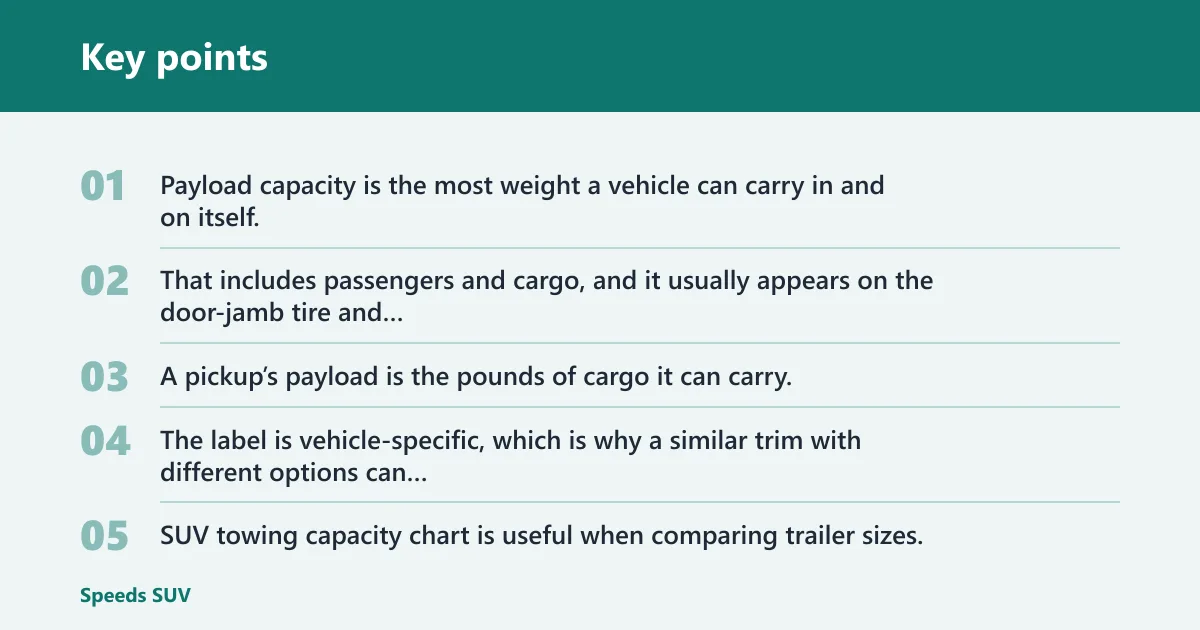
Payload capacity is the most weight a vehicle can carry in and on itself. That includes passengers and cargo, and it usually appears on the door-jamb tire and loading sticker. A pickup’s payload is the pounds of cargo it can carry, but the actual count also includes the people inside the cab. The label is vehicle-specific, which is why a similar trim with different options can have a different number.
What towing capacity means
SUV towing capacity chart is useful when comparing trailer sizes, but towing capacity itself is the most weight a vehicle can pull behind it. It depends on trailer weight and vehicle configuration, and it ties to combined limits, not just the hitch number on the brochure. SAE J2807 is widely used as a reference point for how many tow ratings are established, and it assumes defined test conditions; it does not replace the vehicle’s own label or manual.
Why the two numbers are different
They measure different load paths. One number covers mass on the vehicle, the other covers mass behind it. That is why a truck can have a tow rating that looks large while still carrying a smaller payload number, and why the same trailer can be legal behind one setup but too much once passengers and gear are added. The distinction also explains why brochure towing numbers can look generous while the sticker on the door gives you less room for real-world loading.
Which limit matters first?
In most loaded truck and SUV setups, payload rating binds first. Passengers, cargo, and tongue weight all come out of the same in-vehicle allowance, while towing capacity mainly answers how much trailer weight the vehicle can pull. The first limit you hit depends on where the weight sits, not on the biggest number in the brochure.
Passenger-only load
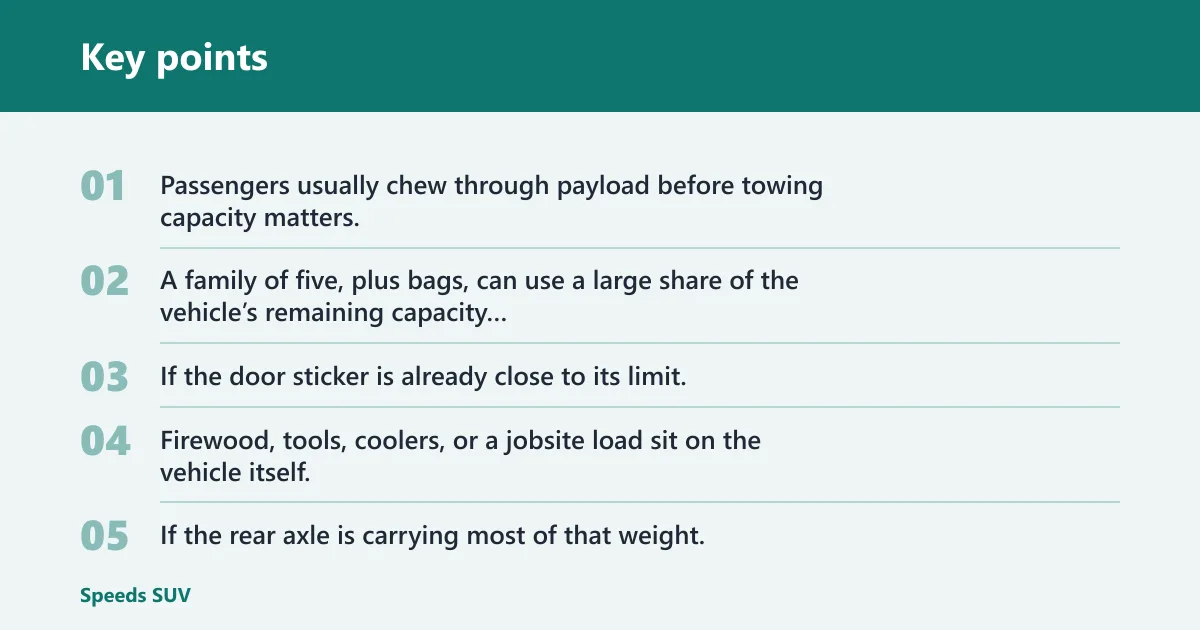
Passengers usually chew through payload before towing capacity matters. A family of five, plus bags, can use a large share of the vehicle’s remaining capacity without a trailer attached. If the door sticker is already close to its limit, there may be very little room left for cargo or accessories.
Bed cargo only
Bed cargo also hits payload first. Firewood, tools, coolers, or a jobsite load sit on the vehicle itself, so they count against the same number as people do. If the rear axle is carrying most of that weight, GAWR can become the tighter limit before total payload is fully used.
Truck and trailer together
With a trailer attached, tongue weight usually becomes the hidden payload drain. A common tongue-weight target is 10 to 15 percent of trailer weight, and that downward force counts against payload. Picture a trailer with a heavy tongue and a cab full of passengers; the payload limit can disappear long before the tow rating does. Trailer weight itself is not the same as tongue weight: the trailer’s total mass is what the tow rating addresses, while the tongue load is only the portion carried by the hitch.
How to check your numbers
Use the vehicle label and the owner’s manual first, then compare the trailer’s actual loaded weight to the trailer rating. For the towing side, look for GCWR or GCVWR in the manual and verify axle ratings before you hitch up. NHTSA’s towing guidance, tire-and-rim load information, and the vehicle maker’s manual all point toward the same habit: check the real numbers on the vehicle, not assumptions from trim level or engine size alone.
Where to find your real ratings
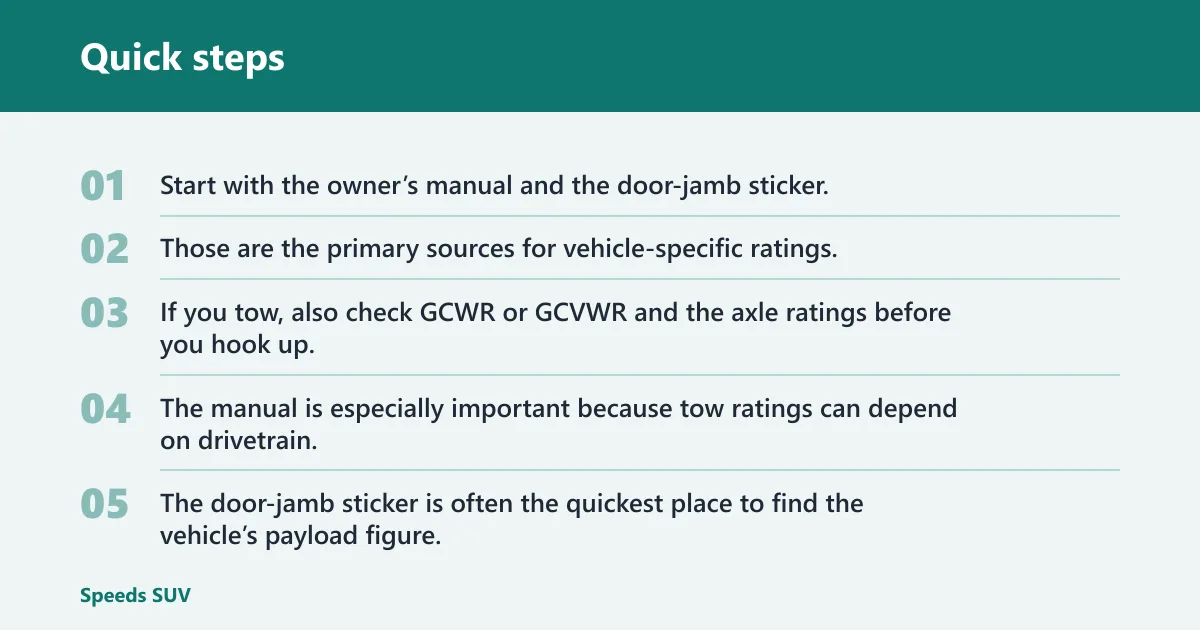
Start with the owner’s manual and the door-jamb sticker. Those are the primary sources for vehicle-specific ratings, and the door label shows the combined occupants and cargo limit. If you tow, also check GCWR or GCVWR and the axle ratings before you hook up. The manual is especially important because tow ratings can depend on drivetrain, axle ratio, hitch equipment, cooling package, and whether the vehicle is configured as the manufacturer tested it.
Door-jamb sticker
The door-jamb sticker is often the quickest place to find the vehicle’s payload figure. It is the number that tells you how much combined weight of occupants and cargo the vehicle can carry. Do not guess from brochure data, because trim, options, and drivetrain can change the number.
Owner’s manual
The owner’s manual usually lists tow-related limits, GCWR or GCVWR, and axle information. It also gives the setup rules that can affect the usable tow rating, such as hitch equipment or trailer assumptions. That makes it the right place to verify whether the trailer plan fits the vehicle, not just the engine. OEM manuals also explain whether the vehicle was certified with a particular hitch, tire size, or load range, which can affect the final usable number.
GCWR and axle ratings
GCWR, or GCVWR, is the maximum combined weight of the loaded vehicle and trailer. That limit matters because towing is a system load, not a trailer-only number. GAWR matters too, because one axle can become the weak point before total payload or tow rating does. Tire and rim load guidance matters here as well: even if the truck’s published limit looks fine, the tires and rims must also carry the load.
Formulas and a worked example
The math is straightforward, but the checks should be made together. Payload capacity = GVWR minus curb weight. Curb weight definitions vary by manufacturer, so read the manual carefully: some brands describe curb weight with a full tank and standard equipment, while others note different assumptions about fluids or options. The safe way to use the number is to rely on the vehicle’s own published sticker and manual, then compare the real loaded vehicle to GVWR, rear GAWR, and GCWR at the same time.
Example: A truck has 7,200 lbs GVWR, 5,400 lbs curb weight, and therefore 1,800 lbs of payload on paper. The owner loads 600 lbs of passengers and cabin cargo, plus 300 lbs of tools in the bed. That leaves 900 lbs for trailer tongue weight before payload is gone. If the rear axle already carries most of the bed load, the rear GAWR check may fail before the total payload number does. Now add a 6,000-lb trailer and a 9,500-lb GCWR. If the truck’s loaded weight is already 6,300 lbs before the trailer, then truck plus trailer total is 12,300 lbs, which exceeds GCWR even if the trailer is under the tow rating. That is why payload, rear axle load, and GCWR need to be checked together.
Quick capacity check
- Read the door-jamb sticker and write down the payload number.
- Add the weight of everyone riding in the vehicle.
- Add cargo in the cabin, bed, or cargo area.
- Add estimated tongue weight if you are towing.
- Check that the total stays below payload, axle ratings, and GCWR or GCVWR.
- Confirm the trailer itself also stays under the tow rating.
Payload rating vs towing capacity decision table
Use this table before you load the vehicle. It separates the three common setups that matter most: people only, cargo only, and truck plus trailer. The goal is simple. Find the first limit that runs out, then leave margin on the door sticker, axle ratings, and combined rating.
| Scenario | Likely binding limit | What to subtract first | Red-flag note |
|---|---|---|---|
| Daily driver with passengers only | Payload rating | Passengers, then any bags or cargo in the cabin or cargo area | If the door-jamb sticker is nearly full, steering feel and braking margin can change before towing is even part of the plan. |
| Truck with bed cargo only | Payload rating, with GAWR sometimes first | Bed cargo and any toolboxes, racks, or accessories mounted on the truck | Rear squat and one axle carrying most of the load are signs to check rear GAWR, not only the total payload number. |
| Truck plus trailer | Payload rating, then GCWR/GCVWR | Tongue weight first, then passengers and cargo in the truck | Even with towing capacity left, tongue weight and the combined truck-plus-trailer weight can push the setup past the safe limit. |
Does payload include passengers?
Yes. Payload capacity includes passengers, and that is one reason the number matters so much in family trucks and SUVs. Every person in the vehicle uses part of the same allowance that would otherwise go to cargo, pets, coolers, or hitch-related load. The sticker number is for real-world use, not just empty seats.
How passenger weight reduces usable payload
Passenger weight cuts directly into the remaining payload before any trailer is connected. That means a vehicle with a healthy tow rating can still be near its payload limit after everyone buckles in. A common first-timer mistake is assuming the trailer rating is the only number that matters, then discovering the cab already used most of the budget.
Where tongue weight fits
Tongue weight also counts against payload. So do hitch parts that sit on or in the vehicle, plus cargo carried in the cabin or bed. Suppose an SUV has four adults aboard and a full cargo area; adding a trailer can push the rear axle, not the tow rating, into the red first.
Does towing capacity include tongue weight?
Tongue weight counts against payload, not as free extra room outside the rating. Towing capacity describes trailer weight behind the vehicle, but the hitch load still pushes down on the truck or SUV. That means a trailer can fit under the tow rating and still overload the vehicle once tongue weight and passengers are added. A reputable towing guide will also note that correct tongue weight helps stability, but the vehicle’s load label still controls how much mass you can carry.
Typical tongue-weight range
A common trailer tongue-weight target is 10 to 15 percent of trailer weight. That load must come from payload.
Why tongue weight cuts into payload
Tongue weight sits on the vehicle. It loads the rear axle, affects ride height, and takes up payload that could otherwise go to people or cargo. If the rear axle is already near GAWR, the trailer may be the trigger that exposes the limit even when total tow rating still looks available.
Why hitch setup can lower usable capacity
Towing capacity is not the only towing consideration. Ball mount weight, hitch hardware, trailer cargo placement, and weight-distribution setup all influence how much of the vehicle’s rating remains usable. A truck may be rated to pull the trailer, but still need a lighter load in the cabin or bed to stay inside combined limits.
Choose Payload rating if…
Choose Payload rating if you carry people, gear, or trailer tongue weight and want the first number that can run out in a real truck or SUV. It is the better choice for family hauling, mixed use, and any setup where the door sticker and axle limits matter before trailer pull does.
Choose towing capacity if…
Choose towing capacity if your main question is how much trailer the vehicle can pull after you have already checked payload, tongue weight, and GCWR. It is the right number for trailer sizing, but it is not a substitute for the vehicle’s carry limit.
Frequently asked questions
What is the difference between payload rating and towing capacity?
Payload rating is the amount of weight a vehicle can carry in and on itself. Towing capacity is the amount it can pull behind it. The first covers passengers, cargo, and tongue weight; the second covers trailer weight and the setup that lets the vehicle tow safely.
Does payload include passengers and cargo?
Yes. Payload includes passengers and cargo, along with anything else carried in or on the vehicle. That is why a full cabin can reduce how much trailer tongue weight or bed cargo you can add later. The door-jamb sticker is the number to check first.
Why is my truck’s payload lower than the tow rating?
Because the vehicle’s carry limit and pull limit are calculated differently. Payload is tied to GVWR minus curb weight, while towing capacity comes from the vehicle’s combined towing limits and setup. A truck can be built to pull a heavier trailer than it can comfortably carry in the cab or bed.
How do GVWR and curb weight relate to payload?
Payload is usually calculated by subtracting curb weight from GVWR. GVWR is the maximum total weight the vehicle can handle safely, and curb weight is the vehicle with standard equipment, fluids, and a full tank of fuel. The difference is the weight left for people and cargo. Because manufacturers define curb weight slightly differently, always use the vehicle-specific label and manual rather than a generic estimate.
Can I exceed payload if I stay under towing capacity?
No. Staying under towing capacity does not protect you from payload overload, because the vehicle can still be too heavy from passengers, cargo, and tongue weight. If the total on the door sticker, axle ratings, or GVWR is exceeded, the setup is over its limit even with a legal trailer weight.
Where do I find my truck’s real payload number?
Check the door-jamb sticker first. It shows the vehicle-specific occupants and cargo limit, which is the real payload number for that truck or SUV. The owner’s manual then fills in the tow rating, GCWR or GCVWR, and any setup details that affect the combined load.