What Is an AWD System and How Does It Work?
An AWD system sends engine power to all four wheels automatically. It uses sensors plus a center coupling or differential to move torque where grip exists. Pick the wrong drivetrain, and you may carry extra weight and parts without better snow or trail performance. This guide explains how AWD works mechanically, how it differs from 4WD, and when it makes sense for SUV use on roads, snow, and light trails.
What AWD means
AWD means the vehicle can send power to all four wheels, either all the time or only when slip appears. It is built for traction management on pavement first, so the system tries to keep the SUV moving smoothly when rain, snow, ice, mud, or gravel cuts grip. That distinction is consistent with how the Society of Automotive Engineers describes drivetrain layouts and how Consumer Reports distinguishes AWD from part-time 4WD in everyday use.
What the system sends to the wheels
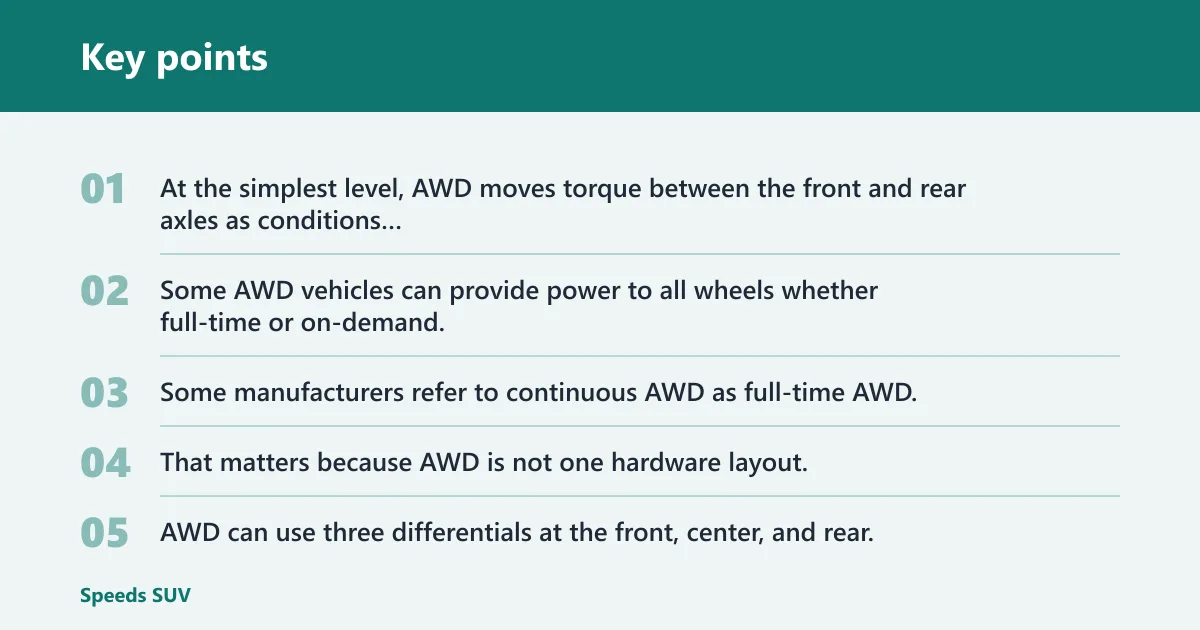
At the simplest level, AWD moves torque between the front and rear axles as conditions change. Some AWD vehicles can provide power to all wheels whether full-time or on-demand. Some manufacturers refer to continuous AWD as full-time AWD, which means the system sends torque to all four wheels 24/7.
That matters because AWD is not one hardware layout. AWD can use three differentials at the front, center, and rear, or it can rely on a center differential or clutch-pack coupling between the axles. A center differential allows axle speeds to differ in turns, while a clutch-pack coupling can progressively vary torque transfer. The Mercedes-Benz 4MATIC overview and BorgWarner’s all-wheel-drive engineering materials both describe these basic control methods.
Why SUV buyers care
For most buyers, AWD is about reducing wheelspin and making the SUV feel steadier when traction changes fast. AWD is standard on many modern SUVs and passenger cars, and many systems can switch to two-wheel drive to improve fuel economy.
That tradeoff is the key buying question. If you want weather confidence, AWD can be a smart fit. If you want true trail hardware, you need to compare it with 4WD instead of assuming the badges mean the same thing.
How AWD works on the road
AWD works by watching for grip changes and moving torque before or after slip appears, depending on the system design. In normal driving, it may send most power to one axle, then shift torque to the other axle when sensors detect wheelspin or a difference in wheel speed.
Launch traction on slippery surfaces
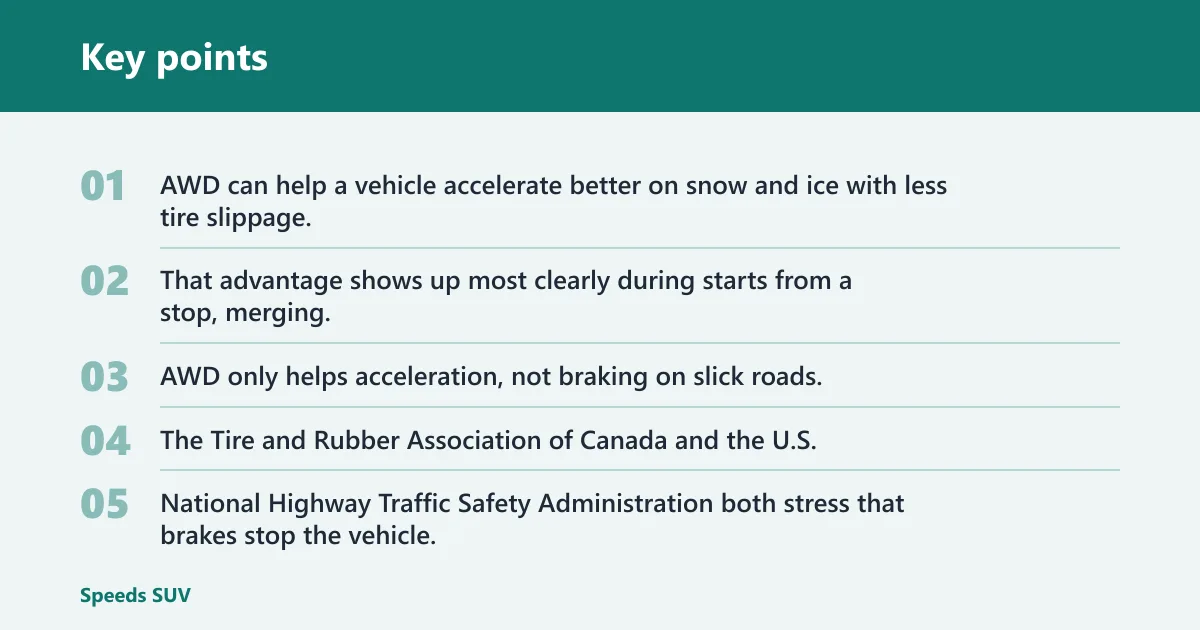
AWD can help a vehicle accelerate better on snow and ice with less tire slippage. That advantage shows up most clearly during starts from a stop, merging, or climbing a slippery hill where one axle would otherwise spin first. AWD only helps acceleration, not braking on slick roads. The Tire and Rubber Association of Canada and the U.S. National Highway Traffic Safety Administration both stress that brakes stop the vehicle; AWD does not shorten stopping distance on ice or snow.
Say your SUV pulls away from a stoplight on packed snow with one front tire on a polished patch and the other on rougher pavement. An on-demand system may send power to both axles after the traction control sensors notice slip, which can reduce wheelspin and help the vehicle move off more cleanly.
What happens in cornering and low-speed turns
On dry pavement, AWD can change how the SUV feels in corners and tight parking-lot turns. A full-time system keeps all wheels driven continuously, so the drivetrain must allow different front and rear wheel speeds as the vehicle turns. That is where the center differential matters.
In low-speed turns, the front and rear axles follow different paths. Without a way to handle that difference, the driveline would bind. AWD systems are built to avoid that in normal pavement use, which is one reason they are standard in crossovers and road-focused SUVs rather than pure trail rigs. SAE and vehicle engineering references describe this as the core reason for using a center differential or controlled coupling in AWD layouts.
How sensors react to wheel slip
Traction control sensors watch wheel speed and other signals to detect slip. In an on-demand AWD setup, they can send power to both axles only when extra traction is needed. That automatic response is why many shoppers call these systems “set it and forget it” in bad weather.
What you may feel as the driver is a brief tug or a change in engine note as the system reallocates torque. Dashboard indicators may flash if the stability or traction system is working hard. The system is not fixing the road; it is reacting to the grip that is actually available.
Full-time AWD vs on-demand AWD
Full-time AWD drives all wheels continuously. On-demand AWD commonly drives one axle, then adds the second axle when sensors detect slip. Both count as AWD, but they behave differently in dry weather, during launch, and in how much drivetrain hardware is always in motion.
Full-time AWD explained
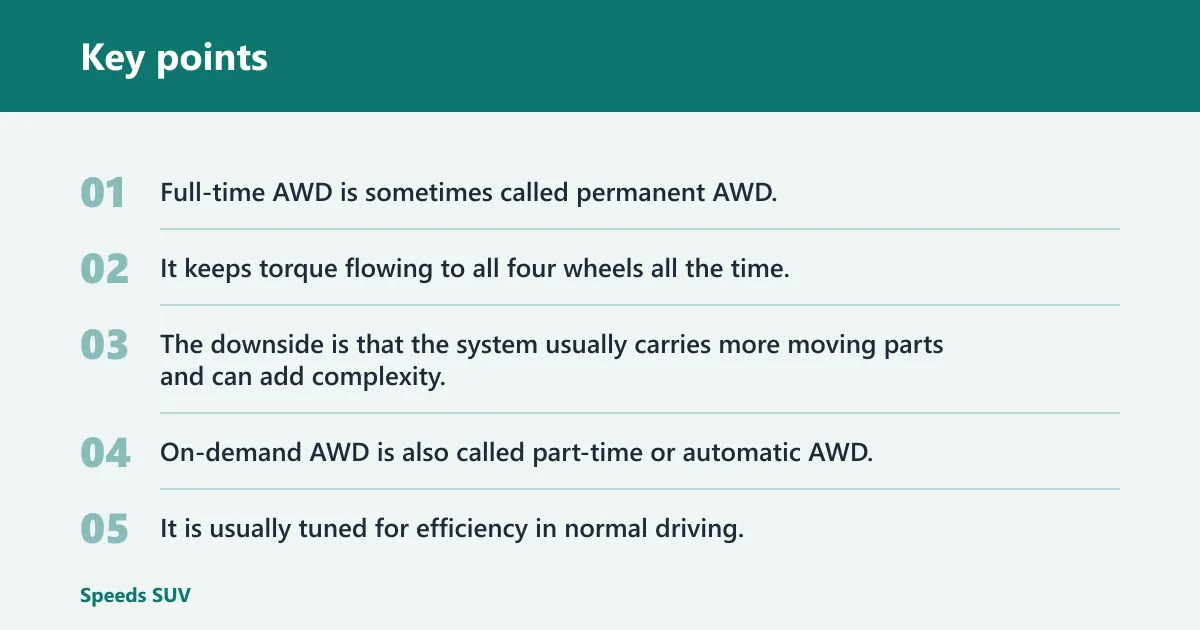
Full-time AWD is sometimes called permanent AWD. It keeps torque flowing to all four wheels all the time, which can give predictable response and immediate torque split. The downside is that the system usually carries more moving parts and can add complexity.
On-demand AWD explained
On-demand AWD is also called part-time or automatic AWD. It is usually tuned for efficiency in normal driving, then engages the second axle when slip appears. Many modern crossover systems use this approach because it gives everyday drivability without running every component at full output all the time.
Why the difference matters in daily driving
The difference shows up in how often the system is actively working. Full-time AWD is always engaged. On-demand AWD may feel like a front-wheel-drive or rear-wheel-drive vehicle until the road gets slick, then it reacts fast enough for most commuting, school runs, and winter travel.
A common first-timer mistake is assuming all AWD crossovers react identically when one wheel loses traction on a wet corner. One model may use a rear-biased layout with faster torque transfer, while another may stay mostly FWD until slip appears. That is why brand brochures can be misleading if you only read the badge.
Why AWD uses a center differential
A center differential allows front and rear tires to rotate at different speeds, which can help AWD work on pavement without binding. AWD systems also use a center differential or clutch-pack coupling between the axles to control how torque moves front to rear.
What the center differential does
During a turn, the front and rear axles do not travel the same distance. The center differential lets them rotate at different speeds while still sending power to both ends. That is the piece that makes continuous AWD practical on dry roads.
Where clutch-pack couplings fit
A clutch-pack coupling is one of the common AWD hardware layouts. Instead of using a purely open mechanical split, it can vary how much torque reaches each axle. In plain language, it can tighten or loosen the link between front and rear as conditions change.
That hardware is common in modern crossovers because it can be packaged efficiently and controlled electronically. It is also why two AWD SUVs can feel very different even if both badges say the same thing on the hatch.
When AWD is worth paying
AWD is worth paying for when the vehicle will regularly face low-traction starts, mixed weather, or road conditions where one axle can lose grip before the other. It is less valuable if the vehicle rarely leaves dry pavement and the main goal is lowest cost, lowest complexity, or maximum fuel economy.
Best-fit scenarios
- Steep icy driveway with repeated cold-start takeoffs
- Plowed suburban roads that still leave slush, patches of ice, or compacted snow
- Deep unplowed snow where extra launch traction matters more than speed
- Wet pavement towing where smooth torque transfer can help launch stability
- Light muddy trail or gravel access road where occasional wheel slip is expected
Tradeoffs and failure cases
- Dry-corner grip still depends on tires, not the drivetrain badge
- AWD does not improve braking on snow or ice
- Worn, mismatched, or different-sized tires can strain the system
- Deep ruts, articulation, and ground clearance can overwhelm crossover AWD
- If towing on wet pavement, AWD helps launch traction but not trailer stability by itself
How to decide quickly
If your worst days are snowy commute days, a steep driveway, or mixed-road winter travel, AWD is often money well spent. If your use case is mostly dry pavement with only occasional rain, the extra hardware may not pay off. If your use case is severe off-road travel, look beyond AWD entirely.
AWD decision table
Use this table to match the drivetrain to your likely use. It compares full-time AWD, on-demand AWD, and 4WD on the features that matter most to SUV shoppers.
| Drivetrain | Launch traction | Dry-road behavior | Snow use | Off-road suitability | Complexity | Typical SUV use case |
|---|---|---|---|---|---|---|
| Full-time AWD | Strong and immediate | Always driven; center differential manages turns | Very good for steady winter traction | Light trails, not serious crawling | Higher | Year-round road use with frequent bad weather |
| On-demand AWD | Good when slip is detected | Usually efficient and quiet in normal driving | Good for occasional snow and ice | Light dirt, gravel, and driveway ruts | Moderate | Daily commuting with seasonal weather swings |
| 4WD / 4×4 | Very strong when engaged | Not meant for regular paved-road use | Useful in deep snow when driver selects it | Best for rougher terrain and low-speed work | Higher and more specialized | Trail use, job sites, and off-pavement travel |
Is AWD good for snow and dirt?
AWD is good for snow, ice, rain, mud, and gravel when the goal is better traction and steadier takeoff, not serious off-road work. It helps most when one or more tires lose grip, because the system can shift power to the wheels that still have some bite.
Confidence use vs capability use
There is a real difference between AWD for confidence and AWD for capability. Confidence use means better starts, calmer merges, and less drama in bad weather. Capability use means rocky climbs, deep ruts, or long off-pavement sections, where AWD often runs out of margin.
Suppose a crossover with on-demand AWD pulls onto a slushy driveway with 18-inch all-season tires. It will usually handle the situation well. Put the same vehicle on loose, uneven trail surfaces with sharp grades, and traction, ground clearance, and wheel articulation become limiting factors before the AWD badge does.
Where AWD starts to fall short
AWD does not improve braking distance by itself. It also cannot make weak tires strong. If the tire compound is poor for the season, or the tread is worn or mismatched, the drivetrain can only work with the grip that remains.
Maintenance matters too. AWD owners often need to match tire sizes and tread wear more closely than drivers of simpler drivetrains, because uneven tire rolling diameter can strain the system. Service intervals for drivetrain fluids vary by manufacturer and should be followed exactly.
AWD vs 4WD
AWD and 4WD are not interchangeable. AWD is usually automatic and built for on-road traction management. 4WD is typically part-time, driver-selected, and built to lock front and rear driveshafts together for low-speed use off pavement.
Driver-selected engagement vs automatic operation
4WD usually requires the driver to shift manually using a knob, button, or lever. Once engaged, it locks the front and rear driveshafts together. That locked setup is useful when traction is very poor, but it is not designed for use on paved roads.
Pavement use vs part-time off-road use
Using 4WD on driving 4WD on dry pavement can cause driveline binding and tire wear. AWD avoids that problem by allowing speed differences between the axles through a center differential or similar coupling. That is why AWD is the better fit for most street-driven SUVs.
Which one fits most SUV buyers?
Car and Driver notes AWD is better for the average driver seeking bad-weather security. That is the key point for most shoppers. If your SUV lives on roads and only sees occasional snow or gravel, AWD is usually the cleaner match. If your trips regularly involve rough trails, 4WD deserves a closer look.
Frequently asked questions
How does AWD work on cars?
AWD works by sending power to all four wheels through a center differential, clutch-pack coupling, or similar hardware. Some systems drive all wheels all the time, while others engage the second axle only when sensors detect slip. The goal is better traction, especially during acceleration.
What does AWD do on a car?
AWD helps the car or SUV move forward when grip is limited. It can improve starts on snow, ice, rain, mud, and gravel by shifting torque to the tires with more traction. It does not shorten braking distance, and it does not replace good tires.
What does AWD do?
AWD manages traction by sending power to the wheels that can use it. In normal road driving, that can mean smoother launches and less wheelspin. In on-demand systems, traction control sensors detect slip and trigger rear-axle engagement or additional front-axle help automatically.
What awd means in a car?
AWD in a car means all-wheel drive. The vehicle can send power to all four wheels, either continuously or only when needed. The exact behavior depends on the hardware, so two AWD models can drive very differently even though the badge is the same.
What is AWD good for?
AWD is good for drivers who want more traction in bad weather and a calmer feel when starting on low-grip surfaces. It is also useful for light gravel, dirt roads, and muddy driveways. It is not a substitute for 4WD when the terrain gets serious.
What makes a car AWD?
A car is AWD when its drivetrain can send power to all four wheels. That can happen full-time or on demand. The system usually uses a center differential or a clutch-pack coupling, along with sensors that monitor slip and shift torque automatically.
Does AWD improve braking or stopping distance?
No. AWD can help a vehicle accelerate from a stop with less wheelspin, but it does not improve braking distance on snow, ice, or wet pavement. Stopping performance depends mainly on tire grip, brake condition, road surface, and driver input, not the drive layout.
What is the difference between AWD and 4WD?
AWD is usually automatic and designed for regular road use in changing weather. 4WD is usually driver-selected and intended for low-speed off-pavement travel. AWD manages axle speed differences with a center differential or coupling, while 4WD often locks the axles together for maximum low-speed traction.
Does this article mean AWD in technology or software?
No. This article covers all-wheel drive in vehicles only. It does not refer to software, computing, or other technology uses of the acronym AWD. If you are researching a vehicle, AWD means the drivetrain can power all four wheels as road conditions change.
Sources
- National Highway Traffic Safety Administration: Tires
- Tire and Rubber Association of Canada
- SAE International
- Consumer Reports: Four-wheel drive and all-wheel drive
- Mercedes-Benz Group: 4MATIC all-wheel drive
- BorgWarner: All-Wheel Drive