What Is Ground Clearance on an SUV or Truck?
Ground clearance is the distance from an SUV or truck’s lowest point to the ground. A higher number usually gives more room over rocks, ruts, and steep breaks, but only if the wheelbase, load, and lowest hanging part clear first. Ignore that, and you can scrape the underbody, damage tires, or get stuck on ruts, rocks, or a steep approach. This guide shows you how to read ground-clearance specs and judge whether a vehicle will actually clear the obstacle.
What ground clearance means
Ground clearance is the distance from level ground to the vehicle’s lowest rigid part, usually measured in inches. That number matters because it tells you where the vehicle will contact first when you meet a curb, rut, crest, or trail edge. The published figure is usually for an empty vehicle, so real-world clearance can be lower with passengers, cargo, or tongue weight.
Why the lowest point matters more than ride height
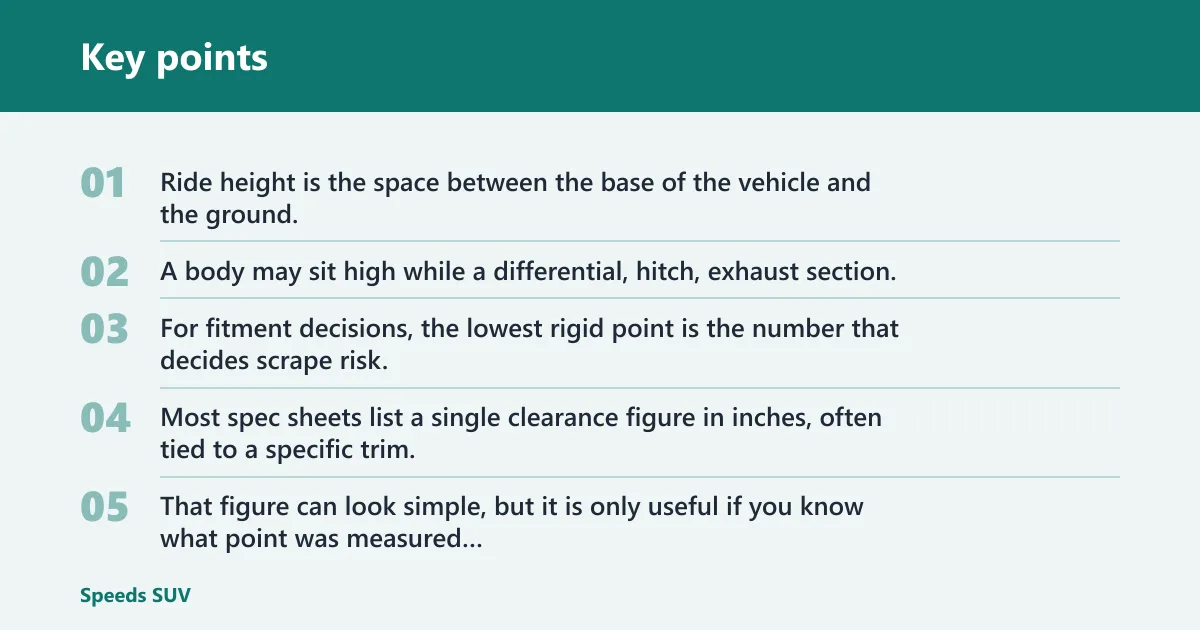
Ride height is the space between the base of the vehicle and the ground, but that is not always the part that contacts the obstacle first. A body may sit high while a differential, hitch, exhaust section, or skid plate hangs lower. For fitment decisions, the lowest rigid point is the number that decides scrape risk.
How manufacturers usually state the number
Most spec sheets list a single clearance figure in inches, often tied to a specific trim, tire size, and drivetrain. That figure can look simple, but it is only useful if you know what point was measured and whether the vehicle is loaded. A published number on paper is not the same as a loaded vehicle at the driveway or trailhead.
How ground clearance is measured
Ground clearance is measured on level ground with the vehicle at rest, from the ground to the lowest rigid point under the vehicle. On many trucks, that point is the rear differential. On some SUVs, it may be an exhaust section, skid plate, spare tire, or hitch hardware instead.
What counts as a rigid part
Only fixed parts count for clearance. Flexible rubber flaps and moving tire tread are not the right reference point. If a component can hang lower than the frame or axle and it can strike the ground, it belongs in the decision. That is why the answer can change with trim, tire choice, or tow equipment.
Why trucks often quote the rear differential
Many trucks are measured at the rear differential because it is often the lowest point under the chassis. That can make a truck’s published number look better than its true lowest point if a hitch, spare tire, or exhaust sits lower. The rear differential is only the reference if it really is the lowest rigid part.
Ground clearance worksheet
This worksheet helps you compare the number on the spec sheet with the number that matters after loading. Use it before you buy, tow, or pack for a trip. The goal is simple: confirm the published clearance, identify the lowest point, and judge whether cargo, passengers, trailer tongue weight, or wheelbase could change the result.
| Check item | What to look for | What it means |
|---|---|---|
| Published clearance | Spec sheet number in inches | Usually an empty-vehicle figure |
| Loaded clearance | Vehicle with passengers, cargo, and towing setup | Often lower because the suspension compresses |
| Lowest-point location | Rear differential, exhaust, skid plate, spare tire, or hitch | The part that decides first contact |
| Wheelbase risk | Long wheelbase versus short wheelbase | Longer vehicles need more breakover angle margin |
| Yes/no checklist | Question | Why it matters |
|---|---|---|
| Yes / No | Will you carry extra cargo or passengers? | Added weight can reduce usable clearance |
| Yes / No | Will you tow a trailer with tongue weight? | Tongue weight compresses the rear suspension |
| Yes / No | Does the vehicle have a long wheelbase? | Longer wheelbases reduce breakover margin |
| Yes / No | Is the lowest point a hitch, spare tire, or exhaust? | That part may scrape before the frame or axle |
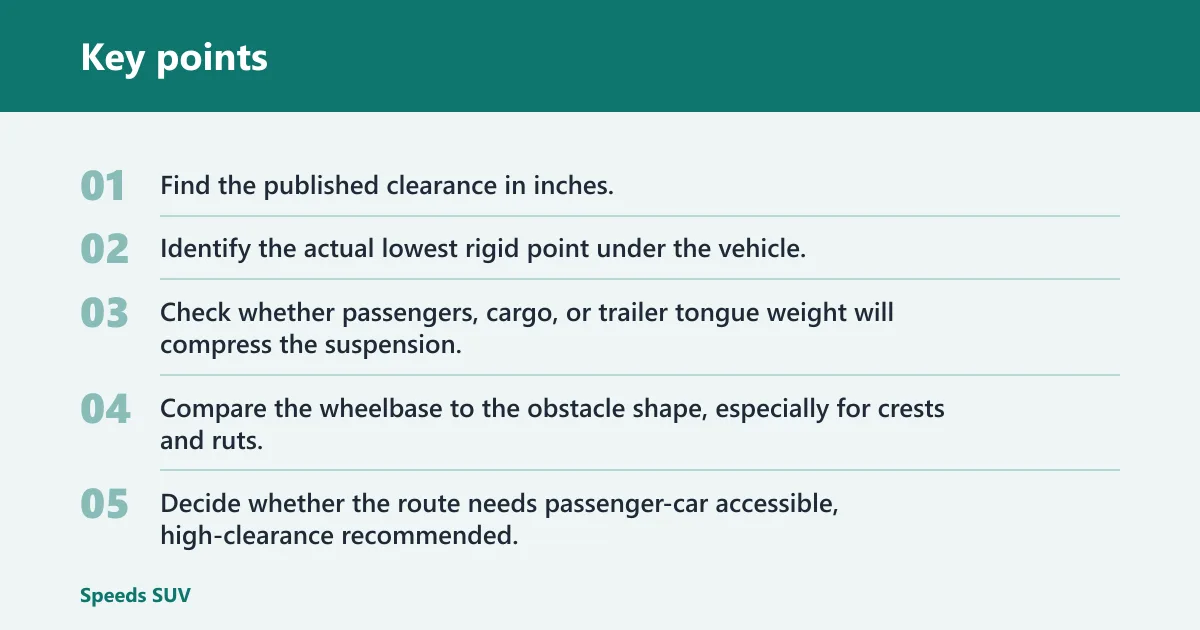
- Find the published clearance in inches.
- Identify the actual lowest rigid point under the vehicle.
- Check whether passengers, cargo, or trailer tongue weight will compress the suspension.
- Compare the wheelbase to the obstacle shape, especially for crests and ruts.
- Decide whether the route needs passenger-car accessible, high-clearance recommended, or 4×4-required planning.
What counts as the lowest point?
The lowest point is whichever rigid part hangs closest to the ground in the vehicle’s current setup. On one vehicle that may be the rear differential. On another it may be the exhaust, skid plate, spare tire, or trailer hitch. The right answer depends on trim, drivetrain, and whether the vehicle is loaded or towing.
Rear differential
On most trucks, the rear differential is the lowest point and the part most often used for clearance quotes. That works well for a stock truck with no extra weight hanging off the rear. Add a trailer or heavy cargo, and the differential may no longer be the first or only concern.
Exhaust and skid plates
Some SUVs and trucks hang exhaust piping or skid plates lower than the axle. A skid plate can protect the underbody, but it can also become the first point of contact if it sits below the axle line. Exhaust routing matters too, especially on vehicles with long wheelbases or tighter packaging under the floor.
Spare tire and trailer hitch
A spare tire cradle or trailer hitch can sit lower than expected. That matters in snow, on a steep driveway apron, or when pulling into a campsite with a sharp dip. A hitch can also turn a clear-looking vehicle into one that drags on the departure side first.
Does loading change clearance?
Yes. Passengers, gear, roof-top tents, and trailer tongue weight compress the suspension, which reduces the usable number from the published spec. The vehicle still has the same basic design clearance, but the real-world number at rest can be lower when the body settles closer to the ground.
Passengers and cargo
Extra load lowers the body relative to the axles. That can shrink the gap at the lowest point and make a mild obstacle into a scrape risk. A road-focused crossover with about 6 to 8 inches of clearance can lose useful margin fast when the cabin and cargo area are full.
Trailer tongue weight
Tongue weight pushes down on the rear suspension, which can lower the rear of the vehicle and reduce departure clearance. That matters at boat ramps, campground entries, and uneven driveways. If the rear is already the lowest area, towing can make the problem easier to hit.
Suspension compression and sag
Because the published clearance figure is for an empty vehicle, sag is part of the buying decision, not a side note. A common first-timer mistake is to compare only the spec sheet and ignore the way a loaded vehicle sits lower before it even reaches the obstacle. That is how a good number becomes a bad fit.
Why wheelbase and angles matter
Ground clearance tells you how much vertical space you have, but wheelbase and angles decide how that space is used. Breakover angle matters at crests and ruts. Approach angle matters when the front climbs a steep ramp or trail entry. Departure angle matters when the rear leaves a ledge or drops into a dip.
Breakover angle and crests
Breakover angle is the angle that tells you whether the middle of the vehicle will high-center on a crest or ridge. It depends on both ground clearance and wheelbase. A shorter wheelbase gives more room to crest a hump without hanging up the center of the vehicle.
Breakover angle can be described with this relation: 2 × arctan(2*G/WB), where G is ground clearance and WB is wheelbase. Using that relationship, a 5-inch clearance vehicle on a 106-inch wheelbase has a breakover angle of about 10.8 degrees. At 6 inches of clearance, a crew-cab pickup with a 145-inch wheelbase has a breakover angle of 9.5 degrees.
That is why a long crew-cab truck can clear the ground at the axle and still drag the center on a sharp driveway transition. The published clearance may be fine, but the wheelbase can make the middle too long for the shape of the obstacle.
Approach angle and front obstacles
Approach angle tells you how steep a front obstacle can be before the bumper or nose contacts it. It matters on ramps, trail entries, and steep driveway aprons. Even with strong clearance, a long front overhang can scrape before the tires reach the high spot.
Departure angle and rear obstacles
Departure angle works the same way at the rear. It matters when leaving ledges, climbing out of dips, or backing away from a steep exit. A hitch, spare tire, or bumper corner can become the first contact point if the rear hangs too low.
What 4×4 and AWD mean here
4×4 or 4WD is not the same thing as ground clearance. It refers to how power reaches the wheels, not how much space exists under the body. AWD can send power to all four wheels too, but it usually lacks low-range gearing. Neither system creates clearance on its own.
4×4 is not clearance
A true off-roader often combines higher clearance with low-range gearing, stronger tires, and underbody protection. The drivetrain helps with traction and control. The clearance helps with physical fitment. You need both to avoid getting stuck or scraping on a route with ruts, rocks, or broken surfaces.
AWD without low range
AWD can still be useful on mild roads, snow, and wet pavement, and it may pair with enough clearance for light trail use. But AWD alone does not mean the vehicle can handle a steep, uneven route. If the obstacle is the problem, the height under the vehicle still decides first contact.
When clearance matters more than drive type
If the route is a curb, driveway apron, snow berm, or campsite entrance, clearance may matter more than whether the vehicle is AWD or 4×4. If the route is loose, steep, or rocky, drive type and gearing matter too. The two questions are separate, and both need an answer.
How to read road and trail ratings
Road and trail ratings help translate the number into route choice. Passenger-car accessible roads generally fit a 2WD vehicle with 5-6 inches of clearance. High-clearance recommended roads ask for more margin. 4×4-required roads usually expect about 9 to 12 inches or more, plus the traction and gearing to match the surface.
Passenger-car accessible
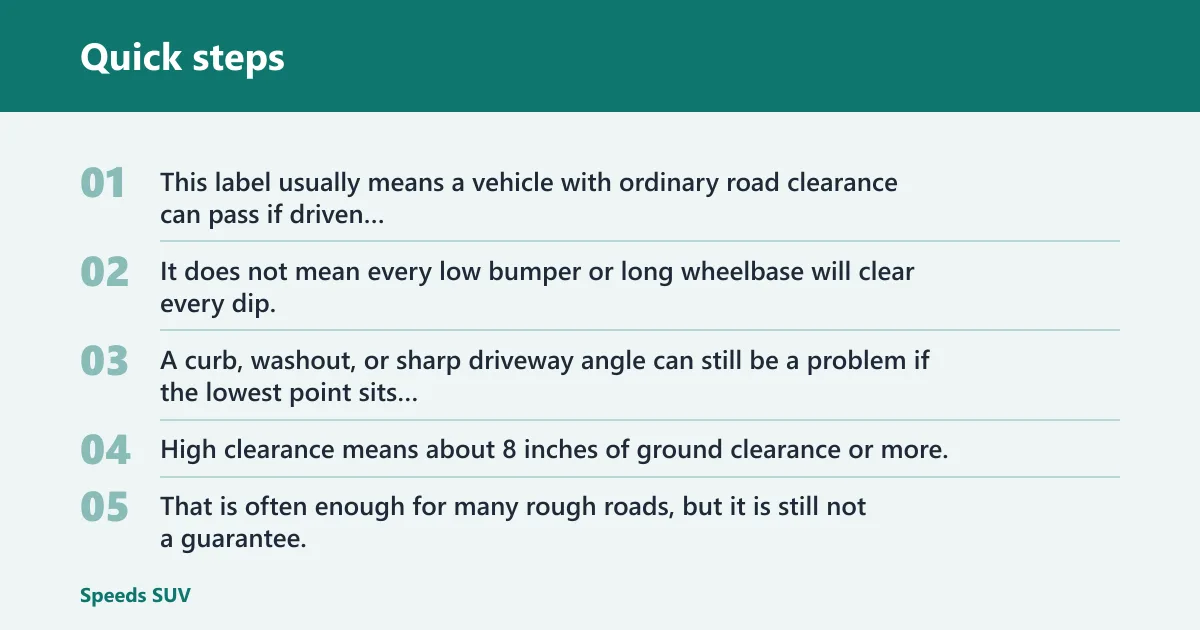
This label usually means a vehicle with ordinary road clearance can pass if driven carefully. It does not mean every low bumper or long wheelbase will clear every dip. A curb, washout, or sharp driveway angle can still be a problem if the lowest point sits too low.
High-clearance recommended
High clearance means about 8 inches of ground clearance or more. That is often enough for many rough roads, but it is still not a guarantee. Use this category as a warning that the route may punish low-hanging parts, especially if the vehicle is loaded or has a long wheelbase.
4×4 required
About 9 to 12 inches or more is what a 4×4-required road asks for. That rating usually assumes both the clearance and the traction setup to handle rougher terrain. A vehicle can have the number and still fail if the lowest point, wheelbase, or loading is wrong for the obstacle shape.
Picture a crossover with about 7 inches of clearance entering a steep campsite lane after the cabin is full and a hitch cargo tray is attached. The front may clear the ramp, but the hitch can drag on the departure side even though the spec sheet looked adequate. The problem is fitment, not just height.
Frequently asked questions
What is vehicle ground clearance?
Vehicle ground clearance is the distance from level ground to the lowest rigid part under the vehicle. It is measured in inches and changes with load because the suspension compresses. The number matters because it predicts whether the underbody, differential, hitch, or exhaust will strike first on an obstacle.
What is car ground clearance?
Car ground clearance is the same concept applied to a passenger vehicle: the vertical distance from the ground to the lowest fixed point underneath. On a car, that point may be the exhaust, subframe, or undertray rather than a differential. The same loading and wheelbase limits still apply.
How is ground clearance measured on an SUV?
Measure it on level ground with the SUV at rest, from the ground to the lowest rigid part. That might be a skid plate, exhaust section, spare tire cradle, or a rear differential. The published figure is usually for an empty vehicle, so added passengers or cargo can lower the real number.
What part of the vehicle counts as ground clearance?
Any rigid part that hangs lowest counts if it can strike the ground. On trucks that is often the rear differential. On SUVs it may be the exhaust, skid plate, spare tire, or trailer hitch. The relevant part is the one that will contact the obstacle first, not the one that looks lowest from the side.
Is ground clearance the same as ride height?
No. Ride height is the space between the base of the vehicle and the ground, while ground clearance is measured to the lowest rigid point underneath. A vehicle can sit relatively high and still have a low hanging part that scrapes first. For obstacle fitment, ground clearance is the better number.
How much ground clearance is considered high for an SUV?
High clearance means about 8 inches of ground clearance or more. Many road-focused crossovers sit around 6 to 8 inches, while off-road SUVs may exceed 8 inches. That number helps, but it does not decide trail ability by itself. Wheelbase, approach angle, and departure angle still matter.
Does towing or loading change ground clearance?
Yes. Passengers, cargo, roof-top tents, and trailer tongue weight compress the suspension and reduce usable clearance. The published number is for an empty vehicle, so loaded clearance can be lower. That is why towing setups and full cargo loads can cause scrape problems that the spec sheet does not show.
Can a truck have high clearance and still high-center?
Yes. A truck can have good published clearance and still high-center if its wheelbase is long or the crest is sharp enough. Breakover angle matters at humps, ruts, and driveway transitions. The center of the truck can contact the ground even when the axles clear cleanly.
What is the difference between clearance and breakover angle?
Clearance is the vertical distance to the lowest point. Breakover angle is the geometry that tells you whether the middle of the vehicle will clear a crest or ridge without high-centering. The first is a height number. The second combines height and wheelbase into a fitment angle.
What do 4×4 and high clearance mean on a backcountry road?
4×4 means the vehicle can send power to all four wheels, and high clearance means the body sits far enough above the ground to clear rough surfaces more easily. Together they point to better route fit, but they still do not guarantee success. Check the road rating, the lowest point, and the wheelbase before you go.