What Does Part-Time 4WD Mean?
Part-time 4WD is a selectable system that locks the front and rear driveshafts together, so 2H is generally used on dry pavement and 4H or 4L is typically reserved for loose, slippery, or low-traction surfaces. Toyota owner manuals commonly warn that part-time 4WD should not be used on dry pavement, and Jeep manuals similarly distinguish between part-time and full-time operation for pavement use.Toyota owner manualsJeep owner manuals Use it on high-grip roads and the drivetrain can bind, causing driveline wind-up, hard steering, tire scrub, and possible component damage. A transfer-case or driveline reference will usually describe this as torque buildup caused by the front and rear axles trying to rotate at different speeds on surfaces that do not allow slip.driveline wind-up This guide explains what each mode does, when to use it, and how to avoid wind-up.
How part-time systems differ
Part-time 4WD means the vehicle does not run in four-wheel drive all the time. In normal use, it stays in 2H and sends power to one axle, usually the rear axle. You engage 4WD only when traction drops or when you need low-speed control off-road.
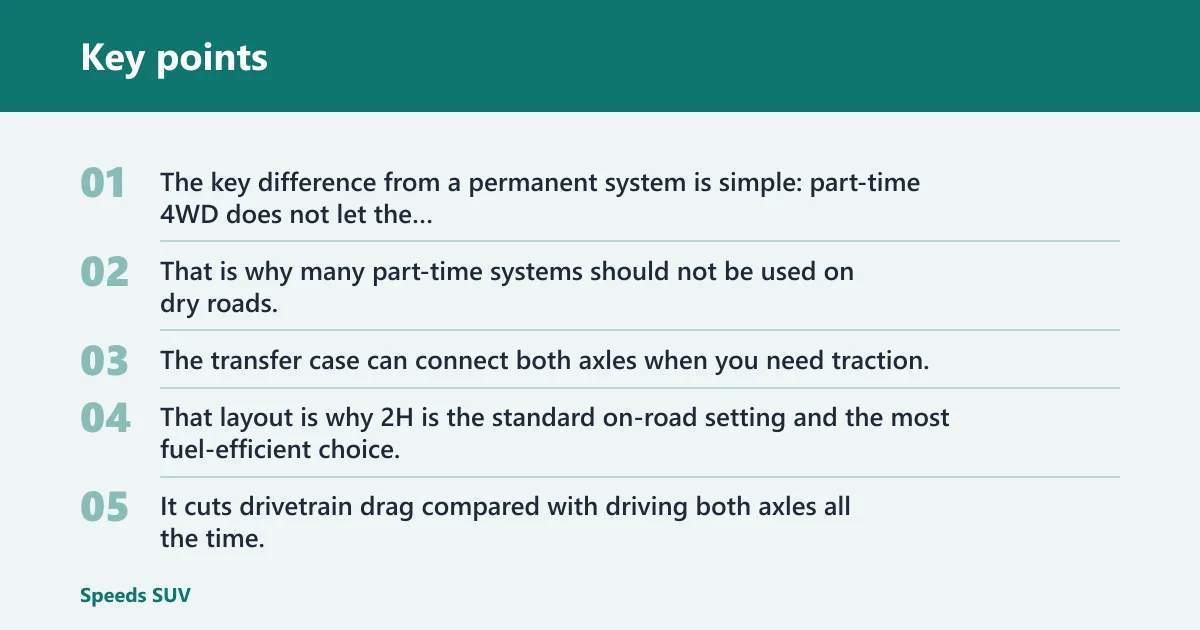
The key difference from a permanent system is simple: part-time 4WD does not let the front and rear axles turn at different speeds on pavement. That is why many part-time systems should not be used on dry roads, even if the road feels “only a little wet.”
Why the system is called part-time
“Part-time” describes how often the front axle is driven, not how strong the vehicle is. The transfer case can connect both axles when you need traction, then return the vehicle to rear-drive operation for normal travel.
That layout is why 2H is the standard on-road setting and the most fuel-efficient choice. It cuts drivetrain drag compared with driving both axles all the time.
How it differs from full-time 4WD
Full-time 4WD can stay engaged on pavement because it includes a center differential or a controlled coupling that lets the front and rear drivetrains rotate at different speeds. Part-time 4WD usually lacks that feature in its locked 4WD mode.
AWD is different again. It is usually road-biased and may send torque automatically without driver selection, while selectable 4WD gives you the choice of 2H, 4H, and 4L. SAE and OEM drivetrain references describe AWD as a system designed to vary torque delivery automatically, while full-time 4WD uses a center differential or similar device to permit continuous pavement use.AWD reference
How does the transfer case work?
The transfer case is the part of the drivetrain that splits torque between the front and rear driveshafts. In a part-time system, it usually offers selector positions such as 2H, 4H, and 4L, and the shift may happen through a mechanical linkage or an electronic actuator.
When 4WD is engaged, the transfer case connects the front output shaft to the rear output shaft. In many systems, 4H keeps the ratio direct for normal-speed traction work, while 4L adds reduction gearing for slow, controlled movement.
2H, 4H, and 4L selector positions
- 2H: two-wheel drive high range, used for normal road driving.
- 4H: four-wheel drive high range, used for slippery or loose surfaces at moderate speeds.
- 4L: four-wheel drive low range, used for very low speed, high torque, and precise control.
Mechanical versus electronic engagement
A mechanical system may use a lever or cable to move the transfer case. An electronic system may use a switch, actuator, or motor to command the shift. The control method changes the feel, but not the basic rule: do not use a part-time 4WD mode on a surface that needs different front and rear wheel speeds.
When to use 2H, 4H, and 4L
Use 2H for normal driving on dry pavement and any surface with steady, predictable grip. Use 4H when the surface is loose or slippery and you still need normal road speeds. Use 4L for crawling, steep grades, deep mud, sand, and recovery work where slow speed and extra torque matter more than fuel economy.
2H for normal road driving
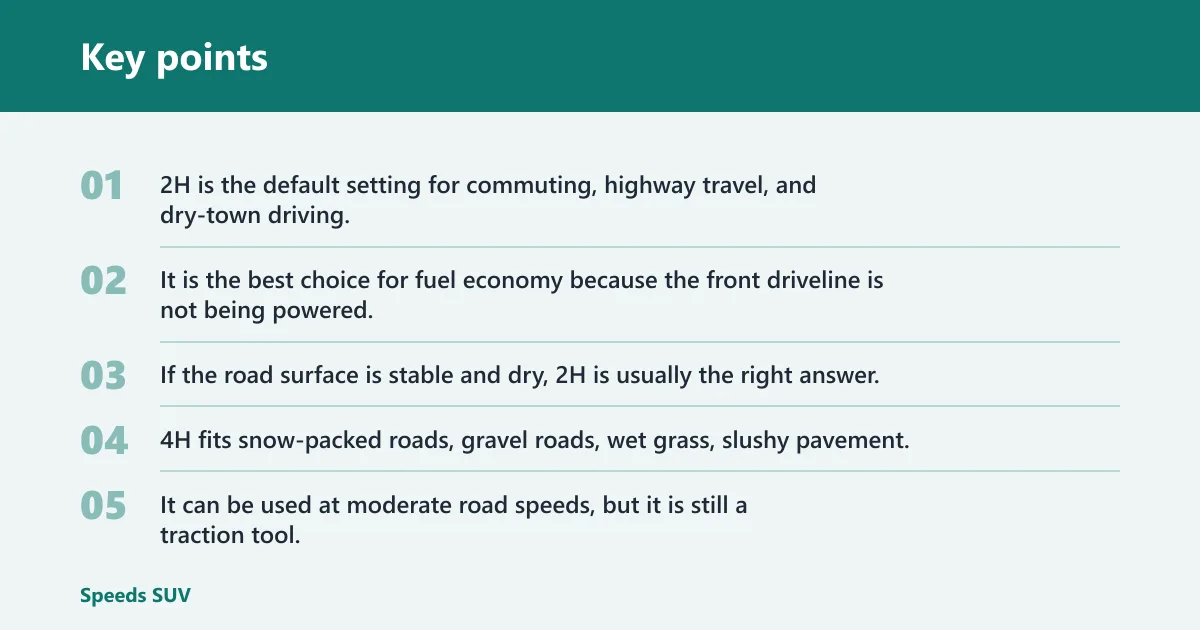
2H is the default setting for commuting, highway travel, and dry-town driving. It is the best choice for fuel economy because the front driveline is not being powered. If the road surface is stable and dry, 2H is usually the right answer.
4H for loose or slippery surfaces
4H fits snow-packed roads, gravel roads, wet grass, slushy pavement, and light off-road travel where traction changes from spot to spot. It can be used at moderate road speeds, but it is still a traction tool, not a substitute for careful driving. On some automatic or demand-based systems, 4H-like engagement may be controlled by electronics and can feel less direct, so the owner manual matters more than the dash label.
4L for low-speed torque and control
4L is for situations where speed should stay low and wheel torque should stay high. That includes steep climbs, deep mud, sand, and towing recovery. It helps the vehicle move slowly without making the transmission do all the work.
Suppose a crossover-sized SUV is on a dry suburban street after rain has stopped. The pavement is clean and the tires have good grip. 2H is still the correct choice, because the road is not loose enough to justify 4WD.
A common first-timer mistake is selecting 4H after a light dusting of snow on a road that has already been plowed. If the pavement is mostly bare and grippy, the drivetrain can bind in turns even though the air temperature is low.
Part-time 4WD vs full-time 4WD vs AWD
Part-time 4WD is driver-selected and usually should not be used on dry pavement. Full-time 4WD can be used on pavement because a center differential or coupling allows speed differences between the front and rear axles. AWD is a separate system that usually shifts torque automatically and is often tuned more for road use.
What buyers should check on a spec sheet
Look for the exact wording in the brochure or owner manual. Terms such as part-time 4WD, full-time 4WD, AWD, automatic 4WD, and 4WDemand can point to different hardware and different operating limits. The selector on the dash or console matters less than the transfer-case design behind it.
If the manual says the system should not be used on dry pavement, treat that warning as a hard limit. If it says the system can remain in 4WD on pavement, it is likely full-time 4WD or an AWD-based system with a center coupling. For a plain-language comparison, see Full-time 4WD again here in the context of system behavior, and compare it with how the owner manual describes pavement use.
Part-time 4WD surface guide
Surface matters more than weather. Wet pavement can still have high traction, while gravel can call for 4WD even on a dry day. The key question is whether the front and rear axles need to rotate at different speeds in turns.
Dry pavement
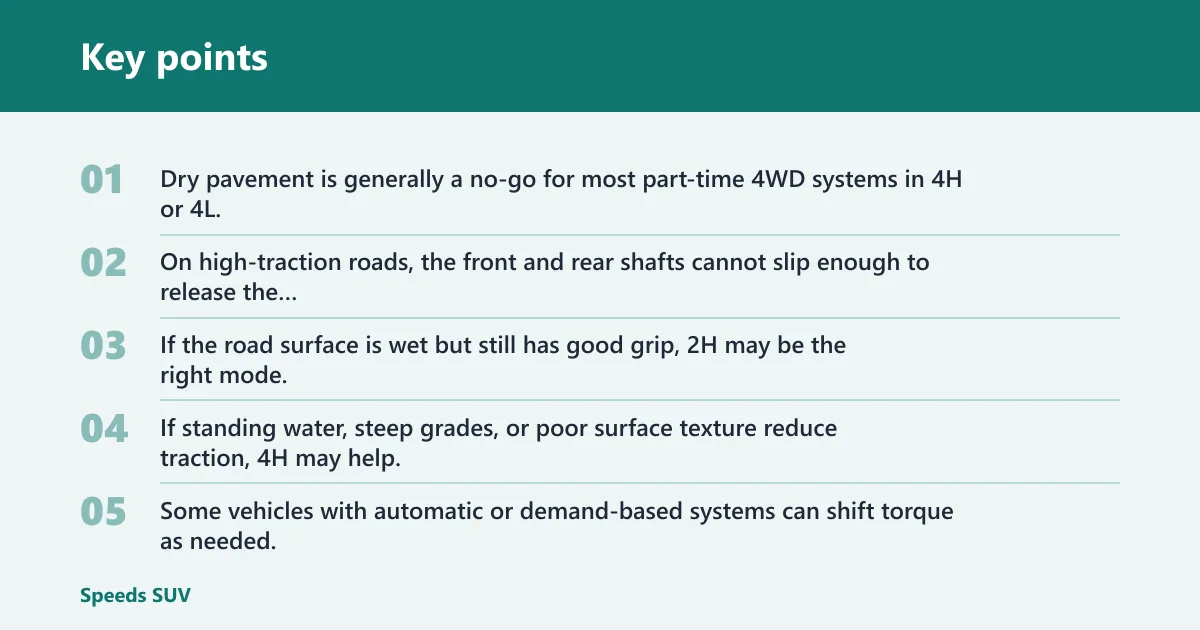
Dry pavement is generally a no-go for most part-time 4WD systems in 4H or 4L. On high-traction roads, the front and rear shafts cannot slip enough to release the built-up tension, so driveline wind-up can appear as hopping, tight steering, or scrub in parking lots.
Rain and wet roads
Rain alone does not always mean 4WD. If the road surface is wet but still has good grip, 2H may be the right mode. If standing water, steep grades, or poor surface texture reduce traction, 4H may help. Some vehicles with automatic or demand-based systems can shift torque as needed, but that does not change the basic rule for a locked part-time transfer case: if the manual says no dry pavement, do not use 4H just because it is raining.
Snow and ice
Snow-covered roads often suit 4H because traction is inconsistent and wheel slip is more likely. Ice is different. Even with 4WD, braking and steering can still be limited, so lower speed and more following distance matter more than the drive mode alone. On ice, 4H may help with moving off and maintaining forward progress, but it does not make the vehicle stop or corner like dry pavement.
Gravel and mud
Gravel roads often work well in 4H because the loose surface lets the driveline move without binding. Mud is a stronger case for 4L if speeds are very low or if wheelspin needs to be controlled carefully.
Sand, climbs, and recovery
Sand usually calls for 4H or 4L depending on depth, speed, and vehicle load. Steep climbs and recovery situations often need 4L because the vehicle can move slowly while the transfer case multiplies torque. That reduces strain and gives the driver finer throttle control. On softer sand, momentum matters too, so some model-specific guidance may prefer 4H first and 4L only when crawling or when the manual calls for it.
4WD mode decision table
This table gives a quick mode check by surface, speed, and misuse risk. If the road changes, change the mode. Do not guess based on weather alone. If traction returns, switch back to 2H.
| Surface | Speed range | Recommended mode | Risk if used incorrectly |
|---|---|---|---|
| Dry pavement | Any normal road speed | 2H | Using 4H or 4L can cause drivetrain wind-up, tire scrub, and hard steering. |
| Rain on clean pavement | Normal road speed if traction remains stable | 2H | Leaving 4WD engaged can bind the drivetrain if grip is too high in turns. |
| Snow | Moderate road speed | 4H | 2H may allow excess wheelspin; 4L is usually too low for normal travel. |
| Slushy pavement | Low to moderate road speed | 4H | Can be useful when the slush reduces traction, but if the surface firms up or clears, return to 2H to reduce bind risk. |
| Wet grass | Low to moderate speed | 4H | Can help with traction, but some vehicles may still bind if the ground is firm and grip is higher than expected. |
| Gravel | Moderate road speed | 4H | 2H can reduce traction and stability on loose corners or grades. |
| Mud | Very low speed | 4L | 4H may not give enough torque control; 2H can stall progress or spin tires. |
| Sand | Low to moderate speed, depending on depth | 4H or 4L | 2H can dig in; using too much speed in any mode can bury the vehicle. |
| Steep climbs | Low speed | 4L | 4H may force more clutch, throttle, or brake use than the terrain needs. |
| Recovery situations | Very low speed | 4L | Using a higher range can reduce control and raise the chance of wheelspin or shock loading. |
| Icy pavement | Very low to cautious moderate speed | Usually 4H, if the manual allows it | 4WD can help with launch and traction, but braking and steering remain limited; if the road clears, switch back to 2H. |
| Traction returns | Resume normal road speed | Switch back to 2H | Staying in 4H on firmer surfaces can reintroduce wind-up and unnecessary drivetrain stress. |
What does part-time 4WD mean on Toyota and 4Runner?
On Toyota and 4Runner models, the label may appear as part-time 4WD, 4WD, 4WDemand, or a similar drive-mode label near the selector. The exact meaning depends on the transfer case and the owner manual, not only on the badge or dash text.
Some Toyota systems use clear 2H, 4H, and 4L logic. Others add automatic or demand-based behavior that changes when the front axle is driven. The manual should tell you whether the vehicle is part-time, full-time, or a hybrid setup with an automatic coupling. Make the manual check the first step, especially if the model can behave differently in rain, snow, or at higher speeds.
How to confirm the system in the owner manual
- Find the drivetrain section in the manual.
- Look for the listed selector positions: 2H, 4H, and 4L.
- Check whether the manual says 4WD can be used on pavement.
- Look for terms such as center differential, coupling, or automatic mode.
- If the manual warns against dry-pavement use, treat it as a part-time system.
Picture a 4Runner driver seeing a 4WD indicator and assuming it means full-time 4WD. If the manual also lists 2H and warns against dry pavement in 4H, the vehicle is part-time, and the safe choice is still 2H for normal street use.
Frequently asked questions
What does part time 4wd mean: it means the vehicle?
It means the vehicle is normally driven in 2H and only uses 4WD when the driver selects it. In most part-time systems, 4H and 4L are for loose, slippery, or low-speed traction work, not for dry pavement. The transfer case locks the axles together in 4WD.
What does full time 4wd mean?
Full-time 4WD means the vehicle can stay in 4WD on pavement because the drivetrain includes a center differential or a coupling that allows front and rear speed differences. That design avoids the bind that part-time systems can create on high-traction roads. The driver does not need to switch back to 2H for normal street use.
What does part time 4×4 mean?
Part-time 4×4 is another way to say part-time 4WD. The vehicle can drive all four wheels when selected, but it is not meant to do that all the time. In most cases, it should stay in 2H on dry pavement and move to 4H or 4L only when traction drops.
What does full time 4×4 mean?
Full-time 4×4 means the vehicle can keep all four wheels driven during normal use, including on pavement. The system uses a center differential or an equivalent coupling to manage different front and rear wheel speeds. That makes it different from a selectable part-time system that can bind on dry roads.
What does 4wdemand part time 4 wheel drive mean?
4WDemand usually means the vehicle can engage four-wheel drive automatically or on demand, but the exact behavior depends on the model. Some systems are still part-time in structure, while others are more like automatic or full-time setups. The manual is the best place to confirm whether pavement use is allowed.
What does automatic full time 4 wheel drive mean?
Automatic full-time 4 wheel drive usually means the vehicle can distribute torque without the driver selecting each change manually. It may use a center differential, clutch pack, or similar device to handle speed differences between axles. If the manual allows pavement use, it is not the same as a locked part-time system.