
What Is a Good Approach Angle for Off-Road Driving?
A good approach angle is about 30 degrees for mild trails, 35 degrees for serious trail use, and 40 degrees or more for hard rock crawling. Too little angle means bumper strikes, stalled climbs, and expensive front-end damage. This guide breaks down practical benchmarks by terrain, vehicle size, and modification level.
What is approach angle?
Approach angle is the front-end clearance metric used to judge how steep an obstacle a vehicle can climb without the front contacting the ground. It is measured statically with the vehicle loaded and stationary, and the larger the angle, the lower the chance of contact while approaching rocks, ledges, or sharp driveway transitions.
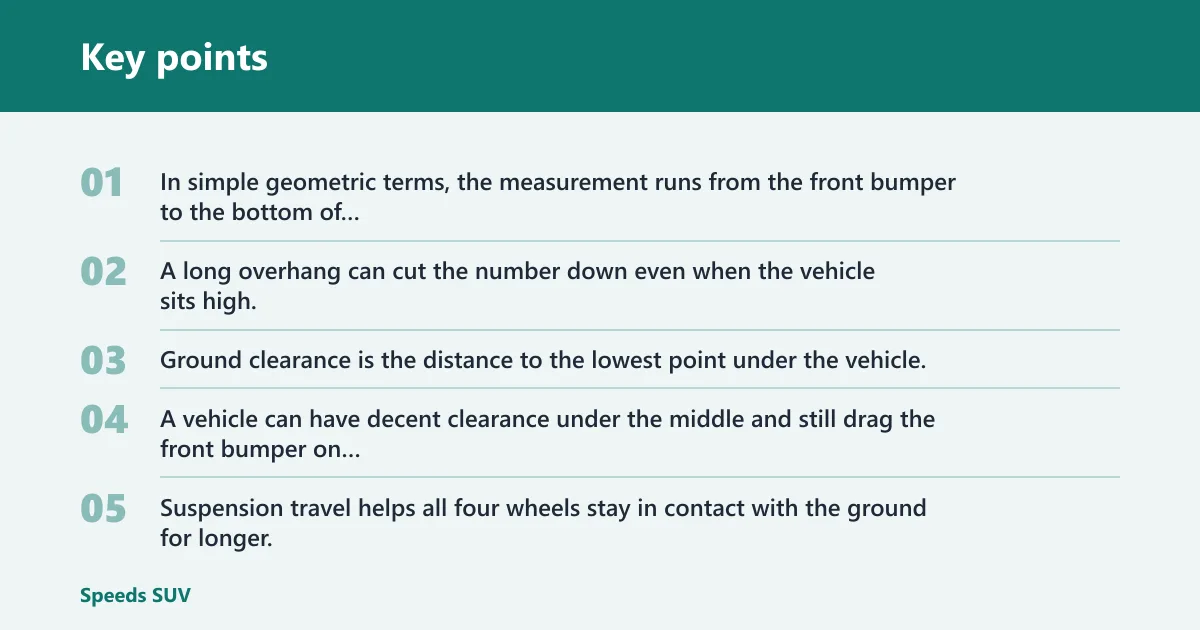
In simple geometric terms, the measurement runs from the front bumper to the bottom of the tyre. That is why bumper shape matters so much. A long overhang can cut the number down even when the vehicle sits high.
Do not confuse it with ground clearance. Ground clearance is the distance to the lowest point under the vehicle, often the differentials on solid-axle 4x4s. A vehicle can have decent clearance under the middle and still drag the front bumper on a steep approach.
Suspension travel helps all four wheels stay in contact with the ground for longer. It helps traction and control. It does not directly raise the approach angle number, because the number is tied to front geometry, not articulation alone.
What is a good approach angle for your use case?
A good approach angle depends on the terrain you actually drive. For street-overland use, around 25 to 30 degrees is a workable floor. For mild trail use, aim for about 30 to 35 degrees. For rocky trail use, about 35 to 40 degrees is a better target, and steep breakover situations often call for about 40 degrees or more at the front.
The right benchmark depends on vehicle size and front-end design. A long-wheelbase SUV can need more care at the front even if its suspension is tuned for rough ground, while a short-wheelbase truck may clear the same obstacle with less drama.
Approach angle benchmark table
| Use case | Suggested minimum range | What it usually handles | Where it stops being enough |
|---|---|---|---|
| Street-overland | 25-30 degrees | Forest roads, mild ruts, campground entrances, shallow ledges | Sharp washouts, tall parking curbs, repeated rock hits |
| Mild trail | 30-35 degrees | Two-track trails, moderate dips, uneven climbs, light rock use | Steep step-ups, deep holes, approach angles that force bumper-first contact |
| Rocky trail | 35-40 degrees | Rock gardens, ledges, uneven break-ins, steep obstacle entries | Front fascia contact on tall ledges or heavily crowned transitions |
| Steep breakover situations | 40 degrees or more | Hard climbs where the front must crest without touching first | Deep drop-ins, abrupt crests, and front overhang that still bottoms out |
Stock and modified vehicles land in different places. A Chevrolet Tahoe and Suburban Z71 get a front fascia that improves approach angle, and both include a front skid plate and front tow hooks. The GMC Yukon AT4 adds a front fascia that improves the vehicle’s front approach angle. Those changes matter because trim-specific shapes can move the front contact point upward or inward.
Picture a full-size SUV that can handle dirt roads all week but taps the bumper on a steep driveway apron. That setup may be fine for overlanding, but it is not a strong choice for repeated rock ledges unless the front end geometry changes.
What changes your approach angle?
Front fascia shape is the biggest visual clue, but it is not the only factor. Bumper design, winches, tow hooks, skid plates, lift height, and tyre size all affect front-end geometry in different ways. Some changes help, while others add protection at the cost of front clearance.
Front fascia and bumper design
A short, high-cut front fascia usually helps more than a long, low one. Trim-specific shapes matter because the same vehicle can have very different front clearance from one package to another. The Chevrolet Tahoe and Suburban Z71 are examples of trims that use front-end shaping to improve approach angle.
Aftermarket bumpers are a mixed bag. Some tuck the front edge upward and improve clearance. Others add bulk, protect the nose, and still protrude far enough to make the approach angle worse than stock.
Tow hooks, skid plates, and winches
Tow hooks can influence front-end geometry because they sit at the nose and may hang lower than the fascia. Skid plates do not create clearance; they reduce damage risk when the angle is not enough. A front skid plate can absorb contact that would otherwise hit plastic or metal bodywork.
Winches often reduce approach angle unless the bumper is built around them with a short nose. That is the main tradeoff: recovery gear adds capability, but it can also move the first contact point forward and down.
Lifts, larger tires, and ride height
A lift can improve approach angle because it raises the front of the vehicle relative to the ground. Larger all-terrain tires can also add height and obstacle clearance. Those tyres are often paired with off-road packages because they help the vehicle roll over rocks and ruts more easily.
That said, tyre size does not fix a long bumper overhang by itself. A taller truck can still hit the bumper first if the front shape is low and extended. That is why wheel size, tyre diameter, and fascia design need to be considered together.
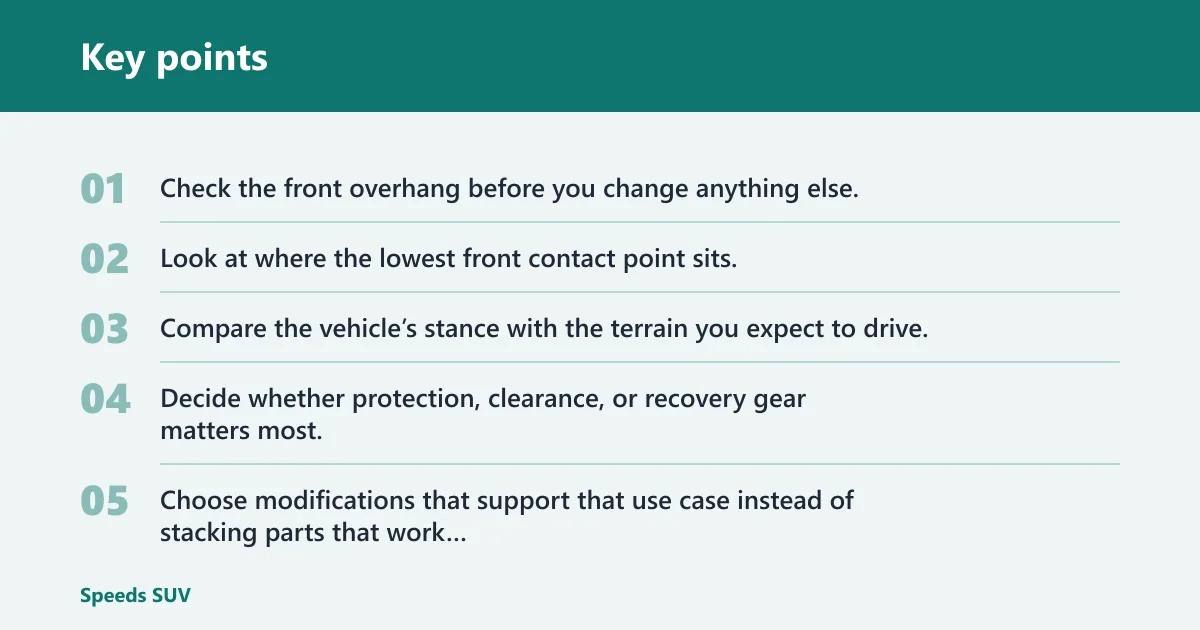
- Check the front overhang before you change anything else.
- Look at where the lowest front contact point sits.
- Compare the vehicle’s stance with the terrain you expect to drive.
- Decide whether protection, clearance, or recovery gear matters most.
- Choose modifications that support that use case instead of stacking parts that work against each other.
How does approach angle compare with other off-road angles?
Approach angle is only one part of off-road geometry. Departure angle is the rear-end equivalent, and breakover angle is the middle-underbody metric that helps prevent high-centering on crests. All three matter because a vehicle that clears the front can still drag the rear or hang up in the middle.
Approach angle is about the front obstacle entry. Departure angle is about how cleanly the rear can leave an obstacle, especially on steep descents and exits where rear protrusions such as tow bars matter. Breakover angle depends on wheelbase and underside shape, so longer vehicles usually need more care over sharp crests.
The Bronco comes with a standard four-wheel-drive system and a two-speed transfer case. That setup helps with low-range crawling on steep obstacles, but it does not change the static approach angle itself. It does make a steep climb easier to control once the front geometry is good enough.
Ground clearance and suspension travel still matter here. The Ford Bronco Raptor offers 13.1 inches of ground clearance, uses 37-inch tyres and a trim-specific suspension tune, and the package is aimed at rough terrain. The point is not that the number alone solves every obstacle. It is that clearance, articulation, and angle all work together.
Suppose a truck has a strong approach angle but a weak breakover angle. It may climb the first ledge cleanly, then high-center on the crest. That is why buyers should compare the full set of angles, not only the front number.
Approach angle tradeoff checklist
Every gain has a cost. A better approach angle often improves obstacle entry, but it can also change daily driving behavior, front styling, and aerodynamics. Use this checklist to judge the tradeoff before modifying a vehicle.
After adding a bumper
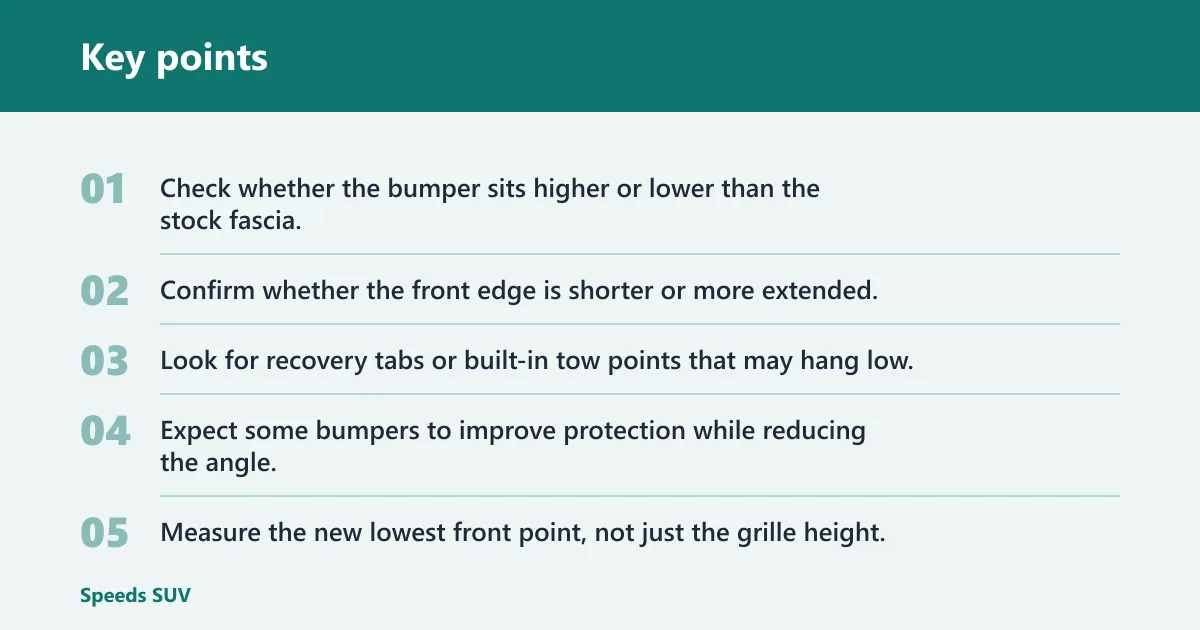
- Check whether the bumper sits higher or lower than the stock fascia.
- Confirm whether the front edge is shorter or more extended.
- Look for recovery tabs or built-in tow points that may hang low.
- Expect some bumpers to improve protection while reducing the angle.
After adding a winch
- Measure the new lowest front point, not just the grille height.
- Watch for extra protrusion that can contact rocks or driveway lips first.
- Check whether the winch mount changes airflow and front-end drag.
- Make sure the bumper still leaves room for skid plate coverage.
After adding a lift or larger tyres
- Confirm the change in static ride height at the front.
- Check whether the tyres add enough clearance to matter on the trail.
- Recheck wheelwell clearance and suspension travel at full compression.
- Do not assume a taller stance fixes a long overhang.
After adding skid plates
- Expect better damage resistance, not more clearance.
- Check whether the plate hangs below the bumper or frame edge.
- Confirm that it protects the weak point without becoming the first strike surface.
- Pair it with a front shape that still suits your terrain.
Can a low approach angle damage the front bumper or skid plate? Yes. On steep driveways or sharp rocks, a low front angle can turn the bumper into the first contact point, and then the skid plate may take the hit if the vehicle keeps moving forward. That is exactly where front-end geometry and protection need to be judged together.
Frequently asked questions
What is angle of approach in vehicles?
Angle of approach is the front-end angle a vehicle can take on before the bumper or nose contacts the ground. It is measured with the vehicle static and loaded, so it reflects the actual geometry you have on the road or trail, not a suspension flex moment.
What is a good approach angle for off-road driving?
For most buyers, 30 degrees is a practical floor for mild trail use, 35 degrees is better for serious trail use, and 40 degrees or more suits hard rock crawling. The right number depends on terrain, wheelbase, and how much front overhang the vehicle carries.
How much approach angle do I need for rocks or steep driveways?
For rocks, aim for at least 35 degrees, and 40 degrees or more is safer for repeated ledges. For steep driveways, 30 degrees may be enough if the transition is smooth, but sharp aprons can still scrape a bumper even when the driveway looks manageable.
Is a bigger approach angle always better?
Not always. A higher number usually helps off-road, but daily driving can suffer if a short bumper, winch mount, or aggressive front shape creates fitment issues, more drag, or awkward curb strikes. The goal is enough angle for your terrain, not the biggest number possible.
How do bumpers, skid plates, and tow hooks affect approach angle?
Bumpers can improve or reduce approach angle depending on shape. Skid plates mainly reduce damage risk, and tow hooks can influence the front edge if they sit low. The best setup keeps recovery and protection while avoiding unnecessary protrusion at the nose.
How does approach angle compare with ground clearance?
Ground clearance is the distance to the lowest point under the vehicle, often the differentials on solid-axle 4x4s. Approach angle is about the front entry point. You need both: clearance helps the underbody, and approach angle helps the front clear the obstacle in the first place.