What Is the Best Used SUV with a Timing Chain?
The best used SUV with a timing chain is usually the one with the cleanest service history, not the one that merely has a chain. If you want a short list, start with the Toyota RAV4 hybrid/petrol variants, Mazda CX-5 Skyactiv-G petrols, and the right Dacia Duster engine for your market, then compare oil-change records, cold-start noise, and repair access. A chain can cut scheduled timing-belt costs, but it does not remove engine wear risk.
Chain SUV decision table
| Model family | Engine type | Why it suits the buyer | Likely chain durability | Known failure sensitivities | Typical inspection priority | Buyer fit | What to verify in history | Red flags to avoid |
|---|---|---|---|---|---|---|---|---|
| Toyota Yaris Cross | 1.5-litre hybrid | Best fit for buyers who want low fuel use and a mainstream hybrid SUV with chain-based timing | Generally strong when serviced to schedule; Toyota’s hybrid powertrains are designed for long service life and the timing chain is a long-life component rather than a routine wear item (Toyota owner literature) | Missed oil changes, infrequent use, and cold-start rattle if maintenance has been neglected | Service history, oil-change cadence, cold-start noise, and confirmation of the exact hybrid system for the market | Best low-risk hybrid | Annual servicing, oil changes on time, warranty cover if still active, and no repair gaps | Skipped services, rough cold starts, warning lights, or a history that suggests short oil intervals were ignored |
| Toyota RAV4 | 2.0/2.5 petrol and hybrid ranges vary by market and generation | Strong reliability benchmark for buyers who want a familiar Japanese SUV with broad market support | Usually strong in well-maintained petrol and hybrid versions; Toyota’s own maintenance schedules and warranty terms support long service life when oil care is consistent | Engine-specific wear if oil changes were missed; always verify the exact unit and market spec rather than assuming all RAV4s are identical | Exact engine code, service intervals, and evidence of routine oil maintenance | Best overall | Complete service book, clean history check, and proof that routine maintenance was kept up | Crash repairs, poor maintenance records, or an unclear engine variant |
| Mazda CX-5 | 2.0/2.5 Skyactiv-G petrol families | Good choice for buyers who want a reliable used SUV with better driver appeal than many economy rivals | Generally strong if serviced regularly; Mazda’s petrol-focused Skyactiv-G engines are chain-driven and reward frequent oil changes | Dirty oil and missed changes can stress the chain system; confirm the petrol engine family because diesel variants differ by market and year | Oil service timing, cold-start sound, and proof the exact Skyactiv-G engine is fitted | Best overall | Regular oil changes, clean ownership history, and evidence of sensible servicing | Delayed servicing, engine noise on cold start, or signs of neglected fluids |
| Dacia Duster | TCe petrol, dCi diesel, and hybrid choices vary by market and year | Best budget-value option for buyers who want a low-price SUV and accept simpler cabin and trim materials | Mixed: some chain-equipped petrol and hybrid versions are straightforward, while diesel and market-specific engines need closer verification | Engine-specific maintenance sensitivity; check for hard use, poor oil service, and whether the exact engine is chain-equipped in your market | Exact engine code, service history, and evidence of regular oil changes | Best cheap buy | Prior maintenance, mileage consistency, body condition, and any work linked to hard use | Patchy service records, heavy wear, and repairs that suggest a cheap buy became an expensive one |
| Honda CR-V | Engine choice varies by generation; petrol and hybrid versions are market-specific | Useful for buyers who want a family SUV with a long reputation for dependable ownership | Usually good when the exact engine and service schedule are known; verify whether your market’s CR-V uses a chain and which powertrain generation it has | Oil neglect, unclear engine spec, and the wrong assumption that all CR-Vs share the same timing setup | Service invoices, gearbox servicing where relevant, and proof of timely oil changes | Family buyer | Service invoices, gearbox servicing where relevant, and proof of timely oil changes | Missing history, oil sludge signs, or uneven wear from neglected maintenance |
| Nissan Qashqai | Engine choice varies by generation; some petrol and mild-hybrid versions use chains, while older or different-market units may not | Common used-SUV choice with a wide market, which helps comparison shopping | Varies materially by engine family; verify the exact powertrain rather than treating the badge as proof of chain timing | Unknown engine spec, patchy servicing, or known model-year weaknesses not matched to the right engine | Exact engine type, full service record, and evidence that any known weak points were addressed | Comparison shopper | Exact engine type, full service record, and evidence that any known weak points were addressed | Unknown engine spec, patchy servicing, or a car history report with unresolved damage |
| Hyundai Tucson | Petrol and hybrid options vary by model year and market | Good for buyers who want a newer-feeling used SUV and a broad choice of trims | Mixed but often acceptable when the exact engine family is confirmed and oil service intervals were followed | Non-standard servicing, incorrect engine assumptions, and market-specific differences in timing hardware | Warranty status, engine code, and service stamps | Warranty-minded buyer | Warranty status, service stamps, and a clean history report | Non-standard servicing, major repairs, or signs of neglect under the bonnet |
| Kia Sportage | Petrol and hybrid options vary by model year and market | Useful for buyers who want a practical family SUV with wide availability on the used market | Varies by engine; verify the exact petrol or hybrid unit and confirm whether it is chain-driven in your market | Missing documents, mismatched mileage records, or engine-specific servicing gaps | Warranty history, oil service timing, and accident records | Family buyer | Warranty history, oil service timing, and accident records | Missing documents, mismatched mileage records, or repair-heavy history |
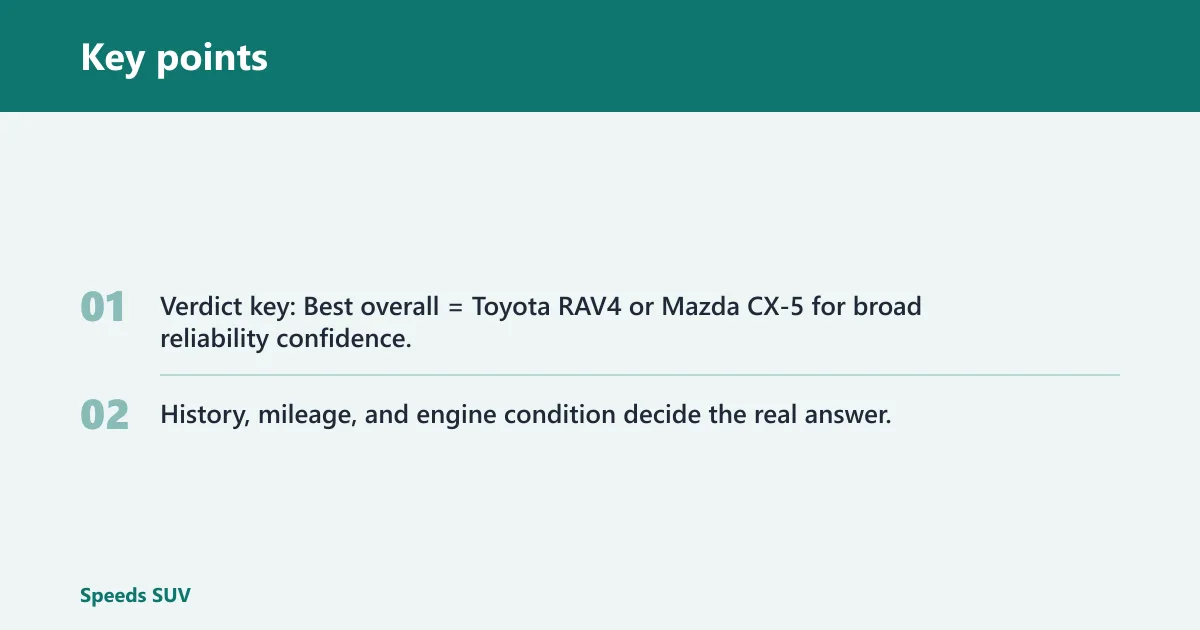
Verdict key: Best overall = Toyota RAV4 or Mazda CX-5 for broad reliability confidence; Best cheap buy = Dacia Duster only if the exact engine and records check out; Best low-risk hybrid = Toyota Yaris Cross. History, mileage, and engine condition decide the real answer.
What a timing chain means
A timing chain is an internal engine timing component that is usually oil-lubricated and built for long service life. Manufacturer service schedules and owner manuals generally treat it as a long-life item rather than a routine replacement part, but it can still wear or fail if oil changes are missed, oil quality is poor, or the engine has been run with low lubrication for too long. Chain presence helps, but it is not a free pass.
How chains differ from timing belts
Timing belts are rubber-based service items that are commonly treated as having a scheduled replacement interval. A chain is usually meant to last much longer, so you avoid a routine belt swap, but you can still face tensioner, guide, or oiling problems. That is why the answer to “which SUVs have timing chains?” matters less than how the engine was maintained.
Why service history still matters
With a used SUV, chain wear often tracks back to skipped oil services rather than the chain itself. Short trips, dirty oil and missed changes, and long service gaps can strain the tensioner and guides. If the record is vague, a chain-equipped SUV can be riskier than a belt-driven one with clean documentation.
Common chain-related warning signs
Listen for startup rattle, uneven idle, warning lights on startup, and rough running when the engine is cold. A brief noise on ignition is a reason to ask questions; persistent clatter is a reason to walk away or budget for inspection. Repair access matters too, because some engines turn a timing job into a costly labour bill.
Which SUVs have timing chains?
Many SUVs use timing chains, especially petrol and hybrid models built for long service life rather than simple scheduled belt changes. The useful question for a used buyer is not whether a chain exists, but whether the exact engine family has a good record and whether the service history supports that reputation. Toyota, Mazda, and some Dacia and Honda variants are common examples, but the engine code matters more than the badge.
Toyota Yaris Cross
The Toyota Yaris Cross is a strong low-risk hybrid example because its 1.5-litre hybrid powertrain is designed for long service life and Toyota backs eligible vehicles with up to 10 years of warranty cover when annual servicing is kept up. That makes it a sensible used-buy benchmark for urban use, but it is not the main answer if you want a broad used-SUV recommendation.
Toyota RAV4
The Toyota RAV4 is best treated as an engine-family story rather than a one-size-fits-all answer. In the used market, the petrol and hybrid 2.0/2.5-litre families are the versions most often cross-shopped for chain timing, while service discipline remains the main reliability filter.
Mazda CX-5
The Mazda CX-5 most commonly enters the chain conversation through its Skyactiv-G petrol engines, which are chain-driven and rewarded by consistent oil changes. That makes it a sensible candidate for buyers who want a mainstream SUV with a reputation for solid long-term ownership, provided the exact petrol engine is confirmed.
Dacia Duster
The Dacia Duster is a good reminder that model names are not enough: engine choice varies a lot by market and year, and some versions are chain-equipped while others are not the same story. Check the exact engine specification and compare it with the manufacturer’s servicing information before you assume timing-chain durability.
Say your budget is tight and you only want a compact SUV for school runs and supermarket trips. A Duster with full service records can make more sense than a pricier badge with missing paperwork, because the lower purchase price leaves more room for routine maintenance.
Are chain SUVs more reliable?
Not automatically. A timing chain can lower scheduled replacement work compared with a belt, but it does not make an SUV safe to buy on its own. The best used SUV is the one with the right engine family, documented servicing, and no evidence of oil neglect or early-chain wear.
When chain layout lowers risk
Chain-equipped SUVs can be attractive when the manufacturer built the engine for long service life and the car has a clean record of oil changes. That is why Toyota and Mazda usually sit near the top of used-SUV reliability conversations. The chain is part of the picture, not the whole answer.
When maintenance history matters more
If the engine has poor oiling design, a sensitive tensioner, or expensive timing access, the chain may still be a liability. A used SUV with a chain but weak history can cost more than a belt-driven model that was serviced on time.
Why engine family matters more than the badge
Two SUVs from the same brand can age very differently. One engine may tolerate missed mileage better, while another reacts badly to long oil intervals. That is why you should compare exact engines, service records, and known weak points before deciding that a chain-equipped SUV is the safer buy.
How do you check a used SUV properly?
Start with the service book, then verify the invoices, then confirm the car history. A full car history check helps you spot ownership gaps, accident repairs, mileage issues, and finance markers. For a chain-equipped SUV, you want proof of regular oil changes and no hidden damage that could complicate an engine repair.
Service-book and invoice checks
- Check that servicing is recorded at regular intervals, not in one long gap.
- Look for oil and filter changes rather than generic stamps only.
- Match mileage across invoices, MOT records, and adverts.
- Ask whether the timing system has ever been inspected, repaired, or heard rattling.
Cold-start and idle checks
Start the engine from cold and listen before the idle settles. A brief chain noise can point to wear, but repeated rattle, shaking, or warning lights need deeper inspection. Suppose a 2.0-litre SUV starts quietly in the morning but rattles for several seconds after a short stop. That pattern deserves attention, because hot restart noise can point to oil pressure or tensioner issues.
History report and ownership checks
Use a car history check to confirm title status, accident records, previous keeper count, and mileage consistency. Those checks do not replace mechanical inspection, but they reduce avoidable risk.
Best used SUV picks by buyer type
If your question is really “what is the best used SUV with a timing chain for me?”, split the answer by priorities. Fuel economy points to the Yaris Cross. Broad reliability confidence points to the RAV4 or CX-5. Tight budgets point to the Duster, provided the paperwork is solid and the car history checks out.
Best for fuel economy
The Toyota Yaris Cross is the strongest answer for buyers who want low fuel use and chain-based timing. Toyota’s warranty terms and service documentation make it the low-risk hybrid choice, while owner-manual guidance supports the idea that the chain is intended as a long-life component rather than a regular replacement item.
Best for family reliability
The Toyota RAV4 and Mazda CX-5 are often used as comparisons among used SUVs for dependable family ownership. Both reward buyers who value a clean service record over a low sticker price. If history is thin, move on.
Best for budget value
The Dacia Duster is the strongest inexpensive used SUV option here. It is the right choice for buyers who need a lower entry price and are willing to inspect the car carefully. It should still be judged on condition, documents, and repair history.
Frequently asked questions
What is the best used SUV with a timing chain?
The Toyota RAV4 or Mazda CX-5 are the best used SUV choices with a timing chain if you want the strongest mix of broad reliability confidence and mainstream ownership appeal. The Yaris Cross is a good low-risk hybrid, but it is better treated as a specialist economy pick than the main all-round answer.
Which SUVs have timing chains instead of timing belts?
Many petrol and hybrid SUVs use timing chains, but the exact answer depends on engine family and model year. The practical shortlist here can include the Toyota Yaris Cross, Toyota RAV4 2.0/2.5 petrol and hybrid versions, Mazda CX-5 Skyactiv-G petrols, and some Dacia Duster engines. Always confirm the engine specification before you buy.
How do I know if a used SUV has a timing chain?
Check the owner’s handbook, service records, and engine specification. Sellers may describe the model broadly, but timing hardware is engine-specific. If the advert is unclear, ask for the exact engine specification and compare it with manufacturer information before you assume the car uses a chain.
Are timing chain SUVs more reliable to buy used?
Sometimes, but not by default. A chain can cut scheduled replacement work compared with a belt, yet a poorly serviced chain engine can still develop expensive problems. Used reliability depends more on oil-change history, engine design, cold-start behaviour, and the quality of the car history check.
Which used SUV models are best for reliability?
Toyota and Mazda are usually the safest starting points for reliability-focused buyers, with the Toyota RAV4 and Mazda CX-5 standing out in this group. The Toyota Yaris Cross is also a strong pick if you want efficiency as well as a chain-based engine layout.
What is the best inexpensive used SUV to buy?
The Dacia Duster is the best inexpensive used SUV here. It is the value choice, not the luxury choice, so the key is to verify service history, mileage consistency, and body condition. A cheap SUV with poor paperwork can become far more expensive than it first looks.