What Causes Transmission Problems in SUVs?
Most SUV transmission problems trace to four causes: low or wrong fluid, heat damage, mechanical wear, or electronic faults. If symptoms show up only hot or under load, start with fluid level and heat exposure before you assume internal failure. Ignoring the wrong cause can turn a simple service into a full rebuild. This guide maps common SUV transmission symptoms to likely causes, so you know what to check first and what diagnosis may actually cost.
Why SUV transmissions fail
SUVs put extra load on a transmission when they tow, climb hills, idle in traffic, or lug a heavy cabin full of passengers. That load raises fluid temperature and speeds wear, especially in vehicles that already run a CVT, a dual-clutch unit, or a high-mileage stepped automatic.
Heat, load, and fluid breakdown
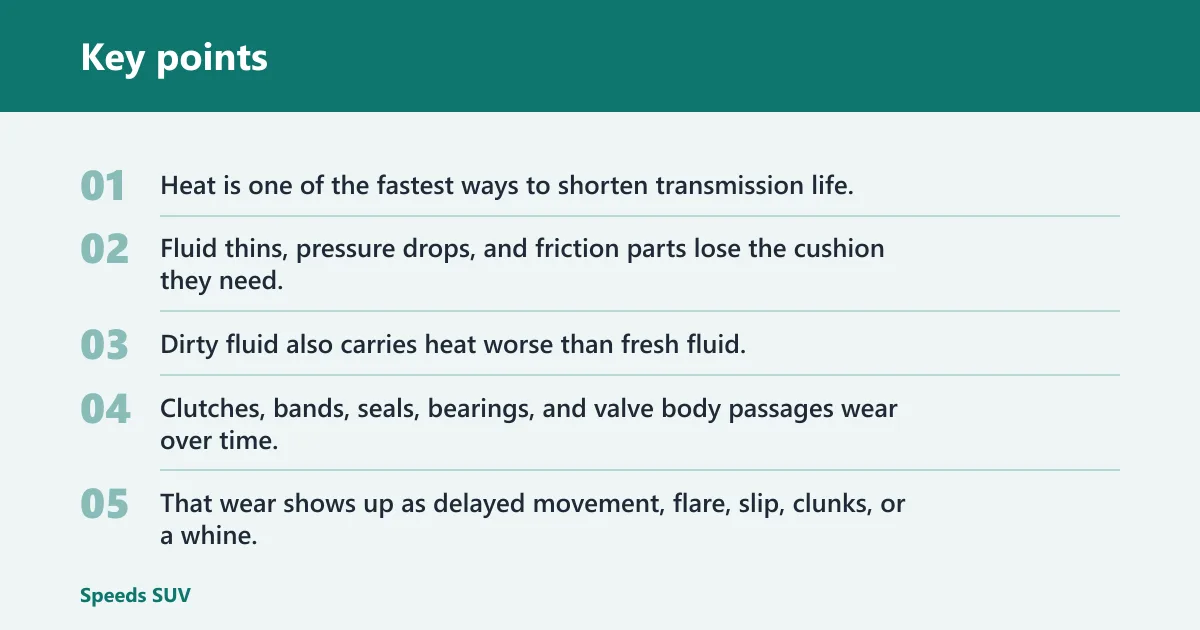
Heat is one of the fastest ways to shorten transmission life. Fluid thins, pressure drops, and friction parts lose the cushion they need. Dirty fluid also carries heat worse than fresh fluid, so a neglected service can turn a minor shift complaint into a repeat overheating pattern.
Wear inside the transmission
Clutches, bands, seals, bearings, and valve body passages wear over time. That wear shows up as delayed movement, flare, slip, clunks, or a whine. Once internal clearances grow, the problem usually gets worse under load before it becomes obvious in normal city driving.
Electronic control faults
Modern SUVs rely on sensors, shift solenoids, and a transmission control module, or TCM. When the TCM sees a fault, it can trigger a warning light, change shift timing, or force limp mode to protect the unit. A scan tool helps identify that path, but it does not prove the final repair by itself.
What causes transmission problems in SUVs?
The most common causes are low or dirty fluid, overheating, internal wear, and electronic control faults such as a bad sensor, solenoid, or TCM issue. In many SUVs, the symptom pattern tells you which cause is more likely. Hot-only problems point toward fluid or heat; cold-start delay can point toward pressure loss or wear.
Fluid level and fluid condition
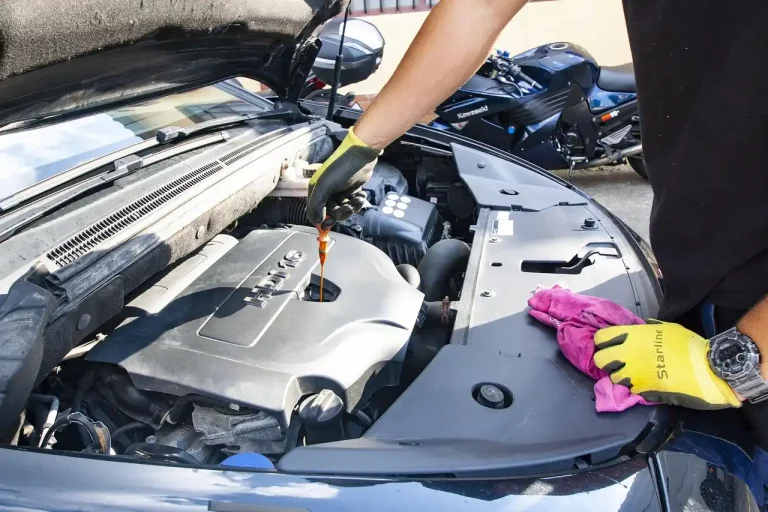
Low transmission fluid can reduce hydraulic pressure, which affects engagement, shift quality, and clutch apply force. Dirty fluid can also act like a warning sign before failure, especially if it smells burnt. Inspection may use a dipstick on some models or a hoist-level check on others.
Mechanical wear and internal damage
Wear inside the transmission often shows up as slip, harshness, or a high-RPM flare without clean acceleration. If a higher gear slips, the transmission may seem fine at low speed but lose control once road speed rises. That pattern usually needs more than a fluid service.
Cooling problems and overheating
Some SUV transmissions are commonly reported to overheat after a long drive, towing, or stop-and-go use. A hot transmission may go into limp mode and cut power. Some CVTs can overheat and enter limp mode with reduced power, which is a strong clue that heat protection, not a simple shift issue, is active.
Sensors, solenoids, and the TCM
Solenoids and sensors control line pressure and gear changes. If the TCM reads an out-of-range signal, it may trigger a warning light and store diagnostic trouble codes. That matters because an electrical fault can mimic a mechanical failure, and a scan can help separate the two.
Transmission causes and symptom matrix
This matrix connects the symptom to the most likely cause category, a quick check you can do, and the point where driving should stop. It is meant for triage, not final repair decisions.
| Symptom | Most likely cause category | Quick check a driver can do | When to stop driving |
|---|---|---|---|
| Delayed engagement into Drive | Low fluid, wear, or valve body pressure loss | Note whether Drive takes several seconds to engage after a cold start | Stop if the delay grows longer or the SUV lurches when it finally moves |
| Delayed engagement into Reverse | Low fluid or worn internal seals | Count the delay from selector movement to movement at the wheels | Stop if Reverse fails to engage or takes seconds every time |
| Slipping on acceleration | Fluid pressure loss, clutch wear, or CVT belt and pulley wear | Watch for high RPM without matching acceleration | Stop if the SUV will not pull normally in traffic |
| Gear hunting | TCM logic, sensor error, or low fluid | Notice repeated upshift/downshift changes on a steady road | Stop if the hunting is paired with warning lights or overheating |
| Harsh upshift | Control fault, worn valve body, or fluid problem | Feel for a strong jolt between specific gears | Stop if the jolt is severe or the transmission bangs on every shift |
| Harsh downshift | Hydraulic control fault or internal wear | See whether the clunk happens only when slowing or braking | Stop if the SUV surges or bucks with each downshift |
| Drive or Reverse engagement shock | Pressure control fault or worn mounts plus transmission wear | Shift from Park at idle and listen for a hard clunk | Stop if engagement is violent or the vehicle jumps forward or back |
| Jerking during slow acceleration | CVT behavior, clutch issue, or oil on clutch discs in a dual-clutch transmission | Compare light throttle takeoff with stronger throttle | Stop if the jerk becomes repetitive or the SUV enters limp mode |
| Shuddering at low speed | Torque-converter shudder, CVT response issue, or clutch slip | Feel whether the shudder happens during steady light throttle | Stop if the vibration spreads to higher speeds |
| Whining or whirring | Wear, low fluid, or pump noise | Listen in Park, Reverse, and Drive for a rising whine | Stop if the noise grows louder with speed or is paired with slip |
| Burnt fluid smell | Overheating or clutch wear | Check for a burnt smell on the dipstick or fluid sample | Stop if the smell appears after a short drive or with warning lights |
| Fluid leak | Seal, pan, cooler line, or case leak | Look under the SUV or on a hoist for wet spots | Stop if the leak is active or fluid level is visibly low |
| Limp mode | Heat protection, TCM fault, or severe internal slip | Note whether power is reduced after driving for a while | Stop driving if the SUV is stuck in reduced power or fixed gear behavior |
| Check Engine light or A/T warning light | Sensor, solenoid, TCM, or transmission-related fault code | Check whether the light is steady or paired with shifting issues | Stop if the light stays on and the transmission behavior changes |
Can low transmission fluid cause an SUV transmission to slip?
Yes. Low transmission fluid can cause slipping because the transmission loses hydraulic pressure and clutch apply force. That can show up as high RPM without acceleration, delayed movement after shifting into Drive, or gear hunting under load. A leak or low level should be treated as a real fault, not a minor nuisance.
How low fluid changes hydraulic pressure
The transmission uses fluid to move pressure where it is needed. When the level drops, the pump can draw air, pressure falls, and the clutches do not clamp correctly. The result may be a flare between shifts or a feeling that the SUV is moving behind the engine instead of with it.
What dirty or burnt fluid means
Dirty transmission fluid with a burnt smell is a bad sign. It points to heat, friction, or both. If fluid is dark and smells burnt, a simple top-off usually is not enough. That condition often means the transmission has already been stressed hard enough to damage internal parts.
Quick checks for leaks and level
Some SUVs still use a dipstick, which makes checking easier. Others require a hoist-level inspection or a shop-level fill procedure. Low transmission fluid can be visible as a leak during inspection, especially around the pan, cooler lines, axle seals, or case seams.
Say your SUV hesitates for five seconds before backing out of a parking space on a cold morning, then shifts normally for the rest of the drive. That pattern can point to low fluid or pressure loss that shows up most clearly before the transmission warms up.
Why do SUVs jerk or shudder?
Jerk or shudder can come from a CVT, a torque-converter automatic, or a dual-clutch system. The cause depends on when it happens. Low-speed shudder often points to clutch or converter behavior, while a rhythmic jerk during gentle acceleration can point to control logic, heat, or wear.
CVT pulleys and steel belt behavior
A CVT uses a pulley system and a steel belt instead of fixed gears. That design can feel different from a stepped automatic. If a CVT overheats, it may respond slowly, jerk, shudder, or enter limp mode. Some drivers describe it as a rubber-band feel, but a worsening version should not be dismissed as normal behavior.
Torque-converter or clutch shudder
Shudder can also come from the torque converter or from clutch engagement in a dual-clutch transmission. Jerking during slow acceleration can signal oil leaking onto clutch discs in a dual-clutch transmission. That kind of fault often starts small and gets worse as the unit heats up.
When heat or wear is the likely trigger
If the SUV jerks after a long highway run, towing session, or steep hill climb, heat is a strong suspect. If it shudders only in one gear range or during one type of shift, wear or a control fault may be more likely. Either way, the symptom is worth a full diagnostic scan.
Suppose a midsize SUV shudders only when easing onto the throttle from a stop, but pulls smoothly once speed rises. That narrow pattern can fit a clutch or CVT issue more closely than an engine misfire, which is why the exact speed and load matter so much.
What the warning lights mean
A Check Engine light or A/T warning light can point to a transmission fault, especially if the light stays on and the shift behavior changes. A steady light means the code is stored and should be checked; a flashing or warning state means the problem may be more urgent and could be tied to active slip or a fail-safe mode.
Check Engine light and A/T warning light
Transmission-related trouble codes can turn on the Check Engine light, the A/T light, or both. A steady light may reflect a sensor, solenoid, or TCM issue. If the light appears with harsh shifting, delayed engagement, or limp mode, do not assume it is only an engine problem.
TCM-triggered codes and scan relevance
The TCM is an electronic control unit, so it can fail, misread a sensor, or command an odd shift pattern. A diagnostic scan matters because it can identify transmission-related trouble codes and separate them from engine or wiring faults. It cannot, by itself, confirm whether the repair is a solenoid, a sensor, or a full rebuild.
Limp mode and reduced-power behavior
Overheat indicator or limp mode behavior often shows up after the SUV has been driven for a while. Reduced power is the point, not a side effect. The transmission may lock itself into a limited gear range to prevent more damage, which is why that symptom deserves immediate attention.
When to stop driving
Stop driving if the SUV slips badly, fails to move, gives off a burnt smell with new noise, or drops into limp mode. Those are the signs that the problem may be moving beyond a service issue. If a warning light stays on before purchase, treat that as a reason for a deeper inspection before any deal is signed.
Severe slipping or no movement
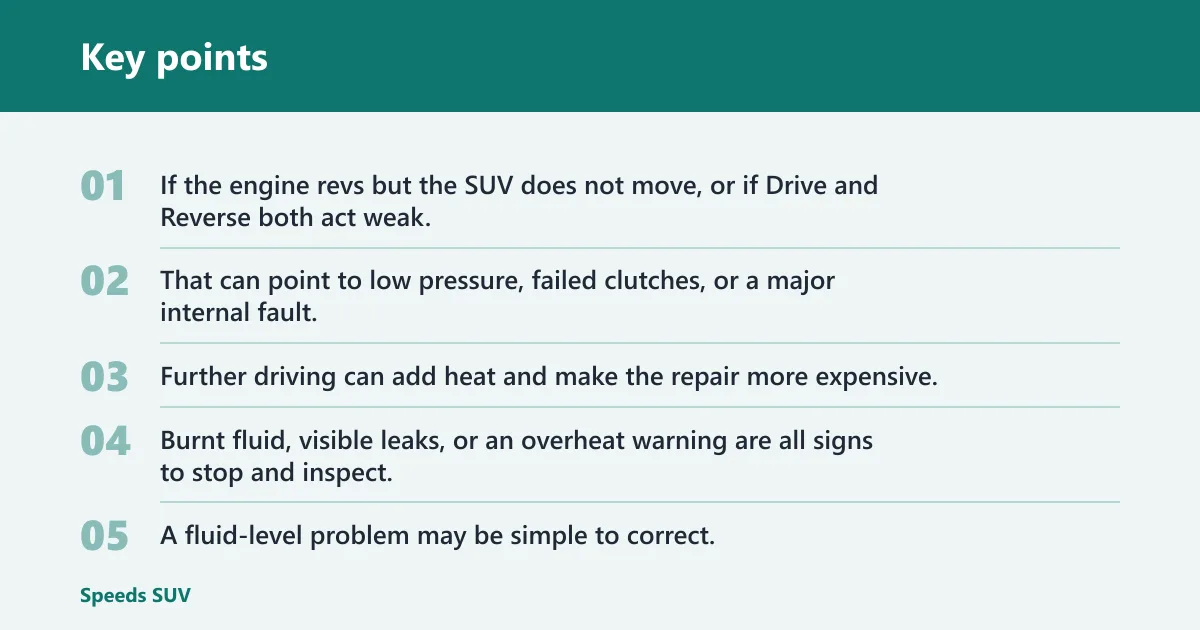
If the engine revs but the SUV does not move, or if Drive and Reverse both act weak, the transmission may be beyond a simple fluid fix. That can point to low pressure, failed clutches, or a major internal fault. Further driving can add heat and make the repair more expensive.
Burnt smell, leaks, or overheating
Burnt fluid, visible leaks, or an overheat warning are all signs to stop and inspect. A fluid-level problem may be simple to correct, but continued driving with a leak can damage the pump, clutches, and converter. Heat is the fastest path from service item to major failure.
Test-drive signs for used-SUV shoppers
Used-SUV shoppers should test drive longer than a quick loop around the block. Pay attention to cold start behavior, Reverse engagement, light-throttle shudder, and whether any warning light stays on. Consumer Reports surveys cover trouble spots including the transmission and electrical system, and its 2025 surveys collected feedback on about 380,000 vehicles. That broad feedback helps buyers spot patterns that short test drives miss. (Consumerreports)
Some shoppers ask what SUV does not have transmission problems. There is no honest universal answer. Every SUV line can have trouble, and warranty history matters more than a slogan. Nissan doubled the Rogue powertrain warranty from 5 years/60,000 miles to 10 years/120,000 miles, which shows how seriously some makers treat transmission risk on specific models.
Frequently asked questions
What are the most common causes of SUV transmission failure?
Low fluid, heat damage, worn clutches or seals, and control faults are the most common causes. If the transmission slips, shudders, or takes too long to engage, the problem may be hydraulic or internal. If a light is on, electronic diagnosis becomes part of the first check.
Can a CVT overheat and trigger transmission problems in an SUV?
Yes. Some CVTs can overheat and enter limp mode with reduced power. A hot CVT may feel slow to respond, jerk, or shudder before it limits performance. If the symptom appears after driving for a while, heat protection is a likely part of the failure path.
Why does my SUV jerk or shudder when accelerating?
Jerk or shudder can come from CVT behavior, torque-converter shudder, clutch problems, or heat-related control changes. Jerking during slow acceleration can signal oil leaking onto clutch discs in a dual-clutch transmission. If the issue happens only at certain speeds or under light throttle, note that pattern before diagnosis.
What does it mean if my SUV takes seconds to shift into Reverse?
A delay of several seconds before Reverse fully engages often points to low fluid, pressure loss, or internal wear. Some SUV transmissions can take 5-6 seconds before Reverse fully engages when cold, but repeated delay is not normal. If the delay worsens, the vehicle should be checked before more driving.
Can transmission problems cause a check engine light in an SUV?
Yes. Transmission faults can trigger the Check Engine light, the A/T warning light, or both. A steady light with rough shifting, slip, or limp mode should be scanned for transmission-related trouble codes. A warning light that stays on needs attention before buying or continuing to drive.
What SUV does not have transmission problems?
No SUV is free from transmission problems. Reliability varies by model, year, maintenance history, and powertrain type. The better question is which SUV shows fewer repeat complaints for the transmission and electrical system, and whether the specific vehicle you are looking at has warning lights, delayed engagement, or service records.