Does My Truck Have Cylinder Deactivation?
A truck may have cylinder deactivation if factory paperwork, emissions labeling, or scan data shows AFM, DFM, MDS, or V4/V8 switching language; if none of those clues appear, confirm by VIN/build data before you assume the engine has it. That matters because truck fitment varies by make, engine family, model year, market, and calibration, and the same body style can be equipped very differently.
What cylinder deactivation
Cylinder deactivation is a fuel-saving strategy that closes some cylinders during light-load driving and brings them back when demand rises. GM has called it Active Fuel Management and Dynamic Fuel Management, Ram has used Multi-Displacement System, and Ford refers to Dynamic Cylinder Deactivation on specific 5.0L applications. EPA fuel-economy references for these systems exist, but the exact savings depend on the truck, engine, axle ratio, load, and drive cycle.
How the system saves fuel in light-load driving
Under cruising or coasting conditions, the engine may not need full displacement. In those moments, the controller can run on fewer cylinders so the engine is using less air and fuel than it would at full-cylinder operation. That is why drivers usually notice it most on steady highway stretches, not during hard acceleration or towing.
How the engine computer switches cylinders on and off
The truck engine control module monitors torque demand, load, throttle input, speed, temperature, and related conditions. When it sees light load, it commands hydraulic or electrically controlled valvetrain hardware so selected valves stay closed while fuel delivery is reduced for those cylinders. Manufacturer technical material for GM’s DFM describes multiple cylinder patterns and controller decisions made very rapidly; the point is that the transitions are designed to be smooth enough that most drivers barely notice them.
Why manufacturers give it different names
Different brands use different labels for the same basic idea. GM has used Active Fuel Management and Dynamic Fuel Management. Ford uses Dynamic Cylinder Deactivation on certain 5.0L applications. Ram buyers may see Multi-Displacement System or MDS. The label matters because the feature can be easy to miss if you only search for one brand name.
How to check your truck’s factory clues
The fastest way to confirm cylinder deactivation is to work from factory paperwork first, then look at the emissions label and owner manual wording, then use scan data, and only then use behavior clues. Do not rely on engine sound alone. A truck can have the hardware, a calibration that uses it, or both depending on year, market, trim, and engine family.
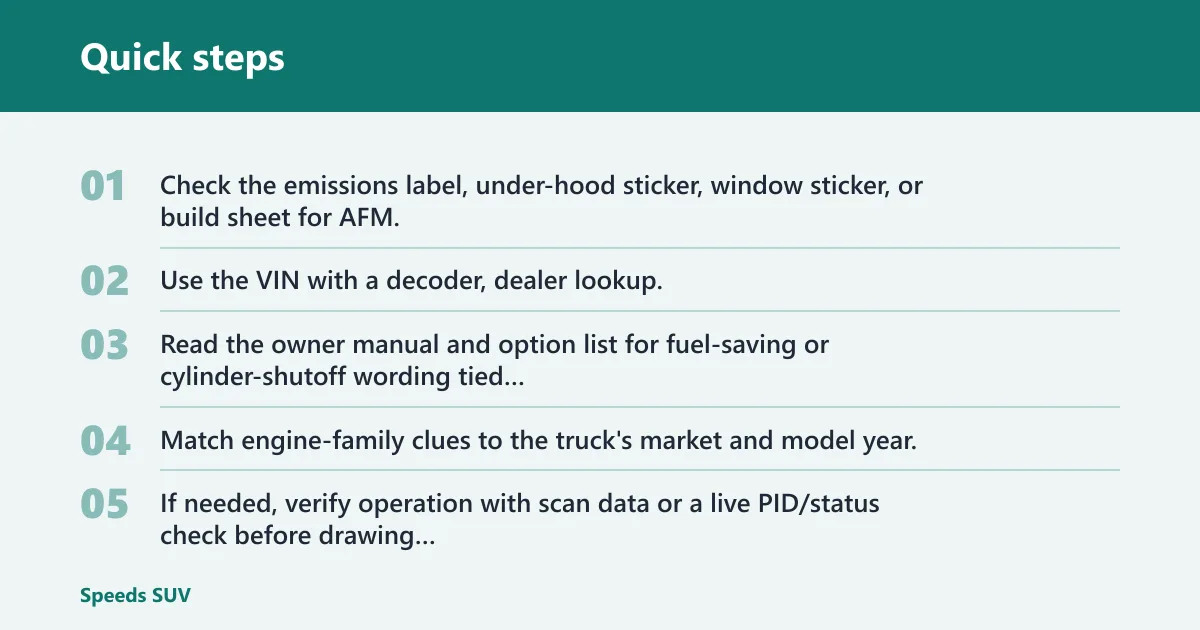
- Check the emissions label, under-hood sticker, window sticker, or build sheet for AFM, DFM, MDS, or V4 wording.
- Use the VIN with a decoder, dealer lookup, or build sheet to identify the exact engine code and factory option content.
- Read the owner manual and option list for fuel-saving or cylinder-shutoff wording tied to the engine operation section.
- Match engine-family clues to the truck’s market and model year, and confirm with the specific RPO/build code where available.
- If needed, verify operation with scan data or a live PID/status check before drawing conclusions from road feel alone.
VIN and build-code lookup
The VIN does not always spell out cylinder deactivation in plain text, but it can point to the exact engine code and factory configuration. That is the cleanest path when a truck has had swaps, tuning, fleet upfits, or incomplete seller paperwork. Build codes are especially useful on trucks whose engine family changed mid-generation or across trim levels.
Window sticker and Monroney label clues
Many factory stickers list powertrain packages, engine family names, or equipment descriptions that hint at AFM, DFM, or MDS. If the sticker calls out a V4-capable mode, that is a strong clue. If the sticker is missing, the emissions label or build sheet may carry the same information in a more technical format, including engine family and calibration references.
Owner manual and option-sheet wording
Owner manuals often describe how the truck may run on fewer cylinders under light load. The wording is usually tucked into the engine operation, fuel economy, or driving sections rather than the main feature list. Look for exact phrases such as “active fuel management,” “dynamic fuel management,” “multi-displacement system,” “cylinder deactivation,” or “V4 mode,” then confirm the engine code and equipment list.
Engine family clues that point to the feature
Engine family matters because some truck engines are strongly associated with cylinder deactivation while others are not. GM small-block V-8 truck engines, Ford’s 5.0L Coyote V8 in specific 2018 and later applications, and Ram V-8 applications with MDS are the most common truck examples. Market, trim, and model year still matter, so the engine family is a clue, not final proof.
Truck cylinder deactivation checklist
| Make | Engine family | Key years / truck applications | Marketing name used | Likely status | Exact confirmation path | What the driver may notice in operation |
|---|---|---|---|---|---|---|
| GM | 5.3L and 6.2L V-8 truck small-blocks | Common across many full-size GM truck applications; confirm by VIN/build data because availability varies by year, trim, and calibration | Active Fuel Management (AFM), Dynamic Fuel Management (DFM) | Common on many truck applications, but not universal across every year or trim | VIN decoder or dealer build sheet; RPO/build code examples on the glovebox/service parts label; owner manual wording; emissions label language; scan data confirming cylinder pattern changes | Near-imperceptible mode changes, slight exhaust-note shift, possible mpg gain on steady cruising |
| GM | Other small-block truck V-8s | Application-dependent; verify by code, not badge, because hardware and calibration can differ by model year and platform | AFM or DFM depending on engine generation and calibration | Mixed; some applications have it, some do not | Emissions label, build sheet, dealer lookup, scan data; RPO/build code examples should match the exact engine code and option content | May feel normal until light-load cruising triggers cylinder shutoff |
| Ford | 5.0L Coyote V8 | Specific 2018 and later truck applications; confirm by VIN/build data because not every 5.0L truck is equipped the same way | Dynamic Cylinder Deactivation | Present on some 2018+ truck applications, not on every 5.0L truck | VIN, window sticker, owner manual, engine code; check the exact calibration and confirm with a scan-tool status or PID if needed | Four of eight cylinders deactivate at light load; possible 1-2 MPG gain in cruising or coasting conditions, depending on duty cycle |
| Ram | Hemi V-8 with MDS | Common on many Ram V-8 truck applications; trim, package, and model year can change equipment | Multi-Displacement System (MDS) | Often present on Hemi-equipped trucks, but confirm by VIN/build sheet because exceptions exist | VIN, Monroney label, option sheet, emissions label; owner manual wording and scan data can confirm whether MDS is enabled | Mode changes can be subtle; some owners notice a different exhaust tone or a light shudder if something is wrong |
| Any make | Turbo or non-V-8 truck engines | Depends on market and calibration; do not assume based on cylinder count alone | Vary by manufacturer | Depends on the exact engine family and software calibration | Factory paperwork, emissions label, and scan data first; then confirm the exact engine code before assuming cylinder deactivation is present | May show no obvious change unless the engine is specifically programmed for cylinder shutoff |
Does your truck behave like it has it?
If the feature is working normally, you usually notice little more than a small change in engine note, a slight change in exhaust pulse, or a steady-cruise fuel-economy improvement. If you hear tick, feel shudder, or get a warning light, do not assume the system is simply working. That can also point to a separate fault, especially on engines that use valvetrain hardware tied to cylinder deactivation.
Normal mode changes versus a fault
Normal cylinder shutoff should feel calm. The computer is designed to engage and disengage with almost no notice, so the driver should not feel a harsh hit each time cylinders return. A brief change in sound during cruising can be normal. A repeated stumble, roughness, or flashing warning is not normal.
Lifter tick, shudder, or vibration
Valvetrain lifters are a common place to look when a truck develops noise on an engine that uses cylinder deactivation. A hydraulic or collapsible lifter that is oil-pressure controlled can wear, stick, or complain audibly. That does not prove the feature is bad, but it does mean the valvetrain needs closer diagnosis. For GM AFM/DFM and Ram MDS applications, lifter behavior is one of the most important items to inspect when the symptom is ticking, roughness, or a repeatable misfire pattern. If available, an internal related guide on AFM/DFM or MDS can help narrow the diagnosis before parts are replaced.
Say your half-ton V-8 starts ticking only after warm idle and then smooths out on the road. That pattern fits a lifter concern more than a simple fuel-saving mode change, so the next step is inspection, not guessing that the truck is “just deactivating cylinders.”
Misfire codes and check-engine lights
Misfire codes, traction complaints, or a check-engine light can appear when the system or a related part is not functioning as intended. The same symptoms can also come from ignition, fuel, vacuum, oil-pressure, or sensor issues. A code scan matters because it separates normal mode changes from a genuine drivability fault.
Oil use and noise complaints
Some owners connect cylinder deactivation with oil use or top-end noise, especially on systems that rely on lifter control. The connection is not automatic. Oil level, maintenance history, and engine condition all matter. If the truck is adding noise and using oil, that is a diagnosis problem, not a forum-label problem.
Which truck engines use it?
GM, Ford, and Ram all use their own versions of cylinder deactivation in selected truck engines. The important part is the application, not the badge. Two trucks with the same body style can differ by engine code, model year, or market, so the exact confirmation step changes with the brand.
GM Dynamic fuel Management and active fuel Management
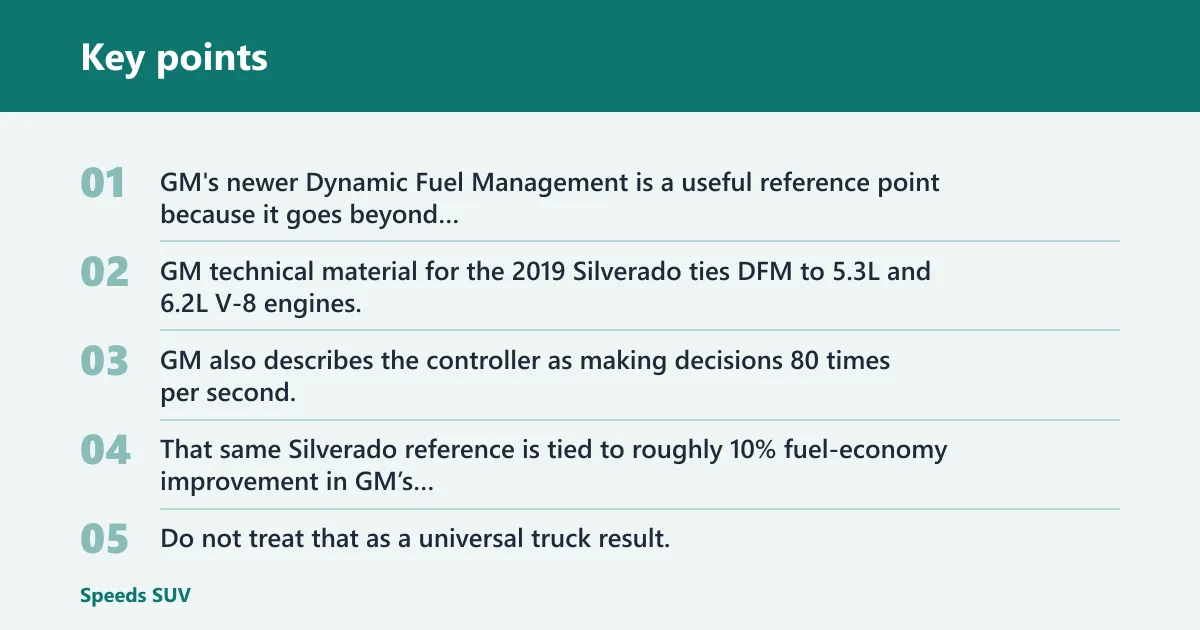
GM’s newer Dynamic Fuel Management is a useful reference point because it goes beyond simple V-4 or V-8 switching. GM technical material for the 2019 Silverado ties DFM to 5.3L and 6.2L V-8 engines, with 17 different cylinder operation patterns. GM also describes the controller as making decisions 80 times per second, which helps explain why the transition can stay hard to notice.
That same Silverado reference is tied to roughly 10% fuel-economy improvement in GM’s cited material. Do not treat that as a universal truck result. It is a reference point for what the technology can do under the tested conditions, not a promise for every driving cycle, payload, axle ratio, or route. EPA and manufacturer fuel-economy data should be treated as application-specific, not blanket numbers for every GM truck.
Ford dynamic cylinder deactivation on the 5.0L coyote V8
Ford’s 5.0L Coyote V8 in specific 2018 and later truck applications can deactivate four of eight cylinders under light load. Ford owner information and product material describe the system in terms of light-load operation and fuel savings, and the EPA’s fuel-economy resources should be used to confirm the specific truck application where available. The feature is easiest to notice on steady highway driving, not around-town stop and go.
Do Ram trucks have cylinder deactivation?
Many Ram trucks are reported to use cylinder deactivation, often under the MDS label on Hemi V-8 applications. But the exact answer depends on the engine, trim, and model year. Some markets and build combinations differ, so the presence of a Hemi badge alone is not enough to confirm the feature. Ram owner manual wording and factory build data are the safer confirmation path.
Trim and year differences to watch
Do not assume a feature stayed the same across a nameplate. A fleet truck, a high-output package, or a market-specific calibration can differ from the retail version. When the paperwork and the engine family disagree, use the factory label and build data before you trust a badge or a seller’s summary.
Can you turn it off?
Yes, some owners turn cylinder deactivation off with aftermarket disabler tools or tuner-based methods, but compatibility is vehicle-specific and the legal and warranty risks are real. The correct answer depends on your truck’s year, calibration, and whether the change affects emissions equipment or diagnostic readiness.
Aftermarket disabler tools
Plug-in disabler devices can block the feature on some trucks by altering the control logic or preventing the system from entering deactivation mode. They are not universal. A device that works on one GM or Ram application may do nothing on another model year, and it may leave diagnostic traces the owner needs to understand.
Tuner-based disable methods
Some tuners can alter the calibration so the engine stays in full-cylinder mode. That may appeal to owners chasing noise reduction, drivability changes, or peace of mind after a lifter concern. It is still a vehicle-specific change, and it should be checked against local rules and the truck’s warranty status before any move is made.
Compatibility limits by make and year
Compatibility is the trap here. A Ford 5.0L application is not the same as a GM small-block truck V-8, and neither is the same as a Ram MDS setup. The disable method, the risk, and the possible side effects depend on the exact engine code and calibration, not just the brand name.
Legal and warranty considerations
Turning off cylinder deactivation can affect emissions compliance and warranty coverage. Some methods may be treated as calibration changes that are not allowed for street use in certain areas. If the truck is still covered, read the warranty terms first. If the truck has a fault, diagnose the fault before assuming a disable is the fix.
Frequently asked questions
How does cylinder deactivation work?
The engine computer monitors load and torque demand, then commands valvetrain hardware to shut some cylinders down during light-load driving. Solenoids and lifters keep the valves closed until the engine needs full power again. The design goal is a switch that happens so smoothly that most drivers barely notice it.
What is cylinder deactivation?
It is a fuel-saving engine feature that shuts off some cylinders when the truck is cruising, coasting, or otherwise using little power. The system cuts fuel use and emissions by running on fewer cylinders until demand rises. Different brands give it different names, but the operating idea is the same.
Does my truck have cylinder deactivation?
Check the emissions label, window sticker, owner manual, and engine code first. If paperwork shows AFM, DFM, MDS, or V4 wording, that is often a strong sign of cylinder deactivation. If the paperwork is unclear, use the VIN or scan data. Guessing from engine sound alone is not reliable enough.
Can cylinder deactivation be turned off?
Sometimes. Some trucks can be modified with aftermarket disabler tools or tuner-based calibration changes, but compatibility varies by make and year. Those changes can create legal, warranty, or emissions issues, so they should be checked against the exact truck rather than treated as a universal fix.
Is cylinder deactivation bad for an engine?
Not by itself. Many engines are designed to use it, and the feature can work normally for a long time. Problems usually arise when a related part such as a lifter, solenoid, or oiling path fails. Noise, shudder, or codes deserve diagnosis; they are not proof that the feature is inherently bad.
Which vehicles have cylinder deactivation?
The feature may be present on some GM truck V-8s, Ford 5.0L Coyote V8 applications, and Ram V-8 models with MDS. The exact answer depends on engine family, model year, trim, and market. Always confirm with factory paperwork or scan data before assuming a specific truck has the feature.