How Long Does a Truck Transmission Last?
A truck transmission can last 150,000 to 300,000 miles, but duty cycle matters more than the odometer. Towing, high temperatures, and skipped fluid changes can cut that lifespan short, and OEM maintenance schedules often call for shorter intervals under severe use. Early slip or shudder should be diagnosed before it becomes a rebuild or replacement.
Truck transmission lifespan table
This table separates transmission type from use case so the range is easier to read. Real-world lifespan still varies by OEM service schedule, fluid spec, tow load, ambient heat, and maintenance history. For example, many manufacturer severe-service schedules shorten transmission-fluid intervals substantially under towing or repeated heat cycles.
| Transmission type | Typical mileage range | Common short-life triggers | Likely next step |
|---|---|---|---|
| Automatic transmission | 150,000 to 200,000 miles with good care | Heat, low or oxidized fluid, valve body wear, torque converter strain | Monitor if shifts are normal; service if fluid is overdue; diagnose if slip or flare starts |
| Manual transmission | 150,000 to 250,000+ miles | Clutch wear, poor clutch control, hard shifting, missed downshifts | Service if engagement changes; diagnose if gears grind or clutch slip appears |
| CVT | 100,000 to 180,000 miles | Heat, dirty or wrong fluid, shudder, slip, overheating | Service early; diagnose quickly if shudder or warning lights appear |
| Dual-clutch transmission | 120,000 to 200,000 miles | Wrong fluid spec, adaptation issues, stop-and-go heat, calibration problems | Diagnose if engagement gets erratic; check programming and fluid spec first |
| Heavy-duty truck transmission | 200,000 to 400,000+ miles | Overheating, poor cooling, severe-duty hauling, neglected service | Monitor by duty cycle; service on schedule; diagnose if heat or shift quality changes |
| Light-duty daily driving | 150,000 to 250,000 miles for many truck units | Short trips, stop-and-go traffic, delayed fluid service | Monitor if no symptoms; service before fluid ages out |
| Towing or hauling | Often below the upper end of the normal range | Heat buildup, lack of tow mode, blocked cooler, steep grades | Service and inspect cooling; diagnose if temperature climbs or shifts soften |
| Severe-duty fleet use | Varies widely, but wear can show much earlier than mileage suggests | Stop-and-go traffic, constant load, heat cycling, missed maintenance | Diagnose on symptoms, not mileage alone; rebuild if slip and heat repeat |
How long does a truck transmission last?
A truck transmission lasts as long as its duty cycle allows. Mileage is only a rough guide; heat, load, and fluid condition decide the real outcome. OEM owner manuals and maintenance schedules typically distinguish normal use from severe use, and severe-service operation can materially shorten service intervals and lifespan.
Why mileage alone is misleading
Two trucks can show the same odometer number and have very different wear. One may have spent its life on highway trips with proper cooling and service. The other may have towed often, sat in stop-and-go traffic, or climbed grades under load, which wears internal parts faster. Fleet maintenance guidance consistently treats duty cycle as the better predictor.
How duty cycle changes the answer
Duty cycle is the better yardstick. A transmission that mostly shifts gently on open roads sees less heat and less clutch wear than one that hunts for gears while pulling a trailer. Severe-duty use can shorten life even when the mileage number looks modest, and the result depends heavily on the specific model and service history.
Why heat and fluid condition matter most
Heat is the common enemy. Transmission research and repair-data sources consistently link overheated fluid to faster oxidation, seal hardening, and clutch wear. Low fluid can cause aeration and pressure loss, and old fluid can reduce cooling and hydraulic function. Once pressure control weakens, wear starts to spread through the unit.
Say a half-ton truck tows about a 7,000-pound trailer through summer hills. If the transmission starts to shudder and the temperature climbs, the problem is not the odometer. Check the load, heat, and cooling system first, then confirm the OEM towing and temperature guidance for that specific truck.
How long should it last by transmission type?
There is no single lifespan for every truck transmission. Automatic units often land in the 150,000 to 200,000-mile range with good care, manuals frequently last 150,000 to 250,000+ miles, CVTs are commonly estimated at 100,000 to 180,000 miles, DCTs at 120,000 to 200,000 miles, and heavy-duty truck units frequently last 200,000 to 400,000+ miles. Those ranges vary materially by model, calibration, and maintenance history.
Automatic transmission
Automatic transmissions are sensitive to heat and fluid condition. Common wear points include the valve body and torque converter, and both can create shift complaints before the whole unit fails. Correct fluid type matters, not just universal fluid, because OEM specs and transmission-maker service charts often warn that the wrong fluid can alter friction behavior and pressure control.
The torque converter also adds heat under load. That matters more in towing, mountain driving, and stop-and-go traffic. If the transmission is working harder, the cooler and fluid have to carry more of the load.
Manual transmission
Manual transmissions frequently last 150,000 to 250,000+ miles, but the clutch is a wear item and driver habits matter a lot. Riding the clutch, slipping it on hills, or forcing shifts can shorten life. A grinding gear complaint is not the same thing as a failed gearbox, though it should be checked against the truck’s clutch and shift-linkage service guidance.
CVT
CVTs are commonly estimated at 100,000 to 180,000 miles, but the spread is wide because model design and maintenance history matter so much. They are especially sensitive to heat and fluid condition, and a neglected service interval can show up first as shudder, slip, or overheating. If those symptoms appear, do not dismiss them as a nuisance.
Dual-clutch transmission (DCT)
DCTs are often estimated at 120,000 to 200,000 miles, but those ranges vary by application and calibration. They depend on the correct fluid spec and on adaptation or programming being right for the vehicle. If shift behavior changes after battery work, module work, or a repair, a scan tool check is often part of the fix.
Heavy-duty truck transmission
Heavy-duty truck transmissions frequently last 200,000 to 400,000+ miles, but the service life depends more on duty cycle than on a single mileage number. Cooling requirements matter here. High load, long grades, and repeated heat cycling can shorten life if the cooler cannot hold temperature down. Fleet-maintenance resources and OEM schedules generally treat severe duty as the deciding factor.
What shortens truck transmission life?
Towing, hauling, steep grades, heat, and skipped service shorten transmission life fastest. Stop-and-go traffic is also a major life-shortening condition. Aggressive shifting can add wear too, especially in automatics and manuals that spend a lot of time near their torque or clutch limits.
Towing, hauling, and steep grades
Towing without tow mode or cooling raises heat quickly. That extra heat attacks the fluid first, then the seals, clutches, and pressure-control parts. Mountain driving does the same thing because the transmission may stay in lower gears and carry load for long stretches. OEM towing guides and fleet resources consistently warn that sustained grade climbing can raise thermal stress sharply.
Overheating and blocked cooling
The cooler is not optional. It keeps temperature under control, and a blocked cooler can trigger a heat-related failure chain. Once fluid overheats, oxidation rises and the transmission loses the hydraulic control it needs for clean shifts and clutch apply. Repair-data sources also note that repeated overheating can mimic or accelerate internal wear symptoms.
Neglected fluid service
Fluid service is not just a time-and-mileage habit. The correct interval matters because fluid breaks down with heat, and the correct spec matters because friction and hydraulic behavior depend on it. Old or wrong fluid can cause slip, shudder, delayed engagement, and pressure loss. Manufacturer schedules often tighten those intervals for severe use.
Aggressive shifting or poor driving habits
Hard launches, towing in too high a gear, and repeated gear hunting all add stress. On a manual, poor clutch habits burn the clutch disc first. On an automatic, repeated shock loads can wear the valve body and torque converter more quickly.
What parts wear first?
The first parts to show wear are often the ones that control fluid and pressure. Transmission fluid degrades, the cooler may lose efficiency, the valve body can wear, and internal friction parts such as clutches and bands can begin to slip. In automatics, the torque converter may also add heat and show wear early under load.
Transmission fluid and oxidation
Transmission fluid does three jobs at once: it lubricates, cools, and helps control hydraulic pressure. Heat oxidation breaks that down. When fluid darkens, smells burnt, or loses its friction behavior, the transmission may start shifting poorly long before a major hard part fails. OEM service schedules and transmission-fluid manufacturers both emphasize matching the fluid to the exact application.
Transmission cooler and heat control
The cooler keeps the fluid in its working range. If airflow is blocked or the cooler is restricted, the transmission can overheat under conditions that should be manageable. That is why towing packages and clean cooling paths matter so much on trucks.
Valve body pressure-control wear
The valve body meters fluid to the right circuits at the right time. Wear here can cause harsh shifts, delayed shifts, gear hunt, or a flare between gears. Those symptoms can look dramatic, but they do not always mean the whole transmission is done.
Clutches, bands, and torque converter wear
Clutches and bands are internal wear components. Slipping, delayed engagement, and a flare on upshift often point to them. In automatics, the torque converter can also generate extra heat under load, so matching and testing matter when the unit is diagnosed or rebuilt.
Picture a 250,000-mile work truck that starts taking about two seconds to move after shifting into drive. If the fluid level is correct but engagement is still delayed, that points away from a simple top-off and toward pressure loss or internal wear.
- Check the fluid level and look for leaks.
- Inspect fluid condition for burnt smell, dark color, or debris.
- Confirm the transmission cooler and lines are not blocked or damaged.
- Scan for codes if warning lights are on.
- Test drive for slip, flare, shudder, or harsh shifts.
- Move to diagnosis if the symptom repeats under heat or load.
What signs mean it is wearing out?
The main warning signs are slipping, delayed engagement, harsh or erratic shifts, overheating, burnt fluid, and warning lights. Not every shifting issue means the transmission is finished, but repeated slip, heat, or flare is enough reason to diagnose instead of guessing. The sooner you catch it, the more likely a service or repair can help.
Slipping, delayed engagement, and flare
Slipping means engine speed rises without a matching increase in road speed. Delayed engagement means the truck pauses before drive or reverse takes hold. A flare is a brief RPM jump during a shift. Those are among the clearest signs of internal wear or pressure loss, according to major repair-data symptom guides.
Harsh or erratic shifts
Harsh shifts can come from valve body wear, bad fluid, sensor issues, or programming problems. Erratic shift timing can also appear after electrical faults or adaptation loss. That is why diagnosis should come before a rebuild decision.
Overheating, burnt fluid, or warning lights
Heat-related complaints often show up first in towing or stop-and-go traffic. If fluid smells burnt or a transmission temperature warning appears, the cooler and fluid condition need attention right away. Ignoring that warning can turn a minor cooling issue into a major repair.
When to diagnose instead of guessing
A transmission that only shifts oddly when cold may need fluid, programming, or a sensor check. A transmission that slips under load, overheats, or starts delaying engagement needs a deeper diagnosis. Repeating the same symptom after service means the problem is not just maintenance.
When to service, diagnose, rebuild, or replace
If the truck has high mileage but no symptoms, service and monitoring are often enough. If early slip, shudder, or heat issues appear, diagnosis is the safer call. Rebuild or replacement becomes more likely when the unit keeps losing pressure, overheats repeatedly, or has multiple symptoms at once.
High-mileage truck with no symptoms
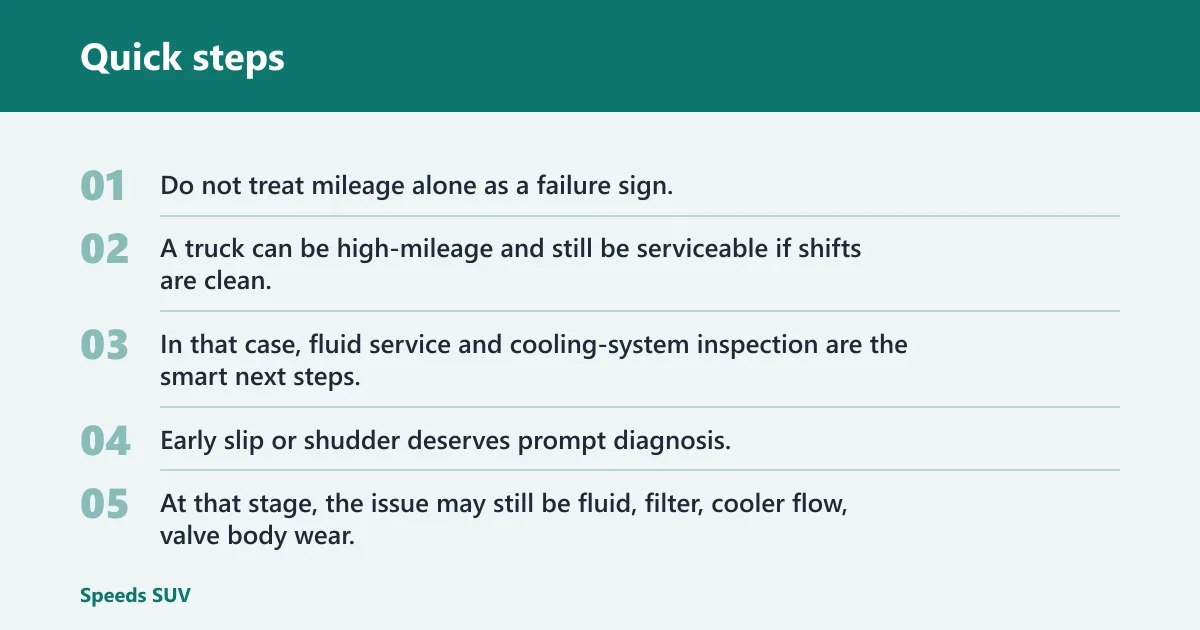
Do not treat mileage alone as a failure sign. A truck can be high-mileage and still be serviceable if shifts are clean, temperatures stay normal, and the fluid history is good. In that case, fluid service and cooling-system inspection are the smart next steps.
Truck with early slip or heat issues
Early slip or shudder deserves prompt diagnosis. At that stage, the issue may still be fluid, filter, cooler flow, valve body wear, or a control problem. Wait too long, and the same symptom can start damaging clutches and bands.
When a rebuild is the safer call
Once a truck shows repeated slip, burnt fluid, delayed engagement, or heat-related limp behavior, a rebuild is often the safer call than waiting for a full failure. That is especially true for towing trucks and fleet units that cannot afford repeat downtime.
Frequently asked questions
How long should a truck transmission last?
For many truck owners, 150,000 to 200,000 miles is a realistic benchmark for a modern automatic with good care, while manuals often last longer and heavy-duty units can go much farther. The transmission should last longer when cooling is good, fluid is correct, and service is on schedule.
How long does an average transmission last?
A broad average hides too much. For trucks, a modern automatic often reaches 150,000 to 200,000 miles with good care, but the real lifespan depends on load, heat, and fluid condition. That is why a duty-cycle answer is more useful than a single average number.
How long does a transmission last in a truck?
In a truck, a transmission may last anywhere from about 100,000 miles on a hard-worked CVT to 400,000+ miles on a well-managed heavy-duty unit. Light-duty daily driving, towing, and fleet use all change the answer. The use case matters more than the badge on the tailgate.
How long does a semi truck transmission last?
Heavy-duty truck units frequently last 200,000 to 400,000+ miles, but semi truck life depends on load, cooling, and service history. Clutch disc components on heavy trucks can also wear according to the manufacturer’s service schedule, and replacement timing varies widely with route, grade profile, and driver behavior. OEM and fleet guidance generally treat load profile as the deciding factor.
What factors shorten truck transmission life?
Heat, towing without proper cooling, stop-and-go traffic, low or wrong fluid, blocked coolers, and poor shifting habits are the main life-shortening factors. Low fluid can cause aeration and pressure loss, and a serious overheat event can shorten transmission life dramatically.
What are the signs a transmission is wearing out?
Slipping, delayed engagement, harsh or erratic shifts, shudder, burnt fluid, overheating, and warning lights are the main signs. Do not assume every shift complaint means failure, but repeated symptoms under load or heat should move the truck from guessing to diagnosis.
How long does a Chevy truck transmission last?
A Chevy truck transmission follows the same rules as any other truck transmission: duty cycle, heat, and maintenance matter more than the emblem. Many modern units often reach 150,000 to 200,000 miles with good care, but towing, stop-and-go use, and poor fluid service can shorten that sharply.
Sources
- Owner’s manual and maintenance schedule for the specific truck model and transmission
- Transmission manufacturer service literature for fluid type, severe-service intervals, and adaptation procedures
- Fleet maintenance resources on towing, heat load, and severe-duty service planning
- Major repair-data sources and technical symptom guides for slip, shudder, delayed engagement, and warning lights