
Why Do Pickup Trucks Rust So Fast?
Pickup trucks rust fast because their frames, bed seams, crossmembers, and cab corners trap salt, mud, and moisture. Winter road brine can start corrosion relatively quickly if drainage is poor. Ignore it, and rust can weaken brake lines, suspension mounts, and frame sections, turning a cheap truck into a costly repair or a hard-to-insure buy. This guide explains where truck rust starts, why pickups corrode faster than many cars, how serious different rust spots are, and what you can do to slow it.
Why winter driving speeds up corrosion
Pickup trucks rust fast because they carry more exposed steel underneath and more places for water to sit. Their frames, brackets, seams, and bed structure collect slush and salt after winter driving, then stay wet longer than smooth body panels. Rust often starts below the truck, where you do not see it first.
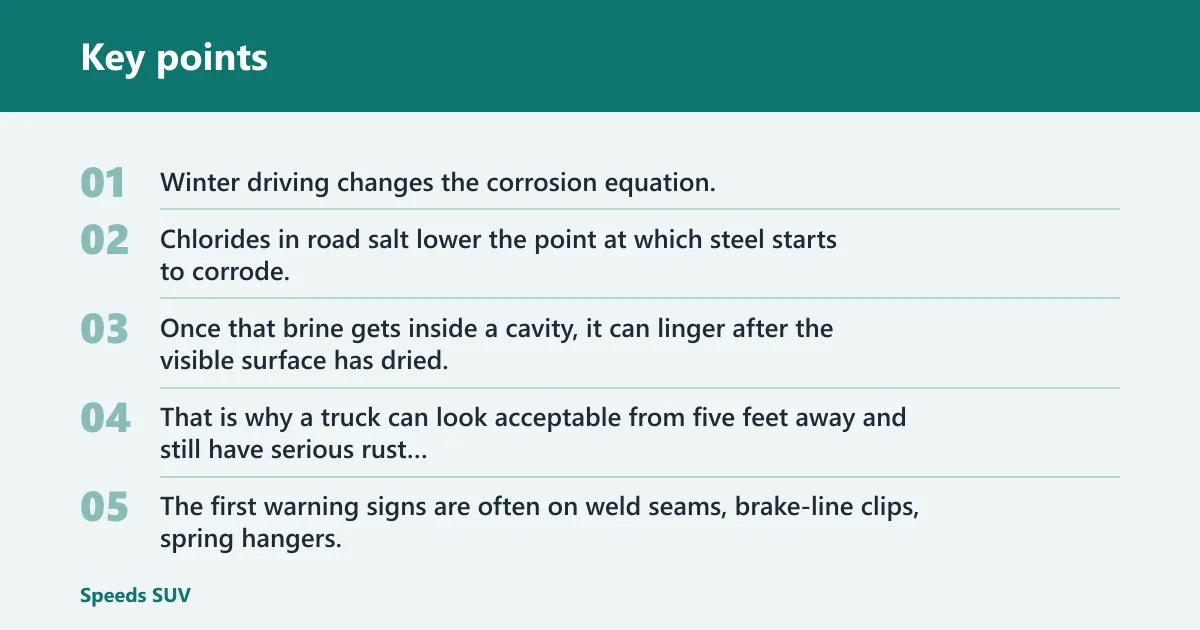
Winter driving changes the corrosion equation. Chlorides in road salt lower the point at which steel starts to corrode, and slush can pack into boxed rails, crossmembers, and mounting points. Once that brine gets inside a cavity, it can linger after the visible surface has dried.
That is why a truck can look acceptable from five feet away and still have serious rust in the underside. The first warning signs are often on weld seams, brake-line clips, spring hangers, and cab mounts rather than on the painted body panels.
Why winter driving matters so much
Road salt is not the whole story; the truck’s shape keeps the salt there. Slushy spray hits the underside, then rides into seams and drain openings. If the truck is parked before those areas dry, the moisture stays in contact with steel for hours.
Why do trucks rust more than cars?
Trucks rust more than many cars because they have a larger exposed underbody, heavier steel structures, and more joints that trap moisture. Pickup frames, bed mounts, and crossmembers create pockets where salt and mud collect. Cars often have more enclosed bodywork and fewer open steel parts beneath them.
Wheel wells and the underside take the first hit because they sit in the spray path. Trucks also spend more time on open roads, towing, or on winter highways where salt use is heavy. The result is a constant cycle of splash, retention, and slow drying.
Frame rails, crossmembers, and cab joints
Frame rails, crossmembers, and cab-to-frame mounts are common rust paths because they combine steel, seams, and coatings that can wear away. Even when the outer paint looks fine, the hidden side of a bracket or weld seam may be losing protection. Those are the spots that often fail first.
Bed, cab, and chassis joints
Pickup beds and cabs meet the frame at multiple bolted points. Those joints collect dirt and moisture, and they usually hold fasteners, washers, and brackets made from steel. Rust often begins on the hardware, then spreads into the nearby panel edge or mount.
Truck frame rust zones
The frame is the part to inspect most carefully. Boxed rails can trap moisture inside, while open-section rails expose more metal to spray. Both designs rust, but boxed sections hide the damage longer and make drainage more important.
Boxed vs open-section rails
Boxed rails can resist bending well, but they also create hidden cavities. If drain holes clog with mud or wax buildup, salty water can sit inside the rail and eat from the inside out. Open-section rails are easier to inspect, yet their seams and flanges still rust where coating coverage is thin.
Weld seams, spring hangers, and cab mounts
Weld seams are common failure lines because coating is thinner there and edges are easy to chip. Spring hangers and cab mounts deserve close inspection because they carry load. If those points lose metal, the problem stops being cosmetic quickly.
Drain holes and trapped moisture
Drain holes are useful only if they stay open. Mud, salt crystals, and road grit can block them in boxed sections, rocker areas, and frame pockets. That trapped moisture creates long dwell time, which is exactly what corrosion needs.
Road salt and winter corrosion
Road salt speeds corrosion by adding chloride contamination to wet steel. The brine spreads under the truck, settles on seams and fasteners, and keeps attracting moisture. Steel hardware usually suffers before painted panels do.
Salt attack is worst after repeated slushy driving. The spray reaches the underside, then sticks to brackets, line clamps, and seam edges. If the truck is not rinsed underneath, the salty film can remain long after the roads look dry.
Why washing helps, but only if you reach the underside
Rinsing the wheel wells and underside removes salt before it has time to stay wet against the metal. A garden hose on the body panels does little for frame cavities or brake-line clips. The goal is to flush the areas that hold brine, not only the paint.
Do aluminum trucks rust?
Aluminum body panels do not rust the way steel does, but they are not immune to corrosion. Aluminum forms its own corrosion products, and mixed-material trucks can suffer galvanic corrosion where aluminum touches steel fasteners or brackets. So an aluminum body does not remove the rust problem.
On newer pickups, aluminum panels may reduce body-panel rust, but the frame, hardware, brake lines, and underbody brackets still need attention. You can have a clean-looking skin over a corroded chassis.
Where aluminum still needs inspection
Check the edges where panels meet steel supports, the fasteners, and any scratched or chipped areas. Galvanic corrosion is more likely where two different metals stay wet together. That is especially true around isolated bolts, trim mounts, and repair points.
Coatings and galvanized steel
Galvanized steel helps because the zinc coating slows corrosion. Factory wax, e-coat, paint, and underbody coatings also reduce exposure. But none of them last forever, and cuts, chips, and seam edges are common starting points when protection breaks down.
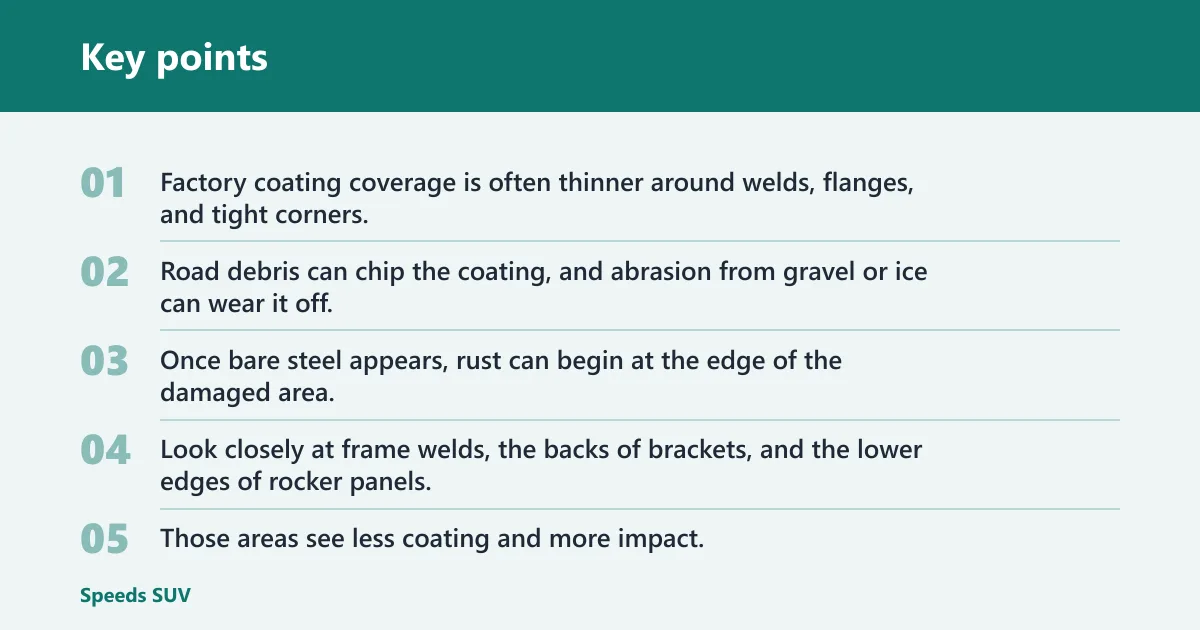
Factory coating coverage is often thinner around welds, flanges, and tight corners. Road debris can chip the coating, and abrasion from gravel or ice can wear it off. Once bare steel appears, rust can begin at the edge of the damaged area.
Where protection gets thin
Look closely at frame welds, the backs of brackets, and the lower edges of rocker panels. Those areas see less coating and more impact. If the coating looks cracked, flaked, or scraped away, treat the spot before rust spreads under the finish.
| Rust zone | Typical cause of failure | Visibility during inspection | Risk level |
|---|---|---|---|
| Frame rails | Salt in boxed cavities, seam rust, coating loss | Low to medium | Structural |
| Crossmembers | Standing brine, chipped coating, trapped mud | Medium | Structural |
| Spring hangers | Water retention and heavy load at welded joints | Medium | Structural |
| Cab mounts | Seam rust and wet debris around brackets | Low to medium | Structural |
| Rocker panels | Blocked drain holes and trapped moisture | Low | Repairable |
| Bed supports | Road spray, seam corrosion, fastener rust | Medium | Repairable |
| Brake lines | Steel line corrosion at clips and bends | Low | Structural |
| Fuel lines | Clamp rust, abrasion, moisture at fittings | Low | Structural |
| Wheel wells | Salt spray, mud buildup, liner wear | High | Cosmetic or repairable |
| Fasteners and brackets | Steel hardware rusts before adjacent panels | High | Repairable |
How do I stop rust on a truck before it spreads?
Start by cleaning the underside, not only the paint. Wash winter salt from the frame, wheel wells, seams, and brackets, then let the truck dry fully. Touch up chips and scrape off loose scale before moisture gets under the edge of the rust.
Protection works best where corrosion starts: seams, drain holes, spring hangers, cab mounts, and fasteners. Wax or underbody coating can reduce new damage, but it will not fix active rust inside a boxed rail. Use it to lower risk, not as a cure.
Inspection habits that help
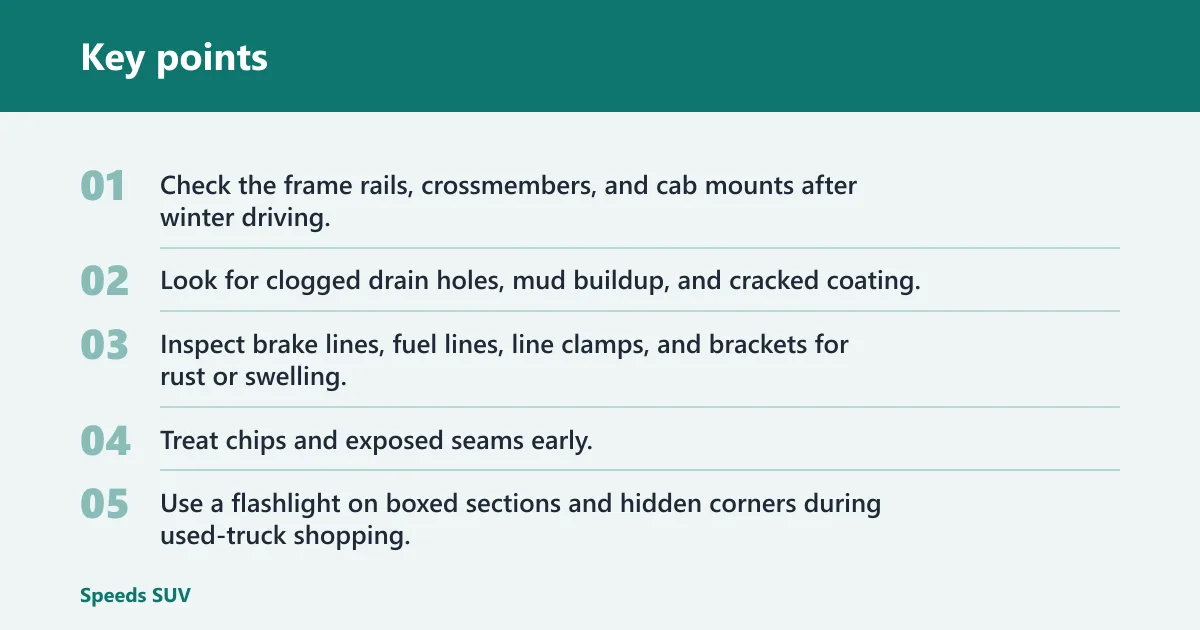
- Check the frame rails, crossmembers, and cab mounts after winter driving.
- Look for clogged drain holes, mud buildup, and cracked coating.
- Inspect brake lines, fuel lines, line clamps, and brackets for rust or swelling.
- Treat chips and exposed seams early.
- Use a flashlight on boxed sections and hidden corners during used-truck shopping.
Two common examples
Say your half-ton truck has clean paint but orange dust on the rear spring hangers. That is not a body-panel problem; it is a chassis problem. If the hangers are flaking, the next step is cleaning, inspection, and repair before the rust reaches the mounting metal.
Suppose a late-model truck has aluminum doors but rusty brake-line clips under the cab. The body may look newer than the frame hardware. That mismatch is common, and it means the underside needs a separate check instead of relying on panel condition alone.
How can I tell if a truck frame is rusted dangerously?
Danger starts when rust moves beyond surface oxidation and into scale rust or perforation. Surface rust can often be cleaned and treated. Scale rust flakes off in layers and means metal loss has begun. Perforation means the steel has holes, and that can affect safety.
Pay close attention to spring hangers, cab mounts, crossmembers, steering and suspension brackets, and brake-line attachment points. If a screwdriver or pick sinks into the metal, or if rust is swelling around a load-bearing area, the truck needs expert inspection.
What is normal and what is not?
Light surface rust on non-structural parts is common on used trucks, especially after winter use. Deep scale on frame rails, cracked brackets, separated seams, or holes in a rail are not normal wear items. Once rust reaches a load path, the repair can move from cleanup to replacement.
Frequently asked questions
Why do pickup trucks rust so fast?
Pickup trucks rust fast because their underside has more steel, more seams, and more cavities that hold salt and moisture. Winter brine reaches frame rails, mounts, and brackets, then stays trapped longer than it does on smooth painted panels. Hidden rust usually starts before the outside looks bad.
Why do Chevy trucks rust so bad?
Brand alone does not explain rust. What matters more is the frame design, coating coverage, winter exposure, and maintenance. A Chevy truck in a salt state with blocked drain holes and worn underbody coating can rust badly, just like any other pickup in the same conditions.
Why do Dodge trucks rust so badly?
Rust patterns on any truck come from design details, coatings, and climate, not just the badge. If a truck has boxed sections, seam edges, and winter salt buildup with weak drainage, it can rust fast. The question is where the salt sits, how long it stays wet, and what protection remains.