AWD Systems Explained and Compared
AWD fits most commuters who deal with rain, packed snow, icy intersections, or steep slick driveways because it can shift torque between axles without driver input. Choose 4WD only if you need low range, locked front-to-rear drive on loose surfaces, or regular trail use, because the wrong system can add cost and weight you never use, or leave you with less real traction than the badge implies. This guide compares AWD, 4WD, FWD, and RWD by how they send power, where they tend to work best, and which setups are often used for commuting, snow, and light off-road use.
AWD is a category, not one system
The real trade-off is pavement manners versus maximum traction hardware. Most AWD systems are tuned for paved roads, mixed weather, and higher-speed driving, but one layout may stay smooth and efficient in heavy rain while another feels more rear-driven, works better in deep snow, or costs more to service.
That is why the badge matters less than the hardware underneath. An AWD system can send power to all four tires all the time, or it can spend most of its life in two-wheel drive and connect the second axle only when software predicts or detects slip.
The useful comparison is not AWD versus non-AWD alone. It is full-time AWD versus on-demand AWD, brake-based AWD versus mechanical torque transfer, rear-biased AWD versus torque-vectoring AWD, and all of those versus part-time 4WD, FWD, and RWD.
The five AWD types that matter
- Full-time AWD with a center differential
- On-demand AWD with a clutch-pack coupling
- Brake-based AWD built from a mostly FWD layout
- Rear-biased or performance AWD
- Torque-vectoring AWD that can overdrive or independently manage axle torque side to side
Why architecture changes behavior
Front-to-rear torque transfer is the whole story. AWD systems use either a center differential or a clutch-pack coupling, and that single design choice changes turn behavior, hill-start feel, fuel economy, and what happens when one axle loses grip.
A center differential allows front and rear axle speed differences in turns. That prevents driveline binding on pavement and explains why true AWD can stay engaged on dry roads without the shudder and hopping that come from a locked part-time 4WD system.
A clutch-pack coupling is common in crossovers. It uses computer control to squeeze clutch plates together and send more torque to the second axle when needed. That can work well, but calibration decides whether it reacts after slip, preloads before slip, or stays mostly disconnected to save fuel.
How does an AWD system work?
AWD works by routing engine torque to both axles through hardware that can handle front and rear speed differences on pavement. In practice, the system uses a center differential or a computer-controlled clutch-pack coupling, then adds brake and stability control to limit wheelspin and keep the vehicle tracking straight.
Front-to-rear torque transfer in plain terms
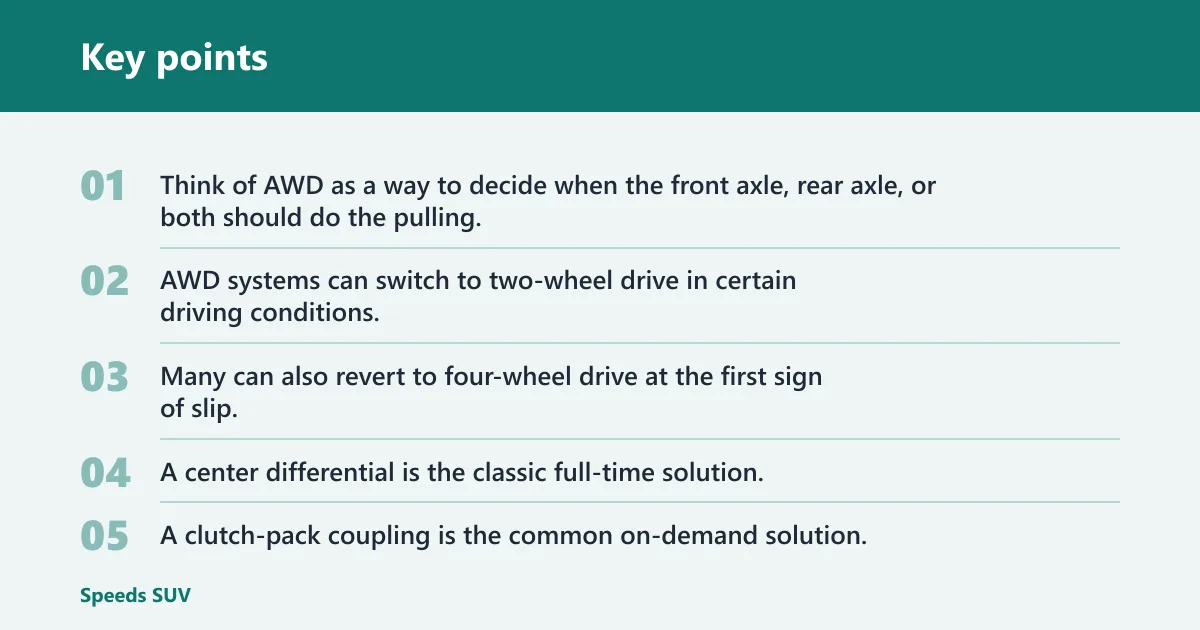
Think of AWD as a way to decide when the front axle, rear axle, or both should do the pulling. Some systems drive both axles continuously. Others run in two-wheel drive much of the time and connect the other axle when sensors see throttle input, steering angle, wheel-speed differences, or slip.
AWD systems can switch to two-wheel drive in certain driving conditions. Many can also revert to four-wheel drive at the first sign of slip. That is why two vehicles labeled AWD may behave very differently on a wet uphill merge or an icy driveway.
Center differential versus clutch-pack coupling
A center differential is the classic full-time solution. It splits power between front and rear while allowing each axle to rotate at different speeds in a turn. AWD is engineered to let each tire rotate at its own speed in turns, so pavement use is normal rather than stressful for the driveline.
A clutch-pack coupling is the common on-demand solution. The clutch closes to transfer torque to the second axle, usually under computer control. It is compact and helps fuel economy, but it may send less torque sooner or later depending on calibration, clutch temperature, and available grip.
Suppose a wet stoplight launch puts the front tires on painted stripes. A proactive clutch-pack system may preload the rear axle before the fronts spin much, while a reactive one may let the fronts flare briefly, then feed torque rearward a moment later.
What brake-based traction control adds
Many crossovers use the brakes to mimic limited-slip action across the axle. If one front tire spins, the brake grabs that wheel so torque can move to the tire with grip through the differential. This can make a basic AWD system feel more capable than its hardware suggests.
It still has limits. Brake-based help creates heat, slows momentum in soft surfaces, and cannot replace low range, locking differentials, or ground clearance. In deep sand, mud, or repeated rock-step climbs, that difference shows up fast.
How does AWD compare to 4WD and 2WD?
AWD is the better fit for paved driving in changing weather, while part-time 4WD is the better fit for low-speed loose surfaces and true trail work. Compared with 2WD, AWD usually pulls away cleaner on wet pavement, packed snow, and uphill starts because both axles can share engine torque, but it also brings more weight, more parts, and lower efficiency.
AWD versus part-time 4WD
Part-time 4WD systems are intended only for use off-road or on extremely slippery surfaces. They usually require the driver to shift into and out of 4WD manually, often with 4High and 4Low modes. In 4High or 4Low, the front and rear driveshafts are locked together.
That locked connection is the key difference. On dry pavement, front and rear axles need to rotate at different speeds in a turn. If they cannot, the driveline winds up. A locked 4WD driveline can shudder on dry pavement in a tight circle, and using 4WD on pavement can cause uneven tire wear.
That condition is driveline binding. The symptoms are tire scrub, hopping, steering resistance, and a feeling that the vehicle wants to push straight ahead in a parking-lot turn. AWD avoids this because its center differential or coupling allows normal axle speed variation.
AWD versus FWD
FWD is the everyday efficiency baseline for most crossovers. It is simpler, lighter, and usually cheaper to buy and maintain. In rain or on packed snow, though, AWD often launches cleaner because the rear axle can help when the front tires are already busy steering and pulling.
What’s the difference between AWD and front-wheel drive in daily use? Mostly margin under power. FWD can be excellent with good tires, but if the road is slick and uphill, or the vehicle is loaded, AWD usually asks less from each front tire.
AWD versus RWD
RWD can feel more balanced under acceleration and often suits towing layouts well, especially in body-on-frame vehicles. On low-grip roads, though, an unloaded rear axle may break traction sooner than an AWD system that can share the work between axles.
Picture a midsize SUV backing a small utility trailer up a damp gravel incline. RWD may do fine if tongue weight loads the rear axle. An AWD system with decent tires gives more margin when one rear tire lands on loose stone and the fronts can help pull.
AWD architecture decision matrix
| Architecture type | Traction priority | Pavement manners | Fuel economy impact | Service complexity | Snow performance | Light off-road suitability | Best fit | Avoid if |
|---|---|---|---|---|---|---|---|---|
| Full-time AWD with center differential | Continuous front-rear drive, very predictable torque flow | Excellent in turns; no binding on dry pavement | Usually higher than FWD-based systems because both axles stay engaged more often | Moderate to high; more gears, fluids, and seals | Very strong on packed snow, icy hills, and mixed dry/wet roads | Good for gravel roads and moderate loose surfaces; limited by tires and clearance | Snow-belt commuting, long highway use, varied weather | Maximum mpg and minimum mechanical complexity matter most |
| On-demand AWD with clutch-pack coupling | Variable; can be reactive or proactive depending on calibration | Usually smooth and efficient; behavior depends on software tuning | Lower penalty than full-time systems because many run in 2WD often | Moderate; clutch wear, fluid service, electronic controls | Good to very good, especially if the system preloads before slip | Fair to good for gravel, light mud, and shallow sand; heat can become a limit | Most crossover buyers, wet climates, occasional snow trips | Repeated deep-snow work or trail use is part of the plan |
| Brake-based AWD on FWD platform | Uses brakes to control spinning wheels; rear axle help is often modest | Normal around town; least mechanical feel through the chassis | Often closest to FWD baseline when cruising | Moderate; depends heavily on sensors, ABS, and brake condition | Adequate to good on plowed roads and icy intersections with proper tires | Limited in deep ruts, soft sand, and long climbs because braking cuts momentum | Urban commuting, occasional winter storms, cost-sensitive shoppers | Unplowed roads, repeated mountain trips, or loose-surface travel are common |
| Rear-biased or performance AWD | Prioritizes rear axle feel, then adds front pull as needed | Sharper corner exits and more neutral handling balance | Usually a moderate to high penalty versus 2WD | High; added couplings, shafts, and control logic | Very good with proper tires, though tuning may favor handling over crawl traction | Fair for gravel roads; usually not aimed at rough or slow technical terrain | Drivers who want wet-weather grip and responsive pavement behavior | Lowest running cost and simplest long-term ownership are the goal |
| Torque-vectoring AWD | Can shift torque front to rear and side to side for traction and yaw control | Best cornering response of the group; very composed on mixed grip | Often among the highest penalties because of extra hardware | High; more actuators, clutches, and control modules | Excellent in variable traction, especially corner exits and split-friction surfaces | Good on gravel and light trails; still limited by clearance and tire type | Mixed weather, winding roads, buyers who value dynamic behavior | Budget, simple maintenance, and long-term repair exposure are top concerns |
How to read the matrix
The pattern is simple. As AWD hardware becomes more active and more capable, service complexity usually rises too. The right system matches where the vehicle spends most of its time, not the most extreme condition it might see once a year.
Is AWD always on?
No. Some AWD systems drive both axles continuously, while others stay mostly in two-wheel drive until software predicts or detects slip. The useful distinction is full-time, reactive, and proactive AWD, because each type changes launch feel, fuel use, and how quickly torque arrives at the second axle.
Full-time systems
These keep both axles in the loop all the time. They tend to feel the most consistent in rain, on patchy ice, and through long sweeping corners because torque does not have to wait for an engagement event.
Reactive systems
These wait for wheel-speed differences or clear slip, then close the clutch-pack coupling. They can work well, but the response is usually easiest to notice in a hard launch on a slick uphill grade or a quick throttle stab out of a wet side street.
Proactive systems
These use throttle position, steering angle, incline, and other inputs to send torque before obvious slip begins. They are often the sweet spot for commuters because they preserve some efficiency while feeling more immediate than purely reactive setups.
Which AWD systems are best for snow and ice?
For packed snow, icy intersections, and mixed dry-wet winter roads, full-time AWD and well-tuned proactive clutch-pack AWD are usually the strongest choices. In deeper snow, tire type, tread depth, and ground clearance can matter more than the badge, because AWD only helps with acceleration, not braking.
Packed snow and icy intersections
AWD systems help vehicles move better on snow-covered or rain-slicked roads. The best winter manners usually come from systems that transfer torque early and smoothly rather than waiting for obvious front-wheel spin.
On an icy left turn from a stop, a full-time system or a proactive on-demand system tends to settle the vehicle sooner. A reactive system may still get moving well, but with a more noticeable pause before the rear axle contributes.
Deep snow and unplowed roads
Deep snow asks for more than torque transfer. It needs ground clearance, enough tire void to keep biting, and a system that does not overheat or cut momentum with heavy brake intervention. Full-time AWD and stronger clutch-pack systems generally hold up better here than brake-based layouts.
Say your neighborhood gets about 8 inches of wet snow and the plow has not come through. A basic brake-based system can still move if the tires are right, but a system that leans on braking at each spinning wheel may slow itself down when momentum matters most.
Why winter tires still matter more than many drivers expect
Tires set the grip limit. AWD can divide torque better, but it cannot create friction where the tire compound and tread cannot find it. On packed snow and ice, winter tires often can affect stopping and turning more than switching from 2WD to AWD on all-season tires.
That also addresses a common mistake: treating AWD as a safety shortcut. It helps the vehicle go. It does not shorten braking distance by itself, and it does not replace conservative speed choices on black ice.
Which systems are best for gravel, mud, sand, and light trails?
For gravel roads and mild two-tracks, most AWD systems work well if tires and clearance fit the surface. For repeated mud, sand, steep climbs, or wheel-lift situations, stronger full-time or clutch-pack AWD still gives way to part-time 4WD, especially when 4Low is needed for slow control.
Where AWD works well
On gravel and washboard roads, AWD helps the vehicle keep pulling when one axle crosses marbles, washouts, or loose patches, and it usually feels steadier when you add throttle mid-corner. Torque-vectoring and rear-biased systems can feel especially settled on corner exits because they manage power distribution more actively.
Where AWD runs out of margin
Mud and sand punish hesitation and heat weak points. Brake-based systems can scrub away momentum. Some clutch-pack systems reduce torque transfer if the coupling gets hot. Low-profile road tires make the problem worse long before the driveline itself reaches its limits.
When 4High or 4Low is the better answer
Choose part-time 4WD when loose-surface use is frequent and slow-speed control matters. 4High suits faster dirt, deeper snow, and muddy tracks. 4Low is for steep descents, crawling, and pulling loads at low speed where torque multiplication and reduced wheel speed help protect traction.
The owner’s manual is the check that matters. It confirms whether the vehicle is AWD or 4WD, whether the system has 4High or 4Low, and whether there is any warning against use on dry pavement.
What are the disadvantages of AWD?
AWD adds weight, cost, and parts count, so the tradeoff is lower efficiency and more service exposure in exchange for better traction under power. It also brings tire-matching requirements and more failure points, which matter if the vehicle will spend most of its life on dry pavement.
Fuel economy and added mass
Extra shafts, couplings, differentials, and control hardware all take energy to move. Even systems that disconnect an axle in steady cruising still carry the mass and mechanical drag of the added hardware compared with a 2WD version.
Tire matching and maintenance
Many AWD systems dislike major tire circumference differences. Uneven wear, one new tire paired with three worn tires, or mismatched brands can force the system to work constantly and create extra heat. Following the owner’s manual on rotation intervals and tire replacement strategy matters more on AWD than on 2WD.
Failure points and repair exposure
Common weak spots include couplings, wheel-speed sensors, seals, bearings, transfer components, and control modules. Warning signs vary, but watch for delayed engagement, vibration during low-speed turns, AWD warning lights, or repeated traction-control intervention where the surface does not explain it.
Choose AWD if… / Choose 4WD or 2WD if…
Choose AWD
- You commute on pavement year-round and regularly see snow, ice, heavy rain, or steep slick driveways.
- You want automatic torque transfer without thinking about when to engage a mode.
- You drive long highway stretches in changing weather and want stable, predictable responses.
- You use gravel roads or mild trails, but not low-speed rock, deep mud, or repeated deep sand.
Choose 4WD
- You need 4High or 4Low for frequent trail work, boat ramps, ranch tracks, deep snow, mud, or sand.
- You tow or haul in places where slow-speed control and locked driveline traction matter.
- You understand that part-time 4WD is for loose or very slippery surfaces, not dry pavement.
Choose 2WD
- Fuel economy, lower purchase cost, and simpler maintenance rank above extra launch traction.
- Your driving is mostly urban or highway in mild weather.
- You are willing to invest first in the right tires, which often changes winter performance more than many buyers expect.
A quick way to confirm the system type
- Read the manual. Check the drivetrain section for AWD, 4WD, 4High, and 4Low language. Dry-pavement warnings usually identify part-time 4WD immediately.
- Check the controls. A button or lever for 2H, 4H, or 4L points to 4WD. An always-available AWD system may have no mode selector or may offer snow, mud, or lock-style traction modes instead.
- Look for tire guidance. The owner’s manual often includes specific warnings about matching tire size and wear. That detail is common on AWD vehicles because tire differences can strain the system.
Frequently asked questions
How does AWD compare to 4WD?
AWD is built for pavement and changing traction, using a center differential or clutch-pack coupling so front and rear axles can turn at different speeds. Part-time 4WD locks the front and rear driveshafts together for loose surfaces, then must be disengaged on dry pavement to avoid binding, shudder, and tire scrub.
How does AWD differ from 2WD?
2WD drives one axle only, either front or rear, so it is usually lighter, simpler, and more efficient. AWD adds a second driven axle and automatic torque transfer, which improves acceleration on slick surfaces and uphill starts, but increases cost, weight, service complexity, and usually fuel use.
What’s the difference between AWD and front-wheel drive?
Front-wheel drive pulls with the front axle alone, while AWD can add the rear axle when grip drops or demand rises. In daily use, that means AWD usually launches better on wet, snowy, or steep roads, but FWD remains the simpler and more efficient choice for mild climates.