How to Calculate Tongue Weight for a Trailer
Tongue weight is the downward load on the hitch. For a bumper-pull trailer, a common starting point is about 10% to 15% of the trailer’s loaded gross weight, then verify the actual number with a scale. Too little tongue weight can let the trailer sway. Too much can overload the hitch, rear axle, and tires. This guide shows how to calculate, measure, verify, and correct tongue weight on a loaded trailer.
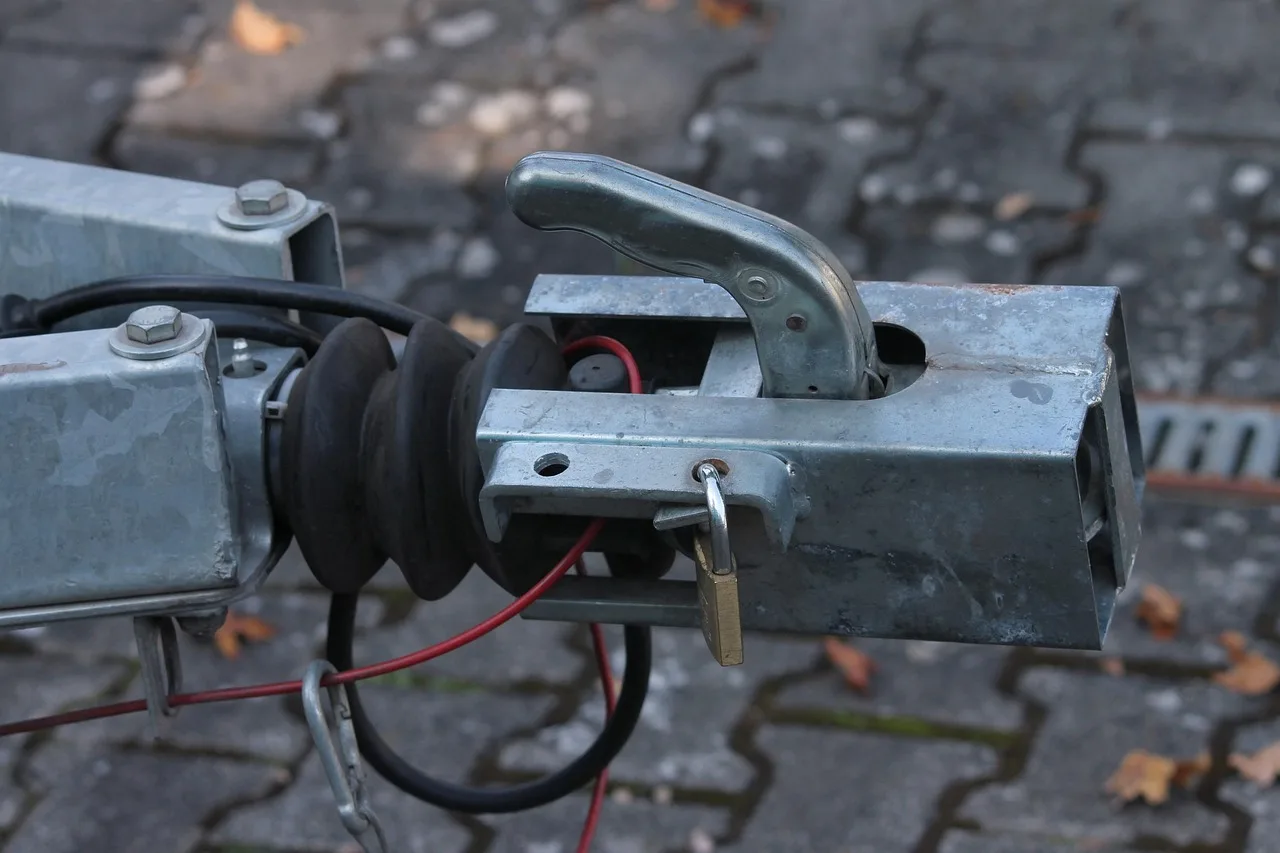
Tongue weight is the downward force at the hitch point, usually stated in pounds or kilograms. Use the trailer’s loaded gross weight as the denominator, not empty trailer weight, because cargo, water, fuel, and accessories change the number you need for safe towing.
To get the percentage, divide tongue weight by trailer gross weight and multiply by 100. That percentage helps you compare your trailer against a target range, but the right range can vary by trailer type and hitch setup. A weight distribution hitch can move load between axles, but it does not change the actual tongue weight.
What you’ll need
- A tongue weight scale for direct measurement
- A bathroom scale and a known lever setup for lighter trailers
- A trailer jack rated for the load
- A tape measure for lever ratio setup
- A calculator or phone calculator
- Your tow vehicle and hitch receiver ratings
- The trailer’s loaded gross weight estimate or scale ticket
How do you calculate tongue weight for a trailer?
Start with the trailer loaded for travel, then use the loaded gross weight to estimate tongue weight at 10% to 15% for a bumper-pull trailer. After that, verify the result with a scale, because cargo placement and hitch setup can shift the actual number away from the estimate.
- Load the trailer fully. Add cargo, water, fuel, propane, and accessories exactly as they will ride on the road. The calculation should reflect travel weight, not an empty trailer.
- Find total trailer weight. Use a certified scale ticket if you have one, or another verified gross weight figure. This is the number you divide by when you calculate the tongue weight percentage.
- Multiply by the target range. Multiply the loaded gross weight by 0.10 and 0.15 to get a low and high estimate. For a 6,000-pound trailer, that works out to about 600 to 900 pounds.
- Compare ratings together. Check the hitch receiver, rear axle, and vehicle payload ratings against the estimated tongue weight. The trailer may be in range while the tow vehicle is not.
- Adjust cargo and recheck. If the estimate is off, move cargo in 25 to 50 pound increments and repeat the math. Small shifts can change the percentage enough to matter, and moving too much weight rearward can quickly create sway.
Suppose a utility trailer has a loaded gross weight of 2,400 pounds. At 12%, tongue weight is 288 pounds; at 15%, it is 360 pounds. If the hitch receiver is rated for 300 pounds of tongue weight, the trailer estimate may look acceptable on paper but still be too high for the receiver once the actual scale value is known.
How do you measure tongue weight for a trailer?
A tongue weight scale gives the most direct reading, while a bathroom scale method can work for lighter trailers when you know the lever ratio. Use the scale method when accuracy matters, then compare the reading with hitch, axle, and payload ratings before towing.
Using a tongue weight scale
- Set the trailer level. Park on firm, level ground and keep the coupler at normal towing height. A tilted setup can skew the reading.
- Place the scale under the coupler. Use the scale exactly as directed by the manufacturer. Make sure the trailer jack or support is rated for the load while you set up.
- Lower the coupler fully. Transfer the tongue load onto the scale and let the reading settle. Record the number in pounds or kilograms.
- Check the percentage. Divide the measured tongue weight by the loaded gross weight and multiply by 100. Compare the result with the target range for that trailer type.
Using a bathroom scale method
- Build the lever setup. Place the bathroom scale on the ground under one end of a rigid beam. Measure from the center of the scale to the point where the beam is supported by a block or jack, then measure from the center of the scale to the point where the coupler load will sit on the beam.
- Apply the known ratio. Put the coupler load on the beam at the marked point and read the scale. Multiply the reading by the lever ratio to estimate tongue weight.
- Keep the load light. Use this method only for lighter trailers where the scale and beam are within their limits. It is a useful estimate, not a substitute for a direct tongue weight scale.
For a lever setup, use the formula Tongue weight = scale reading × lever ratio. For example, with a 3:1 ratio, a 120-pound bathroom scale reading indicates about 360 pounds of tongue weight. Keep the setup within the scale, beam, and jack limits so the estimate stays safe and valid.
How do you calculate tongue weight by trailer type?
Trailer type changes the target and the method. A bumper-pull travel trailer usually sits in the common 10% to 15% range, while boat trailers and utility trailers can need a different target based on axle placement, cargo position, and hitch design. Goosenecks use the same percentage math, but the load is carried over the truck bed.
What is the right tongue weight for a travel trailer?
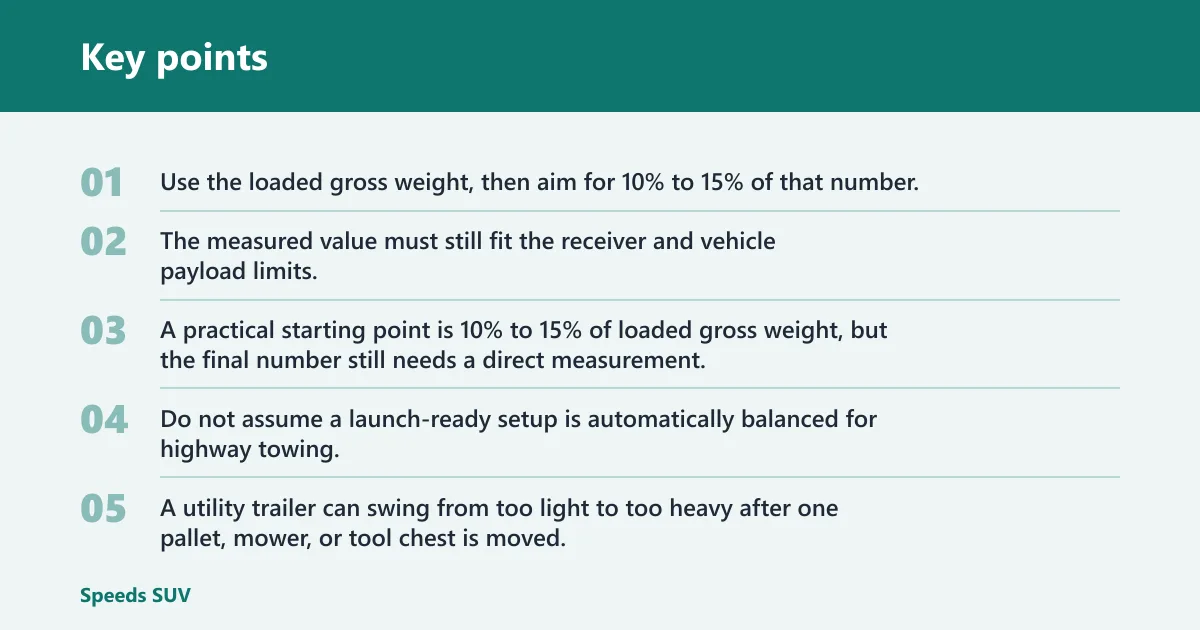
Use the loaded gross weight, then aim for 10% to 15% of that number. Because travel trailers often carry water, propane, and gear at the front or rear, recheck tongue weight after any major loading change. The measured value must still fit the receiver and vehicle payload limits.
What is the right tongue weight for a boat trailer?
Calculate from the boat, fuel, gear, and trailer together, since the boat and accessories change the loaded gross weight. A practical starting point is 10% to 15% of loaded gross weight, but the final number still needs a direct measurement. Do not assume a launch-ready setup is automatically balanced for highway towing.
What is the right tongue weight for a utility trailer?
Use the cargo as the main variable. A utility trailer can swing from too light to too heavy after one pallet, mower, or tool chest is moved. A practical starting point is 10% to 15% of loaded gross weight, then verify with a scale if the load is likely to shift in transit.
What is the right tongue weight for a gooseneck trailer?
For goosenecks, calculate the same way: pin weight ÷ loaded gross weight × 100. The hitch point is in the truck bed, so the number is often expressed as pin weight in practice, and it is typically much higher than bumper-pull tongue weight. Check the truck’s bed, rear axle, and payload ratings together with the measured load.
Tongue weight table
This table gives a practical workflow by trailer type. Use the recommendation that matches the trailer you tow, then verify with a scale whenever possible.
| Trailer type | Recommended measurement method | Calculation steps |
|---|---|---|
| Bumper-pull travel trailers | Tongue weight scale, then percentage check | Use loaded gross weight; multiply by 0.10 to 0.15; measure actual tongue weight; compare with hitch and payload ratings |
| Boat trailers | Tongue weight scale if available; DIY lever only for lighter loads | Add boat, fuel, gear, and trailer; calculate percentage from loaded gross weight; verify the actual load before road use |
| Utility trailers | Scale for final check; bathroom scale method only for light trailers | Load cargo as for travel; use the full loaded weight; estimate the range; shift cargo and recheck if the percentage is outside target |
| Goosenecks | Direct scale reading at the hitch point or truck scale data | Use loaded gross weight; calculate tongue weight percentage; compare the result with truck bed, rear axle, and payload limits |
| Result | What to do next | Why it matters |
|---|---|---|
| Too low | Move cargo forward 25 to 50 pounds, then remeasure | Low tongue weight can let the trailer sway |
| Too high | Move cargo rearward 25 to 50 pounds, then remeasure | Excess tongue weight can overload the hitch, rear axle, or payload |
Common mistakes
The biggest mistake is using empty trailer weight instead of loaded gross weight. That gives a number that looks clean but does not match the trailer as it will actually tow.
Another mistake is treating a weight distribution hitch like a fix for tongue weight. It can redistribute load to the tow vehicle axles and trailer axles, but it does not change the actual tongue weight value you should calculate and measure.
Do not rely on a bathroom scale method as if it were a direct scale reading. It is an estimate that depends on a known lever ratio, and the setup must stay within the scale’s capacity.
Say your travel trailer weighs 7,200 pounds loaded and the scale shows 950 pounds at the coupler. That is 13.2%, which is in range. If the same trailer has a 900-pound receiver limit, the hitch rating still needs attention even though the percentage looks acceptable.
If that didn’t work, start with cargo placement, then check whether the hitch receiver rating, rear axle rating, or payload limit is the tightest constraint. The safest setup is the one that fits all three.
Prevention: Recheck tongue weight after any major loading change, especially water level, battery placement, propane, or heavy cargo that moves to the front or back.
Frequently asked questions
How do you determine tongue weight on a trailer without a scale?
Use a bathroom scale method with a known lever ratio. Read the scale, then multiply by the lever ratio to estimate tongue weight. Treat the result as approximate and verify with a proper tongue weight scale when possible.
How much tongue weight should a trailer have?
A common target for bumper-pull trailers is 10% to 15% of loaded gross weight. Some trailers fall outside that window, so the final target should still fit the hitch receiver, rear axle, and vehicle payload limits.
How do you calculate tongue weight on a gooseneck trailer?
Use the same percentage formula as other trailers: pin weight ÷ loaded gross weight × 100. The hitch point sits in the truck bed, so you should also check the truck’s rear axle and payload ratings before towing.
How do you estimate tongue weight on a trailer?
Multiply the loaded gross weight by 0.10 to 0.15 for a quick estimate, then verify with a scale. If the load includes water, fuel, or shifting cargo, recheck after any change that could move weight forward or rearward.