Where Are the Recovery Points on My SUV or Pickup?
Use only factory tow hooks, frame-mounted recovery points, or rated aftermarket points bolted to the frame. If it is welded to thin sheet metal, plastic, or a hitch ball, do not use it. Bad anchor points can tear off, damage the bumper, or turn a recovery strap into a projectile. This guide shows how to spot the correct points in under two minutes, with a quick vehicle-check list and red flags to avoid.
What a recovery point is and is not
A recovery point is a vehicle-specific load path for pulling a stuck SUV or pickup. It should connect to the chassis rail, frame, or a manufacturer-approved mounting point, and the manual or the hardware may list it for recovery use. A tow point, transport loop, or cosmetic hook is not the same thing.
Recovery point, rated point, and unrated hardware
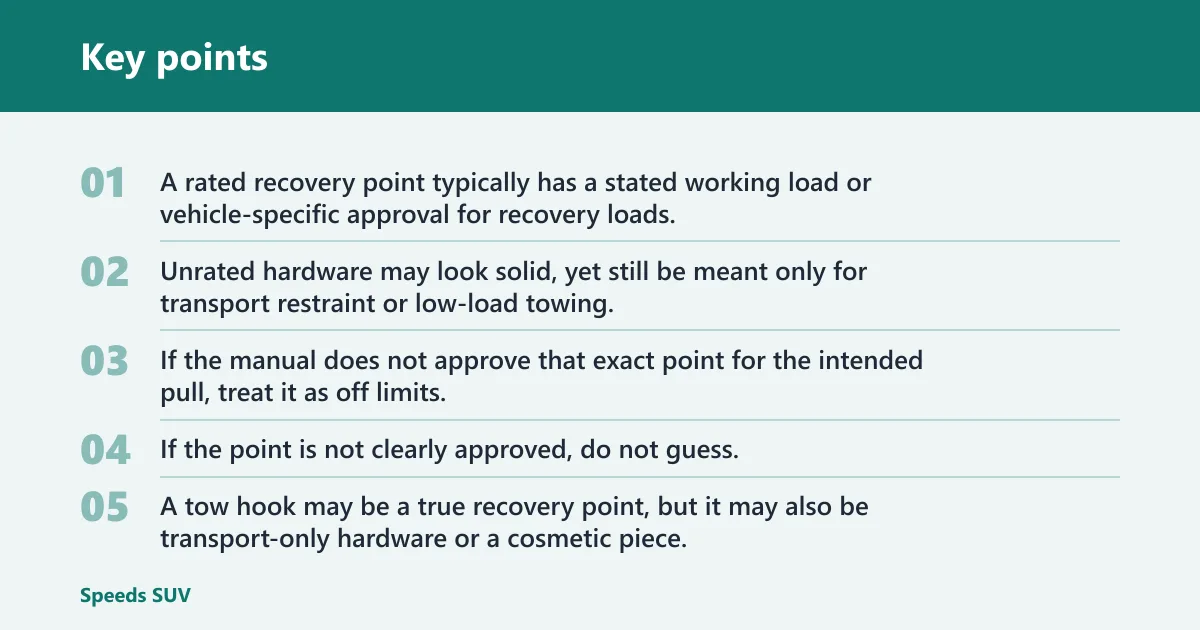
A rated recovery point typically has a stated working load or vehicle-specific approval for recovery loads. Unrated hardware may look solid, yet still be meant only for transport restraint or low-load towing. If the manual does not approve that exact point for the intended pull, treat it as off limits.
That difference matters most in a dynamic recovery, where the load rises fast. A gentle straight-line pull may still demand more than a thin loop or bracket can take, and shock loading can multiply the force quickly. If the point is not clearly approved, do not guess.
Tow hook versus recovery point
A tow hook may be a true recovery point, but it may also be transport-only hardware or a cosmetic piece. Many vehicles have a visible hook at the front that looks sturdy because it is bolted to a bracket or rail. The manual must confirm whether that specific hook is approved for recovery and for which direction of pull.
Some factory screw-in eyes are similar. They are often meant for straight-line towing or light extraction, not angled yanks or snatch recovery. If the manual limits use to towing, do not upgrade that into recovery use on your own.
Tie-down loops, chassis rails, and load paths
Tie-down loops are usually for transport restraint, not recovery. They are often stamped from thin steel, mounted to handle tie-down forces, and placed where straps can secure a vehicle to a trailer. That does not make them suitable for snatch loads or any pull you would not trust to a recovery point.
Chassis rails matter because they show where a real load path should start. If a hook, eye, or bracket is tied into the frame or a reinforced subframe mount, that is a better sign than a bracket attached to the bumper skin or a plastic cover. Still, location alone is not enough; the manual decides.
Where are the front recovery points?
Front recovery points are commonly near the front frame rails, behind a bumper cover, or through an access flap in the bumper. On many SUVs, you may see a screw-in eye socket, a short hook, or a hidden bracket that only becomes visible after opening a plastic cover. Pickups more often place them on or near the frame ends.
Behind bumper covers, flaps, or access doors
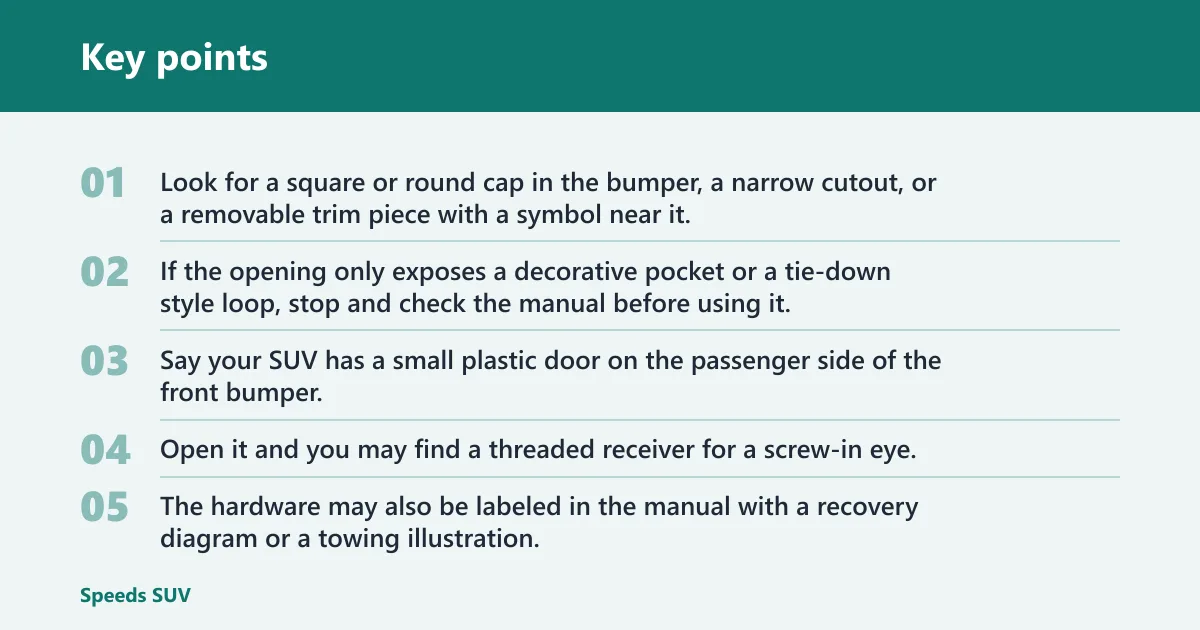
Look for a square or round cap in the bumper, a narrow cutout, or a removable trim piece with a symbol near it. That is often where a factory recovery eye or hook threads in. If the opening only exposes a decorative pocket or a tie-down style loop, stop and check the manual before using it.
Say your SUV has a small plastic door on the passenger side of the front bumper. Open it and you may find a threaded receiver for a screw-in eye. That is a promising sign, but the only safe next step is to confirm the exact part and use in the owner’s manual.
Threaded eyes, hooks, and visible brackets
A true factory front point may look like a threaded hole, a steel loop welded to a reinforced bracket, or a hook with a heavy mounting plate. It should sit close to the frame line, not hang from the outer bumper skin. The hardware may also be labeled in the manual with a recovery diagram or a towing illustration.
On some vehicles, the front point is visible from the outside and on others it is hidden until a cover is removed. A visible part is not automatically safe. Cosmetic tow hooks and shipping eyes can look similar from five feet away.
Pickup-specific frame rail locations
On pickups, the front recovery point is often on the frame rail end, behind the lower bumper opening, or attached to a reinforced crossmember. Many pickups with aftermarket bumpers place the points directly through the bumper shell, but only if the bumper is built for recovery and the hardware is rated. A random welded tab on the bumper is not the same thing.
Picture a half-ton pickup with a steel bumper and two visible loops. If those loops are part of a recovery bumper kit, the builder’s listing and the vehicle manual should both confirm the load path. If the loops are thin, decorative, or near the fog light opening, treat them as unsafe until proven otherwise.
Where are the rear recovery points?
Rear recovery points are often less common than front points, and some vehicles may have none from the factory. When they are present, they may sit behind a rear bumper cover, near a hitch receiver, or on a reinforced bracket tied to the frame rails. Do not confuse a tow ball or trailer hitch with a rear recovery point.
Rear bumper openings and hidden mounts
Check for small removable covers in the rear bumper, especially near one side or just below the bumper line. A factory rear eye may be stored behind a trim cap and threaded in only when needed. If the opening leads to a thin bracket, a plastic carrier, or a trailer wiring recess, do not attach a strap there.
Some SUVs show no obvious rear point at all. That is common on crossovers and on vehicles whose manual only gives towing directions. In that case, you need to verify whether the rear is rated, whether a front-only point is provided, or whether approved aftermarket hardware is needed.
Factory rear eyes versus transport hardware
A rear factory eye should be called out in the manual with a diagram, a mounting location, or a listed accessory. Transport hooks and tie-down loops may appear nearby, but they are often there for shipment or vehicle restraint only. If the rear hardware looks like a thin tab or a stamped loop with no clear recovery listing, do not use it.
When the rear point is missing
If the rear has no visible point and the manual gives no approved rear recovery location, do not improvise with the hitch ball, suspension arms, or bumper skin. Use the approved front point only if the manual allows the intended recovery from that direction, or fit vehicle-specific rated hardware before off-road use.
Recovery point checklist
Use this quick finder to compare what you see on the vehicle with what the manual says. A point is worth using only when the location, shape, marking, and manual reference line up. If one column does not match, treat it as unverified.
| Location | Shape | Marking | Manual reference | Do not use |
|---|---|---|---|---|
| Front frame rail or bumper access flap | Threaded eye, forged hook, or heavy welded loop | May show a recovery symbol, cap label, or part number | Owner’s manual shows front recovery use or approved towing eye | Tie-down loop, tow ball, bumper skin mount |
| Rear frame rail or rear bumper access flap | Heavy bracket, threaded receiver, or factory eye | May be hidden behind a trim cover | Manual lists rear recovery point or rear towing eye for the exact model | Suspension arm, exhaust hanger, plastic trim pocket |
| Pickup frame end or crossmember | Thick steel bracket tied into the frame | May have factory finish, label, or approved accessory marking | Manual or accessory guide confirms recovery use | Random welded tab, hitch ball, bumper skin |
| Aftermarket bumper mount | Reinforced recovery tab or shackle mount | Usually marked with load rating or product ID | Manufacturer listing confirms vehicle fitment and intended use | Unrated weld-on loop, decorative bracket, tie-down point |
How to spot fake or unsafe attachment points
Unsafe points often fail one of three checks: the metal may be too thin, the location may be wrong, or the manual may not approve it. A recovery point should look like part of the vehicle’s structure, not a convenience loop added for shipping, holding cargo, or styling.
Red flags on tie-down loops and thin stamped metal
Tie-down loops are often flat, stamped, or folded from relatively thin steel. They may sit at the outer edge of the underbody and look fine for strapping down a vehicle, yet still be wrong for recovery. If the loop flexes easily by hand or looks like a small cargo anchor, leave it alone.
A common first-timer mistake is assuming any factory loop near the frame is a recovery point. If the vehicle manual names it only as a tie-down or transport loop, that wording matters. Do not upgrade it by appearance.
Why hitch balls, suspension arms, and bumper skin mounts are out
A trailer hitch ball is for trailers, not for vehicle recovery. It can shear or launch hardware if loaded from a strap. Suspension arms and control arms are also wrong because they are not designed as primary recovery anchors, and bumper skin mounts are especially poor because the skin is cosmetic, not structural.
One more hard no-go: any point mounted only to plastic trim, thin body sheet metal, or a decorative bumper cover. Those parts can tear, deform, or rip away long before a recovery load is safe.
What the owner’s manual can and cannot confirm
The owner’s manual is the first place to check, but it may not list every recovery scenario. Some manuals show only towing eyes, shipping hooks, or transport restraint points. Others show front recovery only and say nothing about the rear. Treat any missing approval as a stop sign, not a green light.
If the manual names a point for towing but not recovery, that is not enough to use it for an off-road pull. If it shows a recovery eye, confirm whether it is for straight-line towing, winching, or both, and whether the vehicle has limits on direction of pull.
Do you need rated recovery points?
Yes, if the pull may be more than a gentle straight-line extraction. Rated recovery points matter because recovery loads can rise fast, especially in mud, sand, or when a strap builds tension. If the hardware is not clearly rated or approved, do not use it for dynamic recovery.
Static pull, winch pull, and dynamic recovery
A static pull is slow and controlled. A winch pull is usually steady and direct. A dynamic recovery is the one that adds shock load when a strap tightens suddenly. Those three loads are not the same, and the hardware that suits one may be wrong for another.
If your situation involves a snatch strap, kinetic strap, or any pull where the vehicle may lurch, the point should be rated for that use or specifically approved by the manufacturer. Do not assume a tow eye or transport loop can handle the same load.
When to stop and fit aftermarket hardware
If the vehicle has no visible approved point, or the manual gives only towing instructions, stop and fit vehicle-specific aftermarket recovery points before you go off-road. The hardware should bolt to the frame or another approved structural mount, and the listing should match the exact model, year, trim, and drivetrain where required.
Do not buy a universal hook just because it looks heavy. Fitment matters. Bolt pattern, chassis shape, bumper clearance, and airbag sensor placement can all affect whether the part is acceptable on your vehicle.
What belongs in a recovery kit
Use a recovery kit with a soft shackle or bow shackle that matches the approved point, a strap suited to the type of pull, gloves, and a dampener. Keep the connection method compatible with the hardware you have, and follow the vehicle and product manuals for attachment order and limits.
Follow the vehicle and product manual. Never work under a vehicle held only by a jack. Never exceed the vehicle’s rated roof, hitch, or tow limit. Keep items out of airbag zones and the driver’s view, and check local laws.
What if your SUV has no obvious recovery points?

If nothing obvious is visible, do not assume the vehicle is missing recovery hardware. Many newer SUVs hide the point behind a bumper cover, and some only provide a front eye or a towing eye. Start with the manual, then confirm the exact location and intended use before attaching anything.
How to check the manual and vehicle diagrams
- Find the recovery section. Look in the owner’s manual, not just the towing chapter, for recovery, towing eye, or emergency towing illustrations. If the manual has separate front and rear diagrams, compare them to the bumper shape on the vehicle.
- Match the exact hardware. Check whether the manual calls for a screw-in eye, fixed hook, or aftermarket accessory. If the manual does not name the exact point, do not substitute another loop or bracket.
- Confirm fitment before use. For aftermarket hardware, verify the model-year and chassis fitment, the mounting location, and the intended recovery type. A part that fits one trim can miss sensors or brackets on another.
When to ask a dealer or off-road specialist
Ask for help if the manual is unclear, the bumper covers hide the mounting area, or the vehicle has been modified. A dealer parts department can often confirm the original hardware, and an off-road specialist can verify whether the frame or bumper changes affect the approved load path.
If a vehicle has tow hooks that look factory-made but no recovery label, that is still a question mark. Better to confirm than to guess at a part that may only be for transport or shipping.
Aftermarket options and fitment checks
Aftermarket recovery points are the answer when the vehicle has no approved factory point or when the factory piece is only for towing. Choose hardware built for the exact chassis, not a general-purpose loop. The product listing should state the vehicle fitment and the intended use clearly enough to verify before installation.
Suppose a pickup has rear tie-down loops only and no rear recovery eye. The correct response is not to clip a strap there and hope. It is to fit a rated rear recovery point built for that frame, or to use an approved front point if the recovery scenario allows it.
Frequently asked questions
Where are the recovery points on my SUV or pickup?
They are usually at the front and sometimes at the rear, near the frame rails, behind bumper covers, or through small access doors. Pickups often have frame-mounted points, while SUVs may hide a screw-in eye or hook behind a trim cap. The owner’s manual should confirm the exact location.
How do I find the factory recovery point on my vehicle?
Check the manual first, then look for a bumper cover, access flap, threaded receiver, heavy welded hook, or reinforced bracket close to the chassis rail. A factory point often looks purposeful and structural, not like a thin loop or cosmetic tab. If the manual does not approve it, do not use it.
Are the front and rear recovery points in the same place?
No. Front and rear locations often differ, and many vehicles have only a front point from the factory. The rear may be hidden, may be missing, or may be limited to towing rather than recovery. Check each end separately and do not assume the front setup repeats at the rear.
What does a recovery point look like under a truck or SUV?
It usually looks like a heavy steel eye, hook, or bracket tied into the frame or a reinforced mount. It may sit behind a bumper cutout or a small cover. Thin stamped loops, plastic-mounted tabs, and hitch balls are not what you want for recovery.
How can I tell if a tow hook is a real recovery point?
Look for the manual’s approval, the mounting structure, and any load rating or vehicle-specific listing. A real recovery point is tied to the chassis or another approved structural mount and is listed for the intended use. A tow hook without that confirmation may be transport-only or cosmetic.
Can I use the tie-down loops as recovery points?
No, not unless the vehicle’s manual explicitly approves that exact loop for the intended recovery use. Tie-down loops are generally for transport restraint, and they are often stamped or thin-gauge steel. They are not automatically safe for snatch loads, angled pulls, or other recovery work.
Do I need rated recovery points before off-road recovery?
Yes, if the pull may be dynamic, angled, or heavy. Rated recovery points are built for the load path and are safer than improvising with a loop or hitch ball. If the vehicle has no approved factory point, fit vehicle-specific rated hardware before attempting off-road recovery.
What if my SUV has no obvious recovery points?
Check the manual, inspect behind bumper covers and access flaps, and confirm whether only towing eyes or transport points are provided. If nothing approved is visible, stop and fit vehicle-specific aftermarket hardware or ask a dealer or off-road specialist. Do not use suspension arms, bumper skin, or random loops.
Are recovery points marked or color coded on some vehicles?
Yes, some vehicles use a label, symbol, cap, or colored trim piece to show where the point is hidden. Others mark the threaded receiver or the approved hook with a small icon. Marking helps, but it does not replace the manual. Use the marking only as a clue, not proof.