Are All AWD Systems the Same? AWD Types
What changes is how torque is split, when the rear or front axle joins in, and whether the setup is full-time, part-time, or controlled by software. Miss that, and you can buy an SUV that reacts slowly, uses more fuel, or sends power somewhere you did not expect. This guide compares common AWD architectures and shows how to identify the type in a specific SUV before you buy.
Quick answer
No. AWD covers several control architectures, and the useful comparison is about hardware, software, and how the vehicle behaves in real driving. A system that feels calm on wet pavement may be a poor fit for rocky trails, while a trail-oriented setup may feel less efficient or less polished in daily commuting.
AWD can send power to all four wheels automatically, but that does not mean every system moves torque the same way or at the same moment. Some use a center differential, some use clutches or couplings, and some rely on an electric motor at one axle. AWD systems from different manufacturers do not perform exactly alike.
📊 Car and Driver says AWD and 4WD are not the same. Source: All-Wheel Drive Systems Explained.
AWD system types at a glance
The short version is simple: full-time AWD is built for constant four-wheel drive behavior, part-time AWD is generally designed to favor two-wheel drive until slip appears, automatic AWD uses sensors and computer control, and selectable AWD generally lets the driver choose modes. The key difference is how the system manages axle speed and when it intervenes.
| AWD type | Center differential | Default drive mode | Pavement use | Snow use | Off-road use | Common misuse symptom |
|---|---|---|---|---|---|---|
| Full-time AWD | Usually yes; open, locking, Torsen, or viscous-coupled | All wheels powered at all times | Yes | Strong | Moderate, unless the vehicle adds low range or a rear lock | Rare driveline bind if the center differential is not meant to be locked on dry pavement |
| Part-time AWD | Often no true center differential | One axle drives first; the other joins after slip | Sometimes no, depending on the system | Good once slip is detected | Varies | Transmission windup or binding on dry pavement if the system is used like a full-time setup |
| Automatic AWD | Usually clutch-pack or coupling based | Often front-drive until needed | Yes | Good | Light to moderate | Delayed engagement, heat buildup, or a “feels like FWD” launch before slip transfer happens |
| Selectable AWD | Depends on the mode and hardware | Driver chooses 2WD, AWD, or 4WD-like settings | Mode dependent | Good in AWD mode | Best when the system includes low range or a lock mode | Misuse can cause binding, heat, or poor traction if the wrong mode is used on the wrong surface |
| E-axle AWD | No mechanical center differential in the usual sense | One axle may be driven by the engine, the other by an electric motor | Yes | Very strong response to slip | Good for traction, limited by battery, cooling, and software limits | Can feel abrupt or may taper output if the system protects itself from heat or battery limits |
What each type feels like when traction changes
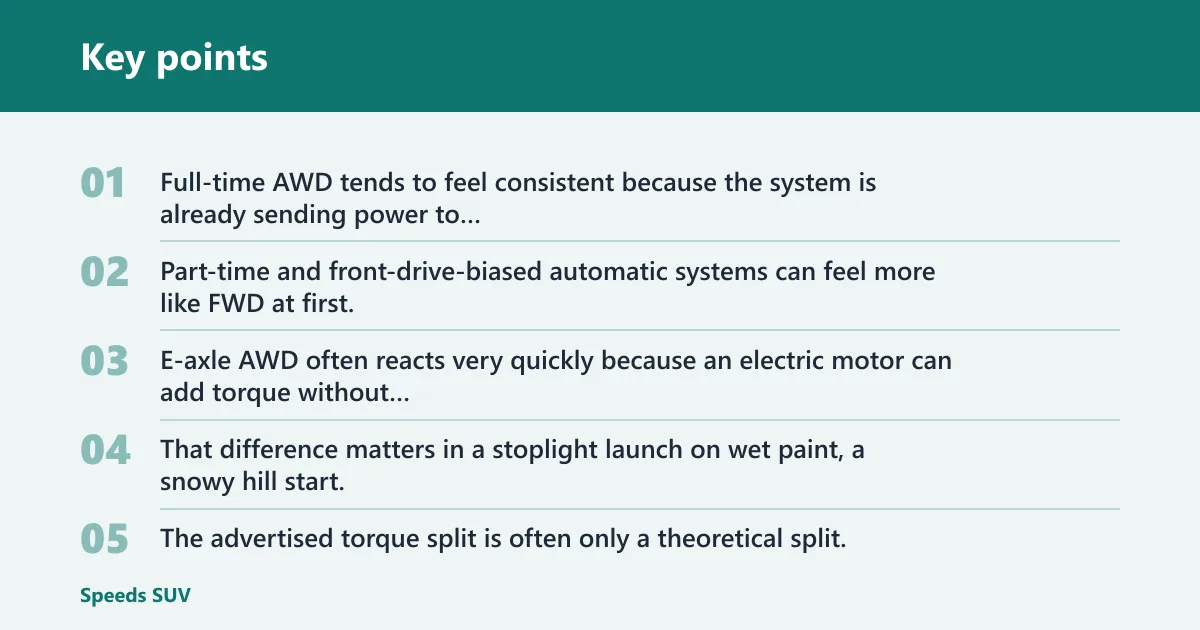
Full-time AWD tends to feel consistent because the system is already sending power to both axles. Part-time and front-drive-biased automatic systems can feel more like FWD at first, then rear drive joins after sensors detect slip. E-axle AWD often reacts very quickly because an electric motor can add torque without waiting for a mechanical coupling to load up.
That difference matters in a stoplight launch on wet paint, a snowy hill start, or a corner exit on a loose gravel road. The advertised torque split is often only a theoretical split; real driving changes the ratio as wheel speed, throttle input, and stability control logic change.
Common drivability symptoms when a system is misused
If a part-time system is driven on dry pavement when it should not be, the usual warning signs are hopping in turns, tight steering feel, and driveline bind. In a clutch-based automatic system, repeated hard launches on slippery surfaces can make the system feel lazy or inconsistent if heat builds in the coupling.
Picture a midsize SUV on a dry parking lot with the steering at full lock. If the owner selected a mode intended for loose surfaces, the vehicle may feel jerky and resistant in the turn. Change only the surface, and the same SUV may behave normally on snow or gravel.
How AWD works on an SUV
AWD uses differentials, clutches, couplings, and software control. Wheel-speed sensors, ABS data, throttle position, steering angle, and stability control inputs tell the system when one tire is slipping and how much torque should move to another axle or wheel. That logic is why AWD can react before a driver notices a problem.
The hardware behind that logic can be a center differential, a clutch pack, or an electric axle. A center differential or clutch-pack coupling lets AWD axles spin at different speeds, which matters on pavement because the front and rear axles never track exactly the same distance in a turn.
Why wheel-speed data matters for traction control
Wheel-speed data is the trigger for many AWD corrections. If one wheel spins faster than the others, the system may send torque elsewhere or brake the slipping wheel. That brake intervention is why AWD is tied so closely to traction control and stability control.
This is also why one SUV can feel calm in a rainy merge while another feels abrupt. The software calibration decides how quickly it reacts, how much brake-based intervention it uses, and whether the system prioritizes smoothness or immediate grip.
What is the difference between AWD and 4WD?
AWD and 4WD are not the same. Car and Driver says AWD and 4WD are not the same, and the driveline behavior is the reason. AWD is tuned for on-road use, while 4WD systems are part-time setups intended only for off-road or extremely slippery surfaces.
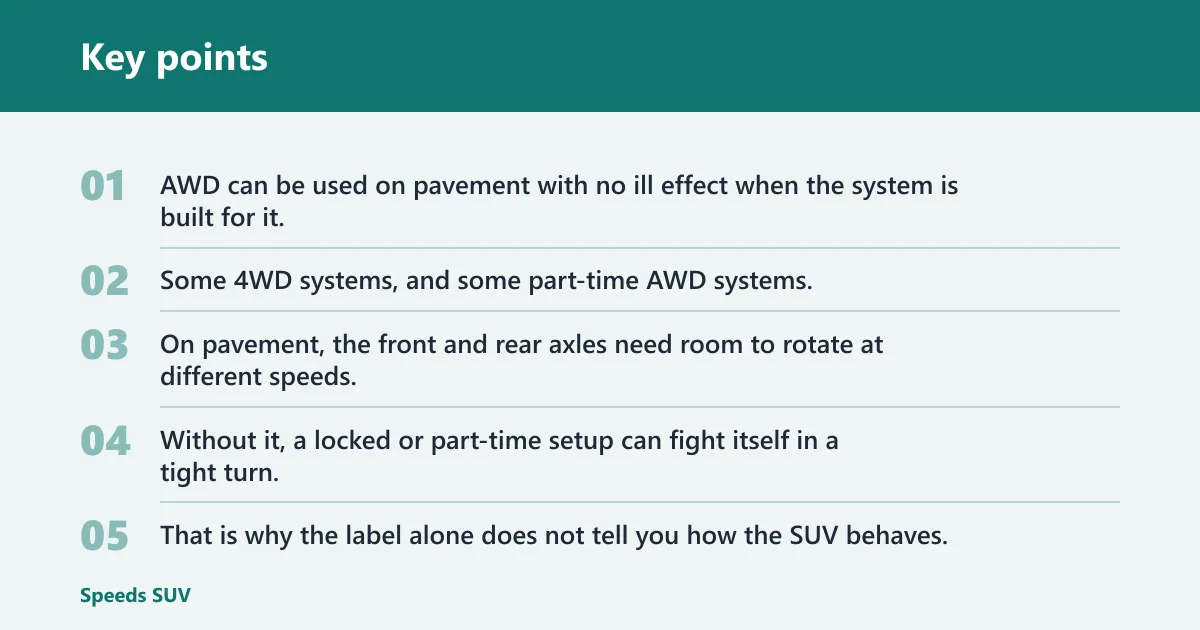
AWD can be used on pavement with no ill effect when the system is built for it. Some 4WD systems, and some part-time AWD systems, should not be used on dry pavement because they can bind the driveline. That is where transmission windup comes in.
Pavement use and driveline binding
On pavement, the front and rear axles need room to rotate at different speeds. A center differential handles that job. Without it, a locked or part-time setup can fight itself in a tight turn, which creates binding, tire scrub, and stress in the drivetrain.
That is why the label alone does not tell you how the SUV behaves. A vehicle with AWD can include both AWD and 4WD modes, but the owner has to know which mode belongs on asphalt and which one belongs on loose ground.
Low range and locking hardware
True off-road systems often include low range, a locking center differential, a rear locker, or all three. Those parts help at crawl speeds on steep or loose terrain. A basic AWD crossover may have none of them, which limits sustained trail use even if it feels confident in snow.
Which AWD system fits your driving?
The best AWD type depends on where you spend most of your time. For snow and ice, a predictable full-time system or a quick-reacting automatic system is usually the cleaner fit. For wet pavement and commuting, a front-drive-based automatic AWD setup often makes sense. For rough trails, look for selectable modes, low range, and locking hardware.
Best for snow and ice
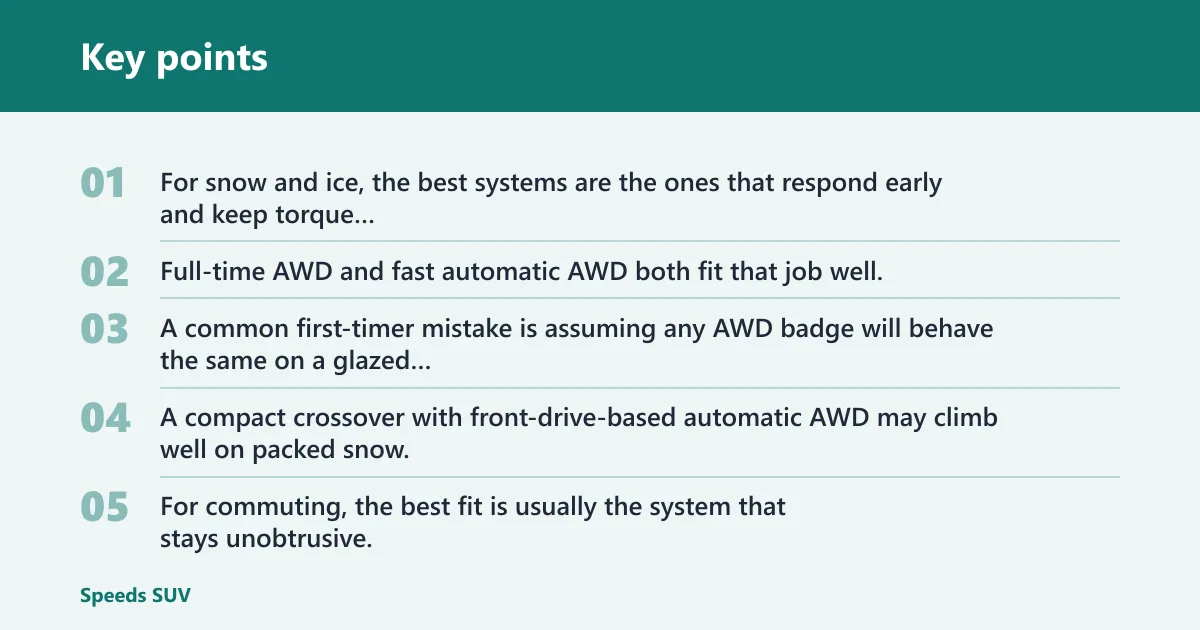
For snow and ice, the best systems are the ones that respond early and keep torque available without drama. Full-time AWD and fast automatic AWD both fit that job well, especially when the vehicle also uses traction control to brake a spinning wheel and keep momentum moving forward.
A common first-timer mistake is assuming any AWD badge will behave the same on a glazed hill. A compact crossover with front-drive-based automatic AWD may climb well on packed snow, but a deeper trail or ice-covered ramp can reveal limits in cooling, clutch capacity, or software tuning.
Best for wet pavement and commuting
For commuting, the best fit is usually the system that stays unobtrusive, saves fuel when it can, and reacts quickly enough for wet merges and rain grooves. Many front-drive-based crossovers use automatic AWD for that reason. Part-time systems can work too, but only if the surfaces match the system’s design.
Best for off-road travel and rough trails
For rough trails, the most capable setup is usually not the simplest AWD badge. Look for low range, a locking center differential, and a control system designed for sustained loose-surface use. Without those features, the SUV may still be good on dirt roads, but it is not built for hard trail work.
AWD system decision table
This table classifies common architectures by the hardware and behavior that matter most. Use it while shopping, then confirm details in the owner’s manual before you assume a system can handle pavement, snow, or trails in the way you want.
| Architecture | Center diff or coupling | Default behavior | Pavement suitability | Snow performance | Off-road suitability | Likely symptom if used wrong |
|---|---|---|---|---|---|---|
| Full-time mechanical AWD | Yes | All wheels powered nonstop | Strong | Strong | Moderate to strong, depending on locks and gearing | Bind if the center diff is locked on dry pavement |
| Part-time AWD | Usually no true center diff | Two-wheel drive first, other axle joins after slip | Limited or model dependent | Good | Moderate | Windup, hop, or binding on dry pavement |
| Automatic clutch-based AWD | Clutch pack or coupling | Often FWD-biased until needed | Strong | Good | Light to moderate | Heat buildup or delayed rear engagement under repeated load |
| Selectable AWD / 4WD-like system | Depends on mode | Driver chooses operating mode | Mode dependent | Good in the proper mode | Strong if low range and a lock are included | Binding or poor traction if the wrong mode is selected |
| E-axle AWD | No conventional center diff | Electric motor drives one axle or adds boost to the other | Strong | Very good response | Moderate, with limits from battery and heat management | Power reduction if the system protects itself from heat or battery limits |
Use the table this way: first, decide whether you need pavement comfort, winter traction, or trail ability. Next, check whether the system is full-time, part-time, automatic, selectable, or electric on one axle. Then confirm whether the vehicle includes a center differential, low range, or a lock mode.
How to tell what kind of AWD a used SUV has
The owner’s manual and drivetrain description are the most reliable ways to verify system type. Start there, then check the drive-mode labels, the axle layout, and whether the spec sheet mentions a center differential, locking differential, or a transfer case. If the listing is vague, assume nothing.
- Look for the exact drivetrain name in the spec sheet or window sticker.
- Check whether the vehicle lists 2WD, AWD, Auto, Lock, Snow, Sand, or low-range modes.
- Search the owner’s manual for the words center differential, coupling, clutch pack, or transfer case.
- Look for statements about pavement use, dry-road restrictions, or mode limits.
- Ask whether the SUV can lock the center differential or has a rear locker.
- Confirm whether the rear axle is mechanically driven, electrically driven, or only engaged after slip.
Questions to ask before you buy
Ask whether the system can be used on dry pavement in every mode, whether it has a true center differential, and whether there is a low-range setting. Also ask how the vehicle behaves if one axle loses traction. That tells you more than a badge ever will.
Suppose a used SUV advertises “AWD” but the manual says the rear axle engages only after front wheel slip. That vehicle may be excellent for rain and light snow, yet it is not the same as a full-time system with a center differential.
Why do some AWD systems feel different in corners?
Some AWD systems feel different in corners because the front and rear axles are allowed, or not allowed, to rotate at different speeds. Torque vectoring can also shift torque side-to-side or axle-to-axle, which changes how the SUV turns, settles, and exits a bend.
A center differential usually makes cornering smoother on pavement. A clutch-based system may feel more front-driven until slip or throttle demand changes the torque transfer. E-axle AWD can feel quick and tidy because motor response is immediate, but the calibration still decides how aggressively the system intervenes.
Who has the best AWD system?
There is no single best AWD system for every buyer. The best one is the architecture that fits your surface, your cargo, and your terrain. A commuter on salted roads may prefer a front-drive-based automatic system, while a trail buyer needs low range and locking hardware more than a clever torque map.
For snow and commuting, the best AWD is usually the one that reacts smoothly and stays usable on pavement. For off-road work, the best AWD is the one that adds low range, a center diff lock, and a layout meant for sustained traction at low speed.
Frequently asked questions
Are all AWD systems the same?
No. AWD includes full-time, part-time, automatic, selectable, and electric axle-based layouts. They differ in how they send torque, whether they need a center differential, and how they behave on pavement, snow, and rough ground.
What are the different types of AWD systems?
Common AWD types include full-time AWD, part-time AWD, automatic AWD, selectable AWD, and e-axle AWD. The biggest dividing line is whether the system uses a center differential, a clutch pack, or an electric motor to move torque.
Is AWD the same as 4WD?
No. AWD is generally built for on-road use and can be used on pavement with no ill effect when designed for that job. 4WD is usually a part-time setup intended for off-road or very slippery surfaces, often with low range.
Which AWD systems are best for snow and ice?
Full-time AWD and fast-reacting automatic AWD are usually the best fit for snow and ice. They keep traction available without requiring much driver input, and stability control can brake a slipping wheel to help the vehicle keep moving.
Which AWD systems are best for off-road driving?
Selectable systems with low range, a locking center differential, and sometimes a rear locker are usually the best for off-road driving. Basic crossover AWD can be useful on dirt or snow, but it is not the same as a trail-focused 4WD layout.
Can you tell what kind of AWD a used SUV has?
Yes, usually by reading the spec sheet, owner’s manual, and drivetrain description. Look for terms such as center differential, clutch pack, coupling, low range, lock, or Auto mode. If the manual limits certain modes to loose surfaces, pay attention.