SUV Towing Capacity Chart: Which Models Tow the Most?
The strongest SUV tow ratings start at 5,000 pounds, but the right pick still needs 10% to 15% towing margin after passengers, cargo, and hitch weight are counted. Skip that margin, and you can end up with sag, heat, or no buffer on hills and in wind. This guide compares SUV towing capacity charts by class, then separates headline ratings from the trim-specific numbers that still work in real use. Where a figure depends on a specific configuration, the note below it is tied to manufacturer towing guides, owner’s manuals, order guides, or SAE J2807-based published ratings.
Quick picks
| SUV | Max tow rating | Configuration needed | Usable towing check |
|---|---|---|---|
| Jeep Grand Wagoneer 2026 | 10,000 pounds | Trailer Tow package; 3.92 axle ratio; standard-wheelbase or long-wheelbase L (Jeep towing guide/order guide) | Best headline rating in this group, but only if the package and axle match the sticker; a 10,000-pound trailer can put tongue weight near 1,000 pounds before passengers or cargo are counted |
| Ford Expedition 2026 | 9,600 pounds | 4WD standard-wheelbase; twin-turbo 3.5-liter EcoBoost V-6; 10-speed automatic (Ford towing guide/order guide) | Strong full-size choice if you want a lower tow figure than the Jeep, but still in the heavy-trailer band; exact tow package content must match the build sheet |
| Toyota Sequoia 2026/2025 | 9,520 pounds | Hybrid-only powertrain; rear-wheel-drive SR5 trim for the max rating (Toyota towing guide/owner’s manual) | Good for buyers who want a hybrid without giving up a top-end tow number; Toyota ties the max figure to exact trim and drivetrain, not just the badge |
| Lincoln Navigator | 8,700 pounds | Body-on-frame full-size SUV; 24-inch wheel setups can reduce towing capacity on some configurations (Lincoln owner’s manual/towing guide) | Still above 8,000 pounds, but some 24-inch wheel setups can reduce towing capacity, so the wheel-size caveat matters on the final sticker |
| Lexus GX 550 Overtrail+ | 9,096 pounds | Twin-turbo 3.4-liter V-6; Overtrail trim variation affects the number (Lexus towing guide/owner’s manual) | The strongest midsize-style towing entry here, though it trails the full-size leaders; exact trim is what unlocks the published rating |
| 2026 Ford Escape | 3,500 pounds | Class II Trailer Tow Package (Ford towing guide/owner’s manual) | Best fit for light trailers when you want compact size and the top end of the compact band |
| 2026 Subaru Forester Wilderness | 3,500 pounds | Wilderness trim (Subaru owner’s manual/towing info) | A compact SUV option for small boats, pop-up campers, and utility trailers |
| 2026 Chevrolet Equinox | 1,500 pounds | Base compact towing setup (Chevrolet owner’s manual/towing guide) | Works for very light trailers only; good example of how fast compact ratings can drop |
Which SUVs tow the most?
Full-size body-on-frame SUVs lead this chart. The Jeep Grand Wagoneer tops the group at 10,000 pounds, followed by the Ford Expedition at 9,600 pounds, the Toyota Sequoia at 9,520 pounds, and the Lincoln Navigator at 8,700 pounds. The Lexus GX 550 Overtrail+ is a strong midsize entry at 9,096 pounds, but it does not outrank the biggest full-size models. Those top figures are published for specific trims and setups, not every version of the nameplate.
Full-size body-on-frame leaders first
Body-on-frame SUV construction is where the highest tow ratings usually live. That layout is common in full-size models and often shares hardware with pickup-truck platforms. It is one reason these SUVs can pull heavier trailers than many car-based crossovers. In published towing guides, that hardware advantage is usually paired with a specific axle ratio, cooling package, and hitch/wiring setup rather than a generic trim badge.
Where midsize SUVs fit in the ranking
The midsize class can still tow well, but it usually trails the largest full-size SUVs. The Lexus GX 550 Overtrail+ is a clear example: a midsize SUV can clear 9,000 pounds in the right trim, yet it still sits below the segment leaders in this chart. Lexus publishes that number for the Overtrail+ configuration, which is why the trim name matters here.
Why compact SUVs rarely break 3,500 pounds
Compact SUVs usually land in the 1,500- to 3,500-pound band. That range works for a small boat, jet ski, utility trailer, or pop-up camper, but it is not where you shop for a heavy travel trailer. Trim and drivetrain matter a lot here, and the manufacturer’s owner’s manual usually spells out the exact package or trim needed to reach the top of the band.
SUV towing chart
This chart focuses on usable comparisons, not just headline numbers. It lists the trim or package needed to reach the stated maximum, then adds an example load check so you can see how quickly a tow setup fills up once people, cargo, and tongue weight enter the picture. For the “usable towing” lens, a safer match usually leaves 10% to 15% of payload unused after tongue weight and passengers are counted.
How to read trim-specific towing ratings
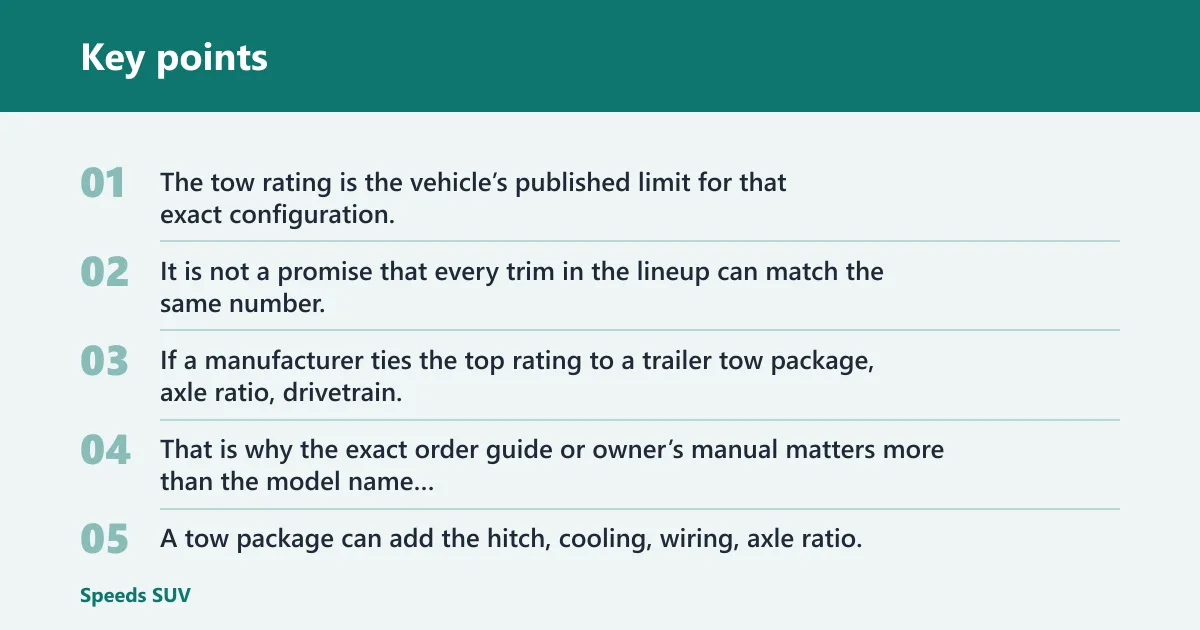
The tow rating is the vehicle’s published limit for that exact configuration. It is not a promise that every trim in the lineup can match the same number. If a manufacturer ties the top rating to a trailer tow package, axle ratio, drivetrain, or wheel size, the number can fall when that equipment changes. That is why the exact order guide or owner’s manual matters more than the model name alone.
Why tow packages and wheel size change the number
A tow package can add the hitch, cooling, wiring, axle ratio, and other hardware needed for the max figure. Wheel size can also matter. The Lincoln Navigator is a good example, since 24-inch wheels can reduce towing capacity on some configurations. When a manufacturer notes that wheel choice affects towing, the published rating applies only to the wheel/tire combination named in the guide.
| Model | Max tow rating | Required setup | Example tongue weight at max trailer | Example passenger/cargo load | Payload check |
|---|---|---|---|---|---|
| Jeep Grand Wagoneer 2026 | 10,000 pounds | Trailer Tow package; 3.92 axle ratio; standard-wheelbase or L (Jeep towing guide/order guide) | 1,000 pounds at 10% | 600 pounds | Check the door sticker first; this load stack is heavy enough to make payload the limit before tow rating does. Example math: if the vehicle has a 1,550-pound payload sticker, 1,000 pounds of tongue weight plus 600 pounds of people/cargo would exceed payload by about 50 pounds; at 15% tongue weight, overload risk rises sharply. |
| Ford Expedition 2026 | 9,600 pounds | 4WD standard-wheelbase; twin-turbo 3.5-liter EcoBoost V-6; 10-speed automatic (Ford towing guide/order guide) | 960 pounds at 10% | 600 pounds | Still needs a healthy payload sticker; verify the exact trim before pairing it with a heavy trailer. Example math: on a 1,700-pound payload sticker, the remaining margin would be roughly 140 pounds before hitch weight is added; at 15% tongue weight, the combination would likely be over payload. |
| Toyota Sequoia 2026/2025 | 9,520 pounds | Rear-wheel-drive SR5 trim; hybrid-only powertrain (Toyota towing guide/owner’s manual) | 952 pounds at 10% | 600 pounds | Strong tow rating, but the hybrid setup and trim choice make the sticker check important. Example math: on a 1,730-pound payload sticker, about 178 pounds remain after 952 pounds of tongue weight and 600 pounds of passengers/cargo; at 15% tongue weight, overload risk is likely. |
| Lincoln Navigator | 8,700 pounds | Body-on-frame full-size SUV; wheel choice can matter (Lincoln owner’s manual/towing guide) | 870 pounds at 10% | 600 pounds | Wheel and option choices can change the real-world match, so confirm the exact build. Example math: with a 1,650-pound payload sticker, roughly 180 pounds remain after 870 pounds of tongue weight and 600 pounds of people/cargo; the 15% tongue-weight case would likely push it over. |
| Lexus GX 550 Overtrail+ | 9,096 pounds | Twin-turbo 3.4-liter V-6; Overtrail+ trim (Lexus towing guide/owner’s manual) | 910 pounds at 10% | 500 pounds | Midsize packaging means less room for error than the full-size leaders. Example math: if the sticker shows 1,410 pounds of payload, the margin is about zero at 910 pounds plus 500 pounds, and any higher tongue weight becomes an overload risk. |
| 2026 Ford Escape | 3,500 pounds | Class II Trailer Tow Package (Ford towing guide/owner’s manual) | 350 pounds at 10% | 400 pounds | Works for light trailers, but payload can disappear fast with five people on board. Example math: if the payload sticker is 1,100 pounds, the remaining margin is about 350 pounds before tongue weight; at 15% tongue weight, the setup is close to the limit with only modest cargo. |
| 2026 Subaru Forester Wilderness | 3,500 pounds | Wilderness trim (Subaru owner’s manual/towing info) | 350 pounds at 10% | 400 pounds | Best used with smaller trailers and a careful check of cargo weight. Example math: if payload is around 1,000 pounds, the combination remains usable, but the remaining margin shrinks quickly once passengers and gear are added. |
| 2026 Chevrolet Equinox | 1,500 pounds | Compact base setup (Chevrolet owner’s manual/towing guide) | 150 pounds at 10% | 300 pounds | Suitable only for very light trailers. Example math: even with a 1,000-pound payload sticker, the remaining margin is modest once tongue weight and passengers are counted, so this is not a heavy-trailer choice. |
How much can full-size SUVs tow?
Full-size SUVs are the top towing choices in this chart. The Jeep Grand Wagoneer reaches 10,000 pounds with the Trailer Tow package and a 3.92 axle ratio. The Ford Expedition follows at 9,600 pounds in a four-wheel-drive standard-wheelbase configuration, while the Toyota Sequoia hits 9,520 pounds in rear-wheel-drive SR5 form. The Lincoln Navigator is rated to tow 8,700 pounds. Those figures are published for the exact configurations listed in the brand guides, which is why the trim detail matters as much as the brand name.
Jeep Grand Wagoneer 2026
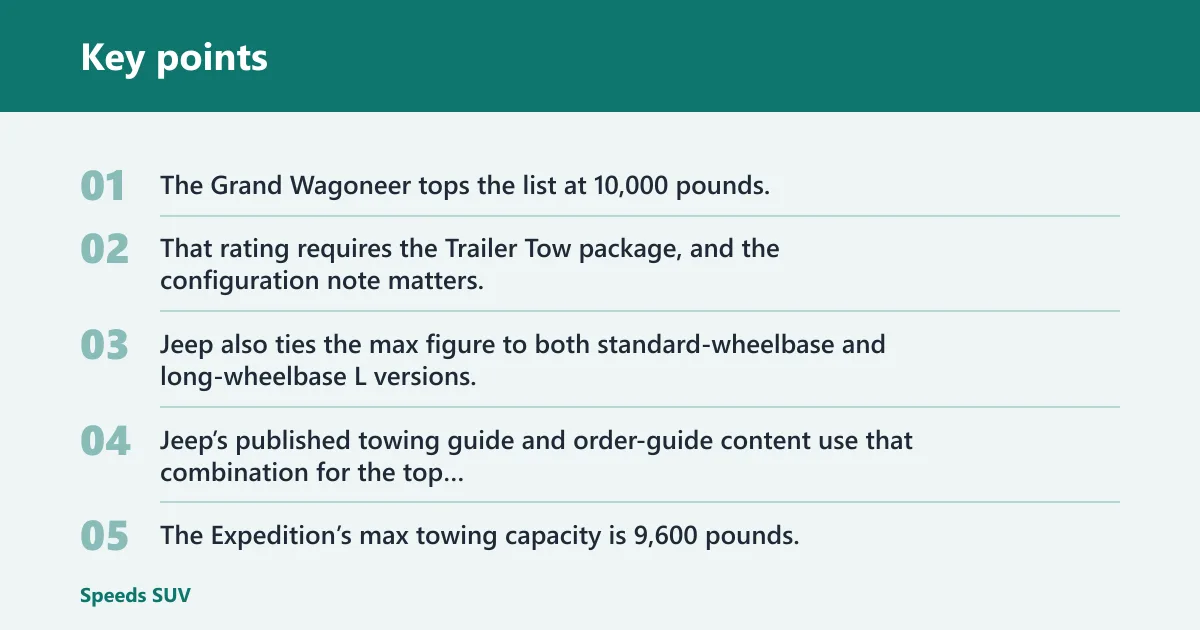
The Grand Wagoneer tops the list at 10,000 pounds. That rating requires the Trailer Tow package, and the configuration note matters. Jeep also ties the max figure to both standard-wheelbase and long-wheelbase L versions, with the 3.92 axle ratio part of the setup. Jeep’s published towing guide and order-guide content use that combination for the top rating, so the number is not universal across every Grand Wagoneer build.
Ford Expedition 2026
The Expedition’s max towing capacity is 9,600 pounds. The published max figure requires a four-wheel-drive standard-wheelbase configuration, and the standard engine is the twin-turbo 3.5-liter EcoBoost V-6 paired with a 10-speed automatic. That is the version to compare, not a looser trim guess. Ford’s towing references tie the max number to the specific build, so rear-wheel drive or other variations may not match it.
Toyota Sequoia 2026/2025
The Sequoia is rated to tow 9,520 pounds, and that figure applies to the rear-wheel-drive SR5 trim. It is hybrid-only, so buyers comparing gas versus hybrid SUVs should note that this model does not give up much tow rating in exchange for electrification. Toyota’s published materials tie the number to that exact trim and drivetrain, which makes the SR5 callout important.
Lincoln Navigator
The Navigator is rated to tow 8,700 pounds. It still sits in the body-on-frame full-size SUV segment, which is the category that usually holds the strongest tow ratings. Wheel selection matters here too, since 24-inch wheels can reduce towing capacity. Lincoln’s owner’s manual and towing information make the wheel-size caveat part of the configuration, not a general rule for every Navigator.
Say your trailer is a 7,000-pound camper and your family adds 600 pounds of people and gear. A full-size SUV with the right package gives you room to stay under the published limits without running the combination right up to the edge. In practical terms, that margin is what helps the SUV stay usable once real payload, not just trailer mass, enters the calculation.
Which midsize SUVs tow the most?
The Lexus GX 550 Overtrail+ leads the midsize side of this chart at 9,096 pounds. It trails the biggest full-size SUVs, but it is still a serious tow vehicle. For buyers who want a smaller footprint than a traditional full-size SUV, that rating is the key number to compare. Lexus publishes the top figure on the Overtrail+ configuration, so this is not a broad midsize average.
Lexus GX 550 Overtrail+
The GX 550 Overtrail+ uses a twin-turbo 3.4-liter V-6, and its Overtrail trim variation affects the tow rating. That matters because the same model family can land in different places depending on the trim and equipment mix. Lexus’s published towing guide/owner’s manual language ties the strongest rating to the specific Overtrail+ configuration rather than the entire GX lineup.
How midsize ratings trail full-size leaders
The gap is real. A midsize SUV can be a strong tow rig, but the highest full-size entries still hold the top spot. That difference matters when trailer weight, passengers, and cargo all stack up in the same trip. The usable margin shrinks faster in midsize SUVs because payload and hitch load eat into the available capacity more quickly.
When a midsize SUV still makes sense
Choose midsize if you want easier daily driving, a smaller parking footprint, or off-road trim content that still leaves room for weekend towing. The GX 550 Overtrail+ is the clearest example in this chart. It is also the best fit here for readers who want a high tow number without moving all the way up to a full-size SUV.
Can compact SUVs tow 3,500 pounds?
Yes, some can. The compact band usually runs from 1,500 to 3,500 pounds, and the top end is enough for small boats, jet skis, utility trailers, and pop-up campers. The 2026 Subaru Forester Wilderness is rated for 3,500 pounds, and the 2026 Ford Escape can also reach 3,500 pounds with a Class II Trailer Tow Package. Chevrolet’s Equinox sits lower at 1,500 pounds, which shows how much the compact class can vary by trim.
Typical compact SUV towing band
Compact SUVs span a wide range. Some models are rated as low as 1,500 pounds, which is why the same class can be either trailer-friendly or trailer-limited depending on trim and drivetrain. If you are comparing compact SUVs, the best reading is usually the owner’s manual plus the tow package chart, not the marketing brochure alone.
Trim and drivetrain limits
Compact tow numbers are often trim-specific. The Escape needs its Class II Trailer Tow Package to reach 3,500 pounds, while the Forester Wilderness gets there through its trim choice. The 2026 Chevrolet Equinox is listed at 1,500 pounds, which shows how quickly the numbers can fall. Those examples are useful because they show the difference between a base compact SUV and one configured for trailer use.
Best uses for lighter trailers
For compact SUVs, stay in the lighter trailer lane. A single-axle utility trailer, a small aluminum boat, or a pop-up camper is a more realistic match than a large enclosed trailer or heavy travel trailer. If the trailer is near the vehicle’s max rating, the payload sticker becomes the limiting factor quickly.
Do hybrids tow less than gas SUVs?
Sometimes, but not always. Some hybrids still tow well, and the Toyota Sequoia shows that a hybrid-only SUV can post a very high rating. Compact hybrids, on the other hand, often tow less than comparable gas versions, so the answer depends on the model and trim. The powertrain alone is not enough to predict the result.
Hybrid-only models with strong ratings
The Sequoia is the clearest example here. Its 9,520-pound rating belongs to a hybrid-only SUV, and the rear-wheel-drive SR5 trim is the published max configuration. That makes it a strong counterexample to the idea that hybrid always means low tow capacity. Toyota’s documentation is trim-specific, so the exact SR5 callout is the one readers should use.
Compact hybrids versus gas versions
Compact hybrids often give up tow rating relative to some gas versions, but not all do. The exact number varies sharply by model and trim, so a hybrid badge alone does not tell you enough to buy or rule out a vehicle. For compact buyers, the safer habit is to confirm the owner’s manual and tow package chart before assuming the hybrid can match the gas version.
What to confirm before you tow
Check the manufacturer’s listing for your exact trim, then confirm the owner’s manual and the trailer label. The same model can change rating with drivetrain, wheel size, or tow package content. If the published number is not tied to your exact build, treat it as an estimate, not a promise.
Why tow ratings vary by configuration
Tow ratings change because equipment changes. A tow package can add the hitch and cooling hardware, and it can also change the axle ratio. SAE J2807 is a towing standard often cited in published max-rating claims, and the final number can still depend on the specific vehicle build. In other words, J2807 helps standardize how ratings are derived, but it does not make one trim’s number automatically apply to every trim.
Tow package and axle ratio
The Grand Wagoneer’s Trailer Tow package and 3.92 axle ratio are a good example of how a package can materially change the published number. The Ford Escape’s Class II Trailer Tow Package is another. Without the right hardware, the max figure does not apply. That is why the package note belongs next to the rating instead of buried in fine print.
SAE J2807 and published ratings
Many manufacturers reference SAE J2807 when they publish towing numbers. That helps standardize the claim, but it does not erase trim differences. The rating still depends on the vehicle configuration in the dealer order guide. If a model-year change is still being finalized, treat the figure as provisional unless the brand has already published the final towing guide.
Payload, passengers, and trailer setup
Tow rating is only part of the picture. The combination still has to work with payload, tongue weight, and trailer equipment. A common first-timer mistake is to chase the headline tow number while ignoring the weight of people, coolers, recovery gear, and a full fuel load. For a usable setup, the remaining payload margin after tongue weight and passengers should still be positive, and ideally it should leave 10% to 15% of the sticker unused.
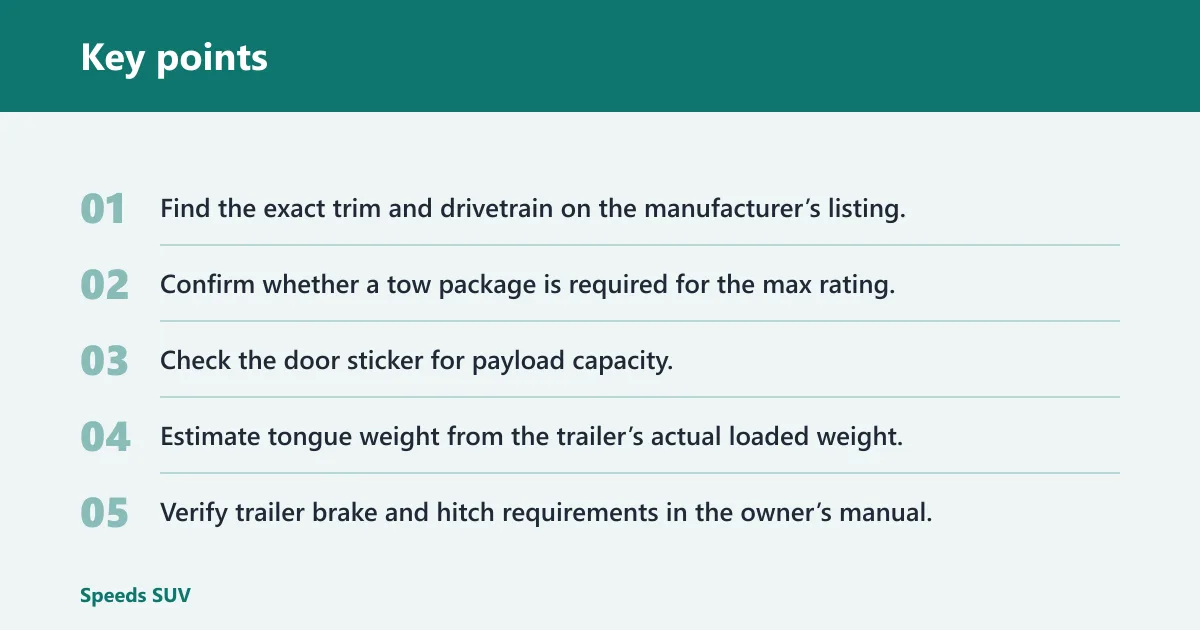
- Find the exact trim and drivetrain on the manufacturer’s listing.
- Confirm whether a tow package is required for the max rating.
- Check the door sticker for payload capacity.
- Estimate tongue weight from the trailer’s actual loaded weight.
- Verify trailer brake and hitch requirements in the owner’s manual.
Suppose a compact SUV is rated at 3,500 pounds and the trailer is loaded close to that number. Add four passengers and weekend cargo, and the payload sticker may become the real limit long before the tow rating does. That is why the usable towing margin matters more than the brochure maximum for real trips.
Frequently asked questions
Which SUV models tow the most?
The Lincoln Navigator also clears 8,000 pounds at 8,700 pounds. Those are the names to start with if you want the heaviest tow ratings, but each one depends on a specific configuration and not every trim will match the max.
What SUV has the highest towing capacity?
The Jeep Grand Wagoneer has the highest towing capacity in this guide at 10,000 pounds. That number requires the Trailer Tow package and a 3.92 axle ratio, so the exact trim and equipment matter as much as the badge. Jeep’s published towing information ties the top rating to that package combination.
Which SUVs can tow 8,000 pounds or more?
The Jeep Grand Wagoneer, Ford Expedition, Toyota Sequoia, Lexus GX 550 Overtrail+, and Lincoln Navigator all meet or exceed 8,000 pounds in the configurations listed here. Always check the exact trim, because the rating can change with drivetrain, wheel size, or package content. A published tow guide or owner’s manual is the right place to confirm the specific build.
Does the tow rating change by trim or tow package?
Yes. That is one of the main reasons tow charts need trim detail. The Grand Wagoneer’s max rating needs the Trailer Tow package, the Expedition’s max rating needs a four-wheel-drive standard-wheelbase setup, and the Escape needs a Class II Trailer Tow Package to reach 3,500 pounds. Those are configuration-specific ratings, not blanket nameplate numbers.
Which compact SUVs can tow 3,500 lbs safely?
The 2026 Subaru Forester Wilderness and the 2026 Ford Escape with the Class II Trailer Tow Package are the compact examples in this guide that reach 3,500 pounds. That rating is best used for lighter trailers, and you should still verify the owner’s manual and payload sticker before you hook up. If your trip includes passengers and gear, the usable margin may be lower than the tow number suggests.
Are hybrid SUVs worse for towing than gas SUVs?
Not always. The Toyota Sequoia shows that a hybrid-only SUV can still post a very high tow rating, while many compact hybrids tow less than their gas counterparts. The right answer depends on the model, the trim, and the package content. A hybrid badge alone does not predict the final number.
What equipment is needed to reach max towing capacity?
Usually, a tow package or trailer tow package, the correct axle ratio, the right drivetrain, and the hitch and wiring listed by the manufacturer. In some cases, wheel size also matters. The exact combination is vehicle-specific, so the owner’s manual is the final check. If the manufacturer’s guide names 24-inch wheels, SR5, Overtrail+, or a specific drivetrain, that wording is part of the requirement.