Does a Tow Package Increase Towing Capacity?
A tow package raises towing capacity only when the manufacturer certifies a higher tow rating for that specific vehicle version; many packages add cooling, hitch, wiring, and brake prep without changing the number. If you ignore the rating, you can void coverage, overload parts, and raise trailer instability risk. This guide shows when a tow package changes the official limit and when it only improves towing readiness.
Tow package vs certified towing rating
Sometimes, but only when the vehicle leaves the factory with a higher certified rating for that exact configuration. A tow package can make towing easier and safer by adding the right hardware, yet the official limit usually stays the same unless the manufacturer has rated that version differently.
Tow-ready hardware versus a higher factory rating
A tow package is usually a factory-installed option bundle. It can add a hitch, wiring, cooling upgrades, and brake-related equipment, and Jeep notes that a tow package can include a trailer tow group with upgrades and additions for maximum towing capability. That improves readiness. It does not automatically change the published limit.
The rating changes only when the manufacturer certifies a different configuration. That means the engine, transmission, axle ratio, cooling system, brake hardware, GCWR, and other equipment line up with a higher official figure.
Why the VIN-specific rating matters
Maximum towing capacity is the manufacturer-set upper limit for a specific vehicle configuration. Jeep says maximum towing capacity is the total maximum weight a vehicle can safely tow. The exact VIN matters because the same model can have different ratings across trims, engines, wheelbases, axles, and tow equipment.
A brochure number is not enough. The door jamb sticker, owner’s manual, towing guide, and VIN-based lookup are the places to verify the real number for that vehicle. That is the number that controls safe, legal, and warranty-sensitive use.
How towing capacity works
Towing capacity is set by the manufacturer, not by a single bolt-on part. It depends on the full vehicle configuration, then gets capped by the weakest practical limit in the chain. GCWR, GVWR, payload, hitch rating, brakes, cooling, and axle ratio all matter.
Manufacturer ratings and vehicle configuration
TowSense says towing depends on engine, transmission, axle ratio, payload capacity, and hitch rating. That list is the right way to think about it. The limit is based on what the vehicle can do as built, not on what one upgrade can theoretically improve.
How GCWR and GVWR limit towing
GCWR is the maximum combined weight of the vehicle and trailer. The same source says towing capacity is determined by subtracting curb weight and payload from GCWR. That is why a higher towing number is usually tied to the whole powertrain and brake package, not just the receiver hitch.
GVWR is the maximum loaded weight of the vehicle itself, including passengers, cargo, fuel, and tongue weight. You cannot legally or safely exceed it. Even if the tow rating looks generous, a full cabin and heavy cargo can consume the margin fast.
Why payload can be the first limit you hit
Payload is often the hidden stop sign. Passengers, luggage, tools, bed cargo, and tongue weight all use payload. A vehicle can be tow-rated for a trailer weight yet still run out of payload before it reaches the published limit.
That is especially common with SUV families carrying people and gear. A trailer that looks fine on paper can push the rear axle, GVWR, or tongue weight budget past its limit before the headline tow number is reached.
Tow package parts and what they change
Different tow-package parts solve different problems. Some improve control and durability. Some prepare the vehicle for braked towing. A few can be part of a higher factory rating, but only when they are part of a certified configuration from the manufacturer.
Hitch, wiring, and trailer brake controller
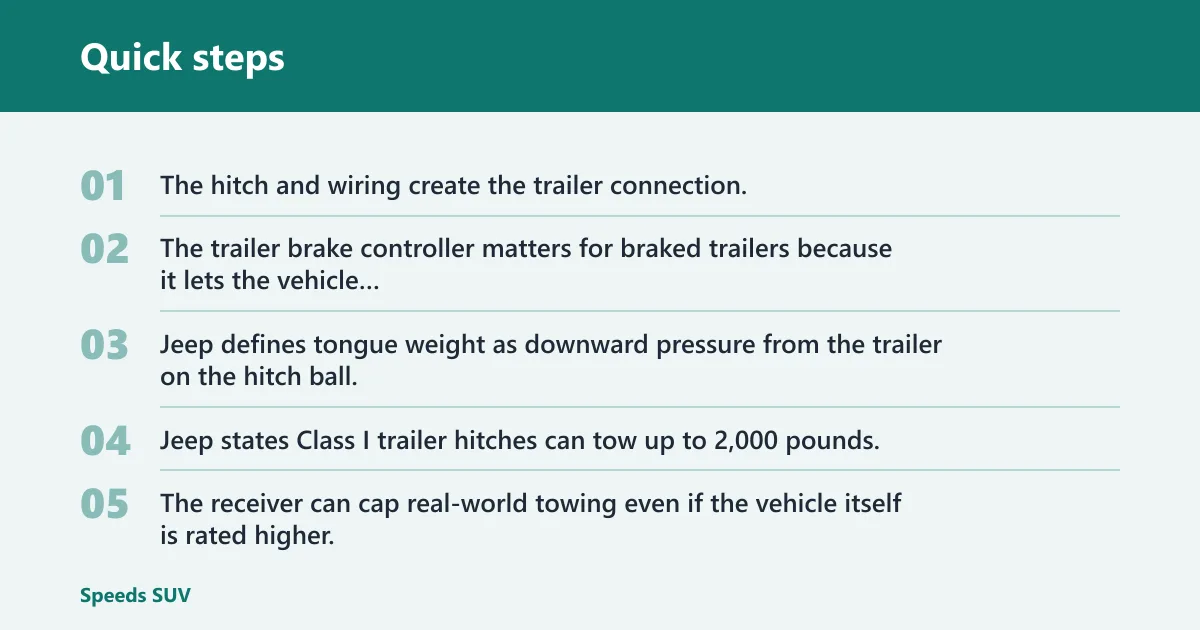
The hitch and wiring create the trailer connection. The trailer brake controller matters for braked trailers because it lets the vehicle manage trailer brake force. Jeep defines tongue weight as downward pressure from the trailer on the hitch ball, and that load must stay inside the hitch and vehicle ratings.
Hitch class matters too. The same source states Class I trailer hitches can tow up to 2,000 pounds, and Class II trailer hitches can tow up to 3,500 pounds. The receiver can cap real-world towing even if the vehicle itself is rated higher.
Transmission cooler and heat control
A transmission cooler helps manage heat under load. Many towing guides say transmission coolers are among the upgrades that can boost capability. That means better durability and less thermal stress during towing, not a guaranteed change to the official rating.
Heat control matters because towing loads the drivetrain for long periods. Better cooling can help the vehicle hold up under use, but the factory tow figure still belongs to the certified configuration.
Axle ratio and cooling changes
An axle ratio change can improve launch feel and hill-climbing ability, and it may be part of a higher-rated factory build. Cooling upgrades can also support the package. But if those changes are added after the fact, they do not automatically rewrite the manufacturer’s tow rating.
That is the key split: hardware can improve capability, while the official number changes only when the maker certifies a different build.
Does this tow package raise my rating?
Use the table below to separate factory certification from aftermarket or dealer-installed parts. If the answer in the second column is no, the package may improve towing readiness but it does not change the official limit on its own.
Tow rating decision table
| Tow package type | Can it change the official tow rating? | What it improves | What it does not change |
|---|---|---|---|
| Factory tow package | Yes, if the manufacturer certifies that VIN or trim at a higher rating | Cooling, hitch, wiring, brake prep, axle and drivetrain setup | It does not raise the rating unless the factory certifies the different configuration |
| Dealer-installed hitch-only package | No, not by itself | Receiver strength and trailer attachment point | GCWR, GVWR, payload limits, and the published tow rating |
| Cooling-only upgrade | No, not by itself | Heat control and durability under load | The official tow number and weight ratings |
| Brake controller addition | No, not by itself | Trailer brake control for braked towing setups | The vehicle’s certified maximum trailer weight |
| Axle ratio change | Only if the manufacturer rates that exact build differently | Pulling feel, grade performance, and launch response | The published rating if added after sale without recertification |
| Suspension-only mods | No, not by itself | Ride support, sag control, and some stability benefits | GVWR, GCWR, payload, and tow rating |
Can you increase towing capacity on a vehicle?
You can increase towing confidence and control, but you usually cannot change the official limit on your own. Only the manufacturer can raise the certified rating through a different approved configuration. Aftermarket parts may help the vehicle tow better, yet they do not rewrite the rating printed for that VIN.
What can improve towing confidence and control?
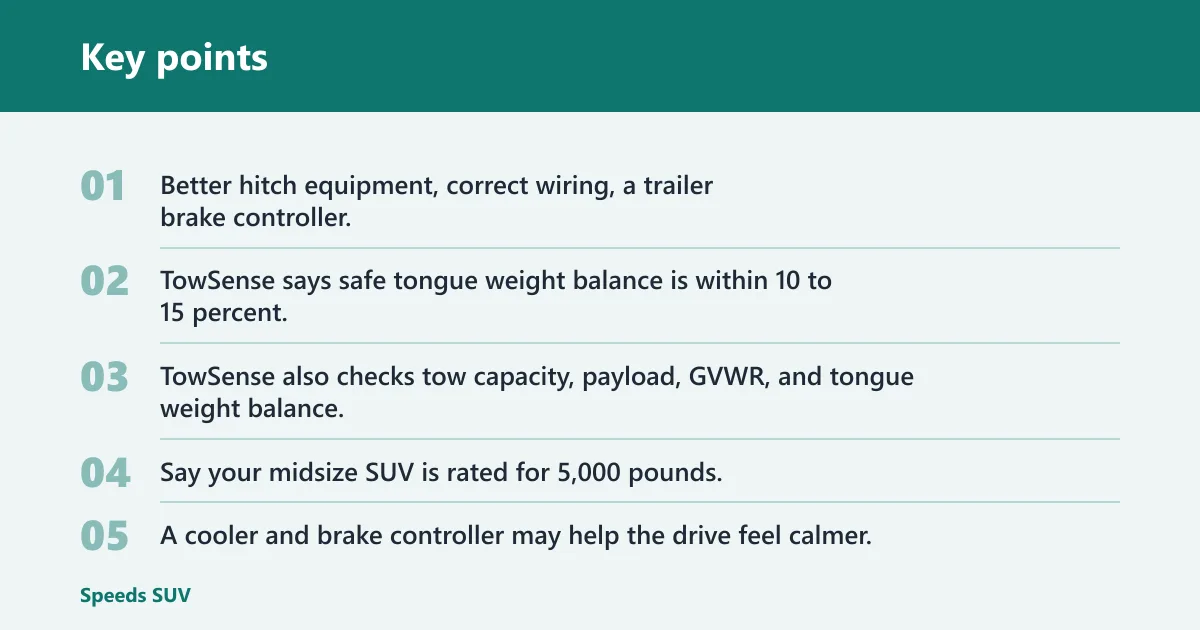
Better hitch equipment, correct wiring, a trailer brake controller, the right hitch class, and a transmission cooler can make towing smoother and more controlled. The same source says safe tongue weight balance is within 10 to 15 percent, and that balance matters for stability. TowSense also checks tow capacity, payload, GVWR, and tongue weight balance.
Say your midsize SUV is rated for 5,000 pounds, but a cargo-heavy cabin leaves too little payload for tongue weight and passengers. A cooler and brake controller may help the drive feel calmer, yet the real limit is still payload and GVWR, not the comfort of the setup.
What cannot change the official limit
Suspension lifts, helper springs, stronger shocks, and a bigger receiver can improve ride quality or sag control. They do not automatically raise the number in the towing guide. The same is true for a cooler, a brake controller, or axle changes that are not part of a factory-certified build.
That matters because the published limit reflects the whole vehicle, not just one upgraded part. A stronger part can fail to protect you from a GCWR or GVWR problem.
When a manufacturer-issued tow package does change the number
A factory tow package can change the rating when the maker certifies the vehicle differently from the base build. That usually means the package is not just a hitch add-on. It is part of a tested configuration that may include cooling, gearing, brake prep, and other hardware needed for the higher number.
That is why two versions of the same SUV or truck can have different tow ratings. The VIN, not the badge on the tailgate, decides the limit.
Tow package vs max tow package
A standard tow package usually adds the equipment needed for trailer use. A max tow package usually bundles more of the hardware that supports the highest factory rating for that model. The difference matters because the label can look similar while the certified capacity is not.
What each package usually includes
A standard tow package often includes a hitch, wiring, and brake-related prep. A max tow package usually adds heavier-duty cooling, a more capable axle ratio, and other pieces needed to support the upper limit. Exact content varies by model year and trim.
That is why you should never assume every tow package means the same thing. One package may prepare the vehicle for towing. Another may be the one tied to the higher rating.
Why the same model can have different ratings
The same truck or SUV can carry different published ratings depending on cab style, wheelbase, engine, axle, transmission, and tow equipment. The same source says a 2024 Ford F-150 can range from 5,000 to 13,500 pounds depending on configuration. That spread shows how much the build matters.
Braked towing and unbraked towing can differ too. Unbraked trailers often have lower limits because the vehicle alone must control more of the stopping load. Braked trailers reduce that burden, which is why the rating may be higher for a braked setup.
How to choose the right setup for your trailer
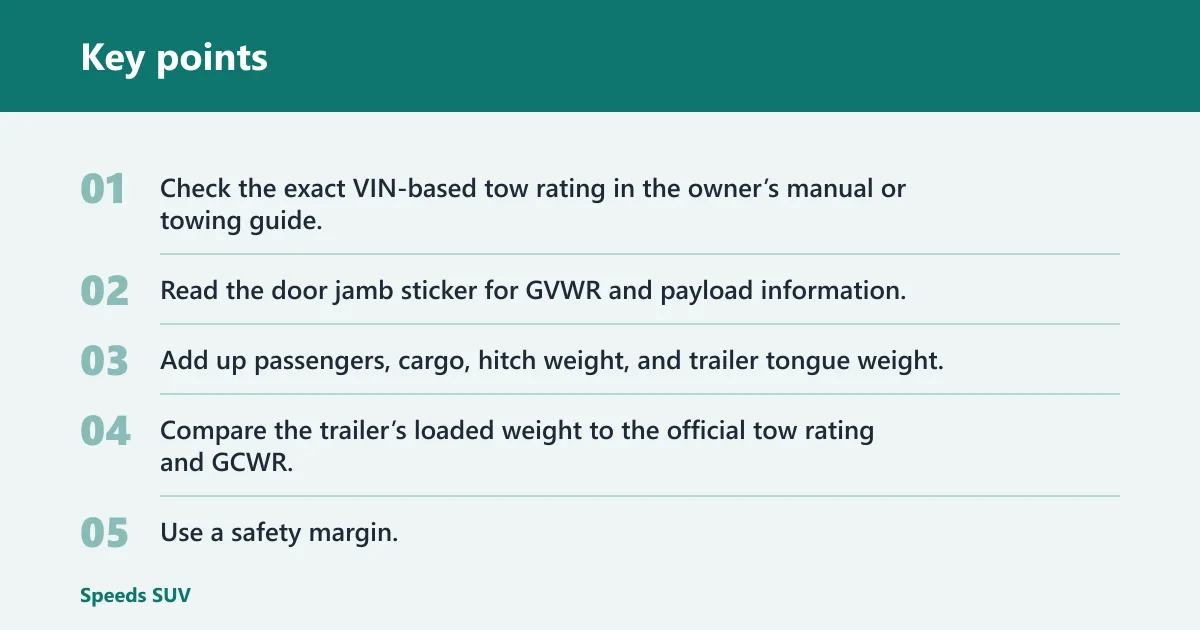
- Check the exact VIN-based tow rating in the owner’s manual or towing guide.
- Read the door jamb sticker for GVWR and payload information.
- Add up passengers, cargo, hitch weight, and trailer tongue weight.
- Compare the trailer’s loaded weight to the official tow rating and GCWR.
- Use a safety margin. Jeep says many manufacturers and experts urge using no more than 80% of maximum towing capacity.
- Confirm that the hitch class and brake controller are appropriate for the trailer.
A common first-timer mistake is focusing on the trailer’s dry weight and ignoring tongue weight. A 3,200-pound trailer with 12 percent tongue weight puts about 384 pounds on the hitch before passengers, luggage, or coolers are counted. That can move the vehicle out of safe range quickly.
What happens if you exceed the limit?
Exceeding the manufacturer limit can overload the drivetrain and braking system. TowSense warns that exceeding tow capacity overloads the drivetrain and braking system. It can also put you over GVWR or GCWR, which affects stability, stopping distance, and legal compliance.
That can matter for warranty claims and insurance handling too. If a failure or crash involves towing above the listed rating, a claim can become harder to defend. The safe move is to stay within the certified numbers, not test how far past them the vehicle will go.
Frequently asked questions
Can you increase towing capacity?
Only the manufacturer can increase the official towing capacity by certifying a different configuration. You can add parts that improve towing readiness, such as a hitch, brake controller, or cooler, but those changes do not automatically raise the published rating for that VIN.
How does towing capacity work?
Towing capacity is the manufacturer-set maximum trailer weight for a specific configuration. It is tied to GCWR, GVWR, payload, brakes, cooling, axle ratio, and hitch limits. The same source says it is determined by subtracting curb weight and payload from GCWR.
Can you tow more than towing capacity?
It is not recommended. Exceeding the rating can overload the drivetrain and braking system, reduce stability, and create legal or insurance problems. A safer rule is to stay well under the limit and use only the exact VIN-based rating from the manufacturer.
Tow package vs max tow package: which do you need?
If you are towing near the upper end of the vehicle’s rating, the max tow package is usually the better match because it is more likely to include the hardware tied to the highest certified figure. For lighter trailers, a standard tow package may be enough if payload and hitch ratings still fit.