Does My Vehicle Have a Tow Package?
A factory tow package can often be checked in about 10 minutes by looking for visible hitch, wiring, cooling, axle, and brake hardware, then confirming the VIN or build sheet. A hitch receiver alone is not proof. This guide shows the exact hardware clues, VIN and build-sheet checks, and the common false-positive traps.
How to tell if your vehicle has a tow package
The fastest way is to start at the rear bumper and work forward. Look for a factory-style receiver, the correct trailer wiring, and tow-specific hardware such as an integrated brake controller or heavy-duty cooling. Then confirm the VIN, build sheet, or option codes, because badges and trim names can mislead you.
Start with the fastest visible checks
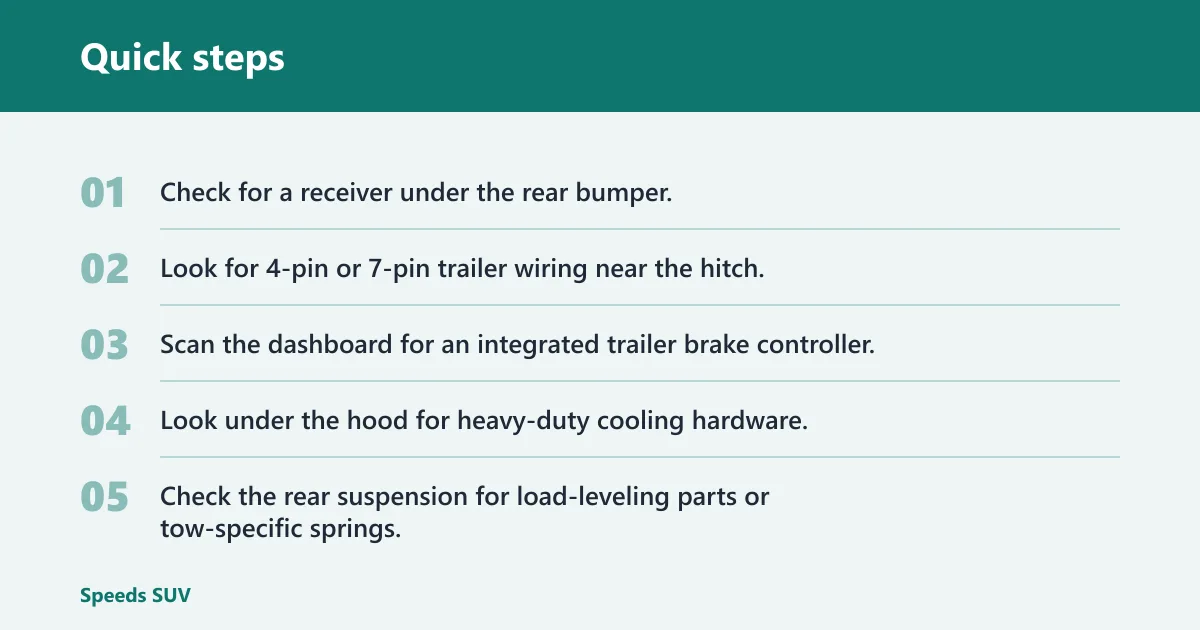
Open the tailgate or stand behind the vehicle and inspect the hitch area first. A factory tow package usually leaves several visible clues at once, such as a receiver, trailer wiring connectors, and sometimes a controller in the cabin. If only one piece is present, treat the setup as incomplete until paperwork confirms the rest.
- Check for a receiver under the rear bumper.
- Look for 4-pin or 7-pin trailer wiring near the hitch.
- Scan the dashboard for an integrated trailer brake controller.
- Look under the hood for heavy-duty cooling hardware.
- Check the rear suspension for load-leveling parts or tow-specific springs.
- Confirm the VIN, build sheet, or window sticker.
What a real factory tow package usually includes
Factory tow equipment often bundles a trailer hitch receiver, trailer wiring, upgraded cooling, and a brake controller. Some brands also add rear load-leveling suspension, trailer sway features, or software changes tied to trailer detection. Dodge’s Durango towing setup, for example, includes a Class IV receiver hitch, a 7 and 4-pin wiring loom, an integrated trailer brake controller, heavy-duty cooling, rear load-leveling suspension, and trailer detection in blind spot monitoring.
Why a hitch alone is not enough
A hitch receiver may be factory-installed, dealer-installed, or added later. That single part does not prove you have the full tow package, the higher tow rating, or the right electrical hardware for trailer brakes. A hitch-only install can look convincing while missing cooling, brake control, or the correct axle ratio.
Tow package verification checklist
Use this checklist to separate real factory tow equipment from partial or aftermarket setups. Work through the hardware first, then paperwork, then the common false positives. If one item is missing, do not assume the rest is there.
| Check item | Where to find it on the vehicle or paperwork | What it means |
|---|---|---|
| Trailer hitch receiver | Under the rear bumper; look for a square receiver tube and factory mounting points | A receiver is a strong clue, but not proof of a full tow package |
| Receiver class | On the hitch label, the hitch hardware, or dealer paperwork | Class III or Class IV hardware usually points to higher-capacity towing equipment |
| 7-pin trailer connector | Near the hitch or inside a factory wiring socket at the rear | Often supports trailer lights plus electric trailer brake control; stronger tow indicator than a 4-pin only setup |
| 4-pin trailer connector | Near the hitch, often clipped to the bumper or stored behind a cover | Usually handles basic trailer lighting; by itself, it may indicate a lighter-duty setup |
| Integrated trailer brake controller | In the cabin, often on the dash or center stack near towing controls | Factory towing feature for electric trailer brakes; common on higher tow packages |
| Heavy-duty cooling | Under the hood; look for larger radiator, transmission cooler, or tow-package cooling label in paperwork | Supports heavy towing by helping manage heat |
| Rear load-leveling suspension | Rear suspension hardware, owner’s manual, window sticker, or build sheet | Helps reduce rear sag under payload and trailer tongue load |
| VIN or build sheet tow code | VIN lookup, dealer printout, manufacturer build sheet, or window sticker | Best proof of factory equipment when the hitch or badges are unclear |
| Aftermarket hitch-only install | Non-factory fasteners, aftermarket brand markings, or mismatch between hitch and wiring | Common false positive; may not change tow rating or include factory tow systems |
| 4-pin only with no other tow gear | Rear connector and no brake controller, no cooling upgrades, no tow code | Often means light trailer wiring only, not a full tow package |
Visible hardware checks
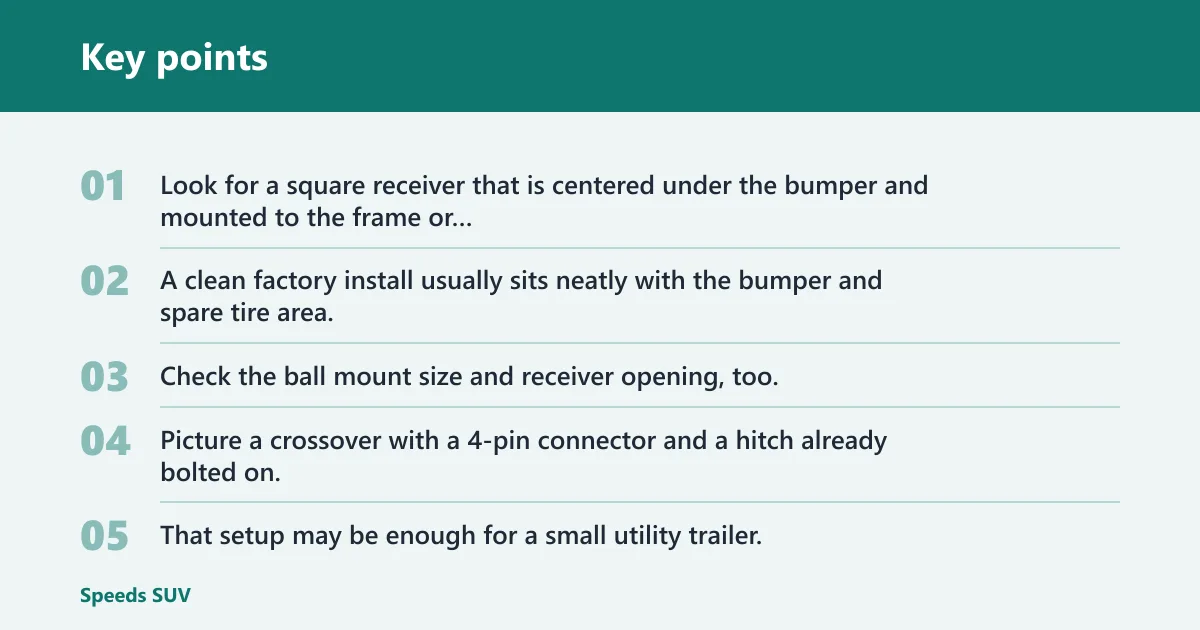
Look for a square receiver that is centered under the bumper and mounted to the frame or factory reinforcement points. A clean factory install usually sits neatly with the bumper and spare tire area, while an aftermarket receiver can show different brackets or hardware. Check the ball mount size and receiver opening, too, because receiver size affects what inserts fit.
Picture a crossover with a 4-pin connector and a hitch already bolted on. That setup may be enough for a small utility trailer, but it still may not have the cooling, brake controller, or tow rating of a true factory tow package. The hitch tells you less than the full equipment set.
VIN and build-sheet checks
When hardware is unclear, the VIN, build sheet, window sticker, or dealer lookup should settle it. Factory tow equipment usually appears as an option code or package description. Use the paperwork as confirmation, not as a replacement for inspection, because a vehicle can be sold or modified after it leaves the factory.
Suppose the rear bumper has a hitch, but the build sheet lists only a basic connector and no tow package code. In that case, the hitch is real, but the factory tow package is probably not. The paperwork and the hardware need to agree.
False-positive warnings
Do not confuse a hitch with a complete package. A dealer may install a receiver for accessories, a previous owner may add a hitch-only kit, or a 4-pin connector may be present without trailer brakes or cooling upgrades. Also watch for badges, trim names, or marketing labels that suggest towing ability without proving the underlying equipment.
What the hitch and wiring reveal
The hitch and wiring often give the quickest clue to tow capability, but they do not tell the whole story. A Class III or Class IV receiver, plus the right plug, makes towing more likely. You still need the VIN or build sheet to prove the full factory setup and the correct tow rating.
Class III and Class IV receiver clues
A Class III or Class IV receiver generally points to more serious towing hardware than a light-duty ball mount. The receiver opening is usually the standard square tube, and the ball mount must fit that opening before you can add the proper hitch ball. If the receiver looks bolt-on aftermarket, verify whether it is factory equipment.
4-pin vs 7-pin trailer wiring
A 4-pin connector handles basic trailer lighting functions. A 7-pin connector usually adds circuits used for trailer brakes and other towing functions. On many vehicles, a 7-pin plug is a stronger sign of a factory tow package than a 4-pin alone, especially when the brake controller is present inside the cabin.
Ball mount and connector compatibility
Do not assume every ball mount fits every receiver or trailer. The receiver size and ball mount shank must match, and the trailer plug must match the trailer’s needs. A 4-pin connector can work for light utility trailers, while a trailer with electric brakes needs a setup that supports those brakes.
Does your vehicle have the cooling and brake parts?
Cooling and brake equipment are among the best clues that you have more than a hitch-only setup. A factory tow package often adds features such as an integrated trailer brake controller, additional cooling, and rear suspension support. If those parts are missing, the vehicle may still tow something, but it may not have the factory tow group.
Integrated trailer brake controller clues
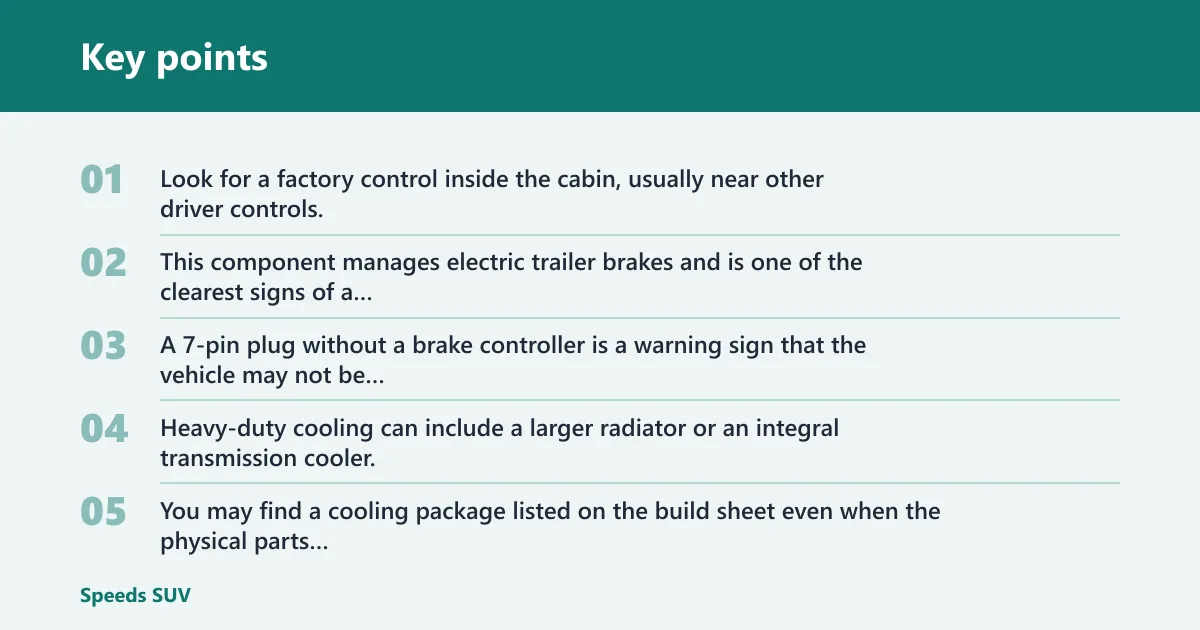
Look for a factory control inside the cabin, usually near other driver controls. This component manages electric trailer brakes and is one of the clearest signs of a higher tow package. A 7-pin plug without a brake controller is a warning sign that the vehicle may not be fully equipped for brake-equipped trailers.
Heavy-duty cooling system signs
Heavy-duty cooling can include a larger radiator or an integral transmission cooler. These parts help manage heat under load. You may find a cooling package listed on the build sheet even when the physical parts are hard to spot, so paperwork matters here more than on the hitch check.
Rear load-leveling or suspension upgrades
Rear load-leveling suspension helps reduce sag when the rear of the vehicle carries tongue weight or cargo. Some brands bundle it with tow groups; others make it a separate option. If you cannot verify the suspension from a sticker or build sheet, do not assume the vehicle has it just because the rear sits higher or lower than another trim.
Tow package, trailer package, or tow tech?
Brands use different names for similar equipment, and the package name alone is not enough. A tow package, trailer package, or tow technology package may overlap, but each brand can bundle different parts under those labels. Always check the actual included equipment and the exact option code.
How brands use different names
Some automakers use “tow package” for the basic hitch-and-wiring bundle, while “trailer package” may add lighting, brake control, or cooling. “Tow technology package” often points to driver-assist features such as trailer detection, trailer sway support, or camera tools. The label matters less than the contents.
What those labels usually add
Common additions include a trailer hitch receiver, 4-pin or 7-pin wiring loom, trailer brake controller, cooling upgrades, and suspension changes. Dodge’s Durango towing setup includes several of these together, which is why package content is more reliable than marketing language. Check the exact build, not the trim badge.
When the package name is not enough
If the name appears on a sales sticker but the wiring, cooling, or controller are missing, treat the package as unconfirmed. Tow rating depends on the full configuration. TowSense says towing depends on engine, transmission, axle ratio, payload, and hitch rating, not just the model name.
How to check your exact tow rating
Your exact tow rating depends on more than the vehicle name. Engine, transmission, axle ratio, drivetrain, payload, and installed options all matter. Tow ratings can differ between trims that look nearly identical, so the only safe number is the one tied to your exact configuration in the owner’s manual or manufacturer lookup.
Why rating changes by trim and drivetrain
A two-wheel-drive version and an all-wheel-drive version of the same SUV can carry different ratings. The same is true for different engines, transmissions, and axle ratios. The same source gives a 2024 Ford F-150 example with a wide tow-rating range, which is a reminder that model name alone is never enough.
Braked versus unbraked towing limits
Braked towing and unbraked towing can have different limits. Dodge says braked towing capacity can be higher than unbraked towing capacity. If your trailer has brakes, the rating may be different from a small trailer without brakes, so check the correct line in the manual.
Where to confirm the final number
Use the owner’s manual, the manufacturer’s towing guide, the VIN lookup, or the dealer build sheet. TowSense checks tow capacity, payload, GVWR, and tongue weight. TowSense also defines safe tongue weight as 10–15%. Those figures help you compare the trailer and vehicle as a matched set, not as separate guesses.
Can you add a tow package to an SUV?
You can often add some tow equipment later, but that does not always create a real factory tow package. A dealer or aftermarket shop may install a receiver, wiring, or brake controller, yet the vehicle may still lack the factory cooling, axle ratio, or tow calibration that set the original rating.
What can be added later?
Common add-ons include a hitch receiver, trailer wiring, and sometimes an aftermarket brake controller. Some vehicles can also receive additional cooling or suspension parts. These upgrades can help with towing, but they do not automatically turn the vehicle into the same setup the factory offered.
What usually cannot be fully added
You usually cannot add a factory axle ratio after purchase without major drivetrain work. You also cannot always replicate factory software, calibration, or integrated trailer features with bolt-on parts alone. That means the final tow rating may stay lower than a true factory tow package rating.
Why added parts do not change factory rating
The tow rating is tied to the vehicle as built, not just the parts hanging on the back. A receiver or 7-pin plug can help with towing, but they do not rewrite the manufacturer’s rating. For safe planning, use the exact rating listed for your VIN and configuration.
Frequently asked questions
Does my car have a tow package?
Check the rear hardware first, then confirm the VIN or build sheet. A hitch receiver alone does not, by itself, prove a tow package. Look for a 7-pin connector, integrated trailer brake controller, heavy-duty cooling, and suspension clues. If those are missing, the vehicle may only have a hitch-only or light-duty setup.
What does a tow package include?
A factory tow package often includes a trailer hitch receiver, trailer wiring, a brake controller, heavier cooling, and sometimes rear load-leveling suspension. The exact parts vary by brand and trim. Dodge’s Durango towing setup includes a Class IV receiver hitch, a 7 and 4-pin wiring loom, and an integrated trailer brake controller.
How can I tell if my vehicle has a tow hitch?
Look under the rear bumper for a square receiver tube and factory mounting points. If the hitch is present, check whether it is OEM or aftermarket by looking at brackets, labels, and build-sheet entries. A hitch by itself shows towing capability, but not necessarily a full factory tow package.
Is a trailer package the same as a tow package?
Not always. Some brands use the terms interchangeably, while others use “trailer package” for a different bundle that may include lighting, brake controls, or driver-assist features. The label matters less than the included parts, so check the exact equipment list, option code, or VIN lookup before deciding.
What is the tow technology package?
A tow technology package usually adds towing-related driver aids rather than only physical hardware. It may include trailer detection, camera features, sway-related software, or monitoring tools. It can improve control and visibility, but it still needs to be checked against the vehicle’s actual hitch, wiring, and rating information.