What Are Recovery Points on a 4×4 or Truck?
Recovery points are reinforced, structure-mounted attachment points built for towing or controlled recovery loads. Use only factory-rated or aftermarket-rated points, never a tie-down, hitch ball, or suspension part. Bad attachment can rip metal, damage the frame, or turn a strap into a projectile. This guide shows how to identify safe points, read load paths, and match hardware to the recovery method.
What recovery points
Recovery points are the places the vehicle maker or an accessory maker intends you to connect recovery gear. They are not general-purpose brackets. A rated recovery point is built to take recovery loads and transfer them into the chassis or another reinforced structure with a known fastener pattern and a stated limit.
That distinction matters because a recovery load travels through the bracket, bolts, and vehicle structure together. If any part is too thin, poorly aligned, or not rated for the direction of pull, the load can bend the bracket or tear the mounting metal. The shape alone does not tell you whether it is safe.
Why vehicle-specific mounting matters
Vehicle-specific mounting geometry matters because the point must match the holes, thickness, and reinforcement used by that model. A point that fits the bumper opening on one SUV may put the bolts in the wrong place on another. That can leave the bracket loading sheet metal instead of the chassis.
Body-on-frame trucks often have stronger mounting options near the frame rails or front crossmember. Unibody SUVs usually rely on reinforced front structure, subframe attachment areas, or accessory brackets designed for that exact vehicle. The same accessory does not fit every vehicle safely.
What a rated point is meant to carry
A rated recovery point should have a stated load or working limit from the vehicle maker or the accessory maker. Some instructions list the limit for one point only; others specify a pair. You need the exact instructions before you decide whether the point suits a static pull, a controlled recovery, or a snatch recovery.
Recovery points vs tow hooks
A tow hook may be useful for moving a vehicle or pulling it onto a flatbed, but shape alone does not make it suitable for recovery. Some hooks are unidirectional, some are meant for light pulling, and some are accessory parts that fit the vehicle but are not rated for dynamic recovery loads.
Intended use matters more than appearance. A forged hook can still be the wrong part if the maker labels it for transport, lash-down, or light pulling only. Always check the vehicle manual or the accessory instructions before you assume a hook can take a strap.
When a tow hook can be used
A tow hook can be used only when its rating and intended use match the job. If the hook is factory fitted and the manual lists it as a recovery point for the specific vehicle, it may be suitable for a controlled pull. If the instructions limit it to towing or transport, do not use it for snatch recovery.
Why some hooks are not for snatch recovery
Snatch recovery adds a shock load when the strap stretches and then releases energy. That changes the force on the hook, bolts, and mounting structure. A hook that holds a slow pull may bend or tear free under that sudden load. Do not assume a hook that looks strong enough is actually suitable.
Where recovery points mount
Factory and aftermarket recovery points usually mount to the front chassis rails, front crossmember, bumper reinforcement, or another reinforced structural area. The goal is to move load into the vehicle structure, not into plastic trim or thin outer panels. If the point only touches a cosmetic bumper, it is the wrong place.
On trucks with body-on-frame construction, the strongest locations are often near the frame rails where the bracket can clamp or bolt through the main structure. On unibody SUVs, the safe mounting area may be more limited and may depend on a vehicle-specific plate or cradle that spreads load across reinforced sections.
Chassis mounts on body-on-frame trucks
Body-on-frame trucks usually offer clearer recovery mounting options because the frame is a separate load-bearing structure. A proper bracket should transfer force into the rail or a reinforced crossmember with fasteners of the grade specified by the maker. Thin brackets or loose hardware can let the mount twist under load.
Reinforced structure on unibody SUVs
Unibody SUVs can be recovered safely, but the point must attach to the reinforced structure designed for that model. That may mean a cradle, a reinforced tow eye, or a specific bracket that spreads force across multiple mounting locations. A random bracket on the front clip is not enough.
Bull bar mounting and vehicle fitment
A bull bar may provide mounting options for recovery points, but it is not required for every install. Fitment depends on the vehicle and the accessory design, and some bars affect airbag compatibility or approach angle. Check the bar instructions and the vehicle manual before assuming the bar can carry recovery loads.
Recovery point checklist
Use this checklist before you connect a strap, shackle, or soft shackle. It separates factory points, aftermarket rated points, and points that should not be used. The key question is simple: does the part have a verified load path into the vehicle structure, and does the method match the rating?
| Branch | Inspection clues | Mounting clues | Static pull | Snatch recovery |
|---|---|---|---|---|
| Factory point | Manual lists it; no cracks, rust, bending, or loose fasteners | Bolts or structure match the OEM mounting points | Use only if the vehicle manual allows it | Use only if the manual explicitly allows dynamic recovery |
| Aftermarket rated point | Stamped or documented rating; correct vehicle-specific fit; no contact with trim | Fasteners, bracket thickness, and geometry match the kit instructions | Suitable if the rating matches the load and method | Suitable only if the maker states snatch recovery is allowed |
| Do-not-use point | Cracks, rust, bending, elongated holes, thin brackets, poor alignment, missing rating | Tie-down loop, suspension arm, tow ball, random bracket, or sheet metal | Do not use | Do not use |
- Find the exact vehicle recovery instructions in the owner manual or accessory sheet.
- Confirm the point is rated for the vehicle and the intended method.
- Inspect for cracks, rust, bending, loose bolts, and elongated holes.
- Check that the load path goes into the chassis or reinforced structure.
- Confirm connector fit: shackle pin, soft shackle loop, or strap eye.
- If any item fails, do not use the point.
Load path and failure points
Load path is the route force takes from the recovery gear into the vehicle. A safe point spreads that force into the chassis or reinforced structure. A bad point concentrates it in a thin bracket, a small number of bolts, or a weak direction of pull. That is how mounts fail.
Common failure points include bent brackets, torn holes, stretched bolts, and crushed bumper mounts. Rust weakens the metal and reduces the margin between the fastener and the edge of the bracket. Poor alignment can also pull the point sideways, which loads the bracket in a direction it was not designed to take.
Why brackets and bolts matter
Bracket thickness and fastener quality matter because they determine how the force gets distributed. Undersized bolts, poor washers, or soft hardware can deform before the vehicle structure does. If the bracket does not sit flat, the first hard pull can pry it off the mounting surface.
What cracks, bends, and rust can mean
Cracks often mean the metal has already been overloaded. Bending can mean the point has taken a pull outside its design limit. Rust matters because it reduces the cross-section that actually carries the load. Any one of these signs is enough to retire the point until it is inspected or replaced.
How bad alignment can tear mounts
If the recovery line pulls at an angle the point was not designed for, the load can twist the bracket and tear the mount hole into an oval. A sideways pull is especially risky when the point sits away from the chassis or when the connector binds against the bumper opening. Keep the line as straight as the situation allows.
Say your pickup has a front recovery bracket bolted to a frame rail, but a strap pulls from the opposite corner of the vehicle. That angle can put a side load on the outer bolt and pry the bracket open, even if the same point would hold a straight pull.
Using shackles and straps
Use connectors that match the point and the recovery method. A bow shackle is common in vehicle recovery because its wider body gives more room for strap eyes and soft shackles, but it still must be correctly rated. A soft shackle is lighter, yet it needs smooth attachment points and careful edge clearance.
Bow shackle basics
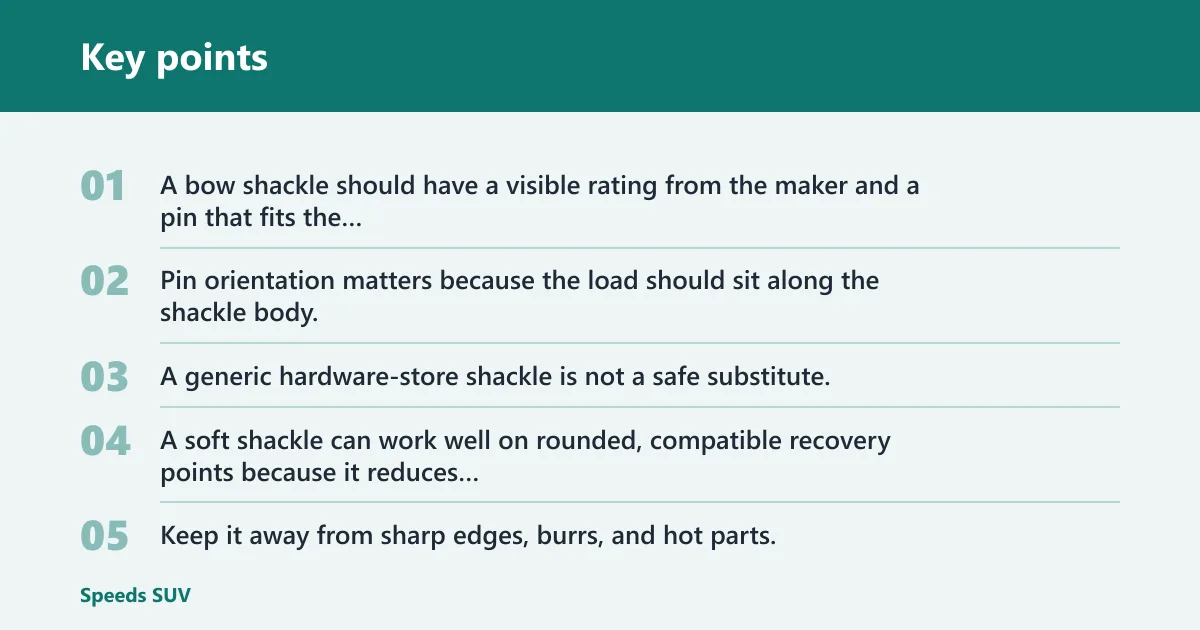
A bow shackle should have a visible rating from the maker and a pin that fits the recovery point without forcing it. Pin orientation matters because the load should sit along the shackle body, not across the threads or against a narrow edge. A generic hardware-store shackle is not a safe substitute.
Soft shackle limits
A soft shackle can work well on rounded, compatible recovery points because it reduces metal contact and is easy to remove. Keep it away from sharp edges, burrs, and hot parts. If the attachment point has a rough edge or a narrow slot that can cut the line, use a different connector.
Snatch strap use with rated points only
A snatch strap is a dynamic recovery strap and should be used only with rated recovery points and compatible connectors. The strap stretches and stores energy, so the load rises quickly when it comes tight. That is why a point suitable for a static pull may still be wrong for snatch recovery.
Suppose a ute is stuck in soft sand and the driver wants a quick pull from another vehicle. If the front hook is only listed for towing, not dynamic recovery, the safer choice is a slower, controlled recovery with rated gear rather than a snatch strap.
Frequently asked questions
What are recovery points on a 4×4 or truck?
Recovery points are reinforced attachment points built into the vehicle or added with a vehicle-specific kit for recovery loads. They connect the recovery gear to the chassis or another reinforced structure. They are not general towing points, and they must be matched to the vehicle and the recovery method.
What is the difference between a recovery point and a tow hook?
A recovery point is intended and rated for vehicle recovery loads. A tow hook may be for transport, light pulling, or a specific factory use case, and it may not be suitable for snatch recovery. The key difference is the stated use and rating, not the visible shape.
Where are the recovery points on my SUV or pickup?
On pickups, they are often near the frame rails, front crossmember, or another reinforced chassis area. On SUVs, they may be on reinforced structure, a cradle, or a vehicle-specific bracket behind the bumper area. Check the owner manual because location and access vary by model.
Can you use a tie-down loop as a recovery point?
No. Tie-down loops are generally for securing or transporting the vehicle, not for recovery loads. They may be thin, welded differently, or attached to a section that cannot handle a shock load. Using one can bend the loop, rip the mount, or launch the connector.
Do you need rated recovery points for snatch recovery?
Yes. Snatch recovery adds dynamic load, so you need rated recovery points and compatible connectors that the vehicle and accessory instructions approve for that use. A point that works for a slow pull is not automatically safe for a snatch strap. Check the rating before any dynamic recovery.
How many recovery points does a vehicle need off-road?
Most vehicles need at least one rated point for a controlled pull, but some recovery methods and vehicle instructions require a pair. The correct answer depends on the recovery direction, the accessory design, and the vehicle manual. Use the number the maker specifies, not a guess.
Can you add recovery points without a bull bar?
Yes. Many vehicles can take aftermarket rated recovery points without a bull bar if a vehicle-specific mounting kit is available. The bracket must still attach to the correct structure and preserve the load path. A bull bar may help on some setups, but it is not required in every case.
What can go wrong if recovery points are installed badly?
Bad installation can lead to loose fasteners, bracket bending, cracked mounts, and tear-out from the chassis or reinforced structure. Wrong bolt grade, poor alignment, and thin mounting material all raise the risk. In a worst case, the connector or bracket can fail under load and become dangerous debris.
What is 4 point recovery?
“4 point recovery” can mean different things in different off-road contexts, so check the source before relying on the term. In vehicle recovery, the important issue is not the phrase itself but whether the load path, rating, and attachment hardware are correct for the specific pull. Do not assume the term implies a safe method.
How much does a recovery truck cost?
The cost of a recovery truck varies widely by size, equipment, and whether it is new or used, so there is no single useful number. For off-road owners, the better question is whether the vehicle has proper recovery points and gear before an incident happens. Correct setup matters more than the tow bill after a failure.