Approach vs Departure vs Breakover Angles: What Matters Most?
Approach angle matters most for steep crests and rock faces, departure angle matters most when descending ledges or dropping off obstacles, and breakover angle matters most on sharp crests; the first angle to hit the trail should drive your upgrade priority. Ignore the wrong one and you can drag bumpers, hang up the frame, or lose traction where the vehicle should keep moving. This guide breaks down what each angle measures, which terrain hits it first, and how to choose the safest upgrade path for your SUV or truck.
| Decision factor | Approach | departure | breakover | Winner |
|---|---|---|---|---|
| Steep climb into an obstacle | Front bumper contact is the first risk | Usually less important at entry | Usually not the first limit | Approach |
| Steep descent off a ledge | Usually clears the exit better than the rear | Rear contact is the first risk | Can matter if the exit rolls onto a crest | departure |
| Sharp ridge or hump | Can be fine before the crest | Can be fine after the crest | Frame or belly contact is the first risk | breakover |
| Accessory-induced limit | Low bumper or front hardware can reduce it | Tow bar or rear accessory can reduce it | Wheelbase and belly clearance set it | Depends on the accessory |
| Best upgrade priority | Front clearance and bumper shape | Rear exit clearance and tow-bar packaging | Wheelbase, belly clearance, and suspension geometry | Obstacle-specific |
Which angle matters most off-road?
The best answer is the one the obstacle asks for first. Approach angle matters at entry, departure angle matters at exit, and breakover angle matters on the top of a hump, ridge, or ramp-like crest. The safest upgrade path protects the first point likely to hit.
Obstacle type decides the limit
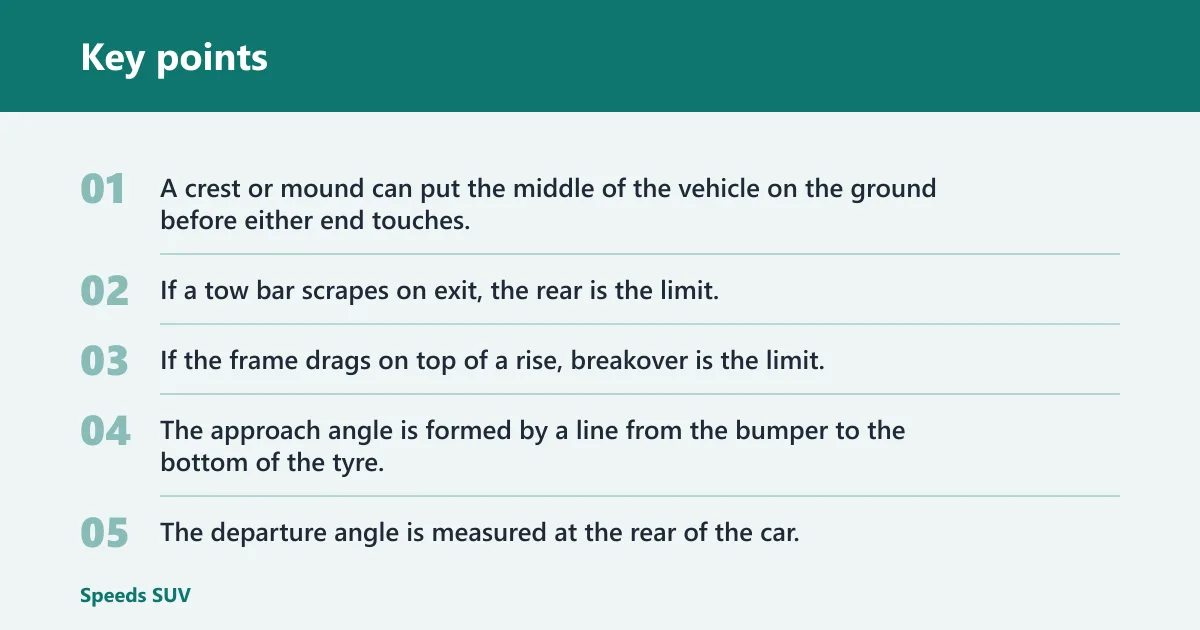
Approach, departure and ramp angles are key off-road vehicle attributes because they help determine how severe an obstacle a vehicle can handle. A steep climb loads the front end first. A drop-off loads the rear first. A crest or mound can put the middle of the vehicle on the ground before either end touches.
First contact point decides the fix
That is why the question is not “which angle is best?” but “which part of the vehicle will touch first?” If the bumper hits first, the front end is the limit. If a tow bar scrapes on exit, the rear is the limit. If the frame drags on top of a rise, breakover is the limit.
Approach angle on the front end
The approach angle is formed by a line from the bumper to the bottom of the tyre. It describes the steepest slope a vehicle can approach without ground contact. Protruding front accessories, skid shapes, and low bumpers reduce it because they move the first contact point farther forward and lower.
Departure angle at the rear
The departure angle is measured at the rear of the car. It shows how steep an incline can be exited without rear contact. Tow bars can reduce the natural departure angle, and if departure angle is smaller than approach angle, the rear can touch on steep inclines even when the front clears easily. (Wikipedia)
Ramp angle between the axles
The ramp angle is also called the ramp-over angle. It describes the largest ramp-like obstacle a vehicle can tackle, and it is closely tied to wheelbase and belly clearance. A long wheelbase can make a crest or mound harder to clear.
Ground clearance and suspension travel
Ground clearance is measured to the lowest point on the vehicle. On solid-axle 4x4s, the differential is usually the lowest point. Suspension travel is the amount of wheel movement available before topping out or bottoming out. More travel helps all four wheels stay on the ground longer, which improves traction and articulation.
Ground clearance and suspension travel matter on rocky trails because they change whether the vehicle drags its body or undercarriage and whether the tyres keep grip when one corner lifts. Angles tell you where contact starts; clearance and travel tell you whether the chassis keeps moving after that.
Terrain angle decision table
| Obstacle | Primary limiting angle | Secondary risk | Usual first contact point | Owner action priority |
|---|---|---|---|---|
| Steep climb | Approach | Front bumper pitch-down | Front bumper or lower valance | Raise front clearance or trim front overhang |
| Steep descent | departure | Rear drag after the drop | Rear bumper or tow bar | Shorten rear overhang or remove protruding hardware |
| Cresting a ridge | breakover | Belly drag as the axles climb different sides | Frame rails or differential housing | Improve belly clearance and confirm wheelbase fit |
| Crossing a mound | breakover | Loss of traction when a wheel unloads | Undercarriage or centre section | Use more suspension travel and a shorter body span |
| Sharp breakover | breakover | Front or rear contact after the crest | Centre underbody first, then ends | Choose a shorter wheelbase or a higher belly point |
Say your SUV can climb a steep driveway without scraping the bumper, but the rear tow bar kisses the ground as soon as the rear wheels roll over the crest. That is not an approach-angle problem. The entry is fine. The exit geometry is the limit.
Suppose a truck with a short front overhang and a strong approach angle still gets stuck on a sharp ridge. The bumper clears, yet the centre section hangs up because the wheelbase is long and the belly is too low for the crest shape. That is breakover, not approach, deciding the outcome.
Can a truck have one good angle and still fail?
Yes. A truck or SUV can have a strong approach angle and still fail on a ramp-like obstacle if breakover angle is the real limit, or it can clear the front and still drag the rear because of a tow bar or long overhang. One strong spec does not guarantee trail clearance.
Common tradeoffs from bumpers, tow bars, and wheelbase
Front bumpers with extra protection can reduce approach angle if they protrude farther than the factory part. Rear accessories can reduce departure angle in the same way. A tow bar is a common example because it can protrude into the rear exit path. Wheelbase changes the result too, because a longer span raises the chance that the centre will touch first on a hump.
That tradeoff is why “more protection” can mean “less clearance.” A heavy front bar may help against brush or rock strikes, but if it lowers the nose or extends the front face, it can make steep entries harder. The same pattern applies at the rear with cargo carriers, recovery gear, and hitch hardware.
Which spec to improve first for your trail type?
Match the obstacle first. If the trail is mostly ledges, climbs, and stepped entrances, start with approach angle. If the trail drops away at the rear, start with departure angle. If the problem is the vehicle hanging on top of a rise, start with breakover.
Check the first contact point. Look for the part most likely to touch: front bumper, rear bumper or tow bar, or centre underbody. That point tells you which angle has become the bottleneck and prevents chasing the wrong spec.
Protect the bottleneck. Use the least harmful fix that addresses the limit. For approach, that may mean trimming front overhang. For departure, it may mean moving or removing a tow bar. For breakover, it may mean a shorter wheelbase platform or more belly clearance.
Recheck the tradeoff. Every change can move the problem somewhere else. Raising one end may change the centre of gravity, while larger tyres or suspension changes can alter the angles and the way the vehicle settles on rough ground.
A vehicle that clears a front ledge can still drag the middle on the next rise. A vehicle that clears the crest can still scrape the rear on the drop. That is why the safest upgrade path follows the obstacle, not a single spec sheet number.
Choose approach if…
Choose approach if your route starts with steep entrances, rock faces, or ledges that threaten the front bumper first. It is the right priority when low front trim, a protruding winch mount, or a long front overhang is the first thing likely to touch.
Choose departure if…
Choose departure if your biggest problem is leaving obstacles, dropping off ledges, or backing down slopes with a rear hitch or tow bar near the ground. It is the right priority when rear contact, not front entry, is what stops the vehicle from continuing.
Choose breakover if…
Choose breakover if the trail has sharp ridges, mounds, or cresting humps that lift the belly onto the obstacle. It is the right priority when wheelbase and centre clearance matter more than either end, because the vehicle hangs in the middle before the bumpers ever touch.
Frequently asked questions
Which matters more off-road: approach angle, departure angle, or breakover angle?
The most important one is the angle that meets the obstacle first. Approach matters most on entry, departure on exit, and breakover on crests or humps. A trail with repeated ridges can make breakover the real limit even if the front and rear angles look strong on paper.
When does a good approach angle stop mattering because breakover angle is the real limit?
A good approach angle stops being enough when the vehicle can enter the obstacle but hangs on the middle section while crossing it. That happens on sharp crests, tall humps, and ramp-like rises where wheelbase and belly clearance decide whether the chassis drags before the front end runs out of room.
How do approach, departure, and ramp angles differ on a truck or SUV?
Approach angle is the front-end angle formed by a line from the bumper to the bottom of the tyre. Departure angle is the rear-end angle at the back of the vehicle. Ramp angle, also called ramp-over angle, is the middle angle that matters when the vehicle crosses a ramp-like obstacle.
Can tow bars or rear accessories make departure angle worse than approach angle?
Yes. Tow bars can reduce the natural departure angle, and rear accessories can push the first contact point farther back. That is why a truck may climb in cleanly but scrape the rear on the way out. In that case, the departure angle can be the weaker side even if the front clears well.
How does wheelbase affect breakover angle compared with approach angle?
Wheelbase often has a larger effect on breakover angle than on approach angle. A longer wheelbase stretches the vehicle across a hump or crest, which increases the chance that the centre will touch first. Approach angle depends more on front overhang and bumper shape than on the span between the axles.
What vehicle attribute usually causes trail damage first: bumper contact, underbody drag, or rear exit angle?
It depends on the obstacle. Bumper contact usually happens first on steep entries or exits with low overhangs. Underbody drag usually happens first on ridges and mounds. Rear exit angle usually shows up first when a tow bar or rear accessory hangs up while leaving a steep drop.
Do ground clearance and suspension travel matter more than angles on rocky trails?
They matter alongside angles, not above them in every case. Ground clearance helps prevent body or undercarriage drag, and suspension travel helps tyres stay planted for traction and articulation. On rocky trails, a vehicle needs enough angle to enter and exit, plus enough clearance and travel to keep moving once it is on the obstacle.
Why can a vehicle with a strong approach angle still get stuck on a ramp-like obstacle?
Because the front may clear while the centre hangs on the crest. That is a breakover issue, not an approach issue. The ramp angle, wheelbase, and belly clearance decide whether the chassis bridges the obstacle or sits on it before the rear axle reaches the top.