SUV Towing: Capacity, Limits, and How to Choose
Choose an SUV by checking payload first, then confirm tongue weight, GVWR, rear-axle rating, and GCWR; For travel trailers, tongue weight is often about 10% to 15% of loaded trailer weight. Ignore those limits and you can overload the SUV even while staying under the advertised tow rating, which can hurt braking, stability, tire life, and warranty coverage. This guide lays out a towing-planning method, the ratings that actually cap capacity, and how to compare SUVs, tow packages, and trailer setups.
The key move is to plan from the loaded trailer backward. Start with what the trailer will actually weigh with water, fuel, propane, batteries, gear, and food, then add the people and cargo inside the SUV. Only then should you check payload, GVWR, GCWR, hitch hardware, trailer brakes, and any tow-package requirements.
What does SUV towing capacity actually mean?
SUV towing capacity is the heaviest trailer a specific SUV configuration is rated to pull, with its required equipment and under the manufacturer’s stated conditions, not a blanket number for every trim in that model line. The useful planning number is the loaded trailer weight, because engine, drivetrain, axle ratio, tow package, wheel and tire setup, and cooling hardware can all change the rating.
Rated maximum versus your real trailer
Brochure numbers are ceiling numbers. They assume a specific configuration and usually a properly equipped vehicle. Dry trailer weight is rarely the right planning figure because campers gain water, propane, batteries, dealer-installed accessories, and cargo before the first trip.
A utility trailer can change fast too. A few landscaping tools, a mower, spare fuel, and tie-downs can move a trailer from easy tow to payload problem even if the trailer itself is light.
Why the same SUV can tow different amounts
Two versions of the same SUV may have different tow ratings because the limiting part is not always the engine. Final-drive ratio, transfer case, suspension tune, cooling package, receiver hardware, software calibration, and wheel or tire combinations can all matter.
That is why model-wide claims mislead. Each towing capacity number quoted in comparisons is the maximum optional capacity for that SUV. Many SUVs can tow 8,000 pounds or more, but only in their strongest configurations.
Examples make the point. The 2026 Jeep Grand Wagoneer is rated to tow 10,000 pounds, but that rating requires the 3.92 axle ratio in the Trailer Tow package, and that package costs $1,995. The 2026 Ford Expedition’s maximum towing capacity is 9,600 pounds, the 2026 Toyota Sequoia’s maximum towing capacity is 9,520 pounds, the 2026 Lexus GX 550 can tow up to 9,096 pounds, and the 2026 Lincoln Navigator’s maximum towing capacity is 8,700 pounds.
What SAE J2807 does and does not do
SAE J2807 is a common engineering standard many manufacturers use to set towing ratings under similar test conditions. It gives a shared method for acceleration, gradeability, cooling performance, handling, and trailer tongue assumptions, which makes ratings easier to compare.
It does not override the limits printed for your exact vehicle. If the owner’s manual, towing section, or doorjamb payload label sets a lower cap, requires certain tires or hitch hardware, or bans a hitch type or wheel size, that vehicle-specific limit is the one that applies.
Which weight limits actually decide whether you can tow?
The deciding limits are usually payload, GVWR, GCWR, hitch rating, rear-axle rating, and tire load capacity, with towing capacity only one of them. Tongue weight counts against payload and GVWR, and GCWR often becomes the real cap once passengers, gear, and a loaded trailer are added together.
Payload and GVWR
Payload is how much weight the SUV can carry inside and on itself. That includes passengers, pets, cargo, aftermarket accessories, and trailer tongue weight pressing down on the hitch.
GVWR is the maximum allowable total vehicle weight. If the loaded SUV plus the hitch load exceeds GVWR, the setup fails even if the trailer is under the advertised tow rating.
For many midsize SUVs, payload often runs out before engine capability does. Four adults, a cooler, luggage, and a realistic tongue weight can eat up hundreds of pounds fast.
GCWR and why it often becomes the ceiling
GCWR is the maximum allowable combined weight of the loaded SUV and the loaded trailer. This is often the limit that exposes an optimistic plan, especially with campers carrying water or boats carrying fuel and gear.
Suppose an SUV has enough brochure tow rating for the trailer. If the cabin is full, the cargo area is packed, and the trailer is loaded for a week away, the combined weight may still exceed GCWR. That is a fail, regardless of engine output on a flat test drive.
Hitch, ball mount, receiver, axle, and tire limits
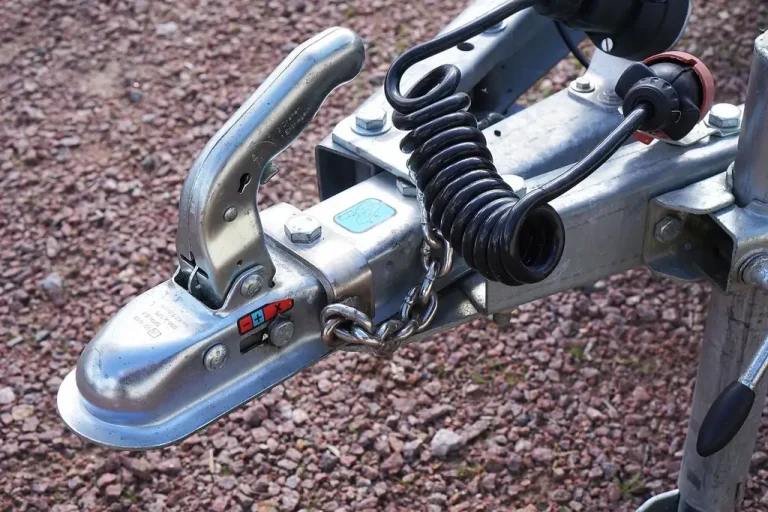
Receiver class sets hard limits on both trailer weight and tongue weight. SUVs commonly use Class III, Class IV, or Class V receivers, and the usable limit is only as high as the lowest-rated part in the chain: receiver, ball mount, hitch ball, coupler, safety chains, or weight-distribution hardware if allowed.
Rear-axle and tire load limits also need a look because tongue weight sits mostly on the rear axle before any weight distribution. A setup can fit the headline tow rating yet still overload the rear axle or rear tires.
How do you calculate your real towing limit?

Calculate the real limit by starting with loaded trailer weight, estimating tongue weight at 10% to 15% for a conventional trailer, then subtracting passengers, cargo, and accessories from payload. After that, check the loaded SUV and trailer against GVWR, GCWR, rear-axle limits, and hitch hardware ratings to find the actual margin.
Use loaded trailer weight, not brochure weight
Travel trailers are the most common trap here. Water, propane, battery weight, cookware, food, bedding, and bikes add up, and the loaded number is what matters at the scale and on the hitch.
For boats, count trailer weight, fuel, anchors, safety gear, coolers, and any gear stored on board. For utility trailers, count the cargo itself, spare tire, tie-downs, ramps, and toolbox weight.
Estimate tongue weight correctly
For conventional bumper-pull trailers, a common rule of thumb is 10% to 15% of loaded trailer weight on the hitch. A trailer that is too light on the tongue can sway; too heavy on the tongue can overload the rear axle and compress the rear suspension hard.
Picture a loaded small camper weighing 4,500 pounds. At 10%, tongue weight is 450 pounds. At 15%, it rises to 675 pounds. That single range can decide whether a midsize SUV still has enough payload for passengers.
Subtract the SUV load before trusting the tow rating
- Find the trailer’s expected loaded weight.
- Estimate tongue weight at 10% to 15% if it is a conventional trailer.
- Add passenger weight.
- Add cargo and accessory weight in the SUV.
- Compare passengers plus cargo plus tongue weight against payload.
- Check loaded SUV weight against GVWR.
- Check loaded SUV plus loaded trailer against GCWR.
- Confirm the receiver, ball mount, hitch ball, and coupler are rated for the load.
Example planning paths
Say your family wants to tow a 3,500-pound camper with two adults, two children, and weekend gear. The trailer may fit the tow rating of many midsize SUVs, but the real question is whether payload still works once the hitch carries roughly 350 to 525 pounds and the cabin is full.
A common first-timer mistake is shopping by dry trailer weight alone, then adding a hitch-mounted cargo tray, a dog crate, and a full cooler later. None of those items show up in the headline tow figure, but all of them count against the vehicle.
Suv towing worksheet
Suv towing decision table
| Scenario | Trailer weight input | Estimated tongue weight input | Passenger weight input | Cargo weight input | SUV payload input | SUV GCWR input | Payload check | GCWR check | Brake and hitch recommendation | Safety buffer target |
|---|---|---|---|---|---|---|---|---|---|---|
| Small camper | 4,500 lb loaded | 540 lb at 12% | 450 lb | 150 lb | 1,500 lb | 10,500 lb | Pass: 1,500 – (540 + 450 + 150) = 360 lb remaining | Pass if loaded SUV weight plus 4,500 lb stays under 10,500 lb | Trailer brakes strongly recommended and often legally required; brake controller; weight-distributing hitch only if the SUV maker allows it | Aim to keep at least 10% payload in reserve and some GCWR margin for water, food, and upgrades |
| Boat | 3,800 lb loaded with fuel and gear | 304 lb at 8% | 350 lb | 100 lb | 1,400 lb | 9,500 lb | Pass: 1,400 – (304 + 350 + 100) = 646 lb remaining | Pass if loaded SUV weight plus 3,800 lb stays under 9,500 lb | Trailer brakes recommended; brake controller if equipped brakes require one; confirm ramp traction and rear-axle load | Aim for extra margin for fuel, wet gear, and marine batteries added later |
| Utility trailer | 2,800 lb loaded | 280 lb at 10% | 200 lb | 200 lb | 1,200 lb | 8,500 lb | Pass: 1,200 – (280 + 200 + 200) = 520 lb remaining | Pass if loaded SUV weight plus 2,800 lb stays under 8,500 lb | Brakes depend on jurisdiction and trailer spec; many states require brakes around or above 3,000 pounds; use sway control if load shifts easily | Aim for margin for toolboxes, ramps, and changing cargo density |
How to use the worksheet
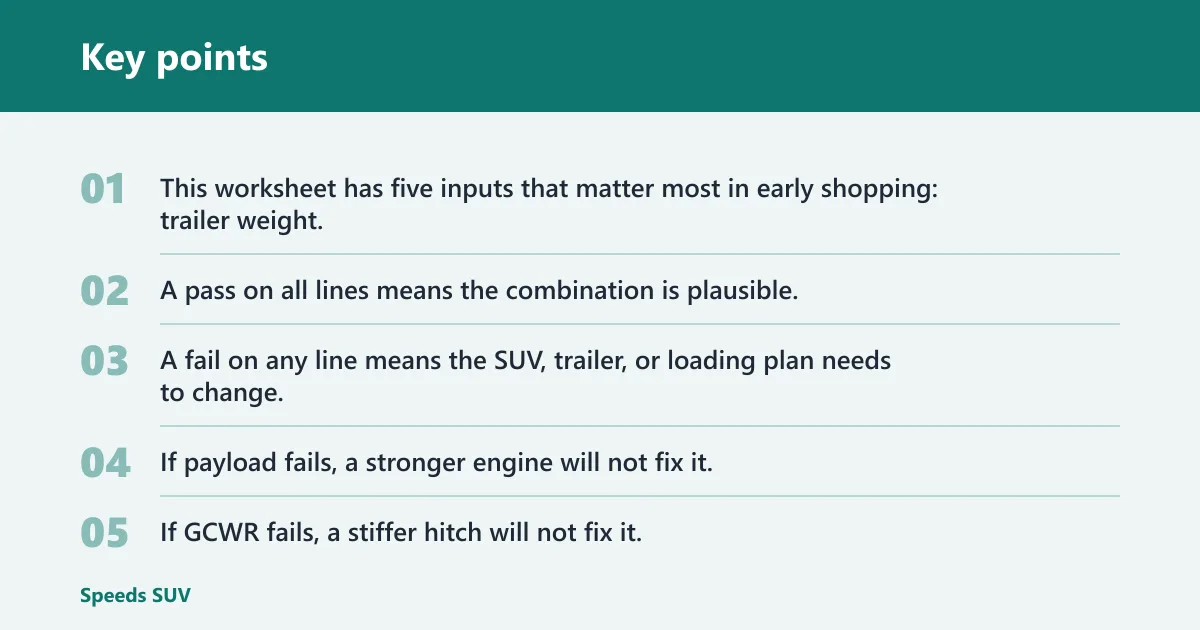
This worksheet has five inputs that matter most in early shopping: trailer weight, estimated tongue weight, passenger weight, cargo weight, and the SUV’s payload and GCWR ratings. A pass on all lines means the combination is plausible. A fail on any line means the SUV, trailer, or loading plan needs to change.
If payload fails, a stronger engine will not fix it. If GCWR fails, a stiffer hitch will not fix it. If hitch rating fails, the load needs lighter hardware or a different vehicle.
What equipment changes an SUV’s tow rating?
Tow ratings change when the SUV’s hardware changes, especially the tow package, axle ratio, cooling system, receiver, wiring, and software calibration. Powertrain output matters, but thermal management, gearing, wheel and tire setup, and integrated trailer controls often decide whether the top rating is available at all.
What a factory tow package usually adds
A proper tow package may include receiver hardware, wiring, larger cooling capacity, alternator changes, lower axle ratio or different final drive, transmission programming, trailer-sway calibration, and brake-controller prep. Some vehicles need that package to reach the published maximum at all.
That is why the practical cost of towing can differ from the sticker on the base vehicle. Reaching the strongest rating may require a specific package and sometimes a specific drivetrain or wheelbase.
Powertrain, gearing, and cooling
Torque gets the attention, but grades and summer heat expose the whole system. Transmission ratios, differential gearing, fluid cooling, fan capacity, and charge-air or engine cooling all affect sustained towing more than a single horsepower claim.
For mountain use, repeated climbs are what matter. A vehicle that feels quick unloaded may downshift often or trim power to control temperatures when towing near its limit.
Brake controller, tires, and suspension details
Some SUVs offer an integrated trailer brake controller. Others need dealer-installed parts or an aftermarket controller. If the trailer has electric brakes, the towing plan should identify how those brakes will be controlled before the purchase.
Tires and wheel size can also affect rating. Lower load-rated tires, appearance packages, or suspension variations can change available capacity, which is another reason to verify the exact configuration, not the model name alone.
When do you need trailer brakes or a weight-distributing hitch?
Trailer brakes are needed whenever the trailer and local law require them, and they are often wise before the legal threshold if the trailer is heavy relative to the SUV. A weight-distributing hitch can improve axle loading on some setups, but it is not always allowed by the vehicle maker.
Brake laws versus braking margin
Requirements vary by jurisdiction, with many states requiring brakes around or above 3,000 pounds. That legal threshold is not a universal safety threshold. A lighter trailer behind a lighter SUV may still benefit from its own brakes, especially in hills or traffic.
If the trailer has electric brakes, a controller is part of the setup, not an extra. Integrated controllers are cleaner, but aftermarket units can work if installed correctly and matched to the trailer.
What a weight-distributing hitch actually changes
A weight-distributing hitch uses spring bars to move some load forward onto the front axle and rearward onto the trailer axles. That can reduce rear sag and restore front-axle load, steering feel, and headlight aim.
It is not universal. Subaru prohibits weight-distributing hitches on the 2026 Outback. That matters because the Outback towing range is about 2,700 to 3,500 pounds, and the 3,500-pound rating applies to turbo XT and Wilderness trims. If a vehicle maker restricts weight distribution, the answer is better planning or a different tow vehicle, not forcing the hardware.
Why does your SUV sag, sway, or overheat when towing?
Rear sag, sway, brake fade, and overheating point to different faults, so the fix depends on the symptom. Sag usually points to tongue weight or payload, sway points to balance and setup, brake fade points to brake capacity and heat, and overheating points to load, gearing, grades, and cooling limits.
Rear sag and rear-axle overload
Sag usually means the hitch load is too high for the rear suspension, the payload is nearly used up, or the tongue percentage is too high. Check actual tongue weight, rear-axle load, cargo placement in the SUV, and whether the trailer is loaded nose-heavy.
If the front lifts and steering gets light, the issue is more than appearance. Front-axle unloading can hurt braking and directional control.
Trailer sway
Sway has a different diagnosis path. Common causes are too little tongue weight, cargo loaded too far rearward in the trailer, too much speed, crosswind, or poor hitch setup. Tire pressure and worn suspension parts can add to the problem.
Suppose a 16-foot utility trailer tows straight when empty but begins to wag after a mower and fuel cans are loaded behind the axle. The changed load balance, not the SUV badge, is the first thing to fix.
Brake fade and overheating
Brake fade usually shows up on downhill runs when the trailer is too heavy for the available braking system or the trailer brakes are badly adjusted. Overheating usually appears on grades, in heat, at altitude, or while towing near the limit with marginal cooling.
If repeated hills force frequent downshifts and temperatures climb, the vehicle may be within the brochure tow rating yet still be a poor match for that route and load.
How do gas and hybrid SUVs differ for towing?
Gas and hybrid SUVs can both tow well, but the better choice depends on payload, GCWR, cooling strategy, and trim-specific limits rather than powertrain type alone. Hybrids may feel strong at lower speeds, while packaging, battery cooling, or equipment differences can still lower the final tow rating.
Where hybrids can work well
Electric motor assistance can help initial launch and low-speed response. That can make ramps, stop-and-go traffic, and moderate loads feel easier than the same task in a weaker naturally aspirated setup.
Where ratings can drop
Battery placement can affect payload or packaging. Cooling requirements can differ by trim. Some hybrid SUVs tow very well, but others give up rating because the whole combination of payload, thermal management, and hardware changes.
The right comparison is not gas versus hybrid in the abstract. It is payload, GCWR, receiver rating, cooling equipment, and whether the exact trim includes the tow package and controller support needed for the trailer.
How do you choose the right SUV for a camper, boat, or utility trailer?
Choose by matching the trailer type to the limiting metric. Campers stress payload and frontal area, boats add wet weight and ramp traction concerns, and utility trailers change load balance often. An SUV works well when payload, wheelbase, hitch limits, and cooling all fit the job; a pickup becomes smarter when trailer size or tongue weight keeps pushing those limits.
Small campers
Campers are often the hardest case because they add tongue weight, frontal area, and onboard supplies. Water, propane, batteries, and camping gear can turn a modest dry number into a much heavier loaded trailer.
For buyers shopping near the 5,000-pound class, common examples include the 2023 Subaru Ascent at 5,000 pounds, the 2023 Honda Pilot rated to tow up to 5,000 pounds, and the 2023 Toyota 4Runner among SUVs rated at 5,000 pounds. Those figures can work for smaller campers, but only if payload and tongue weight still pass.
Boats
Boats often carry less tongue weight percentage than boxy campers, but they still gain weight from fuel, batteries, anchors, coolers, and wet gear. Ramp traction, rear overhang, and corrosion-resistant trailer-brake maintenance also deserve attention.
Utility trailers and when a truck makes more sense
Utility and equipment trailers can be easy one day and problematic the next because the cargo changes. Dense loads, changing balance points, and higher-than-expected tongue weight can overwhelm a short-wheelbase SUV quickly.
A pickup becomes the better tool when payload is the repeated failure point, when tongue weight approaches the SUV’s rear-axle comfort zone, when trailer length starts to dominate stability, or when cargo and trailer must be carried together regularly.
Frequently asked questions
How do I know how much my SUV can tow safely?
Use the loaded trailer weight, not the dry number, then estimate tongue weight and add passenger and cargo weight inside the SUV. If the setup stays within payload, GVWR, GCWR, rear-axle and tire limits, and hitch ratings, the combination is plausible. If any one of those fails, the plan needs revision.
What weight limits matter besides towing capacity?
Payload, GVWR, GCWR, rear-axle rating, tire load rating, and hitch hardware limits all matter. Tongue weight counts against payload and GVWR, and GCWR often exposes an overloaded combination even when the trailer is still under the advertised maximum tow figure.
Do passengers and cargo reduce my SUV towing capacity?
Yes. Passenger weight, pets, luggage, tools, aftermarket accessories, and the trailer’s tongue load all consume payload. That does not always reduce the published tow rating on paper, but it can cut the usable towing margin enough to make the real-world setup fail.
When do I need a trailer brake controller or weight-distributing hitch?
A brake controller is needed when the trailer has electric brakes and local law or prudent setup calls for those brakes to function. A weight-distributing hitch may help with heavier tongue loads, but only if the SUV maker permits it for that model, receiver, and suspension setup.
Which SUVs can tow 5,000 pounds or more?
Buyers shopping higher will find many SUVs can tow 8,000 pounds or more in maximum configurations.
How do I choose between an SUV and a truck for towing?
Choose by the load path, not by body style alone. If payload, rear-axle load, wheelbase, and trailer length all fit comfortably, an SUV can be the right answer. If tongue weight, trailer size, or combined cargo keeps pushing those limits, a pickup is usually the better tool.