What Is the Best Tongue Weight Percentage for Safe Towing?
For bumper-pull towing, start in the 10–15% tongue weight range that many manufacturers and towing guides use for loaded trailers; use about 12–13% as a common starting point when you want steadier tracking without using up too much payload, and move toward 15% when the trailer is long, top-heavy, or tends to sway. Too little tongue weight can trigger sway, while too much can overload the tow vehicle’s rear axle. This guide shows how to pick 10%, 12–13%, or 15% from the trailer’s loading pattern, stability needs, and payload room.
Typical tongue weight range for bumper-pull trailers
For a conventional bumper-pull trailer, 10–15% of the loaded trailer weight is the usual working range. A common first target is the middle of that band, about 12–13%, when you want steadier tracking without using up too much payload. Go lower only when the trailer is light and naturally stable; go higher when sway control matters more than payload margin.
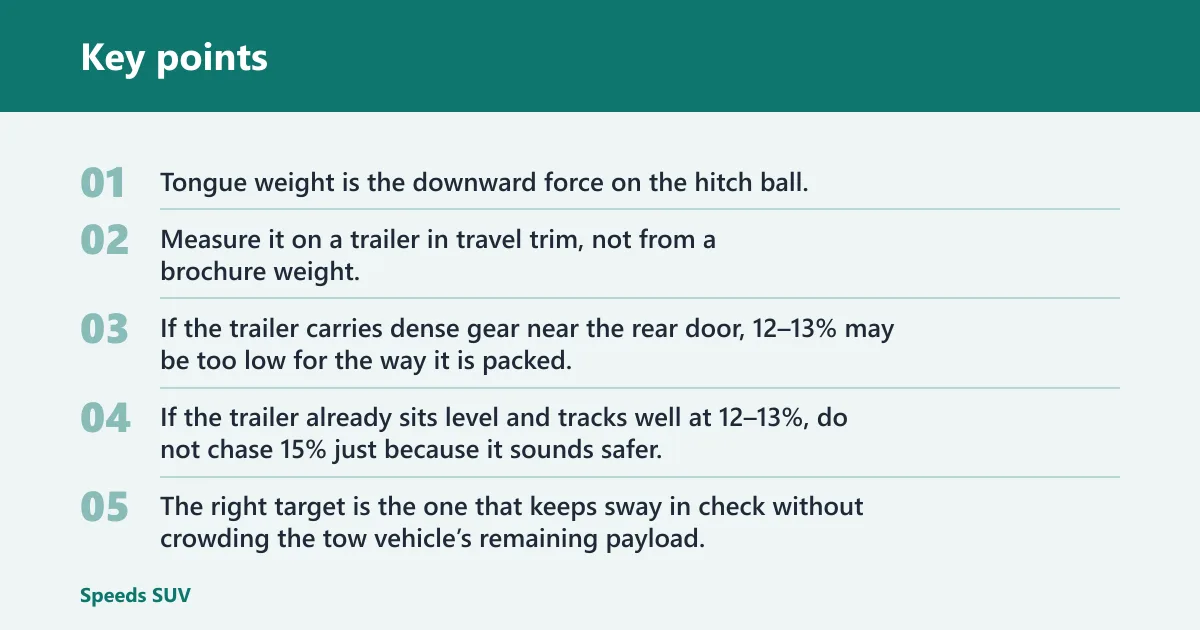
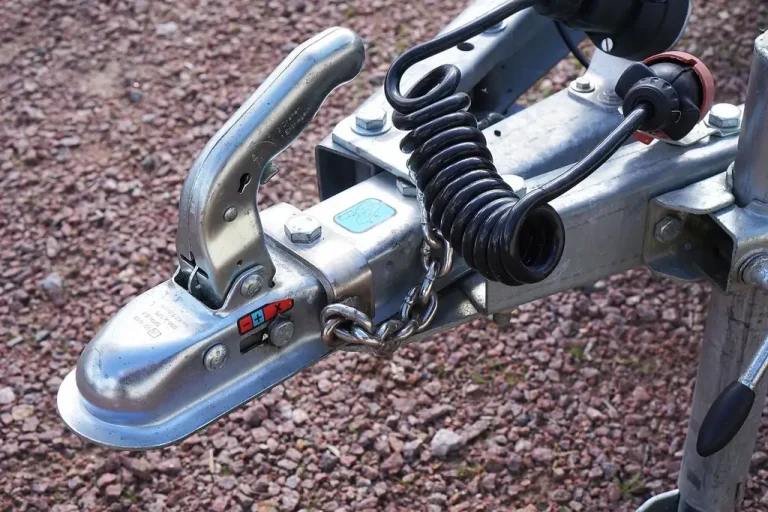
Tongue weight is the downward force on the hitch ball. Measure it on a trailer in travel trim, not from a brochure weight. Fifth-wheel and gooseneck trailers are different; they use pin weight, not tongue weight, and their safe load share is typically higher.
Where 12–13% fits
That range works well for many bumper-pull travel trailers, utility trailers, and cargo trailers because it usually gives enough forward bias to calm sway without pressing too hard on payload. It is a target, not a promise. If the trailer carries dense gear near the rear door, 12–13% may be too low for the way it is packed.
For a trailer loaded to about 6,000 lb, a tongue weight around 720 to 780 lb is a common rule of thumb at about 12–13%, especially if the cargo sits mostly between the axles. That helps keep the nose from feeling light while leaving room for passengers and gear in the tow vehicle.
When 15% is too much
Fifteen percent is usually a stability-first choice, but it can be too much if the tow vehicle is near its payload limit or if the hitch, spring bars, or receiver rating is the tighter limit. Steering feel and braking response depend on the actual axle loads and on whether a weight-distribution hitch is adjusted correctly, so those effects are not guaranteed by the percentage alone.
If the trailer already sits level and tracks well at 12–13%, do not chase 15% just because it sounds safer. More tongue weight is not always better. The right target is the one that keeps sway in check without crowding the tow vehicle’s remaining payload.
Why loaded weight matters more than dry weight
Use loaded trailer weight, not dry weight, when you set a tongue weight target. Water, propane, tools, food, batteries, and recovery gear all change the actual load on the hitch. A dry-weight calculation can leave you far short of the force that will exist on the road.
A brochure may list a trailer at a comfortable number. Once tanks are filled and cabinets are packed, the real figure can climb enough to move the correct tongue weight by hundreds of pounds.
How do you know if your setup is payload-limited?
Your setup is payload-limited when the tongue weight, passengers, and cargo together crowd the tow vehicle’s payload capacity. That limit comes from the door sticker, not from a guess based on tow rating alone. If payload runs out first, a bigger tongue weight percentage may be the wrong fix even if the trailer would tow more calmly with extra nose weight.
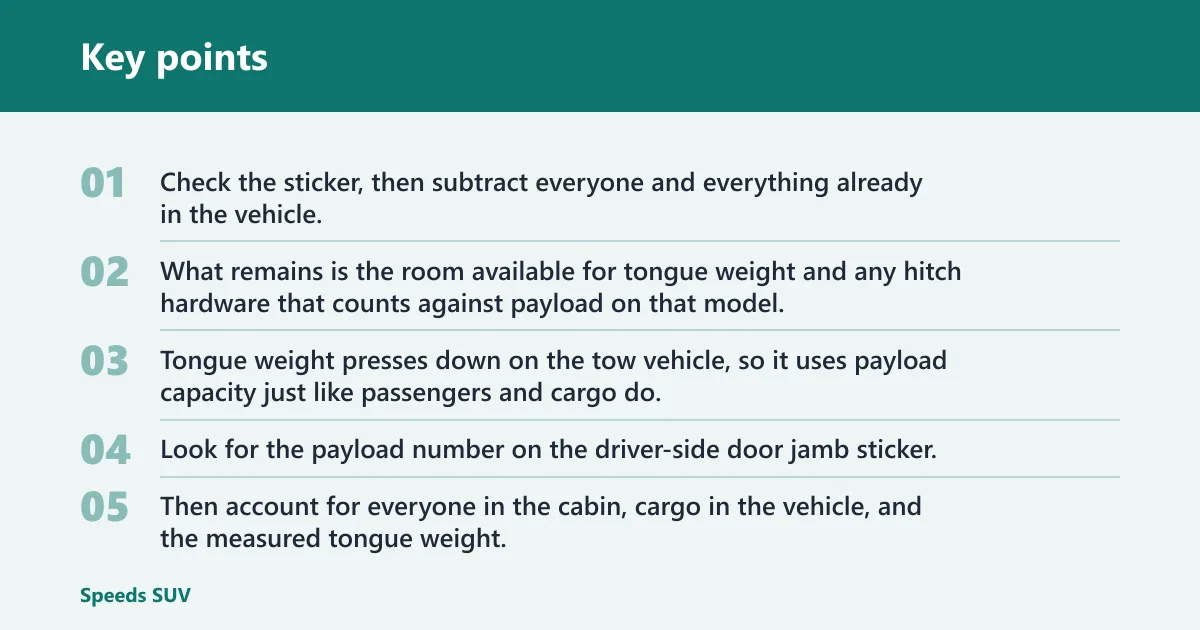
Check the sticker, then subtract everyone and everything already in the vehicle. What remains is the room available for tongue weight and any hitch hardware that counts against payload on that model.
Why tongue weight counts against payload
Tongue weight presses down on the tow vehicle, so it uses payload capacity just like passengers and cargo do. That matters because a trailer can be under the vehicle’s tow rating and still overload the rear axle or leave too little margin for safe steering and braking feel.
Do not treat payload as an afterthought. It is often the first limit to reach on half-ton trucks, crossovers, and SUVs towing bumper-pull trailers.
What to check on the door sticker
Look for the payload number on the driver-side door jamb sticker. That figure is the starting point for the total load the vehicle can carry. Then account for everyone in the cabin, cargo in the vehicle, and the measured tongue weight.
If the remaining margin is thin, choose the lowest tongue weight that still keeps the trailer stable, then verify whether cargo can be moved into the trailer’s front half to help the hitch load without overfilling the tow vehicle.
When passengers and cargo shrink your margin
A full cabin can erase the room you thought you had. A family of four, a cooler, and recovery gear can consume a large slice of payload before the trailer is attached. That is why two rigs with the same trailer can need different tongue weight targets.
Suppose the trailer can be stable at 12–13%, but the tow vehicle is already carrying several people and gear. In that case, the safer move may be to reduce trailer load, shift cargo forward in the trailer, or choose a tow vehicle with more payload headroom.
Tongue weight decision table
This table gives a practical rule for bumper-pull trailers. Use the loaded trailer weight, then choose the tongue weight target that matches the loading pattern and the limiting factor you must check next.
| Setup type | Target percentage | What to check next |
|---|---|---|
| Light trailer, balanced cargo, clean tracking | 10% | Check sway risk first. If the trailer feels light at the hitch or carries gear aft of the axle line, move cargo forward before lowering the percentage further. |
| Midrange trailer, mixed cargo, normal highway use | 12–13% | Check steering feel and payload headroom. This is the usual starting point when you want a stable tow without pushing the tow vehicle’s payload too hard. |
| Heavier bumper-pull trailer, long body, top-heavy load | 15% | Check payload pressure and hitch ratings. If the added tongue weight exceeds the vehicle or hitch limit, reduce trailer load or change the tow setup instead of forcing the number. |
The table gives the rule of thumb, not a license to ignore hardware limits. A trailer can sit in the right percentage band and still exceed the hitch, receiver, or vehicle rating. The loaded math has to work first.
Decision rule: choose 10% only when the trailer is light and balanced; choose 12–13% when you want the best all-around mix of stability and payload margin; choose 15% when stability is the priority and your tow vehicle still has room for the extra downward load.
When should you use a weight distribution hitch?
Use a weight distribution hitch when the bumper-pull setup is heavy enough that the rear of the tow vehicle sags or the front axle unloads more than the manufacturer allows. It redistributes load across axles, which can improve steering and braking feel. It does not change the trailer’s loaded tongue weight, so you still need the correct percentage first.
For many heavier bumper-pull setups, it is also the point where sway control may be part of the system, if the hitch and vehicle manuals allow it. The manual controls the setup; do not assume every trailer, receiver, or ball mount is approved for weight distribution or sway-control hardware.
How it changes axle loading
A weight distribution hitch moves some of the tongue load forward onto the tow vehicle’s front axle and rearward onto the trailer axles. That can restore steering feel and level the stance. It does not reduce the actual mass being carried; it changes where that force is carried.
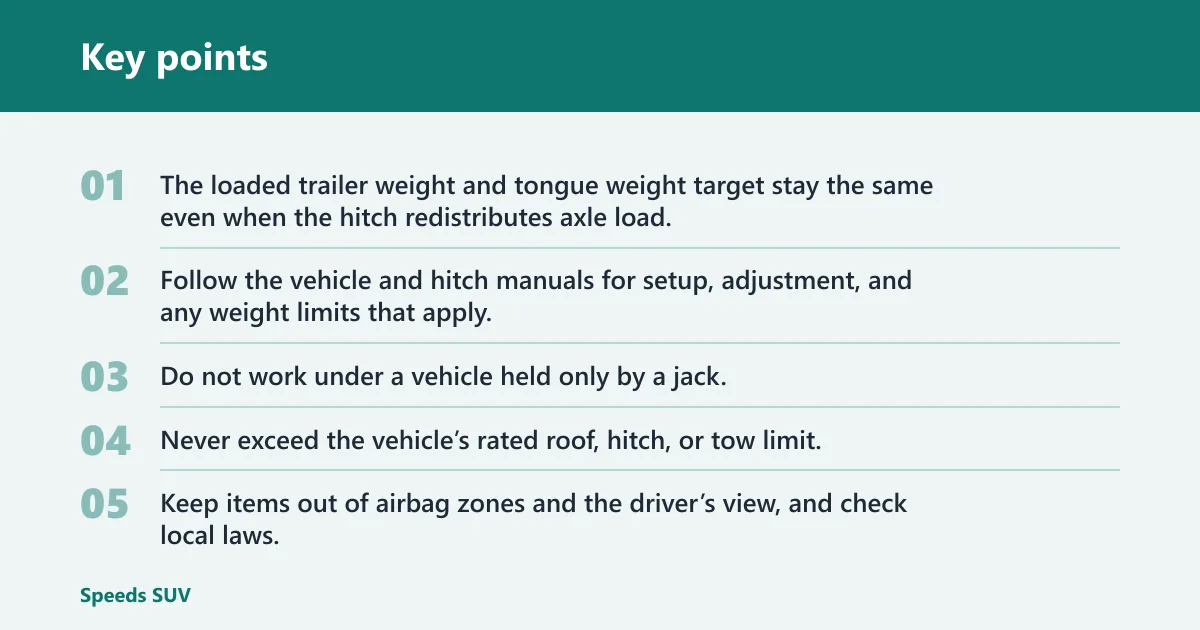
That distinction matters. The loaded trailer weight and tongue weight target stay the same even when the hitch redistributes axle load.
Why hitch and vehicle manuals still matter
Follow the vehicle and hitch manuals for setup, adjustment, and any weight limits that apply. Do not work under a vehicle held only by a jack. Never exceed the vehicle’s rated roof, hitch, or tow limit. Keep items out of airbag zones and the driver’s view, and check local laws.
A weight distribution hitch can improve balance, but it is not a pass to exceed a receiver rating or tow rating. The hardware limits remain part of the decision.
When sway control may be part of the setup
Sway control is worth considering when the trailer is long, catches crosswinds, or carries more mass behind the axle line. It is not a cure for a tail-heavy load. If the trailer is under 10% tongue weight, fix the loading pattern first rather than relying on hardware to mask the problem.
How do you measure tongue weight correctly?
Measure tongue weight on a fully loaded trailer. A tongue weight scale is the cleanest method. For lighter trailers, a bathroom scale method can work, and for heavier rigs a public weigh station or CAT Scale method gives a practical real-world number. Use the same travel trim you plan to tow with.
Use the bathroom-scale or lever method only if you already have a trusted setup for the trailer being measured and can keep the trailer in the same travel trim while you measure it.
Load the trailer first. Put in water, fuel, tools, food, luggage, and any other cargo you expect to carry on the road. The goal is to measure the real load, not an empty shell.
Choose a measurement method. Use a tongue weight scale if you have one. For lighter trailers, the bathroom scale method can work below 300 lb; for heavier trailers, use the lever method or a weigh station method that can handle the load safely.
Record the actual tongue weight. Compare that number to the loaded trailer weight. Then calculate the percentage by dividing tongue weight by loaded trailer weight and multiplying by 100.
Adjust cargo if needed. If the percentage lands below the target band, move cargo forward in the trailer. If it lands too high and payload is tight, reduce forward-heavy cargo or move some weight rearward only if the trailer still stays stable.
A 5,000 lb loaded trailer has a 10% tongue weight floor of 500 lb. A 10,000 lb loaded trailer has a 15% tongue weight ceiling of 1,500 lb. Those are useful checkpoints because they show how quickly the tongue load grows as trailer mass increases.
How does cargo placement change tongue weight?
Moving cargo forward usually raises tongue weight. Moving cargo rearward lowers it. That sounds simple, but the effect can be large when heavy items sit near the rear door or behind the axle line. Water tanks, batteries, and generators can change the result more than boxes of light gear.
Use cargo placement to tune the setup, not to hide a bad one. If the trailer needs a large shift just to stay in the safe range, the loading pattern may be wrong for that trailer.
Shifting cargo forward
Forward cargo placement helps a trailer track straight because it adds load to the hitch. This is the first move when the trailer feels light, oscillates in crosswinds, or shows sway on the highway. Add the weight where the trailer structure and manual allow it, then recheck the percentage.
Keep the change moderate. Small moves can make a clear difference without pushing payload too hard.
Shifting cargo rearward
Rearward cargo placement reduces tongue weight, which can be useful only when the hitch load is too high for the tow vehicle or hardware. It should not be used to chase a flatter ride if sway is already present. A tail-heavy trailer is the setup that usually gets unstable first.
A common first-timer mistake is loading heavy tools at the very back because the space is easy to reach. That can push the trailer below the safe band even when the total trailer weight has not changed.
Why water and gear matter
Water sloshing, full tanks, and dense gear change balance in ways brochure numbers do not show. The tongue weight target must match the way the trailer is packed, not how it appears on paper. That is why loaded trailer weight is the only number that belongs in the calculation.
Frequently asked questions
What is the best tongue weight percentage for safe towing?
For a conventional bumper-pull trailer, 12–13% is the best starting point for many loads because it balances stability and payload headroom. Use 10% only when the trailer is light and well balanced. Move toward 15% when the trailer is long, top-heavy, or more prone to sway.
Is 10% tongue weight enough for a trailer?
Sometimes, but only for a light trailer with a balanced loading pattern and no sway tendency. If the trailer feels light at the hitch, or if cargo sits rearward, 10% may be too low. Below about 10%, sway risk is commonly reported to rise more quickly, especially at highway speeds.
Is 15% tongue weight too much?
Not automatically. Fifteen percent is often the upper end of the safe bumper-pull range, and it can be the right answer for a long or top-heavy trailer. It becomes too much when it overloads payload, exceeds hitch capacity, or makes steering and braking feel dull.
What tongue weight percentage should I use for a travel trailer?
Most travel trailers work best near 12–13% of loaded trailer weight. If the trailer carries more gear forward or tends to sway, 15% may be safer if the vehicle and hitch have room. If payload is tight, keep the load stable first, then tune the number carefully.
How much tongue weight do I need to prevent trailer sway?
Enough to keep the trailer from feeling tail-heavy. For conventional bumper-pull towing, that usually means staying within 10–15% of loaded trailer weight, with 12–13% as a common target. If sway still appears near that range, cargo placement and trailer loading pattern need attention.
Does tongue weight count against payload capacity?
Yes. Tongue weight uses payload just like passengers and cargo do. Check the driver-side door sticker for the payload number, then subtract everyone and everything already in the vehicle. The remaining margin has to cover the measured tongue weight and any hitch equipment that counts toward payload.