What Are the Symptoms of a Bad Timing Chain in an SUV?
A bad timing chain in an SUV can be associated with cold-start rattling, rough idle, misfires, loss of power, and check-engine codes such as P0016 to P0019. If the noise lasts more than a few seconds or gets louder under acceleration, stop driving. If you keep driving, the chain can skip timing and bend valves, or leave you stranded with severe engine damage. This guide sorts symptom patterns by driving condition so you can separate chain, tensioner, guide, sensor, and oil-related faults.
What a bad timing chain feels like
The chain links the crankshaft and camshaft so valve timing stays synchronized. When it wears, stretches, or loses tension, the symptoms often begin with noise, then move into driveability problems. In SUVs, load, towing, stop-start traffic, and cold weather can make those symptoms easier to notice.
Start by noting when the symptom appears. A brief startup rattle points more often to guides or a tensioner than to a fully failed chain. Noise that grows under load, plus rough running or codes, is more concerning because it can mean the chain is no longer holding cam timing where the engine wants it.
Bad timing chain symptoms by driving condition
Timing-chain symptoms change with engine speed and oil pressure. That pattern matters more than any single noise. A cold-start rattle that fades quickly is different from a rattle that stays present at idle, and both differ from hesitation under acceleration or a hard no-start.
After an overnight stop
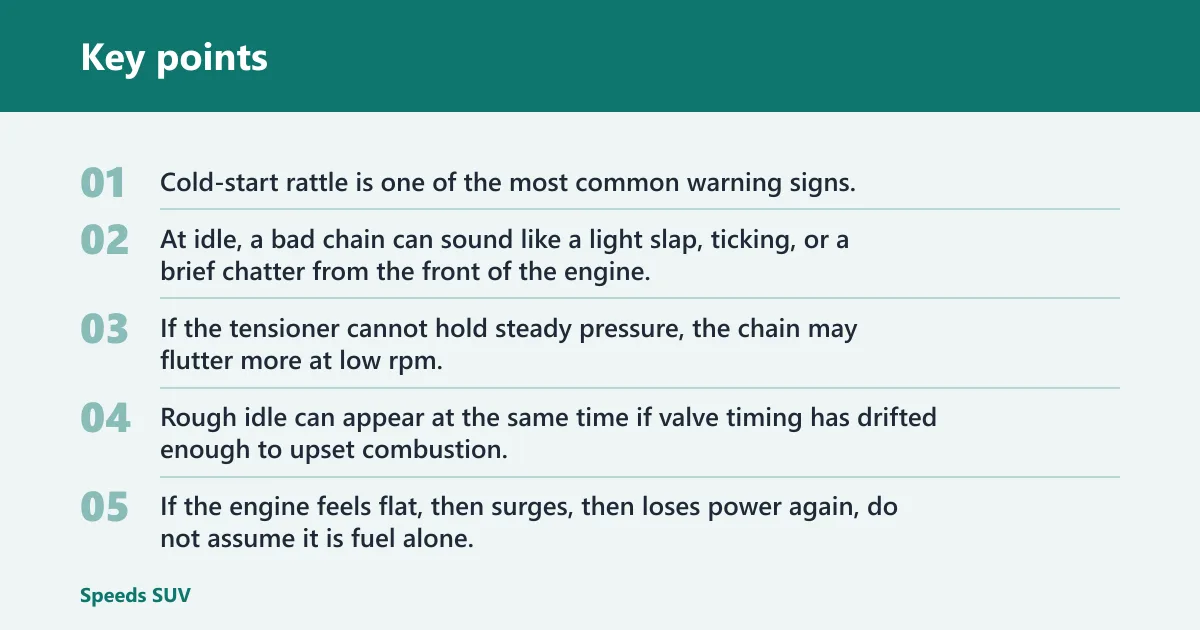
Cold-start rattle is one of the most common warning signs. It often lasts a few seconds after an overnight park, then fades as oil pressure fills the tensioner and takes up slack. That points especially toward a worn tensioner or tired guides, though a stretched chain can do the same thing.
Picture a 3.5-liter SUV that rattles for two seconds on the first start of the morning, then sounds normal the rest of the day. That pattern is less urgent than a long, repeated rattle, but it still needs attention because the slack may be getting worse.
At idle and in traffic
At idle, a bad chain can sound like a light slap, ticking, or a brief chatter from the front of the engine. If the tensioner cannot hold steady pressure, the chain may flutter more at low rpm. Rough idle can appear at the same time if valve timing has drifted enough to upset combustion.
In stop-and-go traffic, a worn chain or weak tensioner can become more noticeable after heat soak, low oil pressure at idle, or repeated restarts. A noise that gets louder after a long wait at a light is more suspicious than one that only appears for a second on cold start.
During acceleration or climbing hills
Under load, a stretched chain can let cam timing slip just enough to cause hesitation, weak passing power, or a stumble when you ask for more throttle. SUV engines often show this when climbing a grade, merging, or towing, because the load makes timing errors easier to feel.
If the engine feels flat, then surges, then loses power again, do not assume it is fuel alone. Timing drift, cam sensor faults, ignition issues, and fuel delivery problems can all overlap here. Chain-related trouble often worsens as the engine works harder.
At highway speed
At a steady cruise, a bad chain may be quieter than it is at idle, but the SUV can still feel off. Some drivers notice a mild misfire, a steady check-engine light, or poor passing response rather than obvious noise. If timing has drifted far enough, the engine may also enter reduced-power behavior.
Suppose an SUV cruises smoothly at 65 mph but shudders and hesitates when passing on a grade. That is not proof of chain wear, but it is a useful pattern because chain slack and phasing errors often show up when the engine moves from light load to heavier load.
What noises point to chain, tensioner, or guides?
Chain noise is usually a rattle, chatter, or slap from the front of the engine, not a deep knock from the bottom end. The shape of the noise matters. A short rattle on startup often points to tensioner or guide wear, while a longer or louder noise can mean the chain is loose enough to hit its guides or cover.
Rattle or chatter on startup
Rattle on startup is the classic complaint. It often shows up after the vehicle sits overnight because oil drains down and the tensioner needs time to refill. That makes hydraulic tensioner problems and worn guides common lookalikes for a stretched chain.
Ticking or slap at idle
A ticking or light slap at idle can mean the chain is moving more than it should inside the cover. Plastic or composite guides can crack or erode, and that wear can make the chain sound loose even before it has stretched enough to set a code.
Noise that fades as oil pressure builds
If the noise fades within a few seconds of startup, the oil system is part of the story. Low oil level, dirty oil, or the wrong viscosity can slow tensioner operation. That does not rule out chain wear, but it does mean oil condition should be checked before any replacement decision.
Can a bad timing chain cause misfire or stall?
Yes. When timing drifts far enough, the engine can misfire, idle roughly, hesitate, stall, or even refuse to start. A timing chain does not have to fail completely to cause these symptoms. Small cam timing errors can upset combustion before the chain ever jumps a full tooth.
Rough idle, hesitation, and loss of power
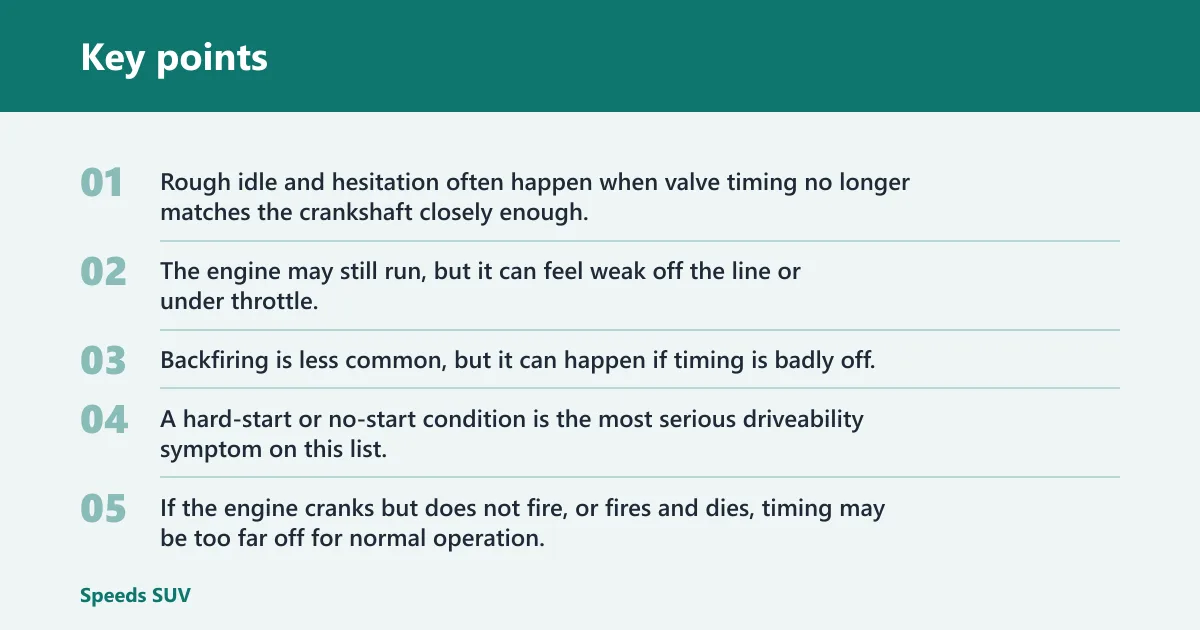
Rough idle and hesitation often happen when valve timing no longer matches the crankshaft closely enough. The engine may still run, but it can feel weak off the line or under throttle. Those symptoms can be mistaken for ignition or fuel trouble because the driver feels them before the code tells the story.
Backfiring and stalling
Backfiring is less common, but it can happen if timing is badly off. Stalling at stops or during low-speed maneuvers is more urgent, because it can point to a chain that has jumped timing or to a related sensor fault that is confusing the engine computer.
No-start and hard-start cases
A hard-start or no-start condition is the most serious driveability symptom on this list. If the engine cranks but does not fire, or fires and dies, timing may be too far off for normal operation. That needs immediate inspection because continued cranking can make the situation worse.
Check engine light and timing codes
OBD-II codes can support the diagnosis, but they do not prove the chain is bad by themselves. Correlation codes such as P0016 and P0017 generally point to a mismatch between crank and cam position. Phasing codes such as P0011 and P0014 point to cam timing that is not where the computer expects it.
P0016 and P0017 correlation faults
P0016 and P0017 usually mean the engine computer sees a crankshaft and camshaft relationship problem. That can come from a stretched chain, a jumped chain, a bad cam sensor, a bad crank sensor, or wiring trouble. The code tells you where to look, not what part to replace first.
P0011 and P0014 phasing faults
P0011 and P0014 often point to cam timing that is advanced or retarded outside the expected range. Oil control problems can trigger these codes, especially if the tensioner uses oil pressure. Dirty oil, low oil, or the wrong viscosity can interfere with operation and create a false timing complaint.
Why a code needs scan data and inspection
A scan tool can show more than the code number. Live data, freeze-frame data, and correlation readings help separate a mechanical timing problem from a sensor or oil-pressure issue. A mechanic should confirm the diagnosis before replacement, because chain jobs are labor-heavy and lookalikes are common.
Timing chain symptom triage table
| Symptom | Most likely chain-related cause | Common lookalikes | Urgency | Next diagnostic step |
|---|---|---|---|---|
| 2 to 5 second rattle after overnight start | Tensioner slack or worn guides | Low oil level, dirty oil, wrong viscosity | Moderate | Check oil level and service history, then scan for codes |
| Rattle that continues at idle | Guide wear or chain slack | Accessory noise, low oil pressure, sensor-related idle issues | High | Inspect oil condition and measure oil pressure if possible |
| Rough idle with hesitation under load | Timing drift from stretch or skipped timing | Ignition miss, fuel delivery problem, vacuum leak | High | Pull codes and review live cam-crank data |
| P0016 or P0017 code with drivability symptoms | Chain stretch or timing jump | Camshaft position sensor, crankshaft position sensor, wiring fault | High | Inspect sensor signals and verify mechanical timing |
| P0011 or P0014 code with oil-related complaints | Tensioner or cam phasing problem | Dirty oil, wrong viscosity, oil pressure issue | High | Confirm oil level and correct oil spec before parts replacement |
| Crank-no-start after running poorly | Chain jumped timing | Crank sensor fault, immobilizer fault, fuel pump issue | Immediate | Stop driving and arrange inspection right away |
What else can mimic a bad timing chain?
Several faults can sound or feel like chain trouble. Camshaft position sensor faults, crankshaft position sensor faults, oil-pressure problems, and even ignition or fuel issues can all create misfire, rough idle, or correlation codes. That is why symptom pattern matters as much as the code itself.
Camshaft position sensor faults
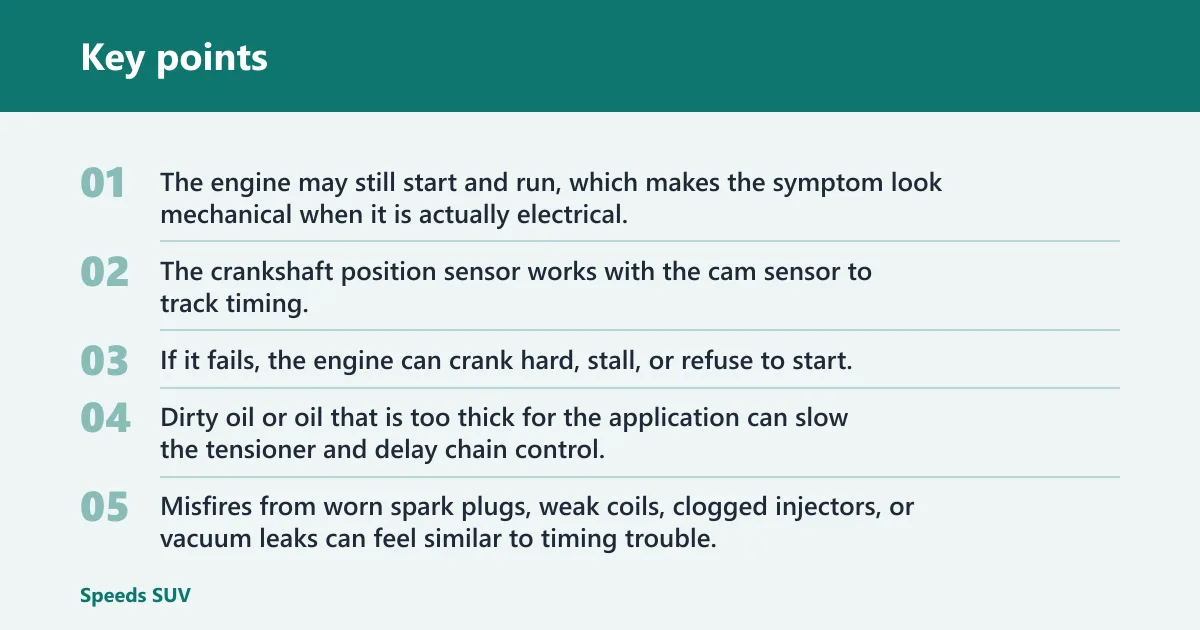
A bad camshaft position sensor can cause correlation faults, misfire, or poor running because the engine computer no longer trusts cam timing data. The engine may still start and run, which makes the symptom look mechanical when it is actually electrical.
Crankshaft position sensor faults
The crankshaft position sensor works with the cam sensor to track timing. If it fails, the engine can crank hard, stall, or refuse to start. Those symptoms can look like a jumped chain, so sensor testing matters before any cover comes off.
Oil level, oil pressure, and viscosity problems
Low oil can worsen chain noise. Dirty oil or oil that is too thick for the application can slow the tensioner and delay chain control. If the noise changes after an oil change, or if the wrong viscosity was used, start there before blaming the chain itself.
Ignition, fuel, and vacuum lookalikes
Misfires from worn spark plugs, weak coils, clogged injectors, or vacuum leaks can feel similar to timing trouble. The clue is that these faults often produce misfire codes without the cam-crank correlation pattern. A scan report and basic under-hood checks help separate them.
When is it unsafe to keep driving?
It is unsafe to keep driving if the SUV has a loud timing rattle plus a flashing check-engine light, a stall, a backfire, or a no-start condition. Those signs point to a problem that can get worse quickly. A chain that jumps timing can damage valves and may leave the engine unable to run.
- Stop if the light flashes. A flashing check-engine light with timing noise may indicate a misfire severe enough to threaten the catalytic converter and the engine itself. Pull over and shut it off.
- Do not keep cranking. If the SUV will not start, repeated cranking can waste battery power and delay proper diagnosis. It also does nothing to fix a mechanical timing error.
- Arrange inspection quickly. Tow the vehicle or have it inspected on site if it stalls, backfires, or refuses to start. Those symptoms move the problem from “noisy” to “urgent.”
Frequently asked questions
How do you know if a timing chain is going bad?
A timing chain that is going bad often gives you a cold-start rattle, rough idle, hesitation, and codes such as P0016 or P0017. If the noise lasts more than a few seconds, returns at idle, or comes with misfire symptoms, the chain, tensioner, or guides need inspection.
How do you tell if your timing chain is bad?
Start with the pattern. Noise after an overnight stop points toward tensioner or guide wear, while hesitation under load or a no-start condition is more serious. Then scan the codes and check oil level and oil quality. A code alone does not prove the chain is bad.
How to tell if timing chain needs to be replaced
Replacement becomes more likely when the SUV has repeated startup rattle, ongoing rough running, correlation codes, or evidence that the chain has stretched or jumped timing. A mechanic should confirm with scan data and inspection. That avoids replacing a chain for a sensor or oil problem.
What noises does a bad timing chain make in an SUV?
Common sounds include a short startup rattle, ticking at idle, or a slap that changes with engine speed. If the sound fades as oil pressure builds, the tensioner or guides are often involved. A steady knock from the lower engine is less typical of timing-chain trouble.
Can a bad timing chain cause an SUV to misfire or stall?
Yes. If cam timing drifts far enough, the engine can misfire, idle poorly, hesitate, stall, or hard-start. The symptoms may look like ignition or fuel trouble at first, but correlation codes and load-related loss of power make timing trouble more likely.
Is it safe to keep driving an SUV with timing chain symptoms?
It is only reasonable to drive a short distance if the noise is brief, there is no flashing light, and the engine still runs normally. If the rattle lasts longer, the engine misfires, or it stalls, stop driving. The risk rises fast once timing drift starts affecting running quality.