Which SUVs Have Timing Chains Instead of Timing Belts?
Most modern SUVs use timing chains, including many Toyota, Honda, Mazda, Subaru, Nissan, Ford, Hyundai, Kia, GM, BMW, and Mercedes-Benz models, but many older and some current engine families still use belts. Verify by engine code, because the badge alone does not tell you. Miss this, and you could end up with a belt-drive SUV that may need a costly service at roughly 100 thousand km or more, and skipping that service can risk engine damage. This guide lists SUV nameplates and engine families that usually use chains, notes trims and engines that still use belts, and shows you how to confirm the setup before you buy.
Common chain-driven SUV brands and why engines matter

Many newer SUV engine families use timing chains, especially four-cylinder engines and newer turbocharged setups. Chains are metal links inside the engine. They drive the camshaft, and they often last much longer than belts. Still, the SUV badge alone is not proof. The engine family and model year matter more than the nameplate.
Common chain-driven nameplates
On the shopping side, chain-driven SUVs are common across Toyota, Honda, Mazda, Subaru, Nissan, Ford, Hyundai, Kia, GM, BMW, and Mercedes-Benz. The exact answer still depends on the engine family. A Toyota RAV4 with one engine can differ from a larger Toyota SUV with another, and the same model can change across model years.
Newer model years also trend toward chains because manufacturers often choose them for lower routine maintenance and longer service life. That does not mean “new” always equals chain. Some current engines still use belts, and some chain-driven engines still need attention if the chain design or tensioner is known for early wear.
Engine family matters more than badge
A common first-timer mistake is assuming every midsize SUV from the same brand uses a timing belt instead of checking whether that engine has a timing chain. One SUV nameplate may offer a small turbo four-cylinder with a chain and a legacy V6 with a different timing setup in another generation. Always match the engine code to the service information before you decide the timing drive is safe.
Picture a buyer comparing two midsize SUVs with the same trim badge. One has a newer four-cylinder and the other has an older V6. The trim badge looks the same on the lot, but the maintenance risk changes once the engine family changes.
Which SUVs can still have timing belts?
Some SUVs still use timing belts, especially older engine families and certain V6 designs. A timing belt uses durable rubber construction and is usually cheaper to replace than a chain. It is typically enclosed behind covers rather than sitting visible from the outside, and it also tends to have a scheduled replacement interval tied to age and mileage, so service history matters.
Smaller engines and belt use
Smaller engines often use chains now, but that is not universal. Some older compact and midsize SUV engines, especially legacy V6s, still use belts. Belts can be affected by age, salt, sand, and engine fluids, so a low-mileage SUV can still need belt service if the calendar has moved on.
Older trims and legacy engine families
Honda and Acura are the clearest examples of why model family alone is not enough. The Honda Pilot and Acura MDX have long used V6 belt-driven engines in many years, while other Honda SUV engines use chains. Subaru Forester models also changed over time, with older generations using timing belts and newer ones generally using chains, so used-car shoppers should always check the exact engine code and year, not the badge.
Suppose a 2016 Honda Pilot looks clean and has only moderate mileage. That does not settle the timing-drive question. You still need the engine code and timing-service records, because the engine family is the deciding factor for whether a belt service may be due.
SUV timing verification table
Use this table as a verification map, not as a substitute for the exact vehicle record. The badge tells you where to start. The engine code tells you what the SUV actually has.
| SUV model | Engine family | Likely timing system | Years/trims to double-check | Exact source to verify from |
|---|---|---|---|---|
| Toyota RAV4 | 2.5L four-cylinder family | Chain | All engine changes by generation; confirm hybrid and non-hybrid engine code | VIN decoder, owner’s manual, dealer parts lookup |
| Toyota Highlander | 2.4T and 3.5L V6 families | Chain | Confirm by year because powertrains changed across generations | VIN decoder, manufacturer service information, dealer parts lookup |
| Honda CR-V | 1.5T and 2.4L four-cylinder families | Chain | Double-check older generation changes and engine code | VIN decoder, service schedule, dealer parts lookup |
| Honda Pilot | 3.5L J35 V6 family | Belt | Double-check V6 trims and model year before buying used | VIN decoder, service schedule, dealer parts lookup |
| Acura MDX | 3.5L J35 V6 family | Belt | Confirm exact year and engine code; some buyers confuse it with chain-driven Honda engines | VIN decoder, owner’s manual, dealer parts lookup |
| Mazda CX-5 | 2.5L four-cylinder family | Chain | Check turbo and non-turbo versions by engine code | VIN decoder, manufacturer service information, dealer parts lookup |
| Subaru Forester | 2.5L boxer family | Chain | Confirm engine code on older and newer generations | VIN decoder, owner’s manual, dealer parts lookup |
| Nissan Rogue | 2.5L four-cylinder family | Chain | Double-check older model years and any engine swaps | VIN decoder, service schedule, dealer parts lookup |
| Ford Escape | EcoBoost four-cylinder families | Chain | Confirm by engine code because the Escape changed engines over time | VIN decoder, manufacturer service information, dealer parts lookup |
| BMW X3 | Modern turbo four-cylinder and six-cylinder families | Chain | Double-check older generations and any service-history gaps | VIN decoder, dealer parts lookup, manufacturer service information |
How to read the table
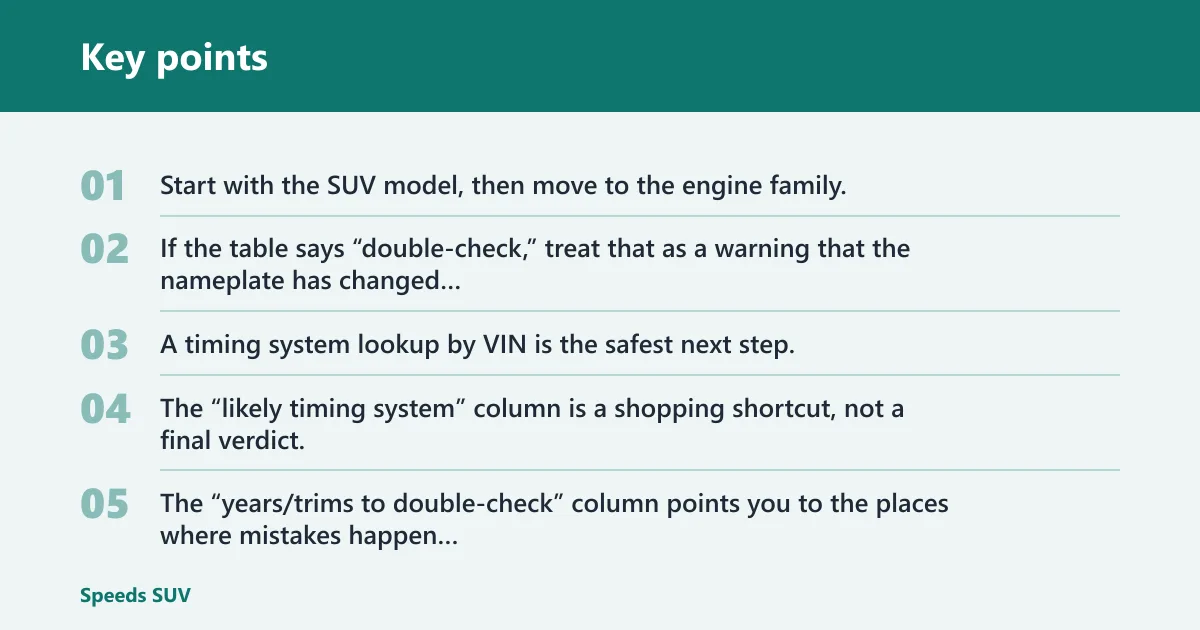
Start with the SUV model, then move to the engine family. If the table says “double-check,” treat that as a warning that the nameplate has changed across years or trims. A timing system lookup by VIN is the safest next step, because the same badge can cover more than one engine family.
What each column tells you
The “likely timing system” column is a shopping shortcut, not a final verdict. The “years/trims to double-check” column points you to the places where mistakes happen most often. The last column tells you exactly where to verify: owner’s manual, service schedule, VIN decoder, manufacturer service information, or dealer parts lookup.
How do you verify your SUV’s timing drive?
The safest way is to identify the engine code first, then match that code to manufacturer service information or dealer parts data. Do not rely on the badge alone, and do not assume the owner’s manual will spell out “chain” or “belt.” Some manuals do, many do not.
VIN lookup and engine code
- Find the VIN on the vehicle documents or the dash plate.
- Use a VIN decoder to identify the exact engine code.
- Match that code to manufacturer service information or a dealer parts lookup.
- Confirm whether the timing drive is a chain or a belt.
Owner’s manual and service schedule
The owner’s manual is useful because it can point you to the correct maintenance schedule. If the schedule includes timing belt replacement, that is a strong clue that the engine does not use a chain. If the manual is silent on the drive type, move to the VIN and parts lookup instead of guessing.
Dealer parts lookup and service information
Dealer parts systems are useful because they often separate engines by exact code. That matters on used SUVs where the same badge covers different powertrains. Manufacturer service information is even better when it lists the timing components, tensioner, and related seals for the exact engine.
What chain wear and belt service look like
Chains and belts fail in different ways. A timing chain uses metal links and is inside the engine, while a timing belt is rubber and usually enclosed behind covers. Chains can last as long as the engine in some designs, but they can still stretch or wear. Belts usually have a scheduled replacement interval and are more sensitive to age.
Chain stretch and tensioner wear
Ford says a timing chain can stretch over time. Ford also links chain stretch with a check engine light and noise, and notes that broken chains are rare but can prevent the engine from starting. Chain tensioners are an inspection clue here; if they are worn or near their limit, the timing drive deserves closer review.
Noise from the timing cover
A rattle from the timing cover area is worth attention on a chain-driven engine. That kind of noise can point to chain stretch, a tired tensioner, or another timing-drive issue. Do not dismiss it as normal engine sound on a used SUV, especially if the seller cannot produce service records.
Age, mileage, and maintenance clues
Belt intervals of 100 thousand km or more are described as common, but belt replacement intervals vary by engine and market, so check the manufacturer schedule for the exact SUV. Chain replacement can often reach €1000 or more, while timing belt replacement cost is often higher than a few hundred euros on many SUVs. Those are not reasons to ignore service; they are reasons to verify it early.
What should used SUV buyers check first?
Start with service history and timing-service documentation. If the SUV has a belt, you want proof of the last replacement date and mileage. If it has a chain, you still want records, because chain tensioners, guides, and stretch can matter on some engines. A missing record set is a risk signal, not a small gap.
Service history and timing records
Ask for invoices, not just verbal reassurance. You want the actual timing-belt or timing-chain service line, the date, the mileage, and the engine code if it is printed on the paperwork. If the seller cannot show anything, treat the timing system as unverified until you do your own lookup.
Pre-purchase questions for the seller
Ask whether the engine has had any timing-related work, whether the check engine light has ever come on for camshaft timing faults, and whether there is any cold-start rattle. If the seller says “the timing was done,” ask what was replaced. Belts, tensioners, pulleys, and water pumps are often discussed together, but the exact contents matter.
When to walk away
Walk away or demand a lower price if the seller cannot prove the timing service on a belt-driven engine that should have had one by now. Also step back if a chain-driven engine has obvious rattle, stored timing-related faults, or missing service history. A cheap purchase can turn into an engine problem fast.
Frequently asked questions
Which SUVs have timing chains?
Most newer SUVs from Toyota, Honda, Mazda, Subaru, Nissan, Ford, BMW, and many others use timing chains on at least some engine families. The badge alone still is not enough. You need the engine code, because the same SUV name can include both chain and belt setups across trims and years.
Which cars have timing chains instead of belts?
Many modern cars and SUVs use chains, especially four-cylinder and turbocharged engines. The same rule applies outside the SUV market: engine family matters more than the badge. For a used buy, check the VIN, then confirm the exact engine code through manufacturer service data or dealer parts lookup.
Do new cars have timing chains or belts?
New vehicles are more likely to have timing chains than older vehicles, but that is not a guarantee. Some current engines still use belts, and some chain-driven engines still need attention if the design has known wear points. Check the model’s service information before assuming anything from the model year alone.
Does my SUV have a timing chain or a timing belt?
Use the VIN and engine code first. Then check the owner’s manual, service schedule, manufacturer service information, or a dealer parts lookup. If those sources disagree or stay vague, treat the engine code as the tie-breaker. The badge by itself is not reliable enough for a buying decision.
Are timing belts better than chains?
Neither is universally better. Belts are usually cheaper to replace and often have clear replacement intervals, while chains are metal, internal, and often last longer. Chains can still stretch or wear, and belts can fail if age or maintenance is ignored. The better choice depends on the engine design and service discipline.
Which used SUV is safer to buy for timing chain maintenance?
A used SUV is safer when the exact engine family is confirmed and the timing-drive history is documented. Favor vehicles with clear service records, no chain-rattle complaints, and no missing belt-service proof. If the engine code cannot be verified, the safer choice is usually the one with the cleaner maintenance file, not the lower sticker price.