What Is Tongue Weight and Why Is It Important?
Tongue weight is the downward force the trailer puts on the hitch, and for most bumper-pull trailers it should be about 10% to 15% of the trailer’s loaded weight. If it falls outside that range, the rig can sway, the rear axle can carry too much, and usable towing capacity drops fast. This guide explains how to measure tongue weight, what changes it, and how to correct it when it is wrong.
What is tongue weight?
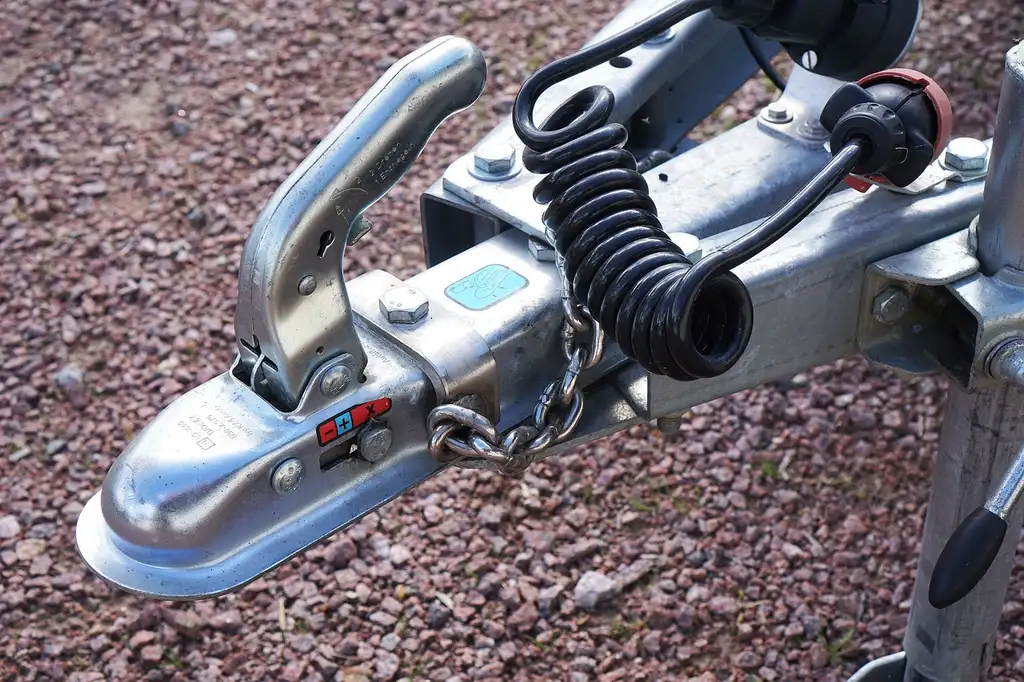
Tongue weight is the downward load the trailer’s coupler puts on the hitch ball. It is not fixed. It changes with loaded trailer weight, cargo placement, water or fuel tank levels, and added accessories on the trailer or tongue.
That last part matters because you should judge tongue weight against the trailer in its towing setup, not against an empty brochure number. A 7,000-lb loaded trailer gives you a useful example: the target tongue weight works out to 700–1,050 lb, with about 840 lb as a middle target.
Why loaded trailer weight comes first
Loaded trailer weight sets the target range. If the trailer is not packed for travel, the tongue-weight figure can look fine on paper and still be wrong on the road. Fill tanks, load gear, and add the items you plan to tow with before you judge the result.
Why does tongue weight matter?
Tongue weight affects trailer stability, tow vehicle payload, and rear axle load at the same time. Too little tongue weight can let the trailer hunt and sway. Too much can overload the SUV’s rear axle or payload before the trailer itself reaches its tow rating.
Sway and straight tracking
Below about 10% of loaded weight, sway is a key risk for a conventional bumper-pull trailer. The trailer can still move straight for a while, then start to wander when speed, wind, or lane changes add a small disturbance. A light tongue makes that disturbance harder to settle.
For example, a travel trailer with bulky gear behind the axle can become less stable at speed. The tongue weight drops enough that the trailer starts to steer the SUV instead of following it. The setup may feel fine in a parking lot, then grow twitchy at highway speed.
Rear axle and payload load
Above about 15% of loaded weight, overload is the key risk for a bumper-pull trailer. The hitch load does not disappear into the frame. It lands on the SUV, mostly through the rear axle, and can use up payload faster than many owners expect.
That is why tongue weight is part of the real towing limit. An SUV can be within its tow rating and still be over on payload once passengers, cargo, hitch gear, and tongue weight are all counted together.
What to watch when the setup feels wrong
A common first-timer mistake is blaming the trailer alone when the problem is really the vehicle’s rear axle load. If the rear end squats hard, steering feels light, or the rig porpoises after bumps, check payload and hitch setup along with tongue weight. Those symptoms can overlap.
What is the right tongue weight?
For a conventional bumper-pull trailer, the common target is 10% to 15% of loaded trailer weight. Gooseneck and 5th-wheel trailers use different geometry and generally call for higher pin-weight guidance, roughly 15% to 25% of loaded trailer weight. The right number depends on trailer type, not just size.
Bumper-pull trailers
The 10% to 15% guideline fits most conventional hitch setups because the load sits farther behind the tow vehicle than it does with a gooseneck or 5th-wheel. Too far below that range and sway risk rises. Too far above it and the SUV’s rear axle starts carrying more than it should.
Gooseneck and 5th-wheel trailers
Gooseneck and 5th-wheel trailers place the connection over or near the truck bed axle, so the load path is different. That is why pin-weight guidance is higher than on a bumper-pull. Do not copy a bumper-pull target into a gooseneck or 5th-wheel setup.
What changes on travel day
Set the target after the trailer is loaded for the trip. Water tanks, propane, batteries, coolers, generators, and tongue-mounted cargo can shift the number more than many owners expect. If the trailer leaves home in one condition and returns in another, the tongue weight can change too.
Keep roughly 60% of cargo weight ahead of the trailer axle as a common rule of thumb. That does not replace measurement, but it helps prevent a rear-heavy load that pushes tongue weight too low.
How do you determine tongue weight?
The best method depends on the job. A CAT scale works well for a full check, a dedicated tongue-weight scale is commonly used for quick setup changes, and the bathroom scale plus lever method is a driveway option for lighter trailers only. Heavy travel trailers need a stronger method.
CAT scale method
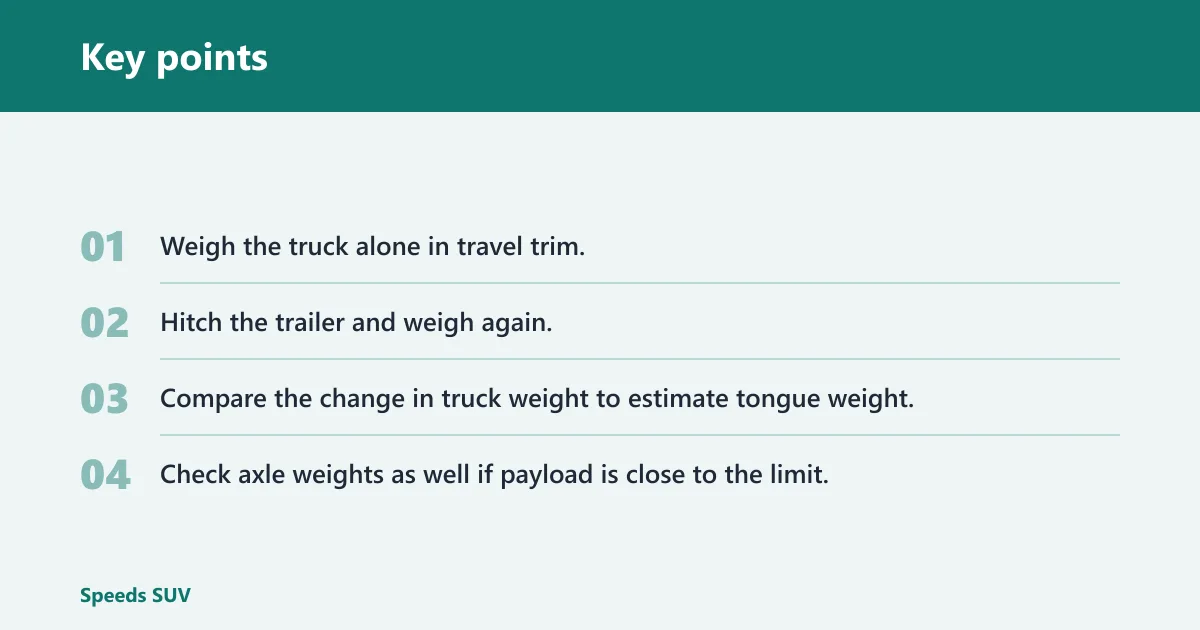
A CAT scale method compares hitched and unhitched truck weight to find tongue weight. That makes it a good choice when you want a road-trip answer, not a guess. It also helps separate tongue weight from other payload items because you can compare axle loads before and after the trailer is coupled.
- Weigh the truck alone in travel trim.
- Hitch the trailer and weigh again.
- Compare the change in truck weight to estimate tongue weight.
- Check axle weights as well if payload is close to the limit.
Dedicated tongue-weight scale
A dedicated tongue-weight scale sits under the coupler jack. It is the fastest repeatable check when you are changing cargo, moving water, or adjusting a hitch. That makes it the best fit for first-time owners who want a simple setup check without a scale stop.
Bathroom scale plus lever method
The bathroom scale plus lever method is a classic driveway method. It can work for lighter trailers, but it is not suitable for heavier travel trailers. The hitch load can exceed what a household scale can handle, and leverage errors become a bigger problem as weight rises.
Use that method only when the trailer is light enough for the setup, and only if you can follow the lever ratio carefully. If the number seems close to the limit, confirm it with a truck scale or a proper tongue-weight scale.
How do you get the proper tongue weight?
Move cargo forward or rearward in the trailer, then recheck the number. Start with the big items first: coolers, tools, generators, and camping gear. Check water, fuel, and accessory weight before departure, because those changes can move tongue weight enough to change sway, axle load, or both.
Shift cargo in small steps
If tongue weight is low, move weight toward the front of the trailer. If it is too high, move some load rearward in small steps and measure again. Avoid guessing. A few heavy items can change the result more than a long row of light bags.
Check tanks and accessories
Water and fuel tank levels matter because fluid is weight, and that weight moves with the trailer. An added battery, bike rack, storage box, or propane cylinder can also change tongue weight. Check the trailer in the same travel condition each time you expect a repeatable result.
Recheck after every load change
Say your trailer tows well with the gray tank near empty, then you fill it for a long run home. The added fluid can shift axle load and change the tongue number enough to show up as a new pull or sway feel. Recheck after any meaningful load change.
Tongue weight checklist
This checklist ties the trailer type to the load target, the failure sign, the best measurement method, and the first correction move. Use it when you need a fast decision, especially if you are sorting out whether tongue weight, payload, or hitch setup is the real problem.
| Trailer type | Target tongue-weight range | Common failure sign | Best measurement method | First correction move |
|---|---|---|---|---|
| Conventional bumper-pull | 10% to 15% of loaded trailer weight | Sway, wandering, poor straight tracking below range; rear squat or payload warning above range | CAT scale for a full check; dedicated tongue-weight scale for quick setup checks | Shift cargo forward or rearward, then remeasure |
| Gooseneck | Roughly 15% to 25% of loaded trailer weight | Truck rear axle load rises fast if pin weight is too high; trailer feel changes if cargo shifts rearward | Dedicated tongue-weight scale or truck scale method for axle-load review | Move cargo to balance pin weight and check tow vehicle payload |
| 5th-wheel | Roughly 15% to 25% of loaded trailer weight | Excess squat or payload use on the truck; unstable feel if the load is too light for the trailer geometry | CAT scale or dedicated tongue-weight scale | Rearrange cargo, then confirm truck axle weights and hitch setup |
Does weight distribution lower tongue weight?
A weight-distribution hitch does not lower tongue weight. It changes how the load is shared across the tow vehicle and trailer axles. The tongue weight is still there. What changes is the way that load is carried, which can help with rear axle load and front-to-rear balance.
When it enters the conversation
A weight-distribution hitch is usually the next conversation when tongue weight runs over about 500 lb. At that point, the question is not only whether the trailer feels stable. It is also whether the SUV can carry the hitch load without overloading the rear axle or exceeding payload.
What it does not fix
It does not turn a bad load into a good one. If the trailer is rear-heavy, the hitch should not be treated as a cure for poor cargo placement. Fix the load first, then use the hitch to manage the remaining axle balance and tow feel.
Frequently asked questions
Why do we need a tongue weight?
You need tongue weight because the trailer has to stay planted and follow the tow vehicle in a straight line. Too little weight can make the trailer sway. Too much can overload the rear axle or payload. The right amount helps the rig track straight and stay controllable.
What is tongue weight capacity?
Tongue weight capacity is the most vertical load your hitch, tow vehicle, and related equipment are set up to carry safely. It is separate from trailer tow rating. If the tongue load is too high, the SUV can run out of payload or rear axle capacity before the trailer itself is over limit.