Ground Clearance vs Ride Height: What Is the Difference?
Ground clearance is the lowest body or underbody point to the ground; ride height is the vehicle’s height from the ground to a set reference point, so the numbers are related but not interchangeable. Mixing them up can make an SUV look more capable on paper than it is on a trail or loading ramp. This guide explains how manufacturers measure each figure, which specs matter most, and how to compare SUVs and trucks without reading brochure language wrong.
| Factor | Ground clearance | Ride height | Winner |
|---|---|---|---|
| What it measures | Lowest fixed point to the ground | Ground to a fixed body reference point | Ground clearance |
| Use for scraping risk | Directly shows the underbody’s limit | Can hint at stance, but not the limit | Ground clearance |
| Comparing brochure figures | More useful when the published method is clear | Useful only if the reference point is named | Ground clearance |
| Body-position context | Indirect | Direct | Ride height |
| Off-road planning | Works with angles and wheelbase | Needs extra geometry to mean anything practical | Ground clearance |
How each measurement is defined
Ground clearance is the number shoppers usually want when they ask whether an SUV will scrape. Ride height is a body-to-ground measurement tied to a reference point on the vehicle, so it can describe stance without telling you where the lowest underbody point sits.
What ground clearance measures
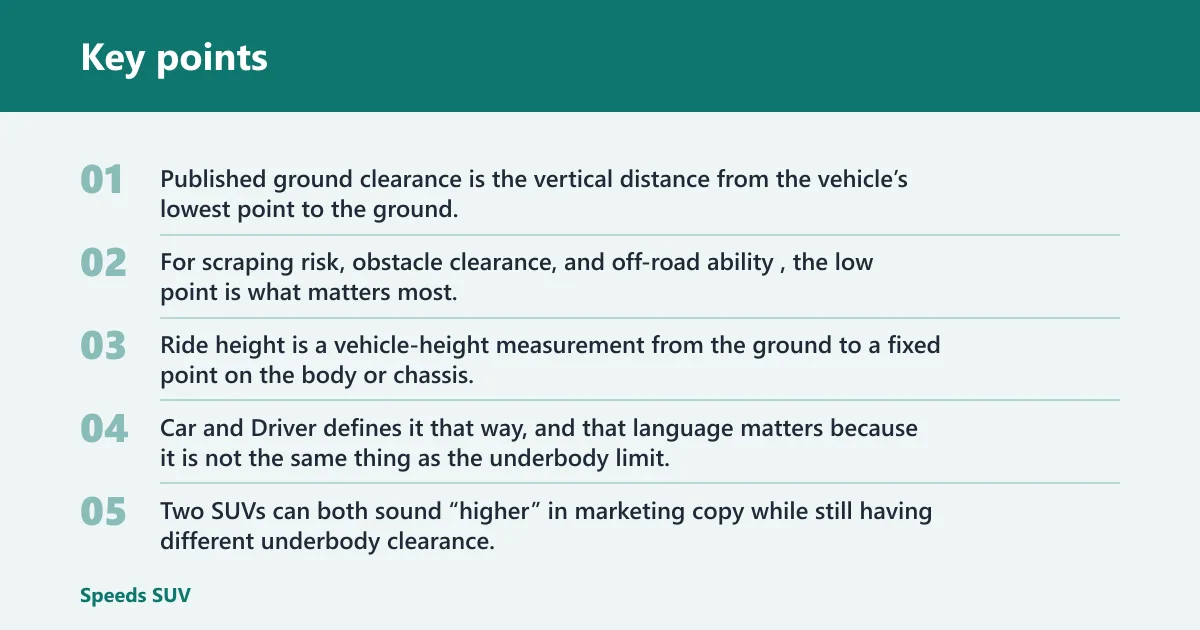
Published ground clearance is the vertical distance from the vehicle’s lowest point to the ground. The measured point can vary by manufacturer and trim, because brochures may reference a fixed underbody point, a chassis member, or another lowest point that stays constant under normal use.
For scraping risk, obstacle clearance, and off-road ability, the low point is what matters most. A vehicle listed at 193 mm clearance, such as the Tata Punch, will usually clear more than one listed at 163 mm, such as the Swift, but the shape underneath still matters.
What ride height measures
Ride height is a vehicle-height measurement from the ground to a fixed point on the body or chassis. Car and Driver defines it that way, and that language matters because it is not the same thing as the underbody limit.
Manufacturers may choose different reference points, which makes the label less useful unless the brochure names the exact location. Two SUVs can both sound “higher” in marketing copy while still having different underbody clearance.
Why the two numbers can differ
The difference comes from geometry. One number describes where the body sits; the other describes what the vehicle can actually pass over without contact.
Suspension design, wheel/tire package, load state, and the shape of the underbody can separate the two. A tall-looking SUV can still have a low point near the exhaust or rear suspension, while a lower-looking one may have a cleaner underside and fewer scrape points.
What point is actually measured?
The measured point is the key to reading the spec correctly. Ground clearance uses the lowest fixed point on the vehicle, while ride height uses a body reference point that can change by manufacturer.
That is why the same-looking brochure number can mean different things on different models. If the reference point is not named, treat the number as incomplete until you confirm what was measured.
Why tires are usually excluded
Published ground clearance usually excludes the tires, but manufacturer methods vary. Some figures are based on a fixed body or chassis point, while others can be influenced by trim, load state, tire specification, and whether the lowest point is fixed or part of a suspension assembly.
Suppose two SUVs have similar listed clearance, but one wears larger tires and the other does not. The larger tire can raise the vehicle slightly, yet the brochure number may still be unchanged if the maker measures from the body or chassis point rather than the tread.
Why manufacturers can publish different figures
Different trims, suspension setups, and measurement methods can produce different published numbers for the same model. A vehicle listed at 8.4 to 8.6 inches on one trim, such as the Toyota RAV4 range, can still vary from another trim if the suspension or body package changes.
That is also why a fixed figure on one trim does not automatically transfer to the whole nameplate. The current Mercedes GLC is rated at 5.5 inches, while the first-generation GLC had approximately 5.9 inches; the first-generation GLC with Air Body Control could raise by up to 2 inches.
Does ride height mean the same thing on every SUV?
No. Ride height depends on the body reference point a maker chooses, so the same term can point to different measurement locations across brands or trims. That makes it less consistent than a clear ground-clearance figure when you are comparing SUVs on a spec sheet.
It also changes with load and suspension state. A full cargo area, several passengers, or a suspension in a softer mode can lower the body relative to the ground, even if the brochure number looked generous.
Body reference points and manufacturer language
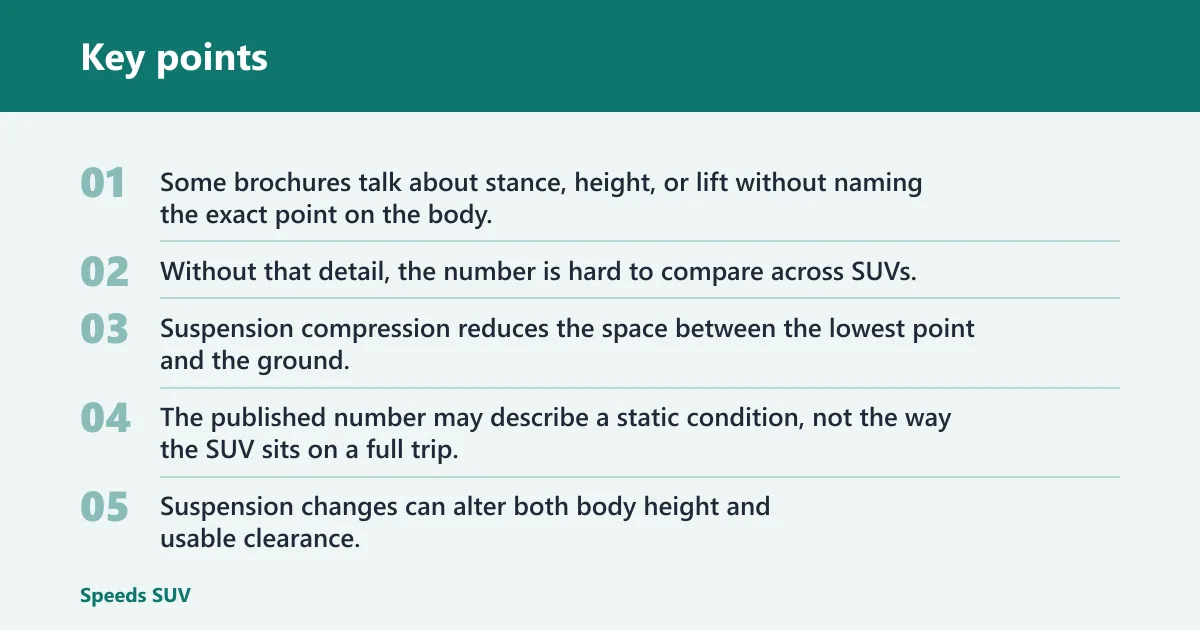
Some brochures talk about stance, height, or lift without naming the exact point on the body. That language is fine for marketing, but it is not enough for a comparison that needs a real clearance limit.
If the brochure says only “higher ride height,” ask what point was measured and whether the figure is tied to body, chassis, or suspension position. Without that detail, the number is hard to compare across SUVs.
Loaded versus unloaded stance
A vehicle sitting unloaded in the showroom can have more clearance than the same vehicle with passengers, cargo, or towing load. Suspension compression reduces the space between the lowest point and the ground.
That is why a brochure figure can look fine while the vehicle still scrapes in daily use. The published number may describe a static condition, not the way the SUV sits on a full trip.
Why trims and suspension changes matter
Suspension changes can alter both body height and usable clearance. Lift kits, lowering kits, air suspension, and different spring rates all change how the vehicle sits and how much travel remains before contact.
A trim with a taller suspension does not automatically win every real-world test. If the wheelbase is long or the underbody hangs low, the vehicle can still touch down on a crest or steep driveway.
Why two SUVs with the same clearance can scrape differently
Two SUVs with the same published clearance can behave very differently because clearance is only one part of the geometry. Suspension layout, wheelbase, load state, tire size, and underbody shape all affect where the vehicle hits first.
That is why a spec sheet needs more than one number. Ground clearance tells you the basic vertical margin, but it does not describe how the vehicle approaches, crests, or leaves an obstacle.
Suspension geometry and underbody shape
Suspension compression changes the effective gap under load. If the rear squats under cargo, the lowest point can move closer to the ground when you need clearance most.
Flat underbody panels can also help or hurt. They may reduce snag points, but a low exhaust or differential can still set the real limit.
Wheelbase and breakover angle
Wheelbase affects breakover angle, which is the ability to crest a rise without the underbody touching the top. A longer wheelbase can worsen cresting obstacles even when clearance looks adequate on paper.
That is the geometry chain many brochures skip. You need clearance plus wheelbase plus breakover angle to judge whether the middle of the vehicle will scrape.
Approach and departure angles
Approach angle matters when the front wheels climb a steep ramp, curb, or trail lip. Departure angle matters when the rear wheels leave the obstacle and the back end can drag.
Ground clearance works with both angles, but it does not replace them. A vehicle can have decent clearance and still scrape the front bumper on entry or the rear bumper on exit.
Ground clearance spec translation checklist
Use this checklist when you read a brochure or compare two SUVs. It keeps you from treating a marketing number as a full geometry answer.
| Check | What to verify | Why it matters |
|---|---|---|
| Measured point | Lowest fixed point, or a body reference point | Tells you whether the figure is true clearance or a stance measurement |
| Load condition | Loaded or unloaded | Shows whether the number reflects showroom height or real driving load |
| Tires included? | Whether the figure counts tire height or not | Prevents comparing unlike methods |
| Companion specs | Wheelbase, approach angle, departure angle, breakover angle | Gives the full picture for ramps, crests, and rough roads |
Find the measured point. Look for the exact underbody or body reference named in the brochure. If the spec does not say where the number starts, treat the figure as incomplete.
Check load condition. Confirm whether the vehicle is listed loaded or unloaded. A full cabin or cargo load can reduce the practical margin to the ground.
See whether tires count. Confirm whether the figure includes tire height or is measured from the body only. This keeps you from comparing a body reference to a true underbody gap.
Compare the geometry specs. Read wheelbase, approach angle, departure angle, and breakover angle alongside clearance. Those numbers explain why one SUV may glide over a ramp while another still scrapes.
How much clearance do you need?
For city streets, speed breakers, and driveways, enough clearance is the amount that prevents repeated scraping on the routes you actually use. For light snow and rough roads, a little extra margin helps, but the whole chassis geometry still decides the outcome.
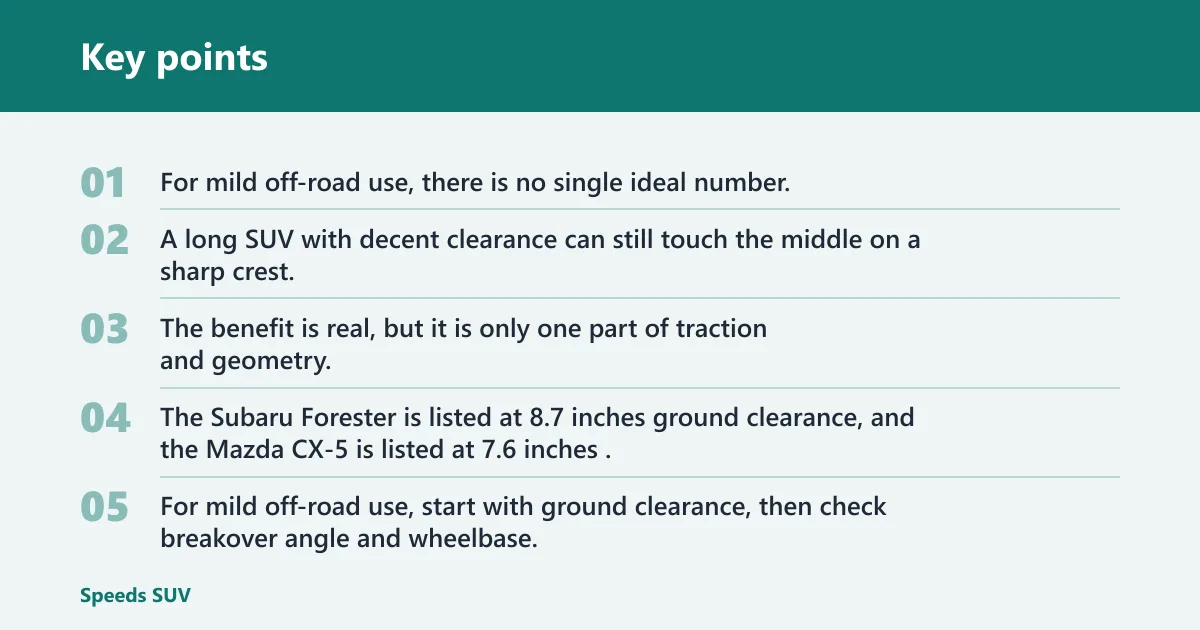
For mild off-road use, there is no single ideal number. As a broad guide, typical values range from 4 inches for sports cars to 9 inches or more for SUVs and crossovers, and most city cars have 4 to 6 inches of ground clearance.
City streets, speed breakers, and driveways
If your main concern is urban scraping, ground clearance matters most at the front lip, center underbody, and rear overhang. High speed breakers and steep driveway aprons can catch even a vehicle with respectable clearance if the approach or departure angle is poor.
A common mistake is to focus only on the listed ride height and overlook how a long wheelbase can still make the underbody scrape on steep driveways. A long SUV with decent clearance can still touch the middle on a sharp crest.
Light snow and rough roads
In snow, ruts, and broken pavement, extra clearance reduces the chance of dragging the underbody through packed material or debris. The benefit is real, but it is only one part of traction and geometry.
The Subaru Forester is listed at 8.7 inches ground clearance, and the Mazda CX-5 is listed at 7.6 inches. Those numbers help, but the final result still depends on tire condition, load, and the vehicle’s approach and departure angles.
Mild off-road use
For mild off-road use, start with ground clearance, then check breakover angle and wheelbase. That combination tells you whether the vehicle can crest a hill without scraping the middle.
The Land Cruiser 79 is listed at 235 mm ground clearance, which gives it a stronger starting point than many city-focused SUVs. Even then, the driver still has to watch the front and rear angles on steep entrances and exits.
What happens when load or tire pressure changes
Load and tire pressure can change how the vehicle sits, even though the brochure number stays the same. Suspension compression reduces usable clearance, and underinflation can affect load-carrying capacity, handling, braking, and the way the vehicle sits under load.
That makes condition part of the comparison. A vehicle that looks fine in the brochure may scrape sooner if it is carrying passengers, cargo, or underinflated tires.
Suspension compression under load
More load means more compression. As the body settles, the lowest point moves closer to the ground and the margin over bumps gets smaller.
This is why a fully packed SUV can scrape on a driveway that felt fine when the vehicle was empty. The spec did not change; the ride attitude did.
Underinflation and real-world risk
Underinflated tires can reduce safe load-carrying capacity and alter how the vehicle responds in braking and cornering. They can also change how the vehicle sits, which affects scraping risk indirectly.
That does not make tire pressure a ground-clearance spec. It does mean the condition of the tires should be right before you judge whether an SUV sits low.
Why condition matters before comparing specs
Two identical vehicles can behave differently if one is loaded and one is not, or if one has tire pressure below spec. The brochure number will be the same, but the usable margin to the ground will not.
Picture an SUV entering a steep parking ramp with five passengers and a trunk full of luggage. The published clearance may still look adequate, but the rear suspension can squat enough to turn a clean entry into a scrape.
Verdict: Ground clearance or ride height?
Choose Ground clearance if you are checking whether an SUV will scrape on a trail, loading ramp, steep driveway, curb, or other obstacle, because it shows the lowest fixed underbody point and is the figure the article says matters most for off-road planning and scraping risk.
Choose ride height if you want a body-position or stance reading, such as comparing how high an SUV sits at a named body reference point, since the article says ride height describes the body-to-ground measurement rather than the underbody limit.
Frequently asked questions
What is the difference between ground clearance and ride height?
Ground clearance measures the lowest fixed point of the vehicle to the ground. Ride height measures from the ground to a fixed body reference point, so it describes stance rather than the underbody limit. For scraping risk, ground clearance is the more useful number.
Is ride height the same as ground clearance on an SUV?
No. They can be related, but they are not the same measurement. An SUV can sit high and still have a lower exhaust, differential, or underbody panel that sets the real clearance limit. Always check what point the brochure actually measured.
Why do two SUVs with the same clearance feel different on rough roads?
Wheelbase, suspension layout, load state, and underbody shape change how an SUV reacts to bumps and crests. One vehicle may have a cleaner underside and better angles, while another may touch down sooner even with the same published clearance. The geometry matters as much as the number.
Does higher ride height mean better off-road capability?
Not by itself. A higher stance can help, but off-road ability also depends on approach angle, departure angle, breakover angle, wheelbase, load state, and suspension travel. A tall SUV with poor geometry can still scrape where a lower one passes cleanly.
Can tire pressure change ground clearance?
It can change real-world ride height and scraping risk indirectly. Underinflated tires can affect load-carrying capacity, handling, and braking, and they can let the vehicle sit lower under load. The brochure clearance number usually does not change, but the usable margin can.
How much ground clearance is enough for light off-road use?
There is no single ideal number, because wheelbase and angles matter too. As a rough reference, many city cars sit in the 4 to 6 inches range, while SUVs often go beyond that and may reach 9 inches or more. For light off-road use, check the full geometry before you decide.