Truck Lifter Problems: Symptoms, Causes and Fixes
A truck lifter problem often points to oil-pressure loss or a collapsed AFM/DFM/hydraulic lifter when ticking lasts more than about 30 seconds after a cold start, follows engine rpm, and pairs with misfire, rough idle, or a fault code. Ignore it and you can wipe a cam lobe, damage a roller, or pay for a teardown that an oil-pressure fix could have avoided. This guide separates normal top-end tick from lifter failure, then covers the symptom patterns, causes, checks, and fixes.
What do truck lifter problems sound and feel like?
Truck lifter problems usually sound like a top-end tick or click that tracks engine rpm, then show up as rough idle, hesitation, a single-cylinder misfire, or a warning light if valve motion starts to change. The key is when the noise shows up: cold start only, hot idle, light throttle, or under acceleration.
Noise patterns that matter
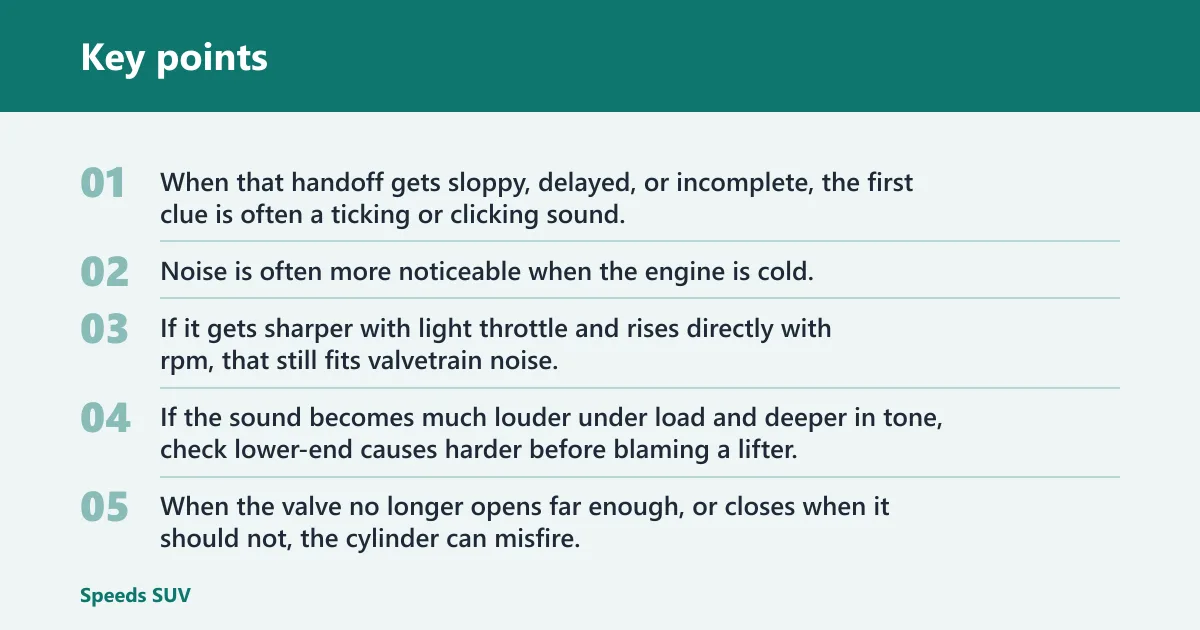
A lifter rides on the camshaft and passes that lobe motion through the pushrod or follower so the valve opens the right amount at the right time. When that handoff gets sloppy, delayed, or incomplete, the first clue is often a ticking or clicking sound. That sound alone does not confirm a bad lifter, because exhaust leaks and injector noise can sound similar.
Cold-start behavior is the first sort. Noise is often more noticeable when the engine is cold. If the tick fades as oil warms, that can point to a hydraulic lifter bleeding down overnight, restricted oil flow, or oil viscosity that no longer controls lash well at startup. It does not prove the issue is harmless.
If the noise stays present hot, especially at idle after a full warm-up, suspicion shifts toward a sticking or collapsed hydraulic lifter, incorrect lash on a mechanical lifter, or cam and roller wear. If it gets sharper with light throttle and rises directly with rpm, that still fits valvetrain noise.
If the sound becomes much louder under load and deeper in tone, check lower-end causes harder before blaming a lifter.
Driveability signs that turn noise into a fault
Bad lifters often add a rough idle, a shake you can feel through the cab, and a cylinder-specific stumble once valve lift or timing starts to drift. When the valve no longer opens far enough, or closes when it should not, the cylinder can misfire. That is the line between an annoying tick and a cylinder-control problem.
A lifter that sticks or collapses can cut valve lift or shift the opening and closing event enough to hurt cylinder filling. The truck may idle unevenly, hesitate when leaving a stop, and feel flat at part throttle. If one cylinder is affected, a scan tool often shows a repeat misfire code for that hole rather than random misfire only.
Suppose a 5.3-liter GM V8 starts with a brief tick every morning, then one week later the tick lasts a minute, the idle goes rough hot, and a cylinder-specific misfire appears. That pattern is far more serious than a short cold-start tick with no code and no driveability change.
When warning lights and codes usually show up
Codes do not appear because a lifter is noisy. They appear because valve operation has drifted enough to affect combustion. That usually means the fault is no longer just acoustic.
Expect warning lights or fault codes when the truck also has rough idle, stumble on tip-in, or a dead-miss sensation. A clean-running engine with a faint top-end tick but no misfire evidence may still need service, but it has not yet crossed into the same urgency tier.
What a lifter does in a truck engine
Hydraulic lifters and oil-pressure control
In the valvetrain, the lifter sits between the camshaft and the rest of the valve actuation parts. Hydraulic lifters automatically adjust valve clearance using oil pressure. When oil pressure is low, oil is dirty, or an internal check mechanism stops holding pressure, lash control can disappear and a tick starts.
That is why oil condition matters so much. Dirty or degraded engine oil is a listed cause of bad lifter problems, and low oil pressure can keep hydraulic lifters from holding proper adjustment. Restricted oil passages can make several lifters noisy at once, especially after long idle time, delayed oil changes, or sludge formation.
Mechanical lifters and valve-lash adjustment
Mechanical lifters rely on fixed clearances and need periodic adjustment. Their symptom pattern can differ from hydraulic designs. Instead of a bleed-down style cold-start tick, an out-of-spec mechanical setup may create persistent lash noise, especially hot, and the fix may be adjustment rather than hydraulic replacement.
The diagnosis changes with design. Hydraulic lifters often point back to oil pressure and internal collapse. Mechanical lifters push the inspection toward lash settings, wear patterns, and whether a single valvetrain point has drifted out of spec.
How lifter motion affects the camshaft and valves
The camshaft drives lifter motion, and the lifter in turn controls how accurately the valve follows that motion. If the lifter sticks, collapses, or rolls poorly on the lobe, valve opening and closing timing changes enough to upset idle quality and torque.
Wear progression matters. A noisy lifter can begin as a top-end tick, then progress to reduced lift, misfire, lobe wear, and metal spread through the oiling system. By the time the truck feels weak under acceleration, the problem may already involve more than one part.
What causes a truck lifter to fail?
Truck lifters usually fail from oil-related problems first, then wear-related problems second: dirty oil, sludge, varnish, restricted passages, low oil pressure, or oil starvation. After that come collapsed hydraulic lifters, sticking internals, worn cam lobes, and truck-specific patterns such as AFM or DFM valvetrain failures on some GM V8s.
Dirty oil, sludge, varnish, and restricted flow
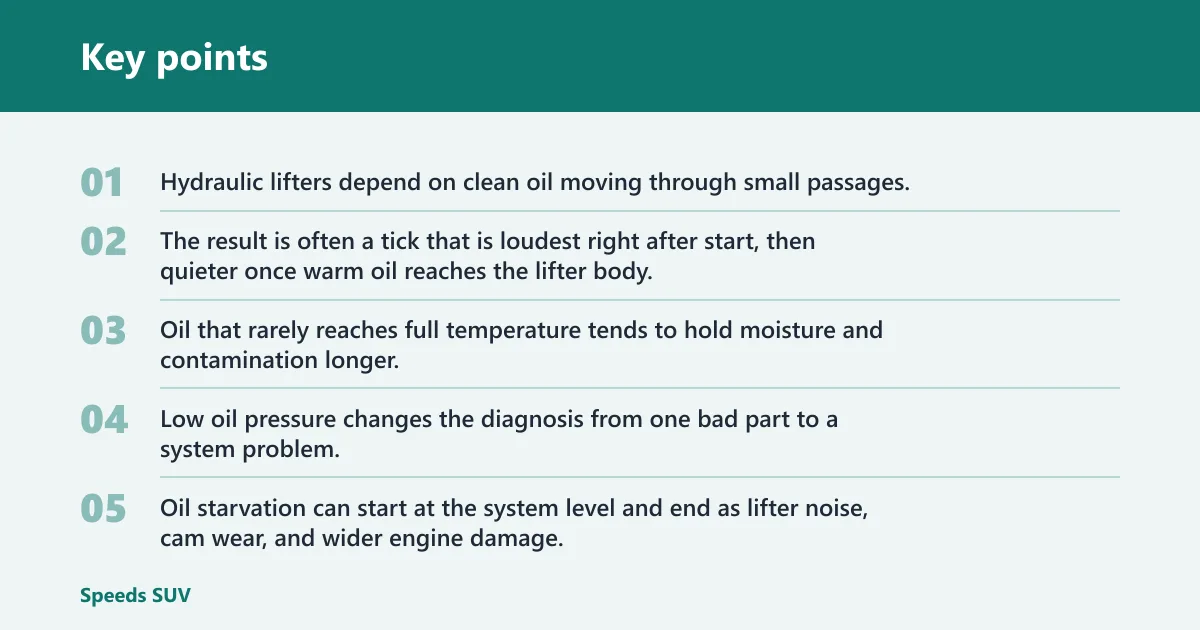
Hydraulic lifters depend on clean oil moving through small passages. Sludge, extended oil-change intervals, and varnish deposits can choke the tiny feed holes and internal check-valve passages enough that the lifter refills slowly after startup, or never fully pumps up at idle. The result is often a tick that is loudest right after start, then quieter once warm oil reaches the lifter body.
That is also why a truck used for many short trips or extended idle time can show more top-end noise than a similar truck driven longer at steady temperature. Oil that rarely reaches full temperature tends to hold moisture and contamination longer.
Low oil pressure and oil-starvation chains
Low oil pressure changes the diagnosis from one bad part to a system problem. If multiple lifters begin ticking, especially with oil-pressure warning evidence or hot-idle pressure concerns, do not assume several lifters failed at once for no reason.
Start with the oil level, viscosity used at the last service, filter quality, pressure readings if available, and whether bearing wear or pump issues could be lowering supply. Oil starvation can start at the system level and end as lifter noise, cam wear, and wider engine damage.
Picture a truck that tows on weekends and idles for long stretches during the week. If the oil level falls low and the noise appears from several cylinders on hot idle, the lifter tick may be the last symptom to arrive, not the first failure in the chain.
Collapsed lifters, sticking lifters, worn lobes, and GM AFM/DFM patterns
A collapsed hydraulic lifter often produces a steady tick that follows rpm and may bring a misfire when valve lift drops enough. A sticking lifter may be more erratic, with noise that changes as temperature and rpm change. Excessive engine wear is also a listed cause of lifter issues, especially when cam lobes and rollers have been running with poor oil control.
On some AFM/DFM-equipped GM V8s, the failure pattern can include a collapsed deactivation lifter, a bent pushrod, a persistent top-end tick, and a cylinder-specific misfire. That does not mean every GM V8 tick is an AFM lifter, but it belongs near the top of the list when the pattern fits.
Lifter diagnosis matrix
Symptom pattern table
| Pattern | Cold-start behavior | Idle behavior | Acceleration behavior | Misfire codes | Urgency | Likely cause | Next check |
|---|---|---|---|---|---|---|---|
| Brief top-end tick only | Fades in less than 30 seconds | Gone hot | No hesitation | None | Low to moderate | Normal bleed-down pattern or minor hydraulic refill delay | Verify oil level, viscosity, and service history |
| Tick lasts beyond 30 seconds | Strong on startup | Quieter warm but still present | Follows rpm | Usually none at first | Moderate | Dirty oil, varnish, restricted lifter feed, weak hydraulic lifter | Inspect oil condition and pressure evidence before teardown |
| Hot-idle tick with rough idle | Present cold and hot | Uneven idle, vibration | Hesitation on tip-in | Possible single-cylinder code | High | Collapsed or sticking hydraulic lifter, incorrect mechanical lash | Scan for cylinder-specific misfire and localize top-end noise |
| Persistent tick plus power loss | Often loud cold | Still loud hot | Worse under rpm increase | Common | High | Worn cam lobe or roller damage | Limit driving and plan valvetrain inspection |
| Several lifters noisy together | Cold and hot | Multiple top-end ticks | May improve off idle, may return hot | Variable | High | Low oil pressure or restricted oil supply | Confirm pressure, oil level, filter, and contamination |
| Sharp tick near manifold | Loudest cold | Often fades warm | Changes with load but not like misfire | None | Moderate | Exhaust manifold leak instead of lifter | Check for soot, puffing, and leak location |
| Deep knock under load | May be present cold | Duller than top-end tick | Stronger with throttle load | Not required | Very high | Rod knock or lower-end problem | Stop driving until lower-end noise is ruled out |
How do you tell lifter tick from rod knock or other noises?
Lifter tick is usually a lighter, faster top-end sound that follows rpm, while rod knock is deeper, heavier, and often gets worse with load. Exhaust leaks can mimic cold-start tick, and injector noise can sound sharp but usually stays uniform without rough idle, misfire, or power loss.
Lifter tick versus rod knock
Location and load response matter more than adjectives. Lifter noise is usually higher in the engine, near the valve covers, and rises in frequency with rpm. Rod knock tends to sound lower in the block and gets more alarming when the engine is pulled under throttle.
If the truck shudders under acceleration, do not force lifter diagnosis onto it. A noisy driveline can cause shuddering acceleration, which is a different problem from valvetrain tick. Separate sound from feel.
Say your truck idles with a fast metallic tick that matches rpm blips but does not get much deeper under moderate throttle in Park. That leans top-end. If the sound turns into a heavier knock under load on the road, stop treating it like a lifter until lower-end damage is ruled out.
Lifter tick versus exhaust manifold leak
Exhaust leaks are a common sound confusion. A manifold leak often ticks sharply on cold start, then softens as metal expands. It is usually strongest near the manifold flange area, not the center of the valve cover.
Look for black soot at the manifold, a puffing sound, or a leak that changes more with exhaust pulse than with valvetrain load. Exhaust leaks usually do not cause rough idle, misfire codes, or cylinder-specific valve-motion faults unless another problem is present.
Lifter tick versus injector and other top-end noises
Injectors can make a clean, even tick that is normal for the system. That sound tends to be steady, similar across cylinders, and not paired with rough running. Direct-injection systems can be especially busy sounding at idle.
A failed lifter tends to stand out because the sound is more isolated, more erratic, or tied to a new driveability change. The moment a top-end tick arrives with rough idle, hesitation, or a misfire code, injector noise moves down the list.
What should you check before engine teardown?
Before teardown, check oil level and condition, confirm whether oil-pressure evidence exists, scan for misfire codes, compare the noise cold versus hot, compare idle versus load, and localize whether the sound is top-end or lower-end. Those checks often separate service-level oil issues from true lifter or cam damage.
Pre-teardown inspection path
- Check oil level. Read the dipstick on level ground using the maker’s procedure for that engine. If the oil is low, badly darkened, fuel-thinned, or gritty, the lifter diagnosis immediately gets an oil-system branch because hydraulic lifters use oil pressure to maintain valve clearance.
- Review service history. Look at the last oil change interval, oil grade used, and whether the truck has a pattern of short trips, towing, or long idle time. Long intervals and contamination fit sticking and bleed-down complaints far better than a sudden random part failure.
- Scan for misfire codes. Pull stored and pending codes, then note whether one cylinder repeats. A cylinder-specific misfire with matching top-end noise raises suspicion of a collapsed lifter, bent pushrod, rocker issue, or worn cam lobe on that cylinder.
- Compare cold and hot. Start the engine cold and time how long the tick lasts, then listen again fully warm at idle. A noise that fades warm is different from a noise that stays present hot, and that difference changes whether oil flow or hard-part wear leads the diagnosis.
- Compare idle and load. Listen at idle, at a light rpm raise in Park, and during gentle road acceleration if the noise is not severe. True lifter noise usually follows rpm; a deep knock that swells under load calls for lower-end caution instead of more top-end guessing.
- Localize the source. Use a mechanic’s stethoscope or a long probe on the valve cover area, then compare that with the exhaust manifold area and the block. The goal is to decide top end, exhaust leak, or lower end before anyone starts removing major parts.
What to log before making a repair call
- How many seconds the noise lasts after a cold start
- Whether it disappears, softens, or stays fully audible hot
- Whether rough idle or hesitation appears at the same time
- Any oil-pressure warning, gauge change, or low-oil event
- Whether the truck tows, idles a lot, or has AFM/DFM hardware
Can you drive a truck with a bad lifter?
You might drive a truck briefly if the noise is a short cold-start tick with no misfire, no rough idle, and no oil-pressure concern, but it still needs prompt inspection. Stop driving when the tick stays hot, a misfire appears, power drops, or the sound suggests cam, roller, or lower-end damage.
Lower-risk cases that still need prompt inspection
A brief startup tick with clean-running behavior belongs in the monitor-and-check category, not the ignore-it category. If the sound is gone quickly, there are no codes, and the engine runs smoothly, the first move is oil and pressure evaluation, not immediate teardown.
That applies even more if maintenance history is unknown. Warm-up quieting only says the noise changed with oil temperature. It does not prove the lifter is healthy.
Stop-driving signs
Do not keep driving if the engine has persistent hot tick, cylinder misfire, reduced power, flashing warning light, or a sound that is deep enough to suggest rod knock. A collapsed lifter or worn lobe can spread metal, and a failed roller can turn a top-end repair into a larger engine job.
On AFM/DFM engines, continued driving with a known collapsed lifter can quickly add pushrod, rocker, and cam damage. At that point, miles driven are no longer buying useful diagnosis.
What damage can a bad lifter cause?
A bad lifter can damage the camshaft lobe, roller, pushrod, rocker, and related valvetrain parts, then contaminate the oil with metal. It can also upset valve operation enough to cause rough idle, cylinder imbalance, and engine misfire, which turns a noise complaint into a drivability and wear problem.
Camshaft wear and metal contamination
The camshaft is the hard part most at risk. If a lifter collapses or stops rolling correctly, the lobe can wear down and lose lift. Once that starts, the lifter and cam often become a matched failure rather than separate repairs.
Metal contamination is the next concern. Fine debris in the oil can move through the engine and complicate what started as a local valvetrain issue.
Valve-operation errors and cylinder imbalance
When lifter action is wrong, valves may not open far enough or at the right time. Cylinder filling suffers. Combustion quality falls. That is how a top-end tick becomes rough idle, hesitation, and code-setting misfire.
Mechanical lifters add another failure route: if lash is too tight or too loose, valve control can drift without the oil-pressure refill pattern seen in hydraulic systems. The symptoms overlap, but the cause and fix differ.
How ignored top-end noise grows
Ignored wear usually follows a pattern: tick, then persistent tick, then rough running, then hard-part damage. The longer the engine is driven after the misfire stage, the more likely the repair expands from a service attempt to a camshaft and lifter job.
How to confirm a lifter is actually bad
The key is to separate a true lifter failure from a normal cold-start tick. A bad lifter usually makes a constant noise that stays with one cylinder and shows up with rough idle, a misfire, or oil-pressure concerns, while a brief tick that fades quickly is often harmless. That distinction matters because it changes whether you investigate valve-train wear, oil supply, or something else entirely.
The supporting guide on bad lifter symptoms walks through the sound pattern, idle behavior, scan data, and oil clues that help you confirm the problem before opening the engine. It gives you a practical way to avoid replacing the wrong part or driving while damage keeps spreading.
Repair options and teardown triggers
Repair path table
| Rank | Action | Best fit | What it can solve | When to skip it | Teardown trigger if it fails |
|---|---|---|---|---|---|
| 1 | Correct oil level and verify viscosity | Low oil, wrong grade, unknown service | Hydraulic refill delay, noise from marginal pressure | Hot misfire, metal noise, obvious lower-end knock | Noise remains hot or codes appear |
| 2 | Oil and filter service | Dirty oil, sludge suspicion, long interval | Sticky hydraulic lifter from contamination | Known cam wear or failed AFM/DFM lifter pattern | Tick persists beyond one short evaluation period |
| 3 | Oil-pressure diagnosis | Several lifters noisy, warning evidence, hot-idle issue | System cause behind multiple noisy lifters | Never skip when pressure concern exists | Pressure is low or unstable |
| 4 | Valve-cover inspection | Single-cylinder tick, rocker or pushrod suspicion | Bent pushrod, loose rocker, obvious valvetrain issue | Deep lower-end knock | Abnormal motion or damaged hardware found |
| 5 | Lifter replacement | Confirmed collapsed or sticking lifter | Direct lifter failure | Cam lobe already damaged | Wear pattern shows lobe or roller damage |
| 6 | Camshaft inspection and valvetrain repair | Persistent misfire, power loss, metal debris, lobe wear signs | Lifter-plus-cam failure | Do not delay when evidence is clear | Required repair path, not a next step |
Low-cost fixes worth trying first
The first repair path is narrow and evidence-based: correct oil level, confirm the specified viscosity, replace degraded oil and filter if service is overdue, and verify whether oil-pressure evidence exists. Those are sensible when the noise is mainly a cold-start tick and the truck still runs cleanly.
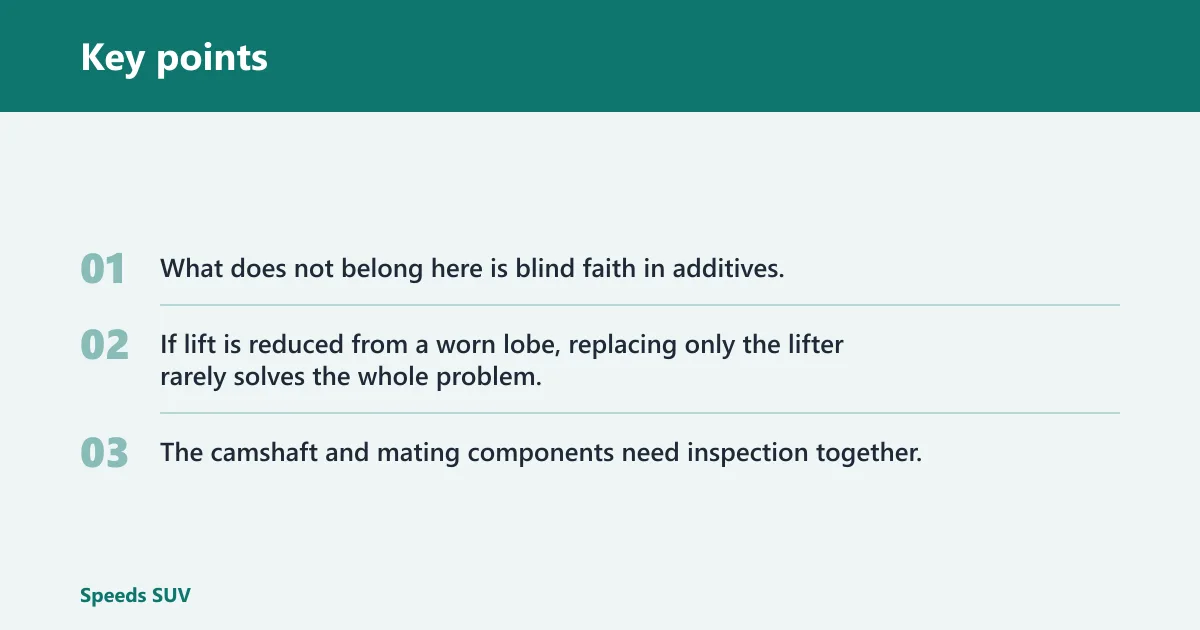
What does not belong here is blind faith in additives. If a truck has hot rough idle, misfire, or one cylinder clearly dropping out, the case is already moving beyond a simple cleaning attempt.
When lifter replacement is likely
A single-cylinder top-end tick with matching misfire, especially on an AFM/DFM V8, often points toward lifter replacement and inspection of related parts on that bank. If the rocker motion is wrong or a pushrod is bent, the repair discussion changes fast from oil service to parts replacement.
When camshaft inspection is required
Persistent noise hot, repeat misfire, noticeable power loss, or signs of metal contamination all push toward opening the engine. If lift is reduced from a worn lobe, replacing only the lifter rarely solves the whole problem. The camshaft and mating components need inspection together.
Frequently asked questions
What are the symptoms of truck lifter problems?
The usual pattern is a top-end ticking or clicking sound that follows rpm, often strongest at cold start, then rough idle, hesitation, vibration, and sometimes power loss. When valve operation is affected enough to upset combustion, warning lights and cylinder-specific misfire codes can appear.
What causes a lifter to fail in a truck engine?
Most failures trace back to dirty oil, sludge, varnish, restricted oil passages, or low oil pressure in hydraulic systems. Mechanical lifters can also develop problems from incorrect lash. Wear-related causes include collapsed lifters, sticking internals, worn cam lobes, and truck-specific AFM/DFM valvetrain failures.
How do you tell a bad lifter from rod knock?
Lifter tick is usually lighter, faster, and located high in the engine near the valve covers, while rod knock is deeper and often gets worse under load. A bad lifter is also more likely to arrive with rough idle or misfire, while lower-end knock may not.
Why do lifter problems happen more at cold start?
Cold oil flows more slowly, and a hydraulic lifter that has bled down overnight or has restricted internal flow may take longer to refill. That makes startup noise easier to hear. If the tick fades warm, the problem changed with oil temperature, it did not necessarily go away.
What should you check first if you suspect a lifter is bad?
Start with oil level and condition, then look for oil-pressure evidence, service history, and scan-tool misfire codes. After that, compare the noise cold versus hot and idle versus light rpm. Those checks usually show whether the truck needs service-level diagnosis or teardown-level inspection.