Questions to Ask a Shop Before Approving a Truck Lifter Repair
Ask these five questions before you approve truck lifter repair: what failed, how it was diagnosed, what parts and labor are included, what warranty applies, and whether the quote is fixed or estimated. Skip them, and you can pay for the wrong repair, extra labor, or a second teardown. This checklist shows the exact questions to ask a shop before you approve lifter work.
Why you should verify the diagnosis first
A hydraulic lifter is one valvetrain component, but lifter noise does not always mean the lifter itself is the only problem. A lifter can collapse, stick, or bleed down, yet similar symptoms can also come from oil pressure issues, camshaft wear, or deeper valve train damage. Check the evidence before you approve any teardown.
Common symptoms include ticking at idle, a cylinder misfire, and rough idle. Those signs matter, but they do not prove the failed part. A shop should show you the test results, explain what was ruled out, and say whether the problem is isolated to one lifter or affects the camshaft, rockers, pushrods, or valves.
What a real lifter diagnosis should include
A credible diagnosis starts with basic checks, then moves to evidence that separates noise from mechanical damage. The checklist suggests asking for oil pressure verification, a compression test, and, when needed, a leakdown test. Those results help show whether the engine has a sealing issue, a valve train fault, or a lubrication problem that pushed the lifter to fail.
A shop should also inspect the oiling system. Dirty oil, sludge, varnish, and low oil pressure can contribute to lifter failure. If the oil is contaminated or the pressure is outside the specified range, replacing only the lifter may miss the underlying cause of failure.
Signs the problem may be deeper than lifter noise
If the truck has a misfire, low compression on one cylinder, metal in the oil, or a camshaft that shows scoring, the repair may extend beyond a single lifter. A failed lifter can damage the cam lobe, and that can send wear through the rest of the valve train. At that point, the shop should explain the full scope before you authorize parts.
An example 5.3L truck is described as having a steady tick at idle and a cylinder misfire under load. If the compression test is low and the leakdown test points to poor valve sealing, the issue is no longer “just a noisy lifter.” The approval should change with the evidence.
Questions that expose a weak diagnosis
- What test confirmed the lifter is the source of the noise?
- Did you check oil pressure, oil condition, and sludge buildup?
- Was a compression test done on the affected cylinder?
- Was a leakdown test done if compression was low?
- Did you inspect the camshaft, rockers, pushrods, and valves for damage?
- Can you show photos, scan data, or notes from the inspection?
What should you ask before teardown?
Before teardown, ask the shop to prove why the engine needs to come apart and what the teardown will include. You want the test results, the inspection notes, and the point where “diagnosis” turns into paid labor. That keeps a small repair from becoming an open-ended estimate.
- Request the test results. Ask for compression numbers, leakdown readings, oil pressure values, and any scan data tied to the misfire. Those figures show whether the problem sits in the lifter, the valves, or a cylinder sealing issue.
- Confirm teardown scope. Ask whether the estimate includes valve cover removal only, top-end disassembly, or deeper engine teardown. The labor hours should match the scope, because a partial inspection costs less than a full disassembly.
- Ask for visual proof. Request photos of worn parts, scoring on the camshaft, or sludge in the oiling system. Clear images help you compare two estimates and stop a shop from quoting a major repair without evidence.
Written notes matter here. A shop that says “found bad lifters” should be able to say how many, on which bank, and what else was checked. If the answer is vague, the diagnosis is not ready for approval.
What should be in a lifter repair estimate?
A lifter repair estimate should list labor hours, parts, diagnostic fees, and whether teardown is included. It should also say what happens if the shop finds camshaft wear, broken hardware, or valve train damage during disassembly. Without that detail, you cannot compare quotes on equal terms.
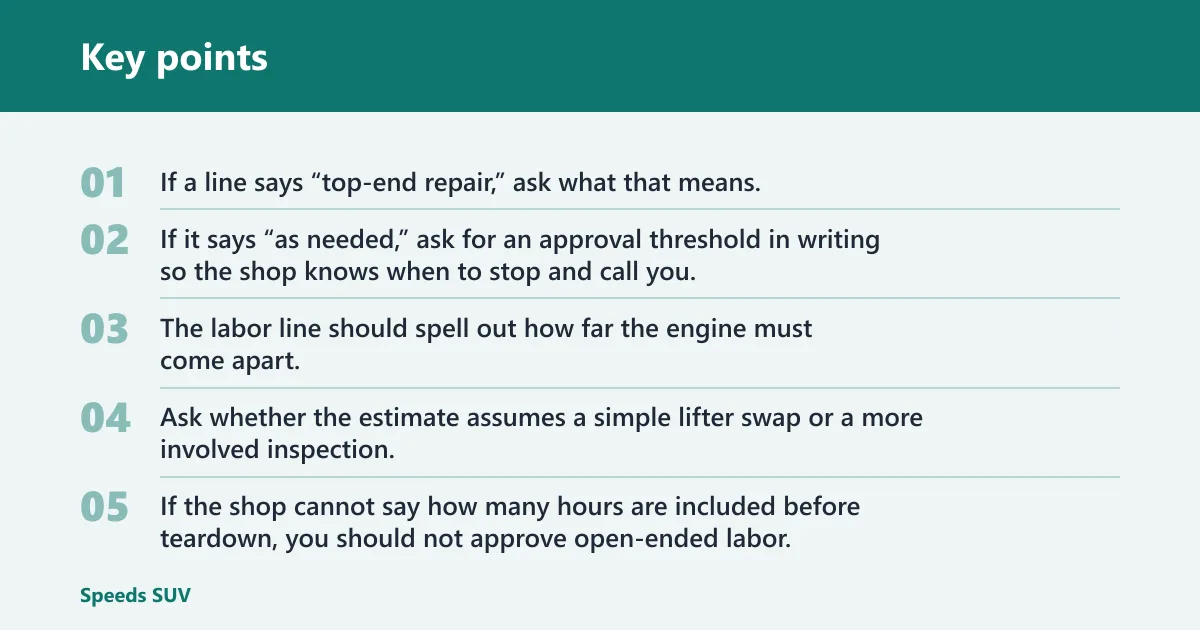
A written estimate should be itemized. If a line says “top-end repair,” ask what that means. If it says “as needed,” ask for an approval threshold in writing so the shop knows when to stop and call you.
| Question to ask | Why it matters | What a good answer sounds like | Red flags |
|---|---|---|---|
| What failed? | Separates a true lifter issue from camshaft or valve train damage. | “Cylinder 3 lifter is collapsed, cam lobe shows no scoring yet, and the misfire matches that cylinder.” | “It sounds like lifters,” with no test data. |
| What diagnosis supports that call? | Shows whether compression, leakdown, oil pressure, or inspection was done. | “Compression was 145 psi on the good cylinders and 85 psi on the problem cylinder; leakdown points to the valve train.” | No numbers, no test names, no notes. |
| What labor hours are included? | Tells you whether teardown and reassembly are priced fairly. | “about 12.0 labor hours for removal, inspection, parts replacement, and reassembly.” | Only a dollar total, with no hours listed. |
| What parts are included? | Prevents surprise add-ons for gaskets, bolts, trays, or related hardware. | “Lifters, gaskets, one-time-use bolts, and updated hardware are included.” | “Anything needed,” without a parts list. |
| What if the camshaft is damaged? | Sets the path if the failed lifter damaged the cam. | “We will call before replacing the camshaft or adding valve train parts.” | No call threshold, just surprise billing later. |
| What warranty applies? | Clarifies parts coverage, labor coverage, and where the warranty works. | “12 months on parts and labor, shop-only unless listed otherwise in writing.” | “It’s covered,” with no length or terms. |
Labor hours and teardown scope
The labor line should spell out how far the engine must come apart. On some engines, lifter access is straightforward; on others, the intake, valve covers, rocker gear, and timing components may all be involved. Ask whether the estimate assumes a simple lifter swap or a more involved inspection.
If the shop cannot say how many hours are included before teardown, you should not approve open-ended labor. A fixed estimate can still allow extra findings, but the approval threshold needs to be written clearly.
Parts list and reuse policy
Ask which parts will be replaced and which parts may be reused. Good estimates list lifters, gaskets, seals, one-time-use bolts, and any updated part revisions. Reusing torque-to-yield bolts or tired gaskets can create a comeback repair.
Also ask whether the estimate includes trays, guides, or related hardware if the engine design uses them. Some engines need more than the lifter itself to complete the job correctly.
Diagnostic fees and approval thresholds
Some shops charge a diagnostic fee that is separate from repair labor. That is reasonable if the fee is itemized and credited correctly, but the estimate should say what the fee covers. Ask whether the fee includes compression testing, leakdown testing, oil pressure checks, or teardown time.
Approval thresholds matter too. A good shop will say, in writing, at what point it must call you before adding camshaft work, extra gaskets, or deeper valve train repair.
What parts should the shop replace?
Most truck lifter repairs begin with the lifters themselves, but the final parts list depends on the damage found. If the camshaft is worn or scored, the lifters may not be enough. The shop should inspect the full valve train, because rockers, pushrods, valves, and guides can show collateral damage.
Lifters, trays, and related hardware
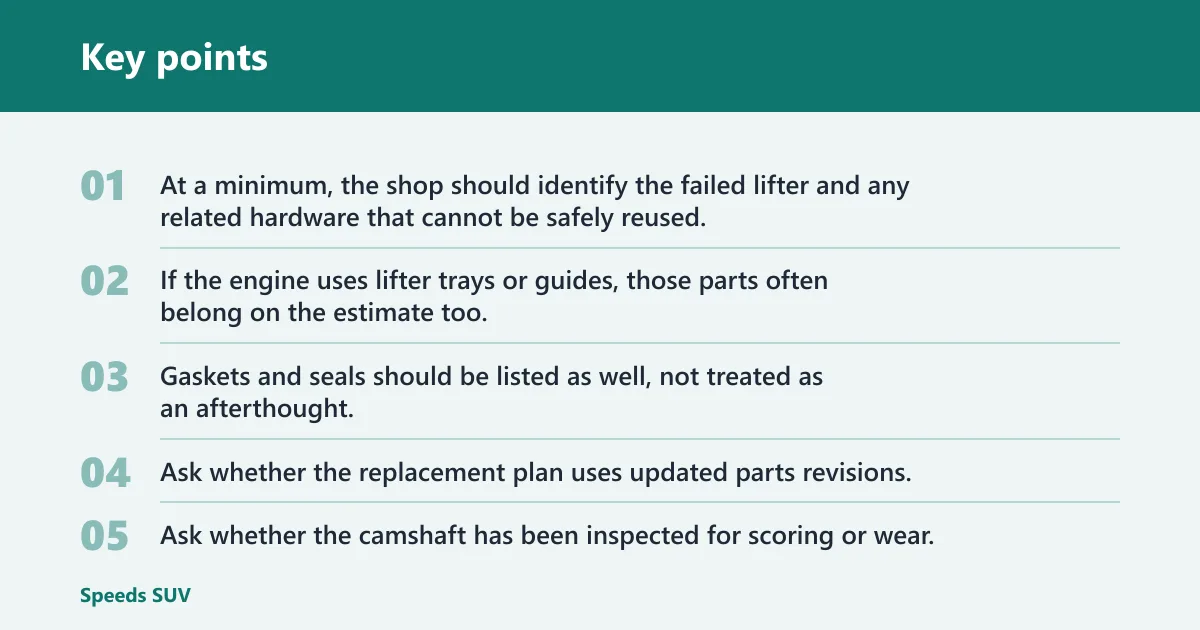
At a minimum, the shop should identify the failed lifter and any related hardware that cannot be safely reused. If the engine uses lifter trays or guides, those parts often belong on the estimate too. Gaskets and seals should be listed as well, not treated as an afterthought.
Ask whether the replacement plan uses updated parts revisions. That matters on engines with known service updates, because the newest version may outlast an older design.
When the camshaft should be replaced
Ask whether the camshaft has been inspected for scoring or wear. If a collapsed or stuck lifter damaged the cam lobe, replacing lifters alone can leave the root problem behind. In that case, the shop should explain why the camshaft, lifters, and any damaged followers or hardware should be replaced together.
A worn camshaft is not automatic on every lifter job. It becomes part of the repair only when inspection shows damage or a wear pattern that will quickly ruin new lifters.
Valve train parts that may need inspection
The valve train should be checked for collateral damage. That means rockers, pushrods, lifters, and valves, along with any signs of bent parts or abnormal wear. If the failed part has sent debris through the engine, the repair can grow fast, and the estimate should say that possibility up front.
Picture a truck that arrives with a single loud tick and a rough idle. If the shop finds a damaged pushrod and a scored cam lobe after inspection, replacing only the lifter is no longer a complete repair.
How long should the repair take?
Repair time depends on engine layout, access, and whether the shop finds extra damage after teardown. A simple lifter replacement may take a day or less on some engines, while more involved jobs can stretch longer if the camshaft, gaskets, or valve train parts need replacement.
What affects labor time on your truck
Ask how long the listed labor hours apply to your engine. Trucks with crowded engine bays, direct injection hardware, or top-end access issues usually take longer than engines with easier access. The shop should explain why the labor time is what it is.
Time also changes when the shop needs to inspect deeper after finding metal, scoring, or a sealing problem. If the estimate assumes a quick lifter swap, make sure it does not hide the added time needed for teardown and reassembly.
What to confirm if the shop needs extra time
- Ask for the new finding. Have the shop say exactly what it found and why the repair time changed. New damage should be tied to a visible or measured issue, not a guess.
- Request the updated estimate. Ask for fresh labor hours and parts before any extra work starts. The revised number should be written, not given only by phone.
- Confirm the stop point. Decide what amount triggers a call before the shop continues. That keeps the repair within your approval limit.
What warranty should you expect?
Ask about both parts coverage and labor coverage before you approve the job. A warranty should say how long it lasts, what it covers, and whether the coverage is nationwide or shop-only. Those details matter if you travel or buy a truck far from home.
Parts coverage versus labor coverage
Some warranties cover only the replacement parts, while others include labor if the repair fails again. Those are different promises. A parts-only warranty may leave you paying to remove the same parts twice, which is a major difference on a lifter job.
Ask for the exact length in writing. Also ask whether the warranty covers related parts that were installed at the same time or only the lifters themselves.
Shop-only terms versus nationwide coverage
Some repair warranties work only at the original shop. Others are honored nationwide through a network or a written program. If you travel, a shop-only warranty can be harder to use, so confirm the terms before you approve the repair.
What actions can void the warranty
Ask what can void the coverage. Common examples include low oil level, wrong oil viscosity, overheating, missed maintenance, or another repair performed by someone else without the shop’s approval. If the warranty depends on oil changes at specific intervals, get that schedule in writing.
Lifter approval checklist
Use this list to compare two estimates with the same questions and the same red flags. If one shop can answer clearly and the other cannot, the clearer estimate is usually the safer one to authorize.
| Question to ask the shop | Estimate line items to confirm | Red flags that should stop approval |
|---|---|---|
| What failed and how was it diagnosed? | Diagnosis fee, compression test, leakdown test, oil pressure check, inspection notes | No numbers, no photos, no explanation of the failed cylinder |
| What labor is included? | Labor hours, teardown scope, reassembly time, call threshold for added work | Only a total price, or “as needed” labor without limits |
| What parts will be replaced? | Lifters, gaskets, seals, bolts, trays, updated revisions, and any extra hardware | No parts list, reuse of one-time-use bolts, no mention of updated parts |
| Was the camshaft inspected? | Camshaft inspection note, wear or scoring findings, replacement threshold | Assuming cam damage without proof, or ignoring cam wear entirely |
| What warranty applies? | Coverage length, parts versus labor, shop-only or nationwide terms | “It’s covered” with no written terms |
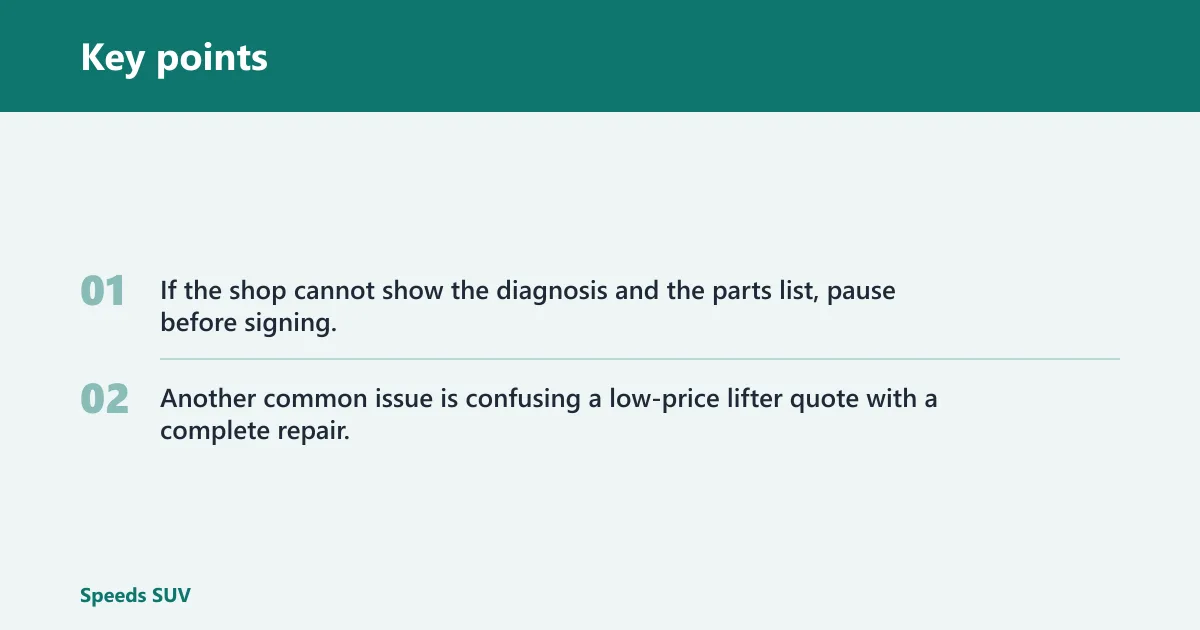
A common first-timer mistake is approving a lifter quote because the noise sounds familiar, then learning the estimate did not include the full valve train inspection. If the shop cannot show the diagnosis and the parts list, pause before signing.
Another common issue is confusing a low-price lifter quote with a complete repair. If the camshaft is worn or the leakdown test points to valve damage, the cheapest number can become the most expensive fix after a second teardown.
Frequently asked questions
What questions should I ask a mechanic before approving lifter repair?
Ask what failed, how it was diagnosed, whether compression and leakdown tests were done, what parts are included, how many labor hours are listed, and what warranty applies. Also ask whether the quote is fixed or only an estimate, and what extra findings require your approval.
How do I know if the shop actually diagnosed a bad lifter?
Look for specific evidence, not just a description of ticking noise. A solid diagnosis includes test results, inspection notes, and a reason the shop ruled out oil pressure problems, valve train damage, or a deeper cylinder issue. Photos of worn parts help, especially if teardown has already started.
Should I ask for a compression test or leakdown test before teardown?
Yes, especially if the truck has a misfire, rough idle, or low compression suspected on one cylinder. A compression test is a basic screen, and a leakdown test helps identify whether the sealing issue is in the valve, ring, or cylinder. Those results can change the repair plan.
What parts should be replaced during a truck lifter repair?
At minimum, expect the failed lifters plus any gaskets, seals, bolts, or trays the engine needs for reassembly. If inspection shows wear, the camshaft may need replacement too. The shop should also inspect rockers, pushrods, and valves for damage before it signs off on a limited repair.
What warranty should a shop offer on lifter repair?
Ask for the warranty length, whether it covers parts and labor, and whether it works only at the original shop or nationwide. Also ask what voids it. Oil starvation, wrong viscosity, or skipped maintenance can affect coverage, so the rules should be written before you pay.
How much can a lifter repair cost after diagnosis?
The cost depends on engine layout, labor access, and whether the camshaft or other valve train parts are damaged. A simple lifter-only repair costs less than a job that needs deeper teardown, updated hardware, and added inspection time. The estimate should break those pieces out clearly.