What Is Normal Oil Consumption Between Oil Changes in an SUV?
Normal oil use in an SUV depends on the maker and the engine design. Many owner manuals and OEM service publications allow some consumption, especially during break-in, high-load driving, towing, or long high-speed runs. The right benchmark is the manufacturer’s stated limit, then your own trend over distance.
What counts as normal oil consumption?
Why manufacturers set different limits
Normal oil consumption varies by manufacturer because engines are built with different clearances, ring packs, turbocharging, ventilation systems, and service assumptions. Some OEM literature allows consumption as high as about 1 quart per 1,000 miles (roughly 1 liter per 1,600 km) under certain conditions, while other manuals set tighter limits. Treat the handbook figure as the ceiling for that specific vehicle, not as a universal standard.
Those differences matter because two SUVs can behave differently under the same driving pattern. Turbocharged engines, direct-injection designs, and higher-mileage engines can all use oil in different ways, so one fixed threshold would mislead more owners than it helps.
Why service interval length changes what feels normal
Modern service intervals vary widely by brand and engine, and many manuals still call for time-based service even when mileage is low. Longer intervals make a small drop in level more likely before the next change, so a top-up may be normal long before the scheduled service if the level remains within the dipstick marks.
The space between the dipstick minimum and maximum marks is commonly around 1 quart or 1 liter on many SUVs, though the exact volume is vehicle-specific and should be confirmed in the owner’s manual or service literature. That means the dipstick range itself may not cover a full service interval without adding oil, especially on long-life service plans.
How to read a handbook claim without overreacting
Read the manual as a limit, not as a promise that the engine will use no oil. If the handbook gives a consumption figure, compare your own tracking against that number over the same distance, then decide whether the trend is stable or worsening.
If an SUV has about a 15,000 km service interval and the level drops from the full mark to the low mark once during that span, that can fit a maker’s allowance if the handbook permits that rate. If it keeps dropping after each top-up, that points to a problem worth diagnosing.
Oil consumption threshold table
| Service interval | Approx. miles | Expected top-up frequency | Warning signs | When to inspect for leaks or burning | Top-up amount since last check | Monitor frequency | Recommended action |
|---|---|---|---|---|---|---|---|
| 5,000 km | About 3,100 miles | Usually none, or one small top-up if the level starts near the middle of the dipstick | Oil warning light, fresh stains under the SUV, or blue smoke | Inspect if the level drops noticeably before the service date or if you need repeated top-ups | Up to about 0.5 quart / 0.5 liter may be worth noting and rechecking, depending on the engine | Recheck in 500 km, then again at the next fuel stop if the level is falling | Recheck in 500 km; inspect for external leaks if the trend continues; if smoke appears, move to diagnosis |
| 10,000 km | About 6,200 miles | One top-up may be normal on some engines | Rising consumption, burning smell, or recurring low-level warnings | Inspect if you add oil more than once before the change or the drop accelerates | About 1 quart / 1 liter over the interval may still fit some OEM limits, but it should be tracked carefully | Recheck every 1,000 km or sooner if the engine has a history of using oil | Inspect for external leaks; if dry outside, diagnose PCV, compression/leak-down, and turbo system issues |
| 15,000 km | About 9,300 miles | One top-up is common enough to track closely | Blue exhaust smoke, visible stains where the SUV parks, or level falling near minimum | Inspect if the same amount is needed every few hundred miles or the level falls in steps | Repeated additions totaling more than about 1 quart / 1 liter deserve inspection even if the engine still runs normally | Recheck at each fuel fill until the rate stabilizes | Inspect for external leaks; if dry, check compression/leak-down, PCV operation, and turbo oil seals/pathways |
| 20,000 km | About 12,400 miles | Periodic top-ups may be needed before the next scheduled service | Oil light warnings, smoke after idling, or oil on the undertray | Inspect if the level approaches minimum before half the interval is gone | Any repeated top-up pattern should be treated as a trend, not a one-off | Recheck every 500 to 1,000 km until the cause is known | Recheck in 500 km; inspect for leaks; if no leak is found, move to internal-consumption diagnosis |
| 30,000 to 50,000 km | About 18,600 to 31,000 miles | Plan for repeated checks and possible top-ups | Frequent low-level warnings, smoke, or oil stains where parked | Inspect early if the level drops faster than expected, because a long interval can hide a real fault | Any top-up pattern that repeats before the interval ends should be logged and compared with the handbook limit | Recheck frequently, especially after towing, highway use, or stop-start driving | Inspect for external leaks first; if the outside is dry, diagnose PCV, turbo, compression/leak-down, and intake-path oiling |
How much oil loss is too much?
Oil loss becomes too much when the level falls faster than the manufacturer allows, or when you need repeated top-ups before the next service. A single top-up can be normal on some SUVs. A recurring drop, a warning light, or visible smoke means you should move from monitoring to inspection.
A simple monitor versus inspect rule
If the level moves down slowly and stays above the minimum mark, keep checking it and note the miles driven. If the level falls to the minimum mark, or the same amount keeps disappearing over a short distance, inspect for leaks, burning, incorrect oil fill, or a ventilation fault.
How much is too much depends on the vehicle, but a useful triage rule is this: one top-up over a long service interval may be acceptable, repeated top-ups are a warning, and a sudden drop is an inspection trigger.
When top-ups are still within normal use
Top-ups can still fit normal use when the engine is following a long service interval, the oil stays between the marks, and the amount added is small relative to the miles driven. That is especially true on SUVs that spend time on the highway, in heat, or under load.
But normal does not mean ignore. Track the amount added, the mileage since the last change, and whether the level falls at the same rate each time. Stable use is easier to accept than a change in pattern.
When repeated top-ups point to a problem
Repeated top-ups before the next change point to either leakage or internal oil use. If the parking spot stays clean, the engine may still be burning oil inside the combustion chamber, or the oil may be ending up in the intake, intercooler, or exhaust path through the turbo system.
A common first-timer mistake is to keep adding oil without recording how much. That hides the trend. Write down each top-up in quarts or liters, then compare it with the miles driven since the last check.
How do you check oil level correctly?
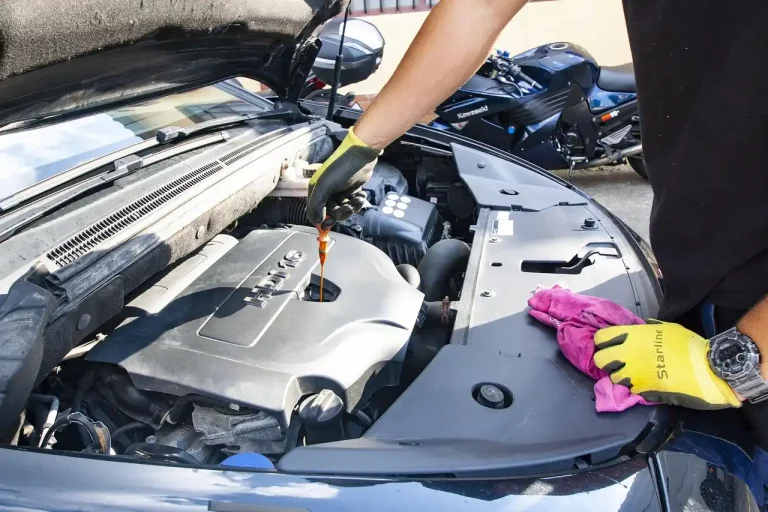
Check the level on level ground, with the engine off long enough for oil to drain back to the sump. Use the same method each time, because a warm reading, a cold reading, and a reading taken right after shutdown can give different results.
Step-by-step check
- Park on level ground.
- Wait long enough for drain-back, then open the hood.
- Pull the dipstick, wipe it clean, and reinsert it fully.
- Pull it again and read the film against the marks.
- Repeat the same process each time you check.
- Record the mileage and how much oil you add, if any.
Read the dipstick the same way each time
Use one method and stick to it. If you check a warm engine one day and a cold one the next, you can mistake normal settling for oil use. The result should be read against the same marks in the same lighting whenever possible.
Suppose the dipstick shows the level at the lower mark after a 6,000-mile interval, and you add 1 quart to bring it back near full. That is useful data only if the same vehicle, oil, and checking method are used again next time.
Track miles driven and amount added
Tracking matters more than a single snapshot. The amount added between services tells you whether the engine is using oil at a steady rate or changing over time. Keep the numbers in quarts or liters, then compare them with the maker’s limit.
Why is my SUV losing oil with no leak?

An SUV can lose oil without an obvious puddle because the oil may be burning inside the engine or entering a part of the system where you do not see it right away. Start with external leakage, then move to internal burning, ventilation faults, oil choice, and fill level.
External leaks to inspect first
External leakage can be checked by looking for oil stains where the car parks. Also inspect the underside, the drain plug area, the filter, and the valve cover area if they are visible from above. A leak can be small enough to drip only after a drive.
If the engine is oily but the ground stays clean, the leak may be collecting on shields or undertrays before it reaches the pavement. That still counts as external leakage.
Internal burning from rings, seals, or turbo faults
Internal oil consumption means the oil is entering the combustion chamber and burning there. Common causes include piston rings, cylinder wall sealing issues, valve stem seals, and turbocharger faults. Blue exhaust smoke can be a clue, especially on startup or after idling.
Turbocharged and direct-injection SUVs can hide oil use for a while because the loss may not leave an obvious stain. If the level keeps falling and the exterior stays dry, internal burning becomes more likely.
PCV faults and oil in the intake path
A faulty PCV system can pull oil mist into the intake, where it coats the throttle body, intake runners, intercooler, or charge pipes. That oil may not show up as a ground leak, but it still lowers the sump level. A stuck valve, blocked separator, or damaged hose can all contribute.
On vehicles with turbo plumbing, oil can collect in the intercooler or intake tract and be burned later. That is one reason a dry driveway does not rule out internal or system-path oil loss.
Wrong oil or overfill as a cause
Using the wrong oil specification can increase consumption, and wrong oil quality can do the same. Too much oil in the crankcase can also be a cause, because overfill can push oil where it should not go and create a false impression of engine wear.
Use the manufacturer oil specification, then verify the level after filling. A small filling error can make the dipstick look normal at first and then turn into a problem after a few drives.
Can the warning light mean something else?
Yes. The oil warning light can signal low oil level, but it can also point to oil pressure issues, filter blockage, pump malfunction, or sensor faults. Do not assume every warning means the same thing. The first step is always to check the level before driving farther.
Low level versus low pressure
A low-level warning means the sump may not have enough oil to cover normal operation. A low-pressure problem is different and can be more urgent. Both deserve attention, but they do not point to the same fault and should not be treated the same way.
Sensor, pump, or wiring faults
Some warning lights are triggered by a failed sensor, damaged wiring, or a pump issue rather than by low oil alone. That is why a dash light is a prompt to check, not proof of one exact cause.
What to do before driving farther
Pull over safely, check the oil level, and top up only if the level is low and the manufacturer allows you to do so. If the light returns after topping up, or if the engine sounds different, arrange inspection before more driving.
What damage can low oil cause?
Low oil can starve engine parts of lubrication and accelerate wear. It can also damage the turbocharger and expensive aftertreatment systems such as DPF or PPF-equipped setups if the underlying problem is allowed to continue.
Engine wear from oil starvation
Oil does more than lubricate moving parts. It also helps control heat and carry contaminants away from critical surfaces. When the level drops too far, friction and heat rise, and the engine may suffer damage long before a driver hears a new noise.
Risk to turbochargers and aftertreatment systems
Turbochargers depend on oil flow and clean oil. Low oil can shorten their life quickly. In some SUVs, low oil can also threaten costly aftertreatment hardware, especially where soot and oil contamination interact with diesel or particulate-filter systems.
Vehicles with DPF or PPF equipment may not always show obvious smoke even when oil is being consumed, because aftertreatment can reduce visible exhaust clues. That makes the dipstick trend, warning lights, and service history even more important.
When to stop driving and arrange inspection
Stop driving if the warning light stays on after a level check, if the engine develops blue smoke, if the oil level drops to the minimum mark again quickly, or if you hear knocking or tapping. Those are repair triggers, not monitor-and-wait signs.
Frequently asked questions
How much oil consumption is normal between oil changes in an SUV?
There is no single normal figure for every SUV. Normal oil consumption varies by manufacturer, and some brands allow much more than others. Use the maker’s stated limit, then compare it with your mileage and top-up history instead of guessing from the dipstick alone.
What oil consumption is considered excessive in an SUV?
Consumption is excessive when it exceeds the manufacturer’s standard, when the level falls fast enough to need repeated top-ups, or when the rate gets worse over time. A sudden increase, blue smoke, or fresh stains where you park all push the issue from monitoring to diagnosis.
How often should I check the oil level in my SUV?
Check it regularly, and increase the frequency if the SUV has a long service interval, a turbocharged engine, or a history of using oil. A good default is to check every few fill-ups or at least once between services, then more often if the level trends down.
Why does my SUV use oil without any visible leak?
The oil may be burning internally rather than leaking outside. Common causes include piston rings, valve stem seals, turbocharger faults, PCV faults, or oil entering the intake and intercooler path. Wrong oil specification or overfill can also make the level fall without a clear puddle under the SUV.
Can oil consumption be normal even with modern engines?
Yes. Modern engines can still use oil, and long service intervals make that more noticeable. The key is whether the usage stays inside the manufacturer’s limit and whether the rate remains stable. A small, steady loss is different from a sudden or worsening drop.
Can a temporary oil change cause higher oil consumption?
A short-term change in oil use after a service can happen for reasons other than the oil brand itself. Common explanations include a fill-level error, a viscosity or specification mismatch, the engine settling after fresh oil has cleaned away deposits, or oil consumption that was already present but not yet noticed. Treat any post-service increase as a monitoring point, not proof that the new oil is the cause.