What Are the Most Common SUV Transmission Problems?
Most common SUV transmission problems are fluid leaks, delayed engagement, slipping, harsh or shuddering shifts, overheating, and warning lights. Any symptom with burnt fluid, no movement, or a flashing transmission light needs immediate diagnosis. Ignoring them can turn a repair into a rebuild. This guide maps each symptom to likely causes, urgency, and the next step.
Transmission triage table
| Symptom | Likely cause | Urgency | Safe to drive? | First diagnostic check |
|---|---|---|---|---|
| Slipping | Low or dirty transmission fluid, worn clutch packs, torque converter trouble, solenoid or valve body faults | High if it happens during acceleration or with a check engine light | Only a short, gentle drive if it is mild; stop if flare or loss of drive appears | Check fluid level and condition, then read OBD-II trouble codes |
| Delayed engagement | Low fluid, degraded fluid, worn seals, valve body wear, control or sensor faults | Medium to high, especially if reverse or drive lags more than a second or two | Limited driving only if it moves normally after the delay; avoid long trips | Inspect fluid level, then test drive from park to drive and reverse on level ground |
| Harsh shifts | Control-module issues, bad shift solenoids, worn mounts, contaminated fluid, software fault, or internal wear | Medium, but higher if the jerk is severe or paired with a warning light | Usually short-distance only until codes and fluid condition are checked | Look for codes and note whether the harsh shift happens cold, hot, or under load |
| No reverse | Internal reverse clutch or band failure, linkage fault, valve body issue, low fluid, or electronic control fault | Critical | No; arrange tow or repair | Confirm fluid level, then check whether drive works and whether reverse engages at all |
| Overheating | Low fluid, blocked cooler, heavy towing, stop-and-go heat, mountain driving, slipping clutch packs | Critical if the transmission light flashes, limp mode starts, or the smell turns burnt | No long driving; stop and let it cool, then diagnose | Check for low fluid, leaks, and trouble codes tied to temperature or shift faults |
| Fluid leak | A fluid leak may come from a punctured pan, a seal leak, an axle seal leak, a cooler line leak, a case crack, or a gasket failure. | High if you see red or brown patches under the car | Risky; only move the SUV if fluid level is confirmed safe | Inspect the ground, pan, cooler lines, and transmission case for fresh wetness |
What are the most common SUV transmission problems?
Commonly reported SUV transmission problems include slipping, delayed engagement, harsh shifts, overheating, no reverse, and fluid leaks. Those complaints matter because SUV transmissions often work harder under load, in stop-and-go traffic, and while towing, so a small fault can turn into a loss of drive sooner than many owners expect.
Slipping under acceleration
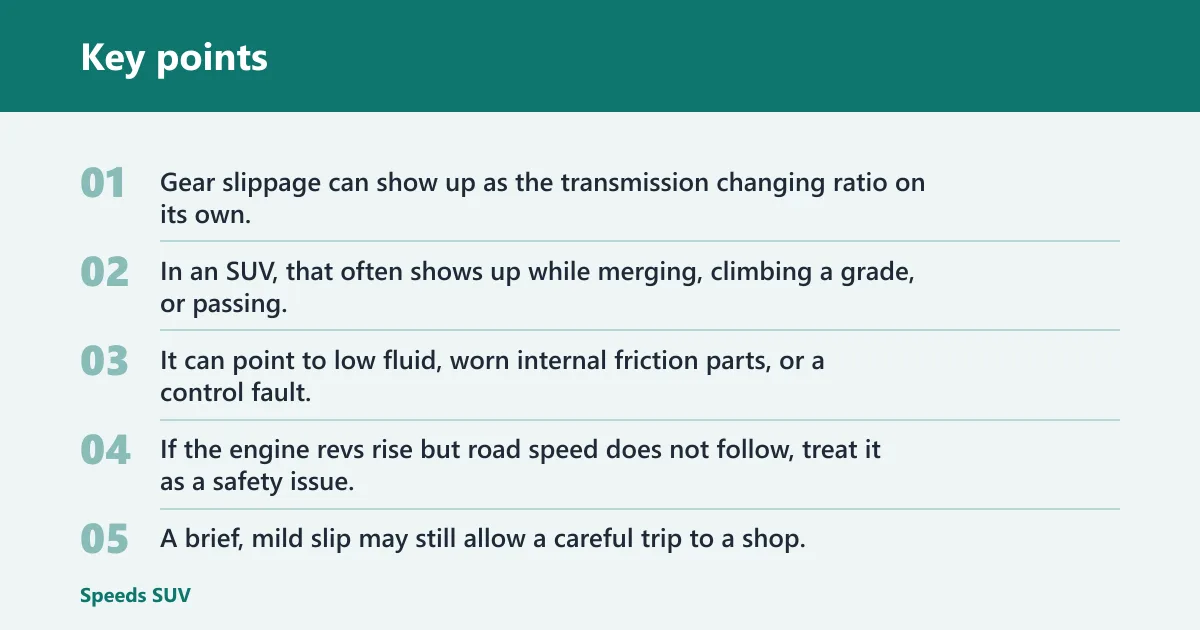
Gear slippage can show up as the transmission changing ratio on its own, letting engine speed jump, or dropping engagement when the accelerator is pressed. In an SUV, that often shows up while merging, climbing a grade, or passing. It can point to low fluid, worn internal friction parts, or a control fault.
If the engine revs rise but road speed does not follow, treat it as a safety issue. A brief, mild slip may still allow a careful trip to a shop, but repeated flare or a sudden loss of drive should stop the trip.
Delayed drive or reverse engagement
Delayed engagement is the pause, bang, or lurch that happens after shifting out of park. It may appear first in reverse, first gear, or drive after a cold start. The usual suspects are low or dirty fluid, worn seals, or valve body control problems.
A common first-timer mistake is to shift from park to drive, wait only a second, and then press harder on the throttle when the SUV hesitates. That can make the take-up jerk worse and hide the real cause.
Harsh or late shifts
Harsh shifts feel like a bang, shake, or sharp tug during gear changes. The guide for some GMC transmission issues lists delayed or incorrect gear shifts and shaking during gear changes, and it also includes gear slippage as a common issue. Those symptoms often point to fluid problems, solenoids, valve body wear, or software control faults.
Late shifts can also show up under load. A towing SUV may hold gears too long, then shift hard when the transmission finally changes ratio.
No reverse or no drive
No reverse is a serious failure pattern. If the SUV will move forward but not back up, or if it loses drive entirely, internal reverse clutch failure, valve body trouble, linkage problems, or low fluid can be involved. This is the kind of symptom that often crosses the tow-or-repair threshold.
Do not assume a reset will fix it. When reverse disappears, the transmission may already be past the point where continued driving helps.
Overheating and fluid leaks
Transmission overheating is more than a temperature warning. Heat breaks down fluid, reduces hydraulic pressure, and speeds internal wear. Heavy towing, long grades, hot weather, and repeated stop-and-go driving all make the problem worse. Red or brown patches under the SUV are a classic leak clue, and low fluid levels or dirty fluid can cause or worsen transmission problems.
Burnt-smelling fluid, dark fluid, or a flashing transmission light are escalation signs. If the transmission goes into limp mode, stop driving far enough to diagnose it before more damage accumulates.
What causes transmission problems in SUVs?
Most SUV transmission problems come from a short list: low or degraded transmission fluid, worn internal parts, valve body or solenoid faults, heat damage, and sensor or software issues. The symptom tells you where to start, but it does not tell you the full failure yet. That is why the first check should always focus on fluid, codes, and shift behavior.
Low or degraded transmission fluid
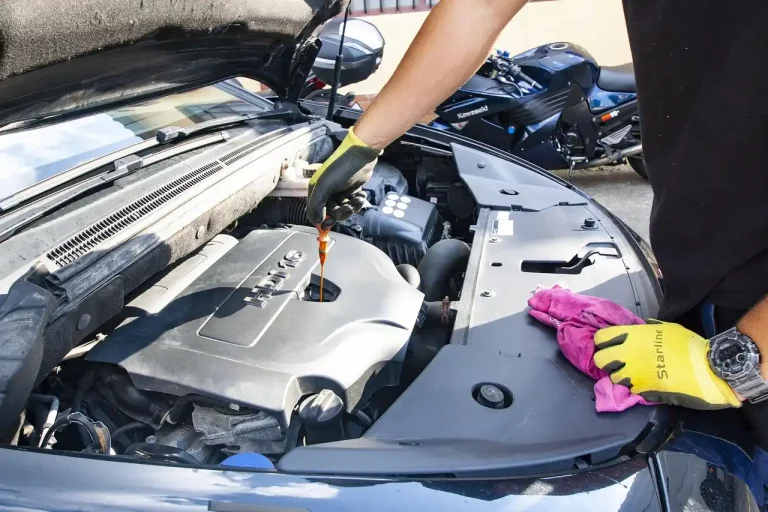
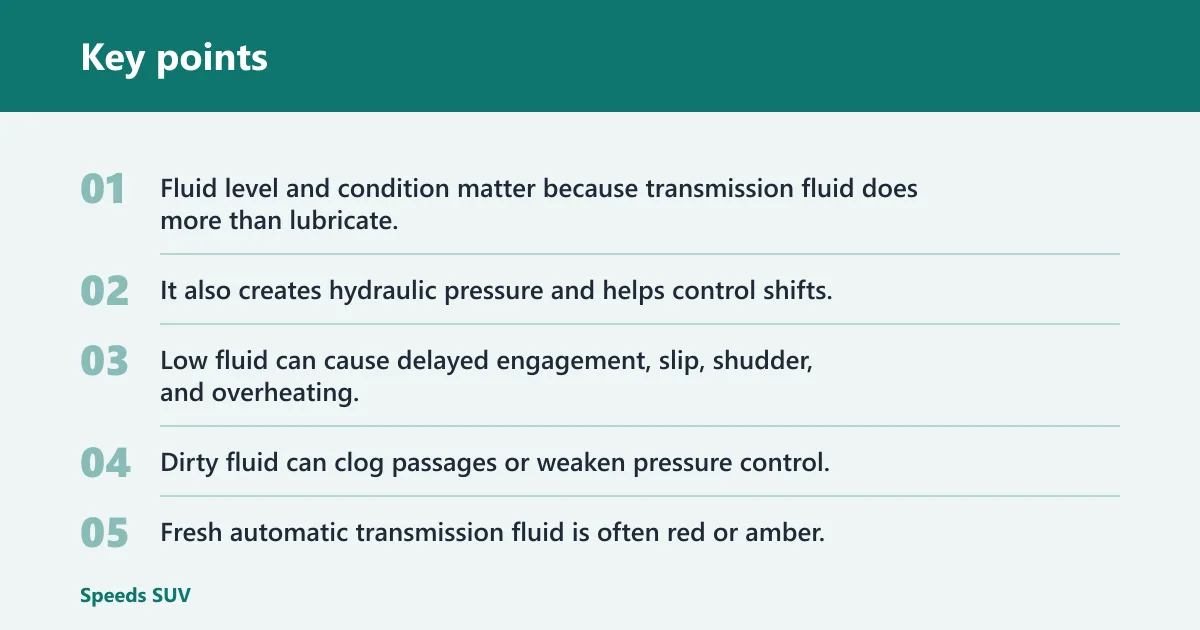
Fluid level and condition matter because transmission fluid does more than lubricate. It also creates hydraulic pressure and helps control shifts. Low fluid can cause delayed engagement, slip, shudder, and overheating. Dirty fluid can clog passages or weaken pressure control.
Check for leaks first. Then inspect color and smell. Fresh automatic transmission fluid is often red or amber; dark brown fluid or a burnt odor usually points to heat and wear.
Valve body, solenoid, or control faults
Modern automatic transmissions depend on solenoids, sensors, and the control module to command shifts. A failed solenoid can create delayed, harsh, or incorrect shifts. A valve body fault can trap pressure where it should not be. A sensor fault can make the transmission choose the wrong gear strategy.
That is where OBD-II trouble codes help. A scan tool does not give a final diagnosis, but it can point you toward the circuit, sensor, or shift fault that needs a deeper check.
Worn clutches, bands, or torque converter parts
Worn friction parts often show up as slip, flare, shudder, or no reverse. The transmission may still move at first, then lose strength once fluid temperature rises or load increases. A torque converter fault can also create shudder during light acceleration or poor engagement at low speed.
Internal wear usually gets worse, not better. If the symptom is increasing week by week, the problem is less likely to be a simple fluid issue.
Heat, towing, and stop-and-go stress
SUVs often pull trailers, carry family loads, or spend long periods in traffic. That combination builds heat. Heat thins the fluid and strains clutches and seals. If the vehicle lives in hills, tow mode matters. If it sits in traffic often, cooler capacity and service history matter.
Suppose a midsize SUV starts shifting hard after a 20-minute uphill pull with a trailer behind it. That pattern points more toward heat and fluid stress than a random one-time glitch.
Software or sensor issues
Some shift complaints come from calibration or sensor input, not hard mechanical damage. A transmission may hesitate, hunt between gears, or shift roughly because a sensor signal is wrong or the control logic is confused. That is one reason the check engine light matters: it often signals that a code can help separate electrical faults from mechanical wear.
How do symptoms differ by transmission type?
Symptoms can look similar across transmission types, but the failure pattern is not always the same. An automatic transmission often shows gear complaints under load or during stop-and-go use. A CVT usually brings a different feel. A 10-speed automatic may create complaints about shift quality, gear hunting, or engagement. That distinction matters because the next check is not always the same.
Automatic transmission symptoms under load
Conventional automatics use fixed gears, clutches, bands, and hydraulic control. In SUVs, symptoms often show up under acceleration, while towing, or on steep grades. Slip, delayed engagement, and harsh shifts are common triage clues because they can come from fluid, pressure control, or internal wear.
When the symptom appears only under load, that does not make it harmless. It often means the transmission is close to the edge of what the failing part can handle.
CVT symptom patterns and warranty context
A CVT transmission uses a pulley system with a steel belt rather than stepped gears. In SUV use, a CVT complaint may feel like engine flare, odd rev holding, jerks, or a rubber-band sensation during acceleration. For some models, warranty coverage matters because certain repairs may fall under longer powertrain coverage. Nissan’s Rogue page says Nissan doubled the powertrain warranty to 10 years/120,000 miles.
The Rogue page also lists engine stalls, hard jolts or jerks, and a check engine light as CVT complaint signs. Those are not proof of a failed unit, but they are enough to justify prompt code reading and fluid inspection.
10-speed automatic shift complaints
Ten-speed automatics can shift many times in a short drive, so owners may notice small changes in shift quality before a complete failure. Complaints often involve rough shifts, slipping, or gear engagement issues. In some GM heavy-duty applications, those reports may show up during towing, hill climbing, or slow traffic.
Because the transmission has many ratio changes, a bad shift can be subtle at first. A single harsh upshift is less useful than a repeated pattern in the same gear range.
What should you check first?
Start with the simplest checks that can separate a fluid problem from a deeper fault. That means fluid level and condition, leaks under the SUV, warning lights, and whether the transmission behaves differently in drive and reverse. These checks will not fix the problem, but they narrow the next step quickly.
Transmission fluid level and condition
Check the fluid only the way the vehicle manual calls for. Some SUVs use a dipstick; others require a level plug or scan-tool temperature check. Low fluid can trigger delayed engagement, slipping, or overheating. Dirty fluid can point to wear or a service interval that has gone too long.
Look for red or brown patches under the car, then look at the fluid itself. If it smells burnt or looks very dark, do not ignore it.
Leaks under the SUV
Fresh wetness near the transmission pan, cooler lines, axle seals, or case seam can point to the leak source. A leak does not have to be large to matter. Even a slow drip can lower pressure enough to cause shudder, slip, or delay after a few trips.
If the ground shows red or brown spots, confirm whether the leak is engine oil, coolant, or transmission fluid before driving farther. Color alone is a clue, not a final answer.
Check engine light and OBD-II trouble codes
The check engine light often appears with transmission-related faults, especially when a sensor, solenoid, or ratio problem sets a powertrain code. An OBD-II scan tool can read those codes and help trace the next diagnostic step. It cannot tell you everything, but it can tell you where to start.
Scan codes can be more useful when the light comes with slip, shudder, or a limp-mode limit on speed. A warning light plus a shift symptom is a stronger case than either one alone.
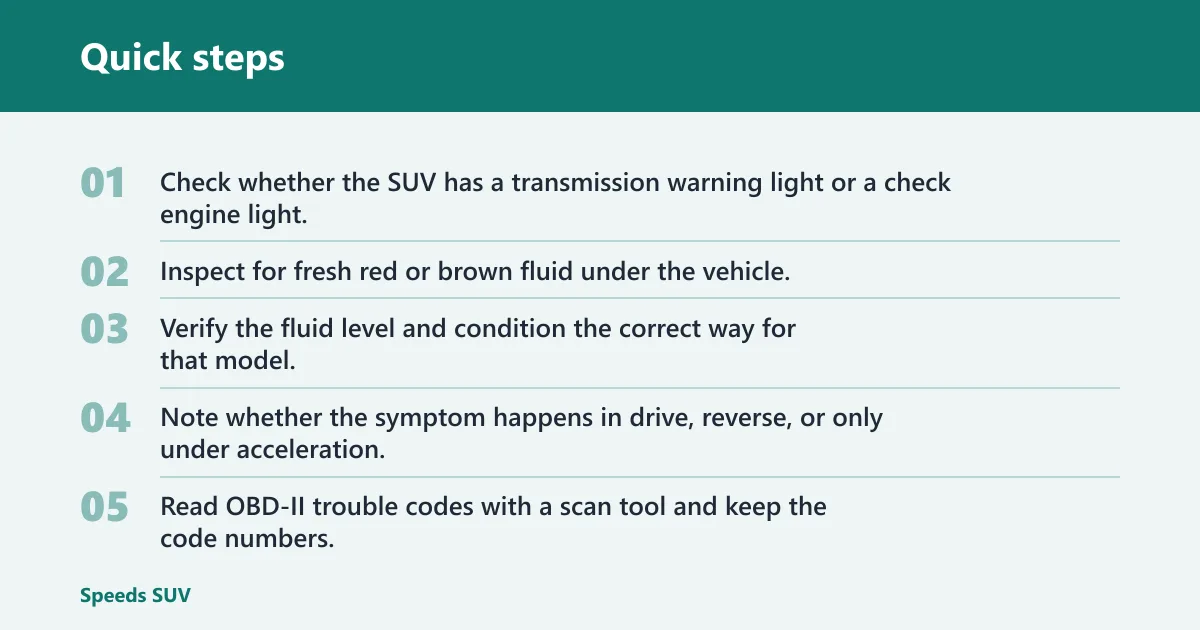
- Check whether the SUV has a transmission warning light or a check engine light.
- Inspect for fresh red or brown fluid under the vehicle.
- Verify the fluid level and condition the correct way for that model.
- Note whether the symptom happens in drive, reverse, or only under acceleration.
- Read OBD-II trouble codes with a scan tool and keep the code numbers.
Shift quality in drive and reverse
Test how long it takes to engage drive and reverse from a complete stop. A healthy transmission should take up promptly and without a hard bang. If drive engages but reverse does not, or reverse takes far longer than drive, that difference is a major clue.
Picture a three-row SUV that backs out of a driveway normally on Monday, then refuses reverse on Wednesday. That kind of change points away from a minor annoyance and toward a failure that needs direct diagnosis.
Can you keep driving with transmission symptoms?
Sometimes, briefly. Sometimes, no. Mild slip, a short delayed engagement, or a one-off harsh shift may allow a short, careful trip to a shop. But overheating, flashing warning lights, burnt fluid, no reverse, or repeated loss of drive should be treated as stop-driving symptoms.
Slip, flare, and shudder
If the SUV slips only once and then behaves, keep the trip short and avoid hard throttle. If the engine flares repeatedly, the transmission shudders, or the vehicle loses speed uphill, keep driving to a minimum. Those symptoms can turn a repair into a replacement if you keep loading the unit.
Delayed engagement on cold start
A short delay after a cold start can happen with low or old fluid, but that does not make it normal. If the delay gets longer, or if the take-up becomes harsh after the pause, the problem is moving past a simple annoyance. Plan a check before the next long drive.
Overheating and limp mode
Heat is one of the fastest ways to damage a transmission. If the SUV enters limp mode, slows gear choices, or starts smelling burnt, stop and let it cool. Driving farther while the unit is overheating can add clutch damage, fluid breakdown, and more codes.
No reverse or loss of drive
No reverse is tow-or-repair territory. Loss of drive is even more serious. If the SUV cannot move predictably in traffic, the safety risk is obvious, and the diagnosis is no longer a casual driveway check.
How can you prevent transmission problems?
Prevention is mostly about heat control, fluid care, and early response. Follow the maintenance schedule for the exact transmission type in the SUV. Replace fluid with the correct spec. Fix leaks early. Do not keep driving through slip, shudder, or warning lights.
Follow fluid service intervals
Use the service interval listed for the transmission type and duty cycle. SUVs that tow, idle in traffic, or climb grades may need attention sooner than light-duty use. Fluid is not generic. The wrong spec can create shift problems that look like a failing transmission.
Address small leaks early
A small leak rarely stays small. Once fluid drops, pressure drops. Once pressure drops, shift quality and cooling suffer. A quick seal or cooler-line repair is usually far cheaper than waiting for a damaged clutch pack or a burnt fluid condition.
Use the right fluid spec
Some transmissions are sensitive to the exact fluid formulation. That matters in conventional automatics and CVTs alike. If the wrong fluid was added, symptoms can start soon after service and may look like slipping, noise, or poor engagement.
Reduce heat from towing and heavy loads
Use tow mode when the SUV is equipped for it. Avoid unnecessary heavy loads in hot weather. Leave more space in traffic to reduce repeated creep-and-brake heat. If mountain driving is common, watch for temperature-related symptoms after long climbs.
Get warning signs checked fast
The best time to act is when the symptom is small. A scan code, a fluid check, and a leak inspection can separate a low-cost fix from a major failure path. Waiting usually reduces options.
Frequently asked questions
Can a transmission go out without warning in an SUV?
Yes, but many failures give clues first. Slipping, delayed engagement, harsh shifts, or a warning light often appear before a complete failure. A sudden no-drive or no-reverse event can happen, especially if an internal part breaks or fluid pressure drops sharply.
If an SUV transmission is bad, will it still move?
Sometimes it will move for a while, but poorly. It may slip, take time to engage, or only move in some gears. That partial movement does not mean it is safe. Once it starts losing drive or reverse, the failure can accelerate quickly.
Why won’t my SUV transmission go into drive?
Common causes include low fluid, a shifter or linkage issue, a valve body fault, a bad solenoid, or internal wear. If reverse works but drive does not, or drive takes several seconds to engage, that points to a transmission fault that needs prompt diagnosis.
How can I prevent transmission problems in my SUV?
Use the correct fluid, follow the service schedule, and repair leaks early. Do not ignore slip, shudder, or delayed engagement. If the SUV tows, climbs grades, or sits in traffic often, it deserves faster attention when symptoms start.
Do Chevys have transmission problems?
Some Chevrolet SUVs and trucks have had widely discussed transmission complaints, but that does not mean every Chevy has the same issue. The better question is which transmission is in the vehicle and what symptom it shows. A code scan and fluid check are more useful than brand rumors.