Which Trucks Are Known for Rust Problems?
The most rust-prone pickup trucks are older full-size models that lived through repeated winter salt exposure, especially 1999–2007 Ford Super Duty, 2000s Chevrolet Silverado/GMC Sierra, and 2004–2014 Toyota Tacoma. Buy only if the frame, brake lines, cab mounts, bed supports, and suspension mounts are solid. Ignore structural rust and you can face failed inspections, expensive repairs, and a truck that is no longer safe to tow or haul. NHTSA recall records, manufacturer corrosion and frame-service documents, and state DOT salt-use data all point to the same pattern: winter salt plus age is the biggest rust multiplier.
Which trucks rust the most?
The worst rust problems usually show up in older truck generations that spent winters in salt-heavy states, not in every truck from a given badge. Age matters, but so do frame design, seam sealing, drainage, coating quality, and road-salt exposure. Frame rust is the bigger warning sign because it affects safety, inspection eligibility, and repairability. For buyers comparing used trucks, generation-by-generation condition matters more than brand reputation.
Why generation matters more than badge
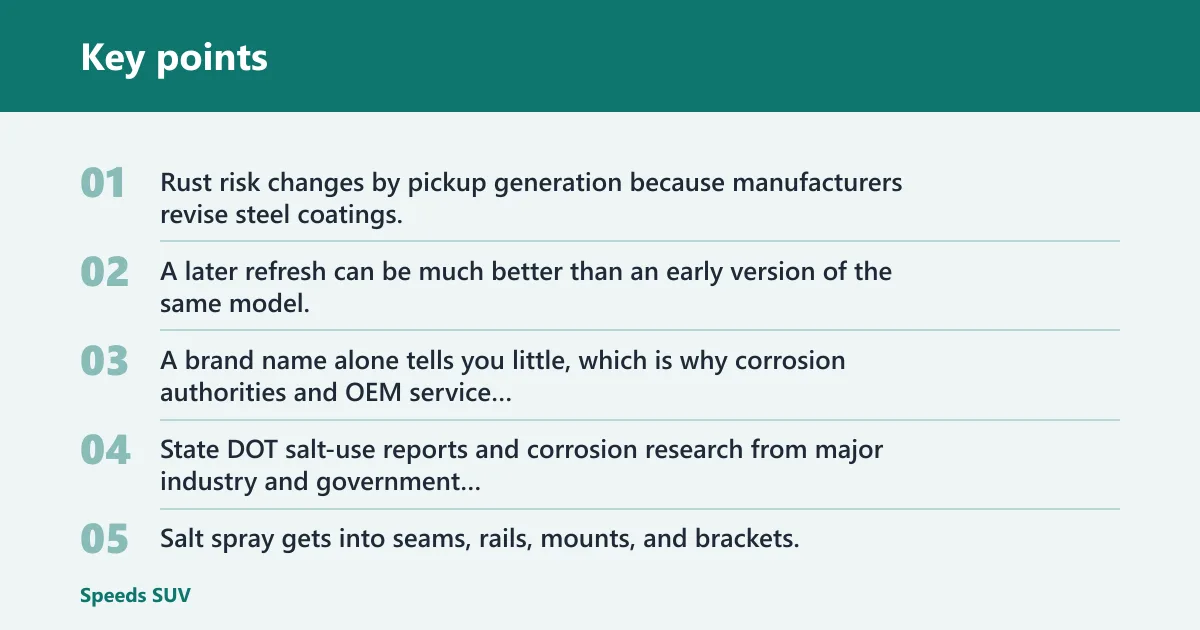
Rust risk changes by pickup generation because manufacturers revise steel coatings, seam sealing, drainage, and underbody layouts over time. A later refresh can be much better than an early version of the same model. A brand name alone tells you little, which is why corrosion authorities and OEM service documents focus on specific years, structural components, and repair campaigns rather than the badge on the grille.
How climate history changes the risk
State DOT salt-use reports and corrosion research from major industry and government sources point to the same issue: repeated winter salt exposure is the biggest driver of underbody corrosion. Salt spray gets into seams, rails, mounts, and brackets, then holds moisture there long enough to keep corrosion moving. Trucks from coastal and humid areas can also corrode faster, but snowbelt road salt is the strongest used-truck rust pattern.
The difference between cosmetic rust and structural corrosion
Surface rust is usually a coating issue on exposed steel. Moderate rust starts to pit the metal, spread under seams, or weaken fasteners and brackets. Structural corrosion is different. If rust has flaked deeply, opened a seam, thinned a frame rail, or eaten through a mount, the repair gets expensive quickly and may never restore full strength. NHTSA complaint and recall histories on some models show why frame and suspension corrosion should be treated as safety issues, not just appearance problems.
| Truck model or generation | Known rust hotspots | Likely severity | Buyer red flags |
|---|---|---|---|
| 1999–2007 Ford Super Duty | Frame rails, cab corners, rocker panels, rear spring hangers, bed supports | High in salt-belt trucks | Frame scaling, perforation near mounts, soft cab corners, crusted brake lines |
| 2000–2006 Chevrolet Silverado / GMC Sierra | Cab corners, rocker panels, wheel arches, bed seams, rear frame sections | High in snowy regions | Rust-through at cab corners, flaky rockers, heavy scaling on the frame |
| 2004–2014 Toyota Tacoma | Frame rails, crossmembers, rear leaf-spring mounts, spare-tire area | High to severe in salt states | Frame flaking, deep pitting, weld-seam loss, safety recall repairs not completed |
| 2002–2008 Dodge Ram | Rear wheel arches, rocker panels, cab corners, frame seams, brake lines | Moderate to high | Bubbling arches, rusted cab supports, line corrosion, heavy underbody scale |
| 2007–2013 Chevrolet Silverado / GMC Sierra | Wheel arches, cab corners, rocker ends, rear frame seams, brake and fuel line clips | Moderate to high | Paint bubbles at cab corners, scaling at line brackets, seam rust at the frame |
| 2004–2008 Ford F-150 | Rear frame sections, cab corners, bed supports, spare-tire crossmember | Moderate to high | Pitting near spring mounts, rust at bed braces, crusted underbody hardware |
| 2009–2014 Ford F-150 | Frame seams, cab mounts, rocker ends, brake line routing points | Moderate | Heavy scaling hidden by undercoating, rust at cab-mount pockets, failing line clips |
| 2011–2016 Ford Super Duty | Frame rails, rear hangers, cab mounts, wheel arches, bed supports | Moderate to high | Flaking around welded seams, soft mounts, rust at rear suspension attachment points |
| 2007–2013 Toyota Tundra | Frame rails, rear axle area, bed supports, brake line brackets | Moderate | Scaling at the frame, seam rust, corrosion hiding under coatings or undercoating |
| Older full-size pickups from any brand | Welded seams, brackets, mounts, wheel wells, bed seams | Varies by region | Mixed paint bubbles, undercoating hiding scale, frame rust in seam lines |
Why do trucks rust faster?
Trucks rust faster than many cars because they spend more time exposed underneath. Their frames, brackets, crossmembers, and suspension parts catch salt spray and wet slush, then dry slowly. Cab mounts, bed supports, and open seams trap debris too, which keeps moisture against steel longer than a smooth painted body panel would. That is why inspection-risk claims for pickups are usually concentrated under the truck, not on the hood or doors.
Road salt and winter wash-in
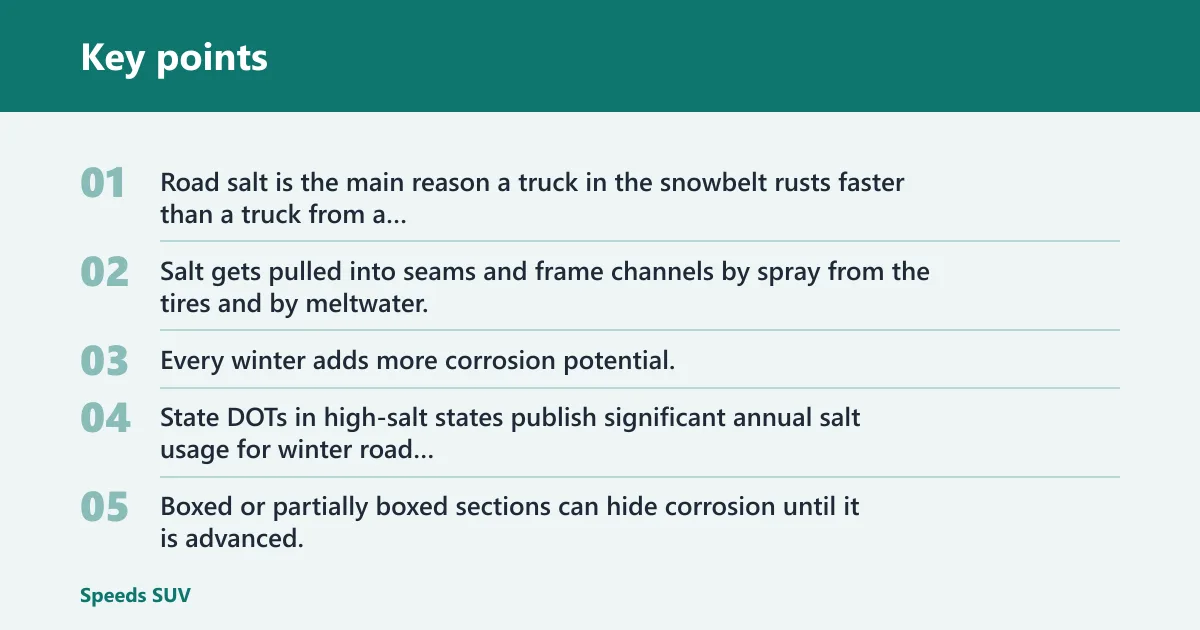
Road salt is the main reason a truck in the snowbelt rusts faster than a truck from a dry state. Salt gets pulled into seams and frame channels by spray from the tires and by meltwater. Every winter adds more corrosion potential, especially if the truck is not washed often enough to clear the underbody. State DOTs in high-salt states publish significant annual salt usage for winter road maintenance, which is why used-truck buyers should treat snowbelt history as a major rust clue.
Frame rails, seams, and trapped moisture
Boxed or partially boxed sections can hide corrosion until it is advanced. Welded seams, brackets, and crossmembers are common failure points because water sits there and oxygen keeps feeding the rust. A thin painted surface can hide a badly weakened section underneath. Major corrosion authorities emphasize that trapped moisture and poor drainage are what turn ordinary surface rust into structural damage.
Steel age, chips, and coating damage
Older steel-heavy trucks rust more because coatings age, chip, and separate from the metal. Stone chips on rocker panels and wheel arches create bare spots. Once the coating fails, corrosion spreads under the paint, often before the buyer sees any hole from the outside. A truck can look acceptable in daylight and still have serious underbody loss where the paint is intact.
Where should you inspect first?
Start underneath, not at the paint. Frame rust matters most, followed by cab corners, rocker panels, wheel arches, suspension mounts, brake lines, and bed seams. A flashlight and magnet help, but the key is to separate cosmetic rust, moderate pitting, and structural loss. Surface discoloration is one thing; flaking scale, swelling seams, holes, and soft metal are deal-breaker clues.
Frame rust and crossmembers
Check the frame rails, welded seams, spring hangers, control-arm mounts, and crossmembers. Cosmetic rust is thin orange staining you can brush away. Moderate rust shows pitting and peeling scale but still leaves solid thickness. Structural rust means holes, delamination, cracked seams, or crushed jack points. A frame with heavy scaling, cracks, or perforation is a safety concern.
Cab corners and rocker panels
Cab corners and rocker panels are common body rust zones on pickups. They trap moisture and road debris, and repairs usually take real labor because the rust often starts inside the panel. Surface bubbles are not the same as rust-through, but they often point to deeper corrosion under the paint. If the metal flexes, crunches, or opens when pressed, that is beyond cosmetic rust.
Wheel arches, suspension mounts, and brake lines
Wheel arches rust from tire spray and packed mud, especially where paint chips start. Suspension mounts and brake lines are more serious. Brake-line corrosion can create a safety issue with little warning, and rusted mounts can change alignment or load support. A line that is swollen, pitted, or crusted at the clamp points is not a minor issue; it is a near-term failure risk.
Picture a 12-year-old half-ton from upstate New York with clean paint above the beltline and orange dust on the frame. A quick walkaround may look fine. A flashlight under the cab, however, can reveal flaking frame seams and pitted brake lines that turn a cheap truck into an expensive repair. That is why inspection-risk claims should always be tied to the underbody, not the showroom shine.
Do aluminum trucks rust?
Aluminum body panels do not rust like steel, so they avoid the classic orange body corrosion on fenders and doors. That does not make them rust-proof overall. Fasteners, brackets, steel frames, and mixed-metal joints can still corrode, and road salt still attacks any exposed steel part underneath. Aluminum may reduce visible body rust, but it does not eliminate the need for a full underbody check.
What aluminum avoids
Aluminum panels resist the red-brown rust that steel develops. That helps with visible body panels, especially where water and chips would usually start corrosion. It does not remove the need for underbody inspection. Corrosion can still start at seam edges, hardware, and steel support parts, even when the outer skin looks clean.
Where mixed-metal corrosion still happens
Mixed-metal joints can corrode at fasteners, brackets, and seams where different metals meet. Galvanized steel reduces corrosion risk on many body and frame parts, but the coating is not a shield forever. If the coating is damaged, rust can still begin at scratches, seams, and hardware. That is why an aluminum-bodied truck can still have severe structural rust underneath.
What counts as a deal-breaker?
Deal-breaker rust is structural, active, or too widespread to repair at a sensible cost. Surface rust on a bracket may be acceptable on an older truck. Frame perforation, major scaling, soft spots, cracked mounts, rusted brake lines, or corrosion at spring hangers should stop the deal unless the seller has documentation for proper repairs.
Surface rust versus scaling and perforation
Surface rust stays on top of the metal. Scaling means the rust has built layers and is peeling. Perforation means the metal is eaten through. Once you reach perforation in a frame rail, mount, or line, the problem moves from cosmetic to structural. At that point, the repair is no longer about appearance; it is about whether the truck can safely carry load.
When to walk away from a used truck
Walk away if the frame has holes, the cab or bed mounts are soft, the brake lines are badly corroded, or a magnet will not stick because the metal has lost integrity. A truck with heavy rust in the structural underbody may still start and drive, but it can fail inspection and cost far more than its value to repair. Manufacturer frame-corrosion campaigns and NHTSA-linked safety concerns make these problems worth treating as hard stops.
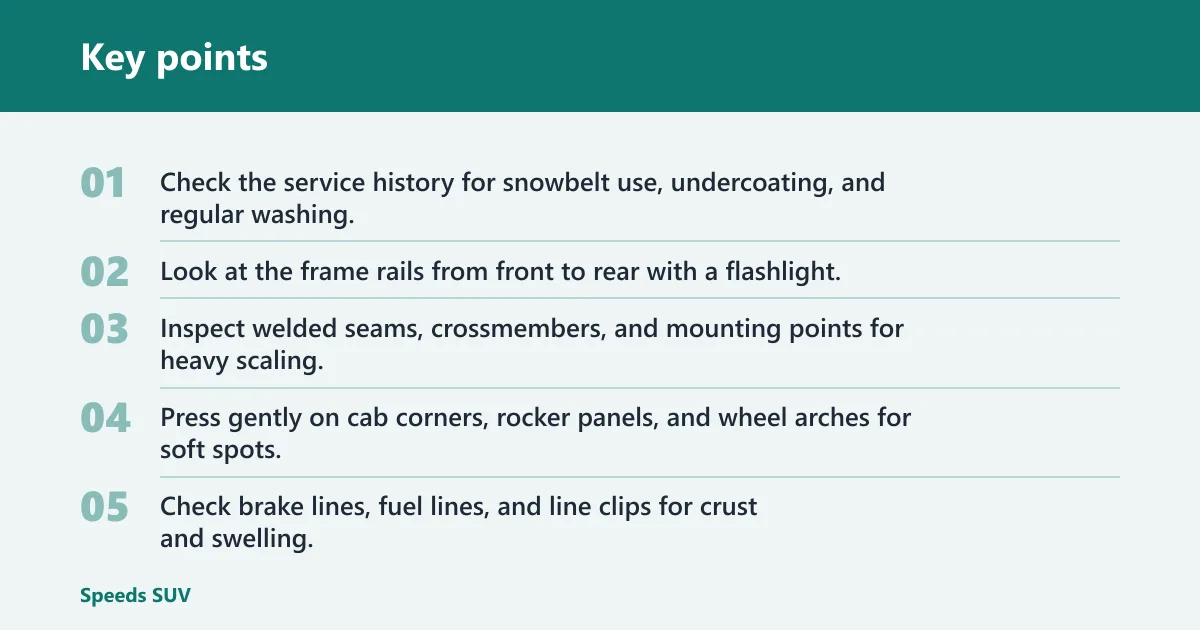
- Check the service history for snowbelt use, undercoating, and regular washing.
- Look at the frame rails from front to rear with a flashlight.
- Inspect welded seams, crossmembers, and mounting points for heavy scaling.
- Press gently on cab corners, rocker panels, and wheel arches for soft spots.
- Check brake lines, fuel lines, and line clips for crust and swelling.
- Look at suspension mounts, leaf-spring hangers, and control-arm points.
- Use a magnet on suspect body areas to spot filler hiding rust repair.
- Check bed supports and seams under the bed for trapped rust.
- Look for fresh undercoating that may hide old corrosion or patch work.
- Reject any truck with frame perforation, major scaling, or rusted brake lines unless a documented repair has already been done.
What states cause the most vehicle rust?
The highest rust risk comes from snowbelt states that use road salt heavily in winter, including much of the Northeast, Upper Midwest, and parts of the Mountain West. Coastal states can also create corrosion risk through salty air, but repeated winter exposure is the clearest pattern in used trucks. State DOT salt-usage data and corrosion guidance both support the same buying rule: the more winter salt a truck saw, the more carefully its underside must be inspected.
Suppose a truck spent ten winters in Wisconsin and only one summer in Arizona. Even if the paint looks decent, the underbody can tell a different story. Climate history matters more than odometer miles when you are judging rust risk, especially when the frame, brake lines, and mounts are the first parts to show salt damage.
Why do trucks rust more than cars?
Trucks rust more than many cars because they are built to carry loads and tow, which means more exposed steel underneath and more seams, brackets, and mounts to trap moisture. Their larger underbody also gets more direct spray from salted roads, especially when the truck has seen repeated winter driving. Added payload and towing can also flex aging hardware, which makes existing corrosion more likely to spread.
Why do pickup trucks rust so fast?
Pickup trucks rust quickly when road salt, wet storage, and damaged coatings all line up. Bed seams, cab corners, wheel arches, and frame rails collect grime and hold moisture. Once corrosion starts in those places, it can spread out of sight before the body panels show major damage. That is why the quickest rust cases are often the trucks that look fine from ten feet away.
Do Ram trucks rust easily?
Some Ram trucks are known for rust in the same places many pickups fail: rocker panels, cab corners, wheel arches, frame seams, and brake lines. The risk depends more on generation, winter exposure, and care than on the badge alone. A clean southern truck can be far better than a salted northern truck, and a truck with documented underbody care is usually a safer bet than one with mystery undercoating.
Why do Chevy trucks rust so bad?
Some Chevrolet Silverado and GMC Sierra generations are widely known for cab corner, rocker, wheel arch, and frame rust because those areas collect moisture and salt, and older coatings did not always hold up well over time. The issue is strongest on salt-belt trucks and weaker on later, better-kept generations. Buyer risk rises sharply when the truck has lived through repeated winters and the underbody has been patched, sprayed, or ignored.
Frequently asked questions
Which trucks are known for rust problems?
The exact risk depends on generation, climate history, and whether the frame, brake lines, and mounts still have solid metal.
Why do some trucks rust more than others?
Trucks rust more when design, coatings, drainage, and climate all work against them. Salt gets trapped in seams and underbody parts, and older steel loses protection over time. Two trucks of the same model can age very differently if one lived in a dry state and the other saw hard winters.
Which pickup trucks rust the fastest in salty climates?
Older full-size pickups with exposed frames, seam-prone cab corners, and rust-prone brake lines tend to rust fastest in salty climates. Salted roads and repeated freeze-thaw cycles push corrosion into hidden areas. That is why the same model can look clean above the beltline and still be unsafe underneath.
How can I tell if a truck has dangerous rust damage?
Dangerous rust shows up as frame perforation, heavy scaling, soft mounts, rusted brake lines, or metal that flakes away under light pressure. Use a flashlight under the truck, check seams and mounts, and look for repair patches that hide deeper loss. If the structure is thin, walk away.
Sources
- NHTSA recall and complaints database for frame, brake-line, and suspension-corrosion issues on used trucks.
- Manufacturer corrosion and service documents for specific Toyota Tacoma, Ford Super Duty, Chevrolet Silverado, and GMC Sierra model years.
- State Department of Transportation winter maintenance and road-salt usage publications for snowbelt salt-exposure context.
- Corrosion authorities and industry guidance from major materials and vehicle-corrosion organizations on trapped moisture, seam corrosion, and structural rust.