What Is Excessive Oil Consumption on an SUV?
Excessive oil consumption on an SUV is often treated as a pattern around 1 quart every 1,000 miles or more, or faster than the owner’s manual allows. That threshold is not universal; manufacturer limits vary by engine and service literature, and some brands allow noticeably more under certain conditions. Ignore it, and you can get low-oil warnings, catalytic-converter damage, and engine wear or seizure. This guide covers normal top-offs, warning signs of a real problem, and when to stop driving.
Quick criteria box
- Normal: Oil level drops slowly, stays within the owner’s manual/service-data limit, and there are no blue-smoke, leak, or warning-light symptoms. Drive normally and keep checking the level.
- Monitor closely: Top-offs are getting more frequent, but the SUV still runs clean and the level remains within spec. Check for leaks, confirm the oil grade, and keep track of miles per quart.
- Excessive: Oil use is near or above 1 quart per 1,000 miles, the low-oil light keeps returning, or you see blue smoke, fresh stains, or a sudden level drop. Stop and inspect before further driving.
What counts as excessive oil consumption?
Excessive oil consumption means the engine is using oil faster than the manufacturer allows, whether that oil is burned inside the engine or lost through an external leak. The key is the pattern over mileage, not a single dipstick reading. Manufacturer limits vary by brand, engine design, and service data, so the owner’s manual and technical service information control the final answer.
Some brands state acceptable use in liters per kilometer, and some service documents allow amounts that would surprise many owners. For example, Toyota and Lexus service information has been cited with accepted consumption ranges such as 0.0052 to 0.3170 quarts per 621 miles, which converts to about 0.05 dl to 3 dl per 1000 km. That is why a single “quart per oil change” guess is not enough.
Why miles per quart matters more than guesswork
A miles-per-quart pattern gives you a repeatable way to compare what the SUV is doing now with what it did before. If the level drops slowly over a long interval and stays inside the maker’s limit, that can be normal. If it drops faster, or the rate climbs after a recent service, treat it as a problem to track.
An oil level warning light can appear when oil is low or when oil pressure is abnormal. It can also be triggered by a sensor or wiring fault, but you should still check the level immediately. A light between oil changes is one of the clearest signals that the engine may be using oil too quickly.
When top-offs stop being normal
Top-offs are part of normal ownership for some SUVs, especially with long fixed or flexible service intervals. Volkswagen Group service schedules, for example, have been documented with flexible oil change intervals from 10,000 km to 50,000 km depending on model and service regime, so a few top-offs between services may be expected. The question is whether the amount stays within the manufacturer’s limit and whether new symptoms appear.
| SUV oil consumption triage table | Normal | Monitor closely | Urgent |
|---|---|---|---|
| Miles-per-quart pattern | Slow, steady use that stays within the owner’s manual or service data | Use is rising, or the interval between top-offs is getting shorter | Near or above 1 quart every 1,000 miles, or sudden rapid loss |
| Likely causes | Normal consumption for the engine, long service interval, light seepage | Wrong viscosity, small leak, early seal wear, PCV issue, driving pattern | Worn piston rings, valve guides, valve seals, turbocharger seals, cylinder wall wear, major leak |
| Visible symptoms | No smoke, no stains, no warning light | Oil smell, occasional stain, small top-offs, occasional smoke after idle | Blue smoke, repeated warning light, wet underbody, fast level drop |
| What to check next | Confirm oil grade, note mileage used, recheck level regularly | Inspect for leaks, review service history, verify the correct oil viscosity | Stop driving if the level is unknown, then request diagnosis and leak inspection |
| Drive or stop? | Drive with monitoring | Drive only after a level check and top-off | Stop and inspect before further driving |
Say an SUV goes through about one quart in 2,500 miles and shows no smoke or stains. That can still be within a manufacturer’s allowed limit, especially on a long service interval. Now suppose the same SUV starts needing about a quart every 700 miles after a recent oil change. That change in pattern matters more than the single number.
How do you tell burning oil from a leak?
Burning oil usually leaves clues at the tailpipe and under acceleration, while a leak usually leaves clues under the vehicle. You need both the oil level pattern and the physical evidence. A stain on the driveway points one way; blue smoke and oil smell point another.
Driveway stains and underbody checks
Start with the parking spot. Fresh oil on the driveway, wet underbody parts, or an oily engine cover points toward an external leak. Check the drain plug, oil filter area, valve cover edges, and any oil pan seams. Fresh drops on the pavement can help rule out leaks from the pan, filter, drain plug, or valve cover gasket. A leak can still be small enough to miss at first, so recurring stains matter.
Blue exhaust smoke and oil smell
Blue smoke from the exhaust is a common sign of oil burning inside the engine. It often shows up under acceleration or after the SUV idles for a while. That points toward internal oil consumption rather than a simple seep. The engine may be pulling oil past valve seals, ring wear, or turbo seals.
What tailpipe clues can and cannot tell you
Tailpipe deposits can support the diagnosis, but they cannot prove one cause by themselves. A dry tailpipe does not rule out burning oil, and some leaking engines never smoke. Use the tailpipe clue together with the level trend, warning lights, and underbody inspection.
What causes oil consumption in an SUV?
Common causes include worn piston rings, valve guides, valve seals, turbocharger seals, cylinder wall wear, and PCV-related issues. Wrong oil viscosity can also raise consumption, especially if the grade is too thin for the engine. Poor-quality oil may add to the problem, but the engine condition still needs checking.
Piston rings, cylinder walls, and blow-by
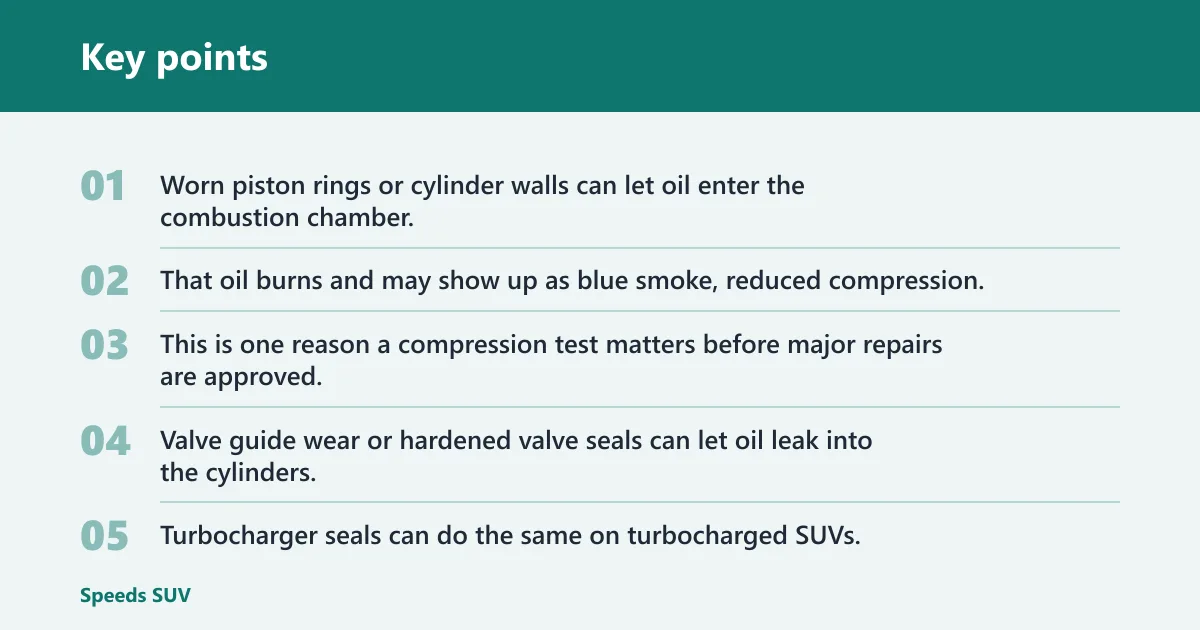
Worn piston rings or cylinder walls can let oil enter the combustion chamber. That oil burns and may show up as blue smoke, reduced compression, or persistent level loss. This is one reason a compression test matters before major repairs are approved.
Valve guides, valve seals, and turbo seals
Valve guide wear or hardened valve seals can let oil leak into the cylinders, often after the engine sits or idles. Turbocharger seals can do the same on turbocharged SUVs. If the smoke is worse after idle or during acceleration, those parts move higher on the list.
Wrong viscosity, PCV issues, and service history
Engine oil viscosity must match the manufacturer’s specification. If the oil is too thin, it can evaporate faster or move past clearances more easily. PCV problems can raise crankcase pressure and push oil where it should not go. Service history matters too, because long intervals can hide a developing problem until the level drops far enough to trigger a warning.
Suppose a turbocharged 2.0L SUV starts using oil after a switch to a thinner grade than the manual allows. The first check should be the oil spec, not the turbo. If the grade is correct and the level still falls fast, then leak inspection and internal wear checks become the next step.
Why some SUVs use more oil
Towing, steep grades, short trips, cold starts, and turbo use can make oil consumption look worse. Those conditions do not create a fault by themselves, but they can raise oil use or expose an existing one. Extended oil intervals can also make topping up between services more common.
Towing, steep grades, and high load
Higher engine load can increase heat and crankcase pressure. An SUV that tows often or climbs long grades may use more oil than the same vehicle on easy highway commuting. That is one reason the same engine can look normal in one use case and not in another.
Short trips and cold starts
Short trips can leave fuel and moisture in the oil longer, and repeated cold starts can increase wear over time. That can change how the engine uses oil, especially if the service interval is long. It is a factor, not a verdict.
Turbocharged engines and extended oil intervals
Turbocharged SUVs can be more sensitive to oil quality, oil level, and service timing. Manufacturer guidance can vary widely; for example, some service literature allows roughly 1 liter per 1,500 kilometers, while other brands may allow about 1 liter per 5,000 kilometers. Those limits are manufacturer-specific, so the owner’s manual or service data is the place to check.
How should you check and top off oil?
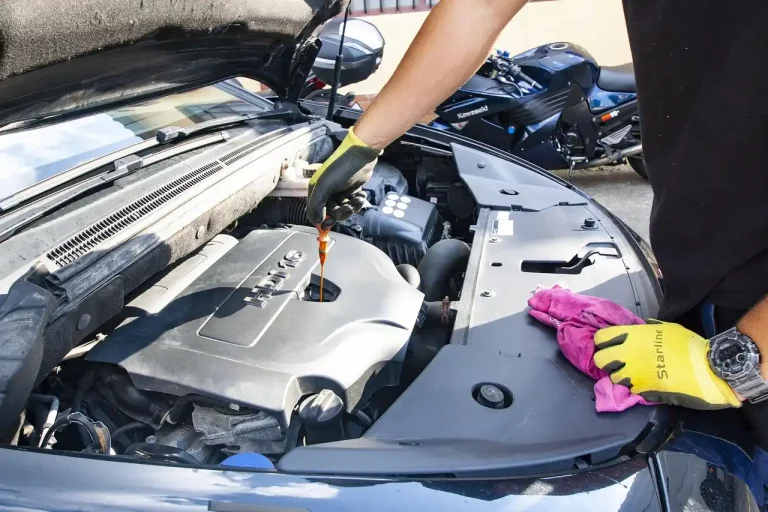
Check the oil on level ground, with the engine off and the vehicle set up the way the owner’s manual specifies. Use the exact oil grade listed for the engine. After a top-off, recheck the level before adding more, because overfilling can cause its own problems.
- Park on level ground and let the engine sit long enough for an accurate check.
- Pull the dipstick or use the approved electronic oil-level procedure.
- Confirm the oil is within the safe range before adding anything.
- Top off in small amounts, then wait and recheck.
- Do not exceed the fill mark, and do not guess at the amount.
- Record mileage and the amount added so you can spot a trend.
Avoid overfilling after a top-off
Too much oil can aerate, raise crankcase pressure, and create new drivability problems. Overfilling can also confuse the diagnosis by making the engine behave differently after the top-off. Add a small amount, recheck, and stop at the correct mark.
How is excessive oil consumption diagnosed?
Proper diagnosis starts with leak inspection and a compression test, then moves to internal wear checks and PCV checks if needed. A mechanic should confirm the cause before major repairs, because the fix for a leaking gasket is not the same as the fix for worn rings or a turbo seal.
Compression test and leak inspection
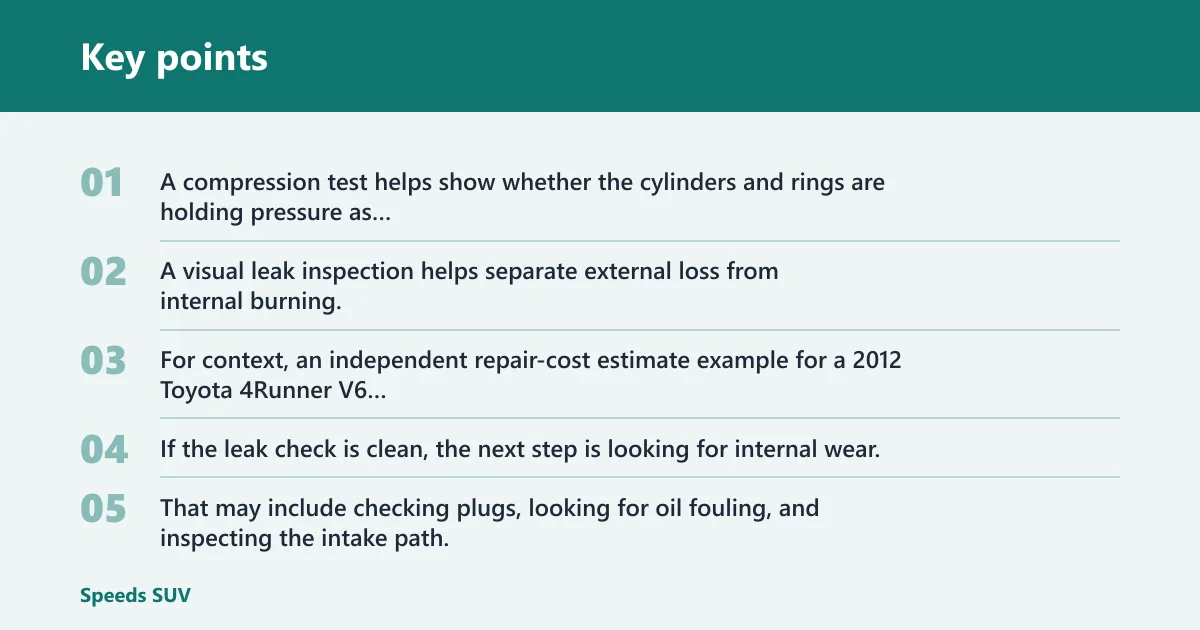
A compression test helps show whether the cylinders and rings are holding pressure as they should. A visual leak inspection helps separate external loss from internal burning. For context, an independent repair-cost estimate example for a 2012 Toyota 4Runner V6 lists a compression test at $370 to $472, but actual pricing depends on labor rates, region, and the exact diagnosis.
Internal wear checks and PCV checks
If the leak check is clean, the next step is looking for internal wear, valve seal problems, or PCV-related pressure issues. That may include checking plugs, looking for oil fouling, and inspecting the intake path. The goal is to narrow the cause before buying parts.
Repair context matters
Repair estimates can range widely once the diagnosis changes. Using the same 2012 Toyota 4Runner V6 example as a reference point, independent estimates have placed valve cover gasket replacement at $773 to $973, camshaft replacement at $2,319 to $2,616, cylinder head gasket replacement at $4,852 to $5,863, and piston rings or an engine rebuild at $6,000+; those figures are model-specific examples, not universal pricing. They show why diagnosis comes first.
Frequently asked questions
What is excessive oil consumption on an SUV?
It is oil use that rises above the manufacturer’s allowed limit or the engine’s normal pattern between services. Many owners use miles per quart to track it. If the level drops fast enough to trigger warning lights or needs frequent top-offs, it deserves diagnosis.
What is normal oil consumption in cars?
Normal oil consumption varies by engine and brand. Some manufacturers allow surprisingly different limits, and some service schedules expect top-offs between oil changes. The owner’s manual or service data is the only safe place to confirm the limit for a specific vehicle.
What causes excessive engine oil consumption?
Common causes include worn piston rings, valve guides, valve seals, turbocharger seals, cylinder wall wear, PCV issues, and the wrong oil viscosity. A leak can also drain the level without any smoke. The pattern and symptoms decide which cause is most likely.
How do I know if my SUV is burning oil or leaking oil?
Check for driveway stains, wet underbody parts, and fresh oil around the filter, drain plug, or gasket seams. Burning oil is more likely when you see blue smoke, especially after idle or during acceleration. Some SUVs show both problems at once.
How much oil consumption is too much between oil changes?
Too much is any rate above the manufacturer’s allowance, and some makers state that in liters per kilometer. A pattern near 1 quart every 1,000 miles is often treated as excessive, but the manual still controls. Rising use, smoke, or warning lights makes it urgent.
Can the wrong oil cause oil consumption in an SUV?
Yes. Oil that is too thin for the engine can pass through clearances more easily and may evaporate faster. The grade has to match the manufacturer’s specification, not just the viscosity on the bottle. Wrong oil can make a marginal engine use more oil.