Why Do Hydraulic Lifters Fail in Truck Engines?
Hydraulic lifters usually fail from oil starvation, aeration, sludge, varnish, wear, or a related valvetrain fault. If you hear a persistent tick, misfire, or low oil pressure, stop driving and test it before teardown. Ignoring it can wipe a cam lobe, bend pushrods, damage rockers, or turn a small oiling problem into an engine rebuild. This guide explains why lifters fail in truck engines, how to separate them from cam, pushrod, rocker, and oil-supply faults, and what to check next.
How hydraulic lifters work in pushrod engines
Hydraulic lifters are self-adjusting valvetrain parts that use engine oil pressure to maintain zero lash. In many truck engines, especially pushrod V8s, the lifter sits between the camshaft and the pushrod, so oil pressure and clean oil are part of the valve train’s operating system, not an afterthought.
When a lifter fills correctly, its internal plunger takes up clearance as parts expand with heat and wear. That keeps the valve train quiet enough, holds valve timing in range, and cuts impact load on the cam lobe, pushrod, and rocker arm. If oil cannot enter or stay inside the lifter, lash returns and noise follows.
How pushrod valvetrains transmit motion
In a pushrod truck engine, the camshaft lobe moves the lifter, the lifter moves the pushrod, the pushrod moves the rocker arm, and the rocker arm opens the valve. A fault anywhere in that chain can sound like a lifter, which is why diagnosis has to include more than one part.
Why zero lash matters
Zero lash means there is no free play in the valve train at operating temperature. Too much clearance creates ticking and can change valve opening events. Too little clearance can hold a valve off its seat, which can cause a misfire, low compression, and hot-running damage.
Why do hydraulic lifters fail?
Hydraulic lifters fail when they cannot fill, hold oil, or move smoothly under load. Common reasons include low oil pressure, aeration, sludge, varnish, internal wear, and contamination that can stick the internal check valve or plunger. On trucks, long oil change intervals and heavy towing make those problems show up sooner.
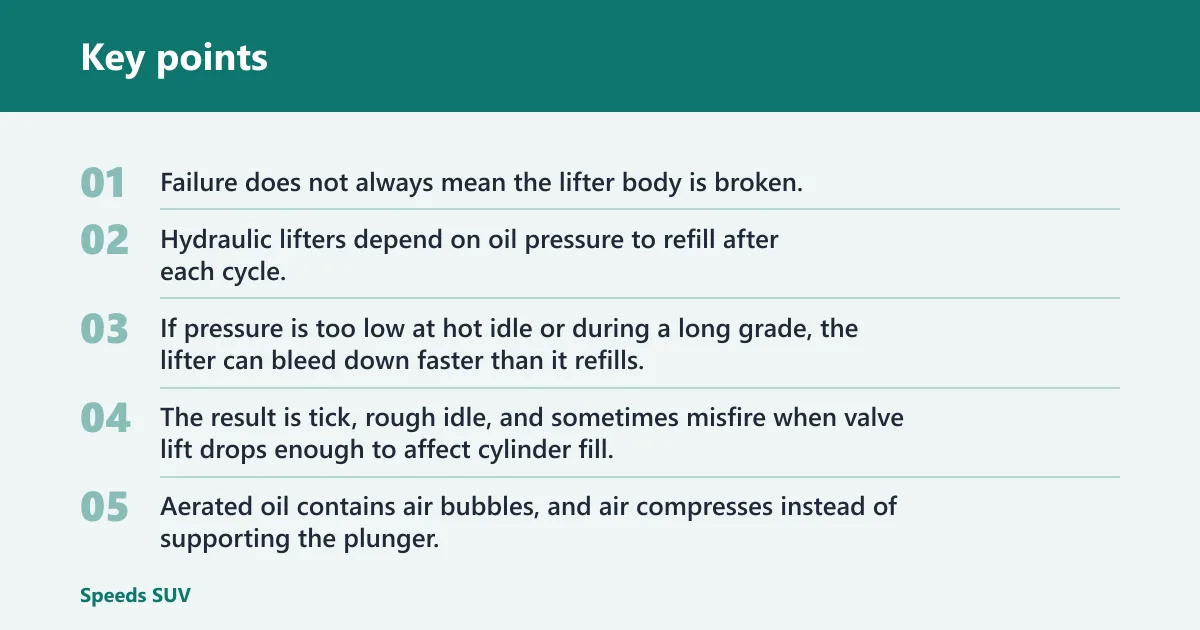
Failure does not always mean the lifter body is broken. A lifter can collapse because the oil supply is weak, because air is mixed into the oil, or because debris is blocking the lifter’s internal feed. That is why the next test should look at the oiling system and the rest of the valve train.
Low oil pressure and oil starvation
Hydraulic lifters depend on oil pressure to refill after each cycle. If pressure is too low at hot idle or during a long grade, the lifter can bleed down faster than it refills. The result is tick, rough idle, and sometimes misfire when valve lift drops enough to affect cylinder fill.
Aeration, sludge, and varnish
Aerated oil contains air bubbles, and air compresses instead of supporting the plunger. Sludge can restrict the lifter feed path, while varnish can make the check valve stick. Either condition can keep the lifter from pumping up even when the gauge shows some oil pressure.
Internal wear, sticking, and bleed-down
Inside the lifter, the plunger, check valve, and bore need close control. Wear lets oil leak out too fast. A stuck plunger or check valve can leave the lifter collapsed after shutdown, so it rattles on restart and may quiet down only after oil flow catches up.
Truck symptoms that point to lifter trouble
Truck lifter problems usually show up as a pattern, not a single sound. Cold-start tick that fades can point to bleed-down. A hot-idle tick that gets louder in gear can point to oil pressure loss. Add misfire, rough idle, or metal in the oil, and the problem is moving beyond a simple noise complaint.
Suppose a 5.3L GM truck has a sharp tick for 20 seconds after a cold start, then quiets down, but the scan tool shows no misfire counters and oil pressure is normal once warm. That pattern is more consistent with lifter bleed-down or slow refill than with a dead cylinder or a wiped cam lobe.
Cold-start tick versus hot-idle tick
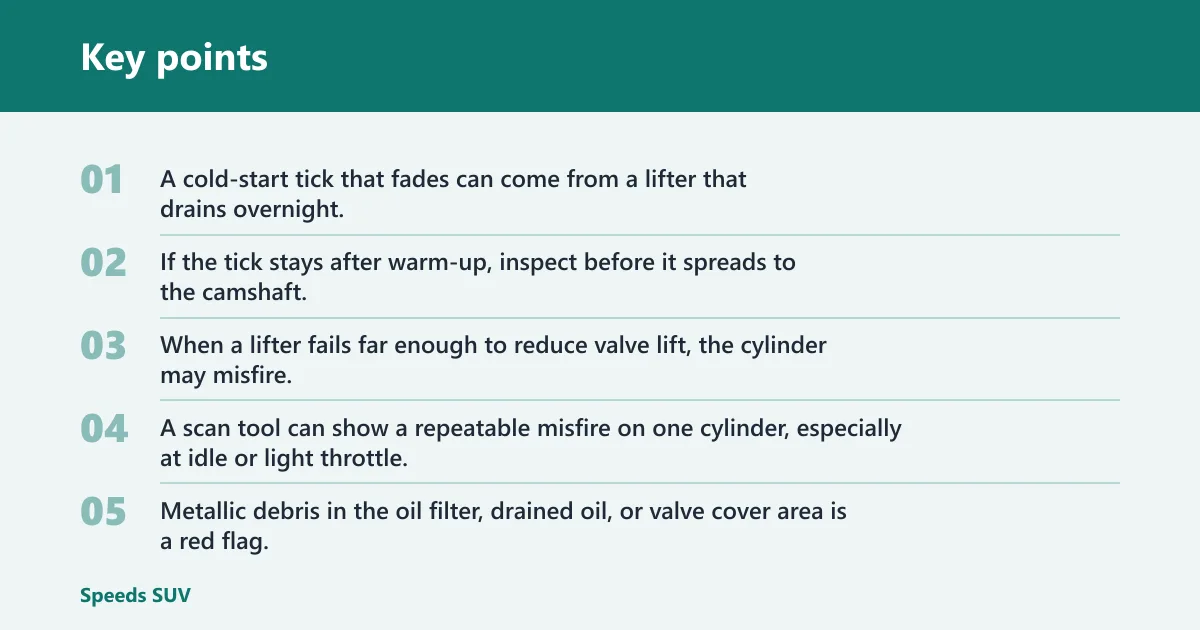
A cold-start tick that fades can come from a lifter that drains overnight. A hot-idle tick is more concerning because hot oil is thinner and pressure is lower, so a weak oiling system shows up there first. If the tick stays after warm-up, inspect before it spreads to the camshaft.
Intermittent misfire and rough idle
When a lifter fails far enough to reduce valve lift, the cylinder may misfire. A scan tool can show a repeatable misfire on one cylinder, especially at idle or light throttle. That makes ignition and fueling worth checking too, because a bad coil, plug, injector, or compression issue can copy the same symptom.
Metallic debris and loss of power
Metallic debris in the oil filter, drained oil, or valve cover area is a red flag. If a cam lobe is wearing through because the lifter is not riding correctly, power drops and debris rises. That is the point where continued running can turn a valvetrain repair into engine damage.
Can low oil pressure cause lifter failure?
Yes. Low oil pressure can cause a hydraulic lifter to collapse, stay noisy, or fail to maintain zero lash. On truck engines, the problem often shows up at hot idle first, because that is when pressure margin is smallest. But the pressure number alone does not explain everything, since aeration or restriction can keep the lifter from filling even if a gauge looks acceptable.
Pressure loss at idle and hot oil
Oil thins as it heats, so a worn pump, worn bearings, or a bypassing relief valve can drop idle pressure enough to starve the lifters. If the tick appears only after the engine is fully hot, verify oil pressure with a mechanical gauge instead of guessing from the dash display.
Restricted pickup screen and filter flow
A restricted pickup screen can starve the pump, and a plugged or collapsing oil filter can reduce flow to the lifters. If a lifter failure follows an oil change, inspect the correct filter part number, the anti-drainback valve, and any debris in the filter media. The filter can tell you more than the noise does.
When oil pressure is the root cause
If measured pressure is below specification, the lifters are often a symptom, not the source. Common next checks are oil level, oil viscosity, pickup screen restriction, pump wear, and bearing clearance. Fixing the lifter alone will not solve a pressure problem that is feeding every moving oil circuit in the engine.
Lifter failure or another valvetrain problem?
Do not stop at the lifter. Camshaft lobe wear, bent pushrods, worn rocker arms, and valve issues can create the same tick, misfire, or power loss. A true diagnosis has to separate the sound of a collapsed lifter from the damage that can make it collapse, or from damage that only looks like a lifter fault.
Camshaft lobe wear
A worn cam lobe reduces lift and can make the engine misfire on one cylinder. It often leaves metal in the oil and may produce a flatter, duller tick than a free-moving lifter. If a lobe is damaged, replacing lifters alone will not fix the cylinder, and the new parts can fail quickly.
Pushrod damage
A bent pushrod changes valve travel and can mimic a weak lifter. It can also bind in the guide or alter rocker geometry. During inspection, roll the pushrod on a flat surface or compare it against a known straight one if the design allows removal without major teardown.
Rocker arm wear and valve issues
Worn rocker tips, loose rocker pivots, or valve guide problems can create noise that sounds like lifter tick. A valve that sticks in the guide can also make a lifter look bad because the cylinder may misfire or show uneven compression. Check the top end before assuming the lifter is the only failure point.
Lifter failure on GM AFM and DFM trucks
AFM and DFM systems on some GM trucks use special lifters for cylinder deactivation. These lifters can fail differently from standard hydraulic lifters because they must move in two modes. A fault here can create intermittent misfire, a persistent tick, or a cylinder that drops out under light load, which can look like ordinary lifter noise at first.
How AFM and DFM lifters differ
Standard hydraulic lifters maintain lash and follow cam motion all the time. AFM and DFM lifters also have internal locking or release parts that let them deactivate a cylinder when commanded. That extra mechanism adds failure points and makes oil cleanliness and correct pressure even more important.
Why deactivation systems fail differently
AFM and DFM lifters can stick in the wrong mode, collapse, or fail to release when commanded. That can cause a dead miss, a surge, or a noise that comes and goes with operating mode. On these trucks, scan data matters because the command state can help separate a deactivation fault from a plain mechanical tick.
What symptoms can mimic standard lifter noise
A GM truck with AFM or DFM may sound like it has one bad lifter when the real issue is a deactivation fault, oil control problem, or cam lobe wear from a failed lifter. That is why cylinder-specific misfire counts, valve train noise location, and oil condition all need to be checked together.
Lifter failure diagnostic table
This table maps common symptom patterns to the most likely cause and the next test to run. Use it to narrow the fault before tearing into the engine.
| Symptom pattern | Likely cause | Next best test |
|---|---|---|
| Cold-start tick that fades in 10 to 60 seconds | Lifter bleed-down, slow refill, or minor varnish | Check oil level, then verify hot and cold oil pressure with a mechanical gauge |
| Hot-idle tick that gets louder in gear | Low oil pressure, worn lifter, or internal leak in the valve train | Measure hot idle pressure and inspect for aerated oil, sludge, or a restricted filter |
| Intermittent misfire on one cylinder | Collapsed lifter, cam lobe wear, bent pushrod, ignition fault, or injector fault | Read misfire counters, then run compression and leakdown tests on that cylinder |
| Low oil pressure warning plus ticking | Oil pump wear, pickup restriction, bearing wear, or filter flow problem | Verify pressure with a gauge and inspect the pickup screen and oil filter |
| Metallic debris in oil or filter | Cam lobe wear, lifter wheel damage, or broader valvetrain wear | Cut open the oil filter and inspect the cam, lifter bores, pushrods, and rockers |
- Confirm the symptom pattern. Note whether the noise is cold, hot, steady, or intermittent, and whether a misfire code points to one cylinder. That pattern guides the rest of the diagnosis and keeps you from replacing parts at random.
- Check oil pressure accurately. Use a mechanical gauge at the correct port and compare hot idle readings with the service specification. A dash display can lag or smooth out a real pressure drop.
- Inspect oil condition and filter. Look for sludge, fuel dilution, metallic debris, and the correct filter part number. If the filter media contains glitter or flakes, treat the problem as internal damage until proven otherwise.
- Run compression and leakdown tests. A weak cylinder points toward valve sealing loss, cam wear, or a lifter that is not opening the valve enough. Leakdown helps separate ring leakage from valve leakage.
- Inspect the top end. Check pushrods, rocker arms, and any accessible lifter or valve cover area for obvious wear or abnormal movement. A bent pushrod or loose rocker can be the real fault.
A common first-timer mistake is replacing a noisy lifter after seeing a single ticking cylinder, then finding the same tick returns because the oil pressure problem was never fixed. If the filter is full of metal or the pressure is low, the repair path is deeper than a parts swap.
Frequently asked questions
What causes lifter failure in a truck engine?
Truck engines often see lifter failure from oil starvation, restricted pickup screens, dirty or wrong oil, and valvetrain wear. On pushrod V8s, the lifter also depends on the cam, pushrods, and rocker arms staying aligned. A fault in any one of those can look like a bad lifter.
Why hydraulic lifters won’t pump up?
A lifter may not pump up because oil cannot reach it fast enough, air is trapped in the oil, the check valve is sticking, or the internal parts are worn. Hot thin oil makes the problem easier to notice. A pressure check and oil inspection should come before teardown.
Are lifters an engine problem or a separate issue?
Lifters are part of the engine, but their failure is often a symptom of a broader oiling or valvetrain problem. Low oil pressure, cam wear, bent pushrods, or worn rockers can all be involved. That is why the diagnosis should cover oil delivery, valve motion, and cylinder health together.
What are hydraulic lifters?
Hydraulic lifters are self-adjusting valvetrain components that use engine oil pressure to maintain zero lash. They sit in the oiling and motion path between the camshaft and the valves in many truck engines. Their job is to keep valve operation quiet and consistent as parts wear and expand.
Mechanical lifters vs hydraulic lifters: what is the difference?
Mechanical lifters do not self-adjust for lash and usually require set clearance. Hydraulic lifters use oil pressure to take up clearance automatically. In truck engines, hydraulic lifters are far more common because they reduce maintenance, but they are also more sensitive to oil pressure and oil cleanliness.