Truck Transmission Problems: Symptoms, Causes & Fixes
Many truck transmission problems fall into a few common buckets: low or burnt fluid, excess heat, electrical or control faults, internal clutch or valve-body wear, or driveline issues that can feel like transmission failure. Miss the symptom-to-cause match and a fluid service or sensor repair can turn into a tow, a failed unit, or an expensive rebuild that may land in the low-thousands. This guide links slipping, harsh shifts, limp mode, overheating, vibration, and warning lights to likely causes, severity, and the right fix.
Start with the safe-to-drive screen. Severe slipping, no-move conditions, a burnt smell, fluid overheating, or limp mode with speed or power limits often point toward scan data, pressure checks, cooler checks, and, in many cases, towing instead of continued driving. Vibration under throttle that disappears on coast follows a different path, because that pattern often points away from the transmission and toward driveline angle or balance.
What are the signs of truck transmission problems?
Truck transmission trouble often shows up as slipping, delayed engagement, hard or erratic shifts, overheating, a burnt fluid smell, limp mode, or a no-move condition. The useful split is whether the symptom follows heat and pressure loss, electronic control faults, or a driveline issue that only feels like transmission failure.
Symptoms that point to fluid, heat, or pressure loss
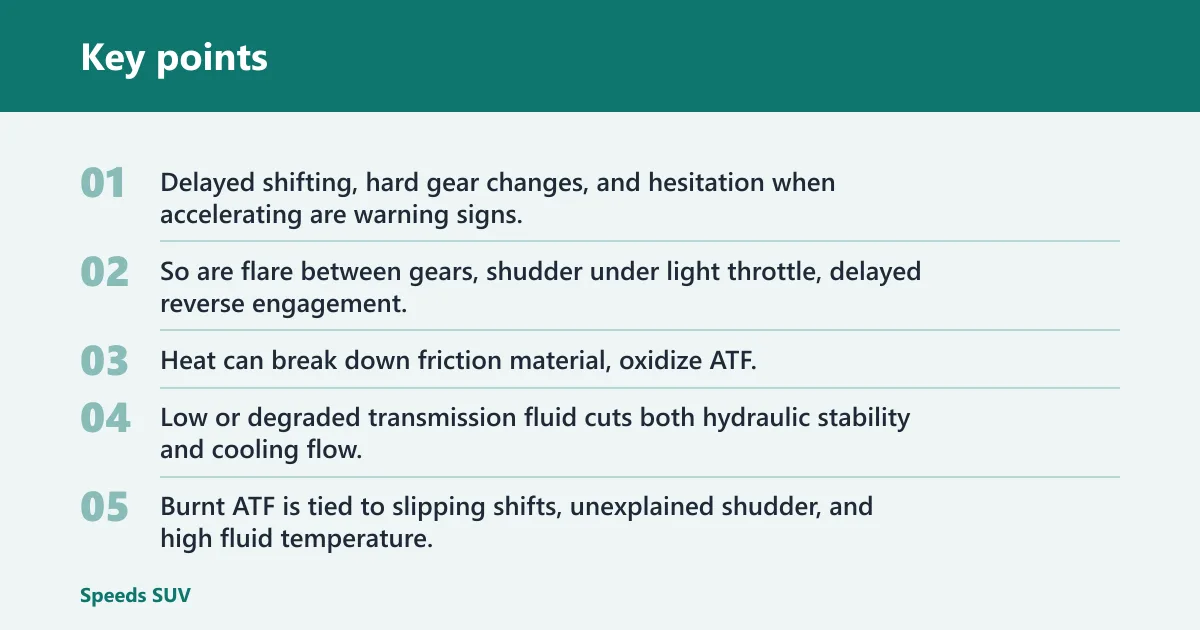
Delayed shifting, hard gear changes, and hesitation when accelerating are warning signs. So are flare between gears, shudder under light throttle, delayed reverse engagement, and rising transmission temperature during towing or grades.
Heat can break down friction material, oxidize ATF, and reduce the margin before clutch slip starts, which is why repeated overheating is commonly said to shorten the life of automatic and AMT units. Low or degraded transmission fluid cuts both hydraulic stability and cooling flow, and dark color, a burnt smell, or gritty texture show the fluid is no longer protecting the unit. Burnt ATF is tied to slipping shifts, unexplained shudder, and high fluid temperature.
A truck that starts fine cold but slips hot often fits this bucket. So does a unit that shifts normally unloaded but acts up while towing, hauling, or climbing. Heavy towing or hauling raises converter slip, clutch apply demand, and fluid temperature.
Symptoms that point to control-system or sensor faults
Repeated flare on the same shift can point to a pressure-control solenoid or calibration issue. Limp mode, sudden harsh default shifts, loss of manual shift function, and lockup cycling at steady speed often fit electronics, wiring, or software better than hard-part failure.
Converter lockup cycling can result from electrical noise or poor grounding. A scan tool can often separate control faults from worn clutches by comparing commanded gear, slip speed, solenoid current, and whether the problem appears only after a sensor reading goes out of range.
AMTs and dual-clutch units deserve separate treatment. An AMT that will not complete a shift may be dealing with clutch actuator travel, gear-position feedback, or calibration logic. A dual-clutch complaint often feels like odd launch behavior, clutch overheat warnings, or one gearset dropping out rather than broad slip in every range.
Symptoms that can come from the driveline instead
Some “transmission” complaints are really load-sensitive vibration or clunk from the driveline. A vibration under throttle that disappears on coast points to driveline angle or balance issues, especially when shifts themselves feel normal and engine speed does not flare.
Look at mount condition, output shaft angle, driveshaft angle, pinion angle, U-joints, and shaft balance before approving teardown. A bad mount can change geometry enough to create shudder on takeoff, and a worn U-joint can mimic harsh engagement.
Transmission symptom matrix
| Symptom | Likely causes | First checks | Severity | Drive, monitor, or tow |
|---|---|---|---|---|
| Delayed drive or reverse engagement | Low fluid, clogged filter, pressure loss, worn seals | Verify level, check for foaming, scan line pressure, inspect leaks | High | Drive only to service if mild; tow if worsening |
| Engine flare on upshift | Low pressure, clutch slip, solenoid or calibration fault | Check fluid condition, compare commanded versus actual line pressure, scan slip speed | High | Tow if repeated or severe |
| Harsh 1-2 or 2-3 shift | Pressure-control solenoid, valve body debris, adaptation or calibration issue | Read codes, watch solenoid current, review update history | Medium to high | Drive only to service |
| No upshift out of one gear | Limp mode, speed sensor fault, TCM strategy, wiring | Scan codes, freeze-frame data, confirm sensor inputs | High | Drive only if speed-limited and safe to service; otherwise tow |
| Overheat on grades | Converter slip, low fluid, cooler restriction, heavy load | Watch ATF temperature, inspect cooler airflow and lines, compare inlet and outlet temps | High | Stop and cool; tow if temperature keeps climbing |
| Burnt smell from fluid | Oxidized fluid, clutch slip, converter heat, poor cooler efficiency | Inspect color and odor, scan temperature history, inspect pan debris | High | Do not continue normal driving; service or tow |
| Shudder at light throttle in lockup range | Converter clutch slip, wrong fluid spec, electrical noise, poor ground | Check lockup command, slip rpm, fluid spec, battery and grounds | Medium to high | Drive only to diagnosis if mild |
| No move in drive or reverse | Major pressure loss, stripped hard parts, failed pump, severe low fluid | Check level, leak volume, line pressure presence, scan gear command | Severe | Tow now |
| Fluid leak at pan or cooler line | Gasket seep, loose pan, rusted cooler line, seal failure | Clean and trace source, verify level, inspect cooler lines for corrosion | Medium to high | Monitor only if minor and level stable; otherwise service immediately |
| Vibration under throttle, gone on coast | Driveline angle, balance, U-joint, mount issue | Inspect mounts, measure angles, check shaft and joints | Medium | Drive to driveline service if no slip or heat signs |
| AMT will not complete shift | Actuator fault, clutch wear, position sensor, software issue | Scan clutch travel and gear-position data, inspect power supply | High | Drive only if unit still selects gears cleanly; often tow |
| Dual-clutch launch judder or overheat warning | Clutch overheating, adaptation fault, contaminated fluid where applicable | Read clutch temperature and adaptation data, confirm latest calibration | High | Stop, cool, and diagnose before reuse |
Why is my truck not shifting gears?
A truck that will not shift usually has either a pressure problem, a control-system problem, or a protective strategy forcing limp mode. Start with fluid level and condition, then move to scan data, because no-shift complaints often feel mechanical from the seat but prove electronic on the scanner.
Low fluid, clogged filter, and pressure loss
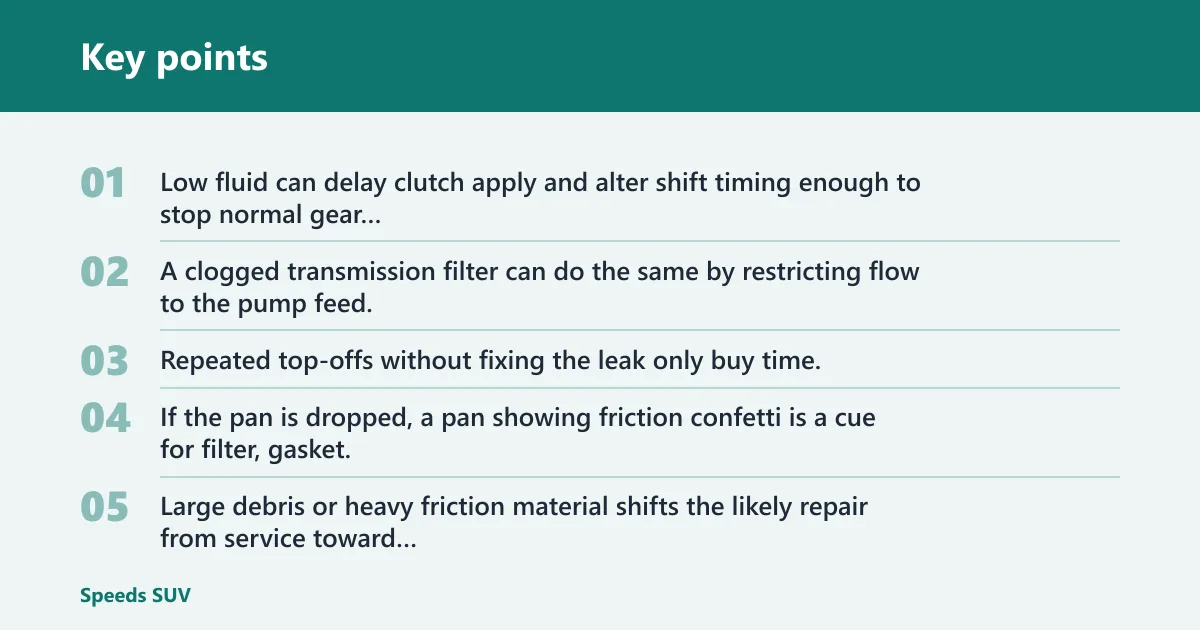
Low fluid can delay clutch apply and alter shift timing enough to stop normal gear changes. A clogged transmission filter can do the same by restricting flow to the pump feed, especially when hot. Repeated top-offs without fixing the leak only buy time.
If the pan is dropped, a pan showing friction confetti is a cue for filter, gasket, and magnet cleaning. Large debris or heavy friction material shifts the likely repair from service toward internal wear.
Solenoids, valve body faults, and line pressure mismatch
Commanded versus actual line pressure is a core diagnostic comparison. If the TCM commands pressure up but actual response lags, valve body debris or a weak pump belongs high on the list. A laggy pressure response can indicate valve body debris or a weak pump.
Harsh shifts can come from the same area. Pressure-control solenoids, sticking valves, and debris contamination can create delayed shifts one minute and bang shifts the next.
TCM calibration, sensor inputs, and limp mode behavior
Limp mode can cut power, limit speed, hold one gear, or disable manual selection to protect the unit. That points to protection logic, not automatically to hard-part failure. Sensor inputs such as input speed, output speed, temperature, brake switch, and range position all matter to shift timing.
Software updates can change temperature correction and shift scheduling. That matters on trucks with repeat flare, lockup cycling, or complaints that started after battery, charging, or grounding issues.
How automatic, AMT, and dual-clutch no-shift complaints differ
Automatics usually fail to shift because pressure, solenoid control, or clutch holding drops out. AMTs often show missed shifts, neutral drops, or refusal to engage due to actuator, clutch, or position-sensor problems. Dual-clutch units more often show gearset-specific faults, launch shudder, or overheat-triggered protection.
Say your fleet truck stays in one gear after a warning light appears, but line pressure and fluid condition look normal. That pattern is more consistent with limp mode and a control fault than with an immediate rebuild call.
What causes a truck transmission to overheat?
Truck transmissions overheat when heat generation beats heat removal. Common paths are converter slip, heavy towing or stop-and-go work, low or degraded fluid, cooler restriction, or poor airflow. Overheat diagnosis should separate a unit making too much heat internally from one that cannot shed normal heat externally.
Converter slip, towing load, and stop-and-go heat buildup
The torque converter can create major heat before a driver feels obvious slip. Lockup clutch slip, repeated release on grades, or highway RPM flare all raise temperature fast. One warning threshold mentioned is ATF temperature exceeding 220°F on grades.
Heavy towing, plowing, route delivery, and urban stop-and-go duty are harder on the converter than unloaded highway use. Automatics and AMTs both suffer here, though an AMT may show clutch-related heat behavior instead of converter heat if it uses a dry clutch.
Cooler efficiency, restricted flow, and auxiliary cooler limits
Verify the spec’d fluid, interval, and cooler efficiency. Cooler checks should include airflow through the heat exchanger, kinked or corroded lines, internal restriction, and inlet versus outlet temperature delta. A cooler that has almost no temperature drop may have poor airflow; one with strange flow behavior may be restricted.
An external auxiliary cooler can help under steady heavy load, but it will not fix converter slip, a blocked line, or oxidized fluid. Coastal corrosion matters here because cooler lines can rust from the outside and seep long before a major leak is noticed.
Fluid oxidation, burnt smell, and when heat becomes a tow-now issue
Burnt odor and darkened fluid matter because oxidation changes friction behavior and heat handling. A truck that repeatedly overheats, smells burnt, or starts slipping after temperature rises should not stay in service until “the next convenient stop.”
Suppose a pickup towing a travel trailer begins hunting between lockup and release on a long climb, then the fluid smell changes at the next pull-off. That is a stop-and-diagnose moment, because continued load can turn a cooler or control problem into clutch damage.
Can low transmission fluid cause shifting problems?
Low transmission fluid can cause delayed engagement, flare, harsh shifts, shudder, overheating, and no-move complaints because the unit can lose stable hydraulic apply pressure and cooling capacity. The useful question is not whether low fluid matters, but why it is low and whether the fluid itself is still usable.
How low fluid affects clutch apply pressure and engagement timing
Clutches and bands need consistent pressure. When the pickup draws aerated fluid instead of a solid supply, apply timing changes and friction elements can slip. Low or degraded transmission fluid can reduce fluid flow through the cooler circuit and lower heat-carrying capacity, so a low-level problem often becomes a heat problem next.
How to check level and condition the right way
- Use the OEM procedure for temperature, engine state, and gear selection.
- Confirm the exact fluid specification before adding or replacing any fluid.
- Check color, smell, and texture, not just level.
- Look for foaming, which suggests aeration or overfill.
- Inspect the pan rail, cooler lines, case connector, and bellhousing area for leaks.
Spec-specific fluid type matters. Wrong friction characteristics can create shudder, poor lockup, or harsh shifts even when level is correct.
Leaks, aeration, contamination, and repeated top-off traps
Repeated top-offs without leak repair are a trap because the underlying air ingestion, pressure loss, or contamination remains. Gasket leaks, cooler-line corrosion, and case connector seepage are common serviceable causes.
A common first-timer mistake is adding generic fluid to stop a low-level warning, then chasing a new shudder a week later. The level may improve while the friction behavior gets worse because the spec was wrong.
What does slipping mean, and how serious is it?
Slipping means engine speed rises without the expected increase in vehicle speed or gear holding. It may happen on a shift, during converter lockup, under load in one gear, or when selecting drive or reverse. Mild slip is still urgent because friction slip creates heat fast.
Engine flare, delayed engagement, and lockup clutch slip
Flare during a shift points to a clutch or pressure-control problem. Delayed engagement from park to drive suggests pressure fill loss. Lockup clutch slip shows up differently: steady-speed shudder, tach movement at cruise, or cycling between lock and release.
Repeated flare on the same shift can point to a pressure-control solenoid or calibration issue. That is one reason slip should be verified with scan data before anyone jumps to a rebuild estimate.
Torque converter versus clutch-pack slip symptoms
Converter slip often appears at cruise or on grades, with shudder or RPM flutter near lockup. Clutch-pack slip is more likely during the actual gear change or under heavy pull in a specific gear. AMTs can mimic slip through clutch wear or adaptation faults, while dual-clutch units may affect only one clutch path.
When slipping points to service, converter work, or rebuild
Service-level fixes make sense when fluid is wrong, degraded, low, or restricted by a clogged filter, and scan data does not show major ratio errors. Converter replacement enters the picture when lockup behavior and heat point there. Rebuild territory starts when slip is broad, persistent, debris is heavy, and pressure or ratio data confirm internal damage.
Is it the transmission or the driveline?
The quickest split is this: transmission faults usually change with gear command, fluid temperature, or line pressure, while driveline faults usually change with load and shaft speed. If the truck shifts correctly but vibrates under throttle and smooths out on coast, inspect the driveline before blaming the transmission.
Driveline geometry: output shaft, driveshaft, and pinion angles
Output shaft angle, driveshaft angle, and pinion angle must work together. Lift kits, sagging rear springs, worn mounts, and previous driveshaft work can upset that geometry enough to create shudder, rumble, or boom that drivers describe as a transmission problem.
Mount condition, U-joints, balance, and load-sensitive vibration
Broken or soft mounts let the powertrain move under torque. That changes working angles and can produce harsh takeoff feel. U-joints with play or bind, missing balance weights, and dented shafts all deserve inspection when the complaint is speed- or load-sensitive rather than shift-specific.
Road-speed vibration versus gear-change behavior
If vibration appears at a certain road speed in multiple gears, the driveline moves up the list. If the complaint happens only during a 2-3 shift or only in lockup apply, transmission control stays in focus.
Picture a 4×4 that vibrates at 45 mph under throttle in third and fourth, then smooths out the instant the driver lifts. That points far more strongly to driveline geometry or balance than to a slipping clutch pack.
What should you check before approving major repairs?
Before approving a rebuild, gather proof from scan data, fluid inspection, pressure behavior, and pan findings. Many expensive mistakes start when a shop or owner sees one bad symptom and skips the checks that separate a cooler, solenoid, calibration, or driveline problem from internal failure.
Scan data: codes, fluid temperature, slip speed, and solenoid current
Start with codes and freeze-frame data. Then look at fluid temperature, commanded gear, input and output speed, converter slip speed, and solenoid current where the system reports it. Trends matter more than one snapshot.
Pressure checks: commanded versus actual line pressure
Commanded versus actual line pressure tells a lot. If commanded rises and actual follows cleanly, the pump and valve body may be healthy enough to look elsewhere. If actual pressure is slow or unstable, debris, restriction, a weak pump, or control hardware belongs higher on the list.
Pan inspection: filter restriction, debris, and magnet findings
Drop the pan when the design allows. Check the filter for clogging, the gasket for seep paths, and the magnet for normal paste versus heavy metal or friction material. A pan showing friction confetti is a warning that service alone may not solve the complaint.
Software updates and calibration checks
Calibration matters on modern automatics, AMTs, and dual-clutch units. Verify current TCM software, relearn status where applicable, battery and ground quality, and any known updates that alter shift timing or temperature correction logic.
What fixes match the most common fault paths?
The right fix follows the fault path. Fluid, filter, leak, and cooler problems often stop at service-level repairs; electronics and pressure-control faults may need wiring, solenoids, valve body work, or software; persistent slip, heavy debris, and no-move conditions push the repair toward converter replacement or rebuild.
Service fixes: fluid, filter, gasket, and leak repair
Start here when fluid is low, oxidized, burnt, contaminated, or wrong-spec, and when the pan does not show major debris. Include filter and gasket service, magnet cleaning, and leak repair at the same time. A fresh fill without fixing the cause is incomplete work.
Cooling fixes: lines, cooler cleaning, replacement, and airflow correction
Cooling repairs include clearing blocked airflow, replacing restricted or leaking lines, flushing or replacing a contaminated cooler where the OEM permits, and checking whether an auxiliary cooler is sized and routed properly for towing duty.
Control fixes: sensors, wiring, solenoids, valve body, and TCM updates
Use this path when scan data points to sensor mismatch, erratic solenoid current, poor grounds, or line-pressure control errors. Valve body cleaning or replacement may solve delayed or harsh shifts caused by debris contamination.
Mechanical fixes: converter, internal hard parts, and rebuild threshold
Converter replacement makes sense when lockup slip and heat are the main pattern. Full rebuild becomes more likely when the truck has repeated broad slip, no-move complaints, major ratio errors, or heavy friction and metal in the pan.
Repair scope should match proof. That is how owners and fleets avoid paying rebuild money for a cooler restriction, wiring fault, or bad mount.
How can you prevent repeat transmission problems?
Repeat failures usually come from one of four misses: wrong fluid spec, poor heat control, ignored leaks or cooler-line corrosion, or service intervals that do not match the truck’s actual workload. Prevention is less about a fixed mileage rule and more about duty cycle, temperature, and contamination control.
Maintenance intervals by use case: towing, hauling, fleet duty, and heat
Most manufacturers list different service schedules for normal and severe use. Towing, hauling, mountain grades, hot climates, and stop-and-go fleet work belong on the severe side. Those trucks need closer attention to fluid condition, filter service where applicable, and cooler health.
Fluid-spec discipline and contamination control
Use only the specified fluid. Keep fill tools clean, cap open cooler lines during related repairs, and do not mix fluids unless the OEM allows it. Wrong fluid and dirt in the valve body create problems that look expensive even when the hard parts are still sound.
Corrosion, cooler-line inspection, and operating habits that raise heat
Inspect cooler lines, fittings, and brackets for rust in snow-belt or coastal use. During towing, watch for repeated release on grades and back off before heat snowballs. If the truck consistently runs hot in its real workload, cooler efficiency and calibration deserve review instead of repeated fluid changes alone.
Frequently asked questions
Should I keep driving if my truck has a burnt transmission smell?
No normal-use recommendation fits a burnt transmission smell. Burnt fluid is tied to heat and slip, and both can worsen quickly. Check level and condition, scan temperature if possible, and plan service or towing rather than continuing to haul, tow, or climb grades.
What causes hard shifting in a truck transmission?
Hard shifting usually comes from pressure-control problems, valve body debris, solenoid faults, wrong or degraded fluid, or TCM logic reacting to bad sensor data. It can also appear in limp mode. Scan data and commanded-versus-actual line pressure are the fastest ways to narrow it down.
How do I know if the problem is the transmission or the driveline?
If the symptom follows a specific shift event, fluid temperature rise, slip, or limp mode, suspect the transmission or its controls. If it shows up as vibration under throttle, disappears on coast, and does not change with shift timing, inspect mounts, U-joints, balance, and driveline angles first.