Why Is My SUV Using Oil but Not Leaking?
If your SUV loses oil with no puddle, the engine may be burning it, leaking it inside the engine bay, or pulling it through a failed seal, and a loss of around 1 quart per 1,000 to 2,000 miles is often treated as a red flag. Ignore it and you can end up with low oil pressure, a damaged catalytic converter, and a repair that spreads to other parts. This guide shows how to separate consumption from hidden leaks, what to check first, and when to stop swapping parts at random.
Why an SUV can lose oil without a puddle

Oil can disappear with no driveway spot because it may burn inside the cylinders or move into the intake path. It can also seep from a gasket or housing, then burn off on hot parts before it reaches the ground. One dipstick reading does not prove a pattern.
Hidden external seepage
Start by ruling out leaks you may not notice under the vehicle. Check the valve cover gaskets, oil pan edges, drain plug area, oil filter housing, and any front cover or cooler line connections. A small seep can coat the engine underside and never drip enough to form a puddle.
Why the dipstick matters
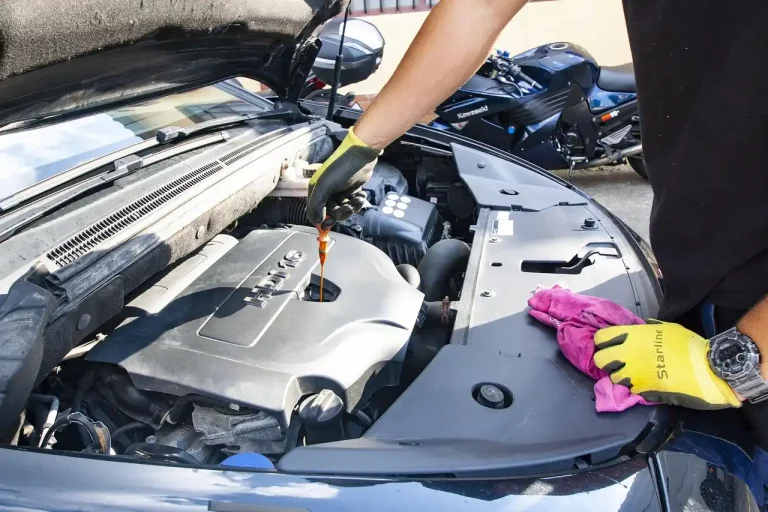
The oil dipstick is the first measurement tool, but only if you use it the same way each time. Check on level ground, with the engine off and cooled per the owner procedure. If the level keeps dropping over miles, you are seeing real consumption, not a one-time reading.
Oil consumption diagnostic matrix
| Smoke color | When oil level drops | Spark plug condition | Exhaust smell | Turbo presence | Recommended test |
|---|---|---|---|---|---|
| Blue, often brief | After cold start or deceleration | Oil-fouled one or two plugs | Burning oil, sometimes sharp | Not required | Valve stem seal check, borescope |
| Blue under acceleration | Under load, long highway pulls, towing | Wet or sooty plugs, misfire possible | Burned oil odor after throttle | May be turbocharged | Compression test, leak-down test |
| Little or no visible smoke | Steady drop over hundreds of miles | Normal or mildly dark plugs | May be absent | Either | PCV check, external leak inspection |
| Blue or hazy, intermittent | After idling or boost | Oil on plugs plus intake residue | May smell oily under boost | Yes | Inspect turbo seals, intercooler pipes |
-
Inspect visible leak points.
Clean the suspected area, then look for fresh wet oil around the valve cover, pan rail, drain plug, filter housing, and cooler lines. Hidden seepage can burn off before it drips, so a clean surface matters. -
Verify the oil level correctly.
Park on level ground and follow the owner procedure for a cooled engine. Record the dipstick reading the same way each time so you can compare miles, not guesses. -
Track the consumption rate.
Write down the odometer and how much oil you add. That turns a vague concern into a quart-per-mile trend you can use for diagnosis.
If an SUV with a turbocharged V6 drops about half a quart every 800 miles and the driveway stays clean, that can point toward PCV, turbo seal, or internal burning issues. That pattern points away from a simple floor leak and toward a PCV issue, turbo seal problem, or internal burning path.
Can a bad PCV valve cause oil use?
Yes. A bad PCV valve can raise crankcase pressure, may pull oil mist into the intake, or stick in a way that makes the engine breathe incorrectly. That can raise oil use without any ground leak, which is why the PCV system is often checked before major teardown work.
How PCV problems move oil into the intake
The positive crankcase ventilation valve controls crankcase pressure and routes vapors back into the engine. If it clogs, the crankcase can build pressure and push oil past seals. If it sticks open, it can pull too much oil vapor into the intake stream and burn it.
What a simple PCV check can reveal
-
Inspect the valve and hoses.
Look for cracked hoses, sludge, or oil pooled in the lines. A restricted hose or clogged valve can change crankcase flow enough to raise oil use. -
Check for abnormal suction.
With the engine idling, a faulty PCV path may show excessive vacuum at the oil fill opening or odd idle quality. That does not prove failure by itself, but it narrows the next test. -
Replace only when confirmed.
A simple valve replacement is reasonable if the part is clearly stuck or clogged. If oil loss continues, keep moving through the rest of the diagnosis instead of treating the PCV as a cure-all.
What do blue smoke and oily spark plugs mean?
Blue smoke from the exhaust is one of the clearer signs of oil burning, but it may come and go and be easy to miss. Oily spark plugs are another clue. Together, they point to internal oil entry rather than a simple external seep, especially when the smell is strongest after start-up or on deceleration.
Cold start and deceleration clues
Valve stem seals often show up after the SUV sits overnight or when the throttle closes on downhill driving. Oil can drip into a cylinder while the engine is off, then burn in a short puff on startup. That pattern can look normal at idle and still be a real fault.
How plug fouling points to one cylinder
Spark plugs can show where the problem lives. One plug wet with oil, while the others look normal, can point to a valve seal issue, ring wear in that cylinder, or a turbo oil path feeding one bank. Misfire or rough idle may appear with the fouled plug.
A common first-timer mistake is assuming no smoke means no burning. Blue smoke can appear only for a few seconds on cold start or after an extended idle, then vanish before anyone notices.
When rings, valve seals, or turbo seals are to blame
If external leaks and PCV problems do not explain the loss, look at the parts that keep oil out of the combustion chamber and intake. Piston rings, valve stem seals, and turbocharger seals can all let oil disappear inside the engine without leaving a puddle underneath.
Piston rings
Piston rings seal combustion pressure and help keep oil off the cylinder walls. When they wear, oil can enter the combustion chamber and burn. Compression and leak-down tests are the usual next checks, often paired with borescope inspection for oily deposits on the piston crown.
Valve stem seals
Valve stem seals control oil around the valve stems. When they wear, oil can drip into a cylinder, especially after start-up or on deceleration. The smoke may be brief, which makes the symptom easy to miss and easy to mislabel as a leak.
Turbocharger seals
On turbocharged SUVs, failed turbo seals can send oil into the intake or exhaust side. You may find oil in intercooler pipes or the intake tract, and the SUV can use oil without any ground puddles. Boosted engines also make this path more likely to show under acceleration.
-
Run a compression test.
Compare cylinders with the engine warm and the fuel and ignition disabled as appropriate for the tool and vehicle. Uneven readings can support ring wear or valve sealing loss. -
Follow with leak-down testing.
Pressurized leak-down testing helps separate ring sealing loss from valve sealing loss. It is especially useful when compression numbers are borderline or the symptom pattern is unclear. -
Inspect the intake tract.
Remove intercooler piping where applicable and look for wet oil film or pooling. Turbo seal leakage often leaves this trail before it leaves a puddle.
How to track oil use accurately
Accurate tracking starts with the dipstick, not memory. Check the oil on level ground, with the engine off and cooled per the owner procedure, then record mileage and oil added. That gives you a trend you can compare between oil changes.
Mileage-based oil log
| Odometer | Oil added | Miles since last check | Quart-per-mile trend |
|---|---|---|---|
| 62,000 | 0.0 qt | 0 | — |
| 62,800 | 0.5 qt | 800 | 0.00063 qt/mi |
| 63,600 | 0.5 qt | 800 | 0.00063 qt/mi |
| 64,600 | 1.0 qt | 1,000 | 0.00100 qt/mi |
If the trend stays similar over several checks, the engine is using oil at a real rate. If the reading jumps around, repeat the measurement before replacing parts. One bad sample can come from parking angle, timing, or an incomplete drain-back period.
Oil viscosity and specification
Wrong oil viscosity or a spec mismatch can affect consumption. The oil should match the OEM approval and viscosity grade listed for the engine. In some engines, a thinner oil can be consumed more readily, while high-mileage formulations may help only as a stopgap, not a repair.
When to stop driving and get a diagnosis
Stop treating oil loss as a small annoyance when the level drops fast, the warning light comes on, or the SUV starts to smoke regularly. Prolonged oil burning can damage the catalytic converter, foul oxygen sensors, and shorten the life of other emissions parts. Low oil can also damage the engine itself.
When the risk is urgent
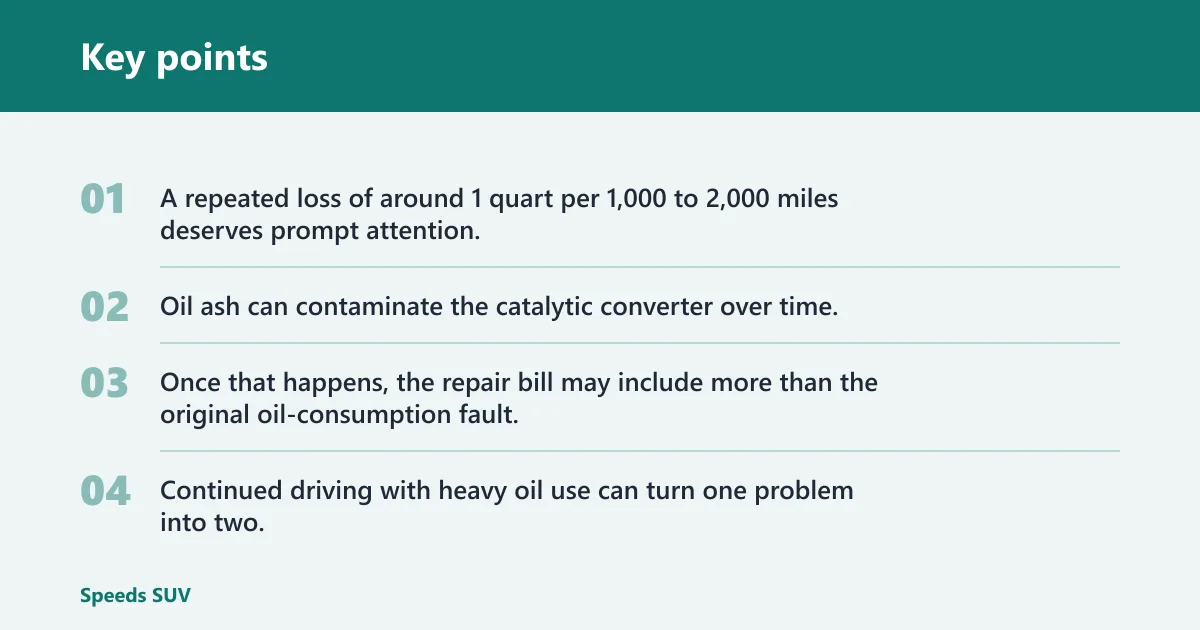
If the dipstick is low again within a few hundred miles, or if you need to add oil often enough to keep the level safe, the diagnosis should move from observation to repair planning. A repeated loss of around 1 quart per 1,000 to 2,000 miles deserves prompt attention.
Why catalytic converter damage matters
Oil ash can contaminate the catalytic converter over time. Once that happens, the repair bill may include more than the original oil-consumption fault. Continued driving with heavy oil use can turn one problem into two.
Frequently asked questions
Why is my SUV using oil but not leaking?
Most often, the oil is being burned inside the engine or pulled into the intake, not dripping to the ground. Common causes include PCV faults, worn piston rings, valve stem seals, turbo seal failure on turbocharged SUVs, or a viscosity/spec mismatch that encourages consumption.
Why is my SUV burning oil but not leaking?
Burning oil without a leak usually means oil is entering the combustion chamber or exhaust stream. Blue smoke, oily plugs, a burning smell, and oil in intake piping point toward internal causes. A compression test, leak-down test, and borescope inspection help separate the fault paths.
How do I tell if my SUV is burning oil or leaking it internally?
Use the dipstick trend first, then look for symptom patterns. Blue smoke, fouled plugs, and oil use that rises after cold starts, deceleration, or boost point to burning. Wet engine surfaces, oil around the filter housing, or seepage at the pan point more toward a hidden external leak.
Can a bad PCV valve cause an SUV to use oil?
Yes. A bad PCV valve can change crankcase pressure or pull oil mist into the intake, increasing oil consumption without a puddle. It is one of the first parts to check because it is simpler than ring or valve work, but continued oil loss means more testing is needed.
Can worn piston rings make an SUV consume oil with no drip on the ground?
Yes. Worn piston rings can let oil enter the combustion chamber, where it burns instead of leaking out. Blue smoke may be brief or intermittent, and spark plugs can foul. Compression and leak-down tests are the usual checks when ring wear is suspected.
When should I stop driving an SUV that is using oil?
Stop or limit driving when the level drops quickly, the oil warning light appears, or you must keep adding oil to stay safe. Continued use can damage the engine, catalytic converter, and oxygen sensors. If the loss is repeated, the SUV needs diagnosis rather than more guessing.