Which Used AWD Systems Are Most Reliable Long Term?
The most reliable used AWD systems are usually simple, mechanical setups from Toyota/Lexus, Subaru, Honda, and truck-based SUVs. If you want the safest bet, favor systems with fewer clutches, pumps, and electronics. Ignore that difference and you can buy a vehicle that still drives fine but turns into a transfer case, coupling, or differential bill later. This guide ranks the most durable AWD designs, explains what fails, and points to the systems worth trusting on the used market.
Which used AWD systems last longest?
The longest-lasting used AWD systems are often the ones with fewer wear items and easier service access, such as Toyota Dynamic Torque Control AWD, Subaru Symmetrical AWD, and Mazda i-Activ AWD. Their durability still depends on fluid service and inspection history, but each tends to age better than more complex torque-vectoring layouts when maintenance is uneven.
Toyota dynamic torque control AWD
This on-demand system appears in many Toyota and Lexus crossovers and is designed with efficiency and simplicity in mind. It usually has a front-drive bias and adds rear drive when the system asks for it, so there are fewer always-loaded parts than in some full-time performance systems. Fluid checks still matter, especially on higher-mileage examples where the PTU, transfer case, or rear drive components may have been neglected.
Subaru Symmetrical AWD
Subaru’s full-time architecture has a long reputation for staying in service for many years, especially in Outback, Forester, and Crosstrek models. The center differential or coupling arrangement is part of that story, along with the way power is shared more continuously than in many part-time systems. That said, this is still an AWD system with fluids, seals, and wear items, not a free pass.
Mazda i-Activ AWD
Mazda’s predictive AWD setup has a low-drama ownership profile in many compact crossovers. It uses sensors to anticipate slip and send torque before wheelspin starts, so sensor health and fluid condition matter more than many shoppers expect. When maintenance is current, it is often a strong fit for buyers who want normal commuting behavior and less mechanical fuss.
AWD reliability matrix
| AWD architecture | Simplicity | Service burden | Known failure points | Ownership risk |
|---|---|---|---|---|
| Toyota Dynamic Torque Control AWD | High | Low to moderate | PTU wear, transfer case fluid neglect, rear differential noise | Low if serviced on time |
| Subaru Symmetrical AWD | High | Moderate | Center coupling wear, differential service neglect, seepage from seals | Low to moderate |
| Mazda i-Activ AWD | High | Low to moderate | Sensor faults, fluid neglect, coupling wear in neglected examples | Low to moderate |
| Honda Real Time AWD | Moderate | Moderate | Rear coupling wear, fluid neglect, shudder during engagement | Moderate |
| Honda i-VTM4 | Moderate | Moderate to high | Rear drive unit complexity, fluid service gaps, electronic control faults | Moderate to high |
| Acura SH-AWD | Lower | Higher | Torque-vectoring hardware, rear drive unit issues, repair cost exposure | Higher |
This table is not a snow ranking. It is a survivability ranking. A system can be excellent in winter and still be expensive to keep alive after 100,000 miles if its service needs are ignored.
Which AWD systems are simpler to own?
The simplest used AWD systems to own are the ones that do not pile extra torque-vectoring hardware onto a normal crossover layout. Honda Real Time AWD can be straightforward in some applications, while Acura SH-AWD usually adds more complexity and more repair exposure. Simpler does not mean maintenance-free, and model-specific differences still matter.
Honda Real Time AWD and i-VTM4
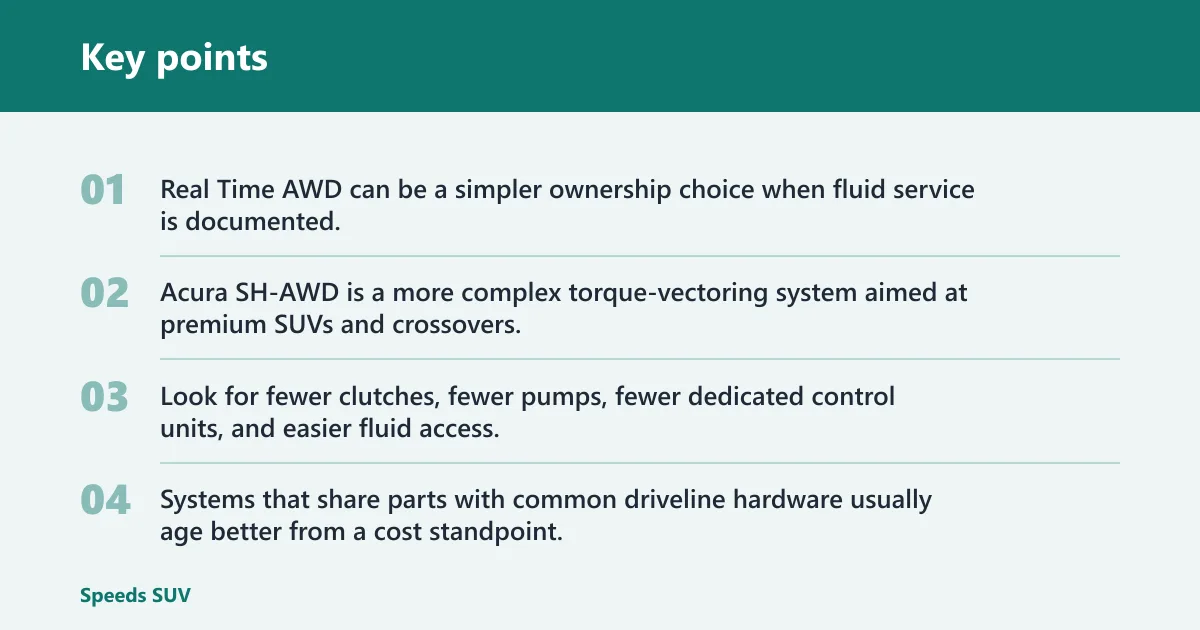
Honda’s front-biased on-demand AWD appears in many SUVs and crossovers, while i-VTM4 adds rear torque vectoring in some newer or higher-trim models. Real Time AWD can be a simpler ownership choice when fluid service is documented. i-VTM4 adds capability, but also more parts that can raise repair cost if the vehicle has seen long service gaps or repeated low-fluid operation.
Acura SH-AWD
Acura SH-AWD is a more complex torque-vectoring system aimed at premium SUVs and crossovers. That complexity can improve handling feel, but it also increases repair risk compared with simpler AWD layouts. For a used buyer, that means service records matter even more, because a neglected premium system can cost far more than a basic on-demand unit to put right.
What makes a system easy to live with?
Look for fewer clutches, fewer pumps, fewer dedicated control units, and easier fluid access. Systems that share parts with common driveline hardware usually age better from a cost standpoint. A durable architecture with plain service access is often a safer used purchase than a flashy system with higher repair labor.
What fails first in used AWD systems?
The first failures are often quiet. They usually start as fluid neglect, seepage, shudder, binding, noise, or a warning light that gets ignored. In many used SUVs, the most expensive early trouble shows up in the transfer case, PTU, rear differential, or coupling pack before the engine itself shows any obvious driveline symptom.
AWD transfer case
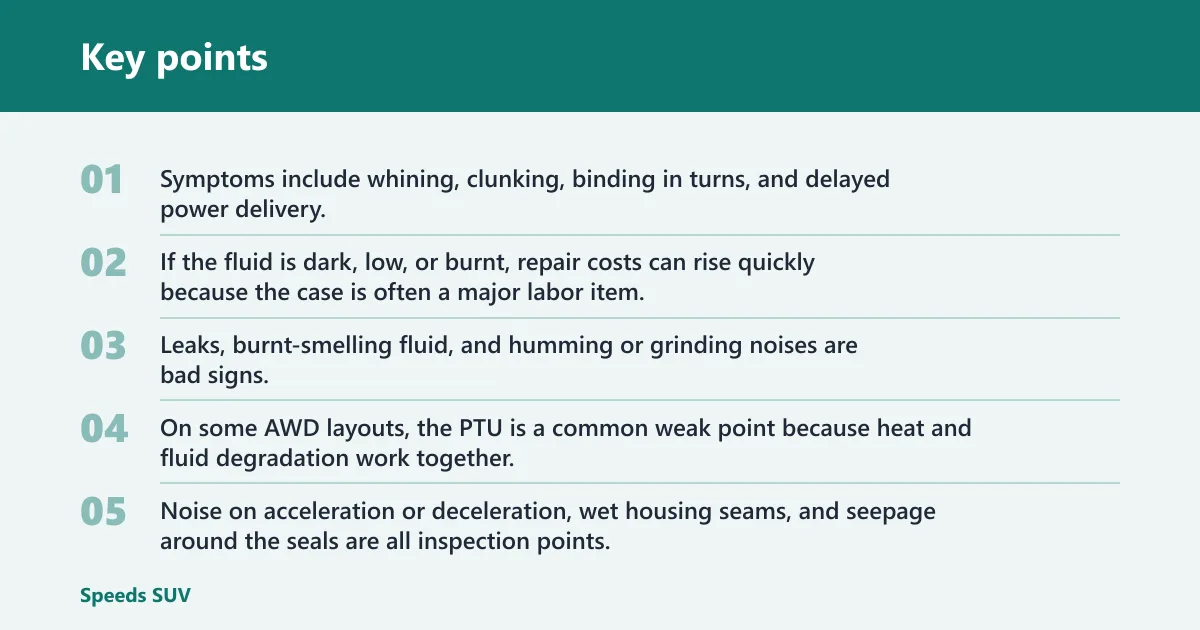
The transfer case needs fluid service on schedule, and many shoppers miss that because the vehicle still drives normally until wear gets advanced. Symptoms include whining, clunking, binding in turns, and delayed power delivery. If the fluid is dark, low, or burnt, repair costs can rise quickly because the case is often a major labor item.
PTU and front-drivetrain heat issues
The power transfer unit sits close to the front drivetrain and can live with heat, short trips, and old fluid for a while before trouble becomes obvious. Leaks, burnt-smelling fluid, and humming or grinding noises are bad signs. On some AWD layouts, the PTU is a common weak point because heat and fluid degradation work together.
Rear differential
The rear differential is a key load-sharing part, and its fluid should not be ignored just because the car still feels smooth. Noise on acceleration or deceleration, wet housing seams, and seepage around the seals are all inspection points. A neglected rear diff can point to broader maintenance gaps elsewhere in the drivetrain.
AWD coupling and clutch pack
Electronic or hydraulic coupling units and clutch packs wear with age, heat, and repeated engagement. Common symptoms are shudder at low speed, binding in tight turns, delayed rear engagement, or a grab-release feel during parking maneuvers. Replacement cost can be meaningful because parts and labor often rise together on these systems.
Picture a 92,000-mile crossover that sounds quiet on the highway but shudders during a slow 90-degree turn in a parking lot. That symptom can point to a coupling or clutch pack issue, not a tire problem, especially if the fluid history is unknown.
What should you check before buying?
Used SUV service records matter more than mileage alone, because they show whether AWD fluids were actually changed on time. A clean record does not guarantee perfection, but it helps separate durable systems from neglected ones. If the seller cannot explain transfer case, PTU, rear differential, or coupling service, the inspection needs to be sharper.
-
Confirm fluid history.
Ask for records showing transfer case, PTU, rear differential, and coupling service where applicable. Many manufacturers list service intervals in the owner’s manual, and a missing record at about 60,000 to 100,000 miles is a warning sign on a used AWD SUV. -
Inspect for leaks.
Look under the vehicle for wet seals, drip points, and fluid residue around the PTU, transfer case, and rear differential. Even a slow seep can mean the unit has run hot or low on fluid long enough to matter. -
Test tight turns.
Drive slowly in a full-lock circle in both directions and listen for binding, hopping, shudder, or clunks. AWD couplings and clutch packs often complain first during low-speed maneuvers. -
Watch for warning lights.
Any drivetrain, stability, or AWD warning light deserves a scan before purchase. A light that has been cleared for sale can still point to stored codes and a pending repair. -
Get a pre-purchase inspection.
Ask for an inspection that includes fluid condition, leak checks, road test behavior, and scan-tool review. That single visit can reveal whether a bargain SUV is actually a future driveline repair.
Suppose a shopper is comparing two 110,000-mile SUVs with the same price. One has records showing transfer case and rear differential service at 60,000 and 100,000 miles. The other has no AWD records at all. The first vehicle is the better bet even if the second looks cleaner.
Which used SUVs fit high-mileage buyers?
High-mileage buyers should favor models with simpler AWD layouts and clear service access. Toyota, Subaru, and Mazda crossovers often fit that brief when the records are solid. Honda can fit as well, but the exact system matters, and Acura SH-AWD asks for more caution because of its higher repair exposure.
Models with simpler AWD layouts
Toyota RAV4, Highlander, and Lexus crossovers with straightforward on-demand AWD are often reasonable high-mileage targets when maintenance is documented. Subaru Outback, Forester, and Crosstrek can also be strong choices because the AWD architecture is familiar and widely understood by independent shops. Mazda CX-5 and similar models are worth a close look when sensors and fluids are in good condition.
Models where service history matters most
Honda SUVs with Real Time AWD can be good buys, but the service record should tell the story. Acura models with SH-AWD need even more proof, because the repair bill for a neglected premium system can outpace the purchase savings fast. In both cases, the drivetrain design matters as much as the badge.
Mileage limits by condition, not a single rule
There is no single mileage that makes a used AWD SUV too old. A 140,000-mile vehicle with documented AWD service can be a better buy than an 80,000-mile example with no records and visible seepage. Mileage is only a number until you know whether the fluids, seals, and couplings were cared for.
Frequently asked questions
Which used AWD systems are the most reliable long term?
Toyota Dynamic Torque Control AWD, Subaru Symmetrical AWD, and Mazda i-Activ AWD are often considered strong choices for long-term reliability because they are comparatively simple and widely used. Their strength comes from lower complexity and better survivability when serviced on time, not from any promise that they cannot fail.
What AWD systems last the longest with the least maintenance?
The systems that tend to last longest are the ones with fewer clutches, fewer pumps, and fewer torque-vectoring parts. Toyota’s on-demand layouts, Subaru’s full-time architecture, and Mazda’s predictive system often hold up well, but all still need fluid checks and periodic service to stay healthy.
Are Toyota AWD systems more reliable than Subaru AWD systems?
That depends on the exact architecture and the maintenance record. Toyota on-demand systems are often simpler, while Subaru’s full-time setup has a strong long-term reputation. Either can outlast the other in a specific vehicle if one was serviced and the other was ignored.
Which used SUVs have reliable AWD systems?
Toyota RAV4 and Highlander, Subaru Outback and Forester, and Mazda CX-5 are common used SUV names that often pair with durable AWD systems. Honda SUVs can also be good picks, but the exact AWD version matters, and the service history should be verified before buying.
What should I look for in a used AWD system before buying?
Check fluid records, look for leaks, listen for humming or clunking, and test tight turns at low speed. A pre-purchase inspection should include the transfer case, PTU, rear differential, and any coupling or clutch pack. Clear records matter more than a clean exterior.
How much does it cost to repair a failed AWD system?
Repair costs vary widely by part and vehicle, but failed couplings, transfer cases, PTUs, or rear differentials can become expensive quickly. Labor often drives the bill up because these components can take time to access, and premium torque-vectoring systems usually cost more than simple on-demand layouts.
What mileage is too high for a used AWD SUV?
There is no single cutoff. A well-maintained 120,000-mile AWD SUV can be safer than a neglected 70,000-mile one. The better question is whether the fluid service is documented, the test drive is quiet, and the inspection shows no leak, shudder, or binding.