How Approach Angle Affects Trailer Loading Clearance
A steeper approach angle makes loading harder because the front bumper, splitter, or underbody can hit the ramp breakover before the tires climb. That can force you into longer ramps, a lower deck, or a clearance check first. Scraping can damage bumpers, splitters, tow hooks, and ramps, and can stop the load entirely. This guide explains how approach angle affects trailer, car hauler, and flatbed loading clearance.
What approach angle means at loading time
Front overhang and the lowest leading edge
Approach angle is a loading-clearance problem at the front of the vehicle. The key geometry is the distance from the front tire contact patch to the lowest point at the nose, plus the height of that lowest point above the ground. If the nose reaches the ramp breakover before the tire climbs, contact starts at the bumper corner, splitter lip, skid plate, or a front tow hook mount.
Low-clearance vehicles are the hardest case. A lowered car with a front splitter can lose clearance from both the front edge and the center underbody. An SUV or work truck usually has more nose clearance, but a long front overhang can still catch on a short, steep ramp.
Loaded versus unloaded stance
Suspension position changes the angle at the trailer. A loaded vehicle with passengers, cargo, or soft rear springs can sit lower in back and change how the nose meets the ramp. Tow vehicles and trailers also move under load, so the loading angle can change after the first axle touches.
That matters most at the transition point where the ramp meets the deck. Even if the ramp slope looks acceptable, the deck lip can still be the first contact point because the vehicle changes pitch as the front wheels climb.
Where scrape contact usually starts
The first contact point is often one of four spots: the bumper corner, splitter lip, skid plate, or winch fairlead area on an equipped front end. On some vehicles, the lowest point is not the visible bumper cover. It is the plastic undertray, a protruding lip, or a front-mounted accessory.
Check the lowest leading edge with the wheels straight and the suspension at normal ride height. Then look again with the front end lightly compressed, because loading can reduce clearance enough to change a pass into a fail.
How ramp angle and deck lips cause contact
Ramp incline is only one part of the problem. The transition at the trailer lip can be steeper than the ramp itself, and that sharp change in angle can hit the nose even when the ramp length seems adequate. If the vehicle bottoms out at the transition, longer ramps or a lower deck are the next fixes.
Ramp incline versus transition point
Loading angle has two checks: the overall slope of the ramp and the breakover at the deck edge. The ramp slope sets the general climb. The lip transition decides whether the front edge scrapes as the tire moves from the ramp to the deck.
A common mistake is judging only the ramp board. A shallow-looking ramp with a sharp top edge can still contact a low splitter. A smoother top transition, or a trailer with a lower deck, gives more usable clearance than a steeper surface alone.
Why the deck edge can be the limit
The deck edge matters because the vehicle pitches as the front wheels climb. That pitch rotates the nose downward relative to the trailer for a moment, which can shorten clearance at the exact point where the tire reaches the lip. On a low car, that is often where the scrape happens first.
Suppose a lowered coupe has about 4 inches of front ground clearance at the splitter and a short front overhang. If the ramp and lip together force the nose down more than that margin before the tire reaches the deck, the car will contact the trailer even though the ramp surface looked manageable from a distance.
How suspension compression changes clearance
Suspension compression reduces usable clearance. A heavy front axle, a soft front spring, or a small bump while aligning the tires can lower the nose enough to change the result. That is why a static measurement on level ground is only the starting point.
When the front end compresses, the lowest point may move rearward and downward. That is a common reason splitters and skid plates scrape before the bumper cover does.
How to estimate your vehicle’s clearance
You can estimate approach risk with a simple geometry check: measure the front overhang, measure the height of the lowest front point, and compare that shape to the ramp and lip angle. The goal is not a perfect engineering model. It is a quick pass/fail check before you drive onto the trailer.
A simple ride-height and overhang formula
Use this rough estimate for the vehicle’s front approach angle:
Estimated approach angle ≈ arctan(front ground clearance ÷ front overhang)
Measure the front ground clearance from level ground to the lowest leading edge, then measure front overhang from the front tire contact patch to that point. The result tells you the maximum slope the front edge can usually meet before contact begins, before you account for suspension compression or the deck lip.
Example: if the lowest front point is about 5 inches off the ground and the front overhang is about 40 inches, the estimate is arctan(5/40), or about 7 degrees. A ramp that is effectively steeper than that, or a lip that adds another sharp angle, raises scrape risk.
What to measure on the vehicle and trailer
- Measure the front overhang. Use a tape measure from the center of the front tire contact patch to the lowest front point. Record the number in inches, because that is what you will compare against ramp length and deck height.
- Measure the lowest front point. Check the bumper corner, splitter lip, skid plate, undertray, and any front tow hook or fairlead area. Use the lowest point, not the part that looks lowest from the side.
- Measure ramp length and deck height. Longer ramps lower the angle the vehicle actually sees. Higher decks usually increase risk, especially on open car haulers and flatbeds where the rear ramp angle may be the limiting point.
- Check the lip transition. Look at the angle change where the ramp meets the deck or where the deck meets a dovetail. A sharp transition can scrape even if the ramp slope seems mild.
Picture a sedan with a 4.5-inch splitter gap and a 42-inch front overhang. If the ramp and lip create more pitch than that clearance allows, the vehicle may need longer ramps, more rear support at the trailer, or a different trailer type altogether.
Trailer loading types and their geometry
Trailer choice changes how approach angle works at the nose. Some setups let the vehicle roll or be winched at a low angle. Others place the deck higher, which pushes the loading angle up and reduces front clearance.
Tow dollies
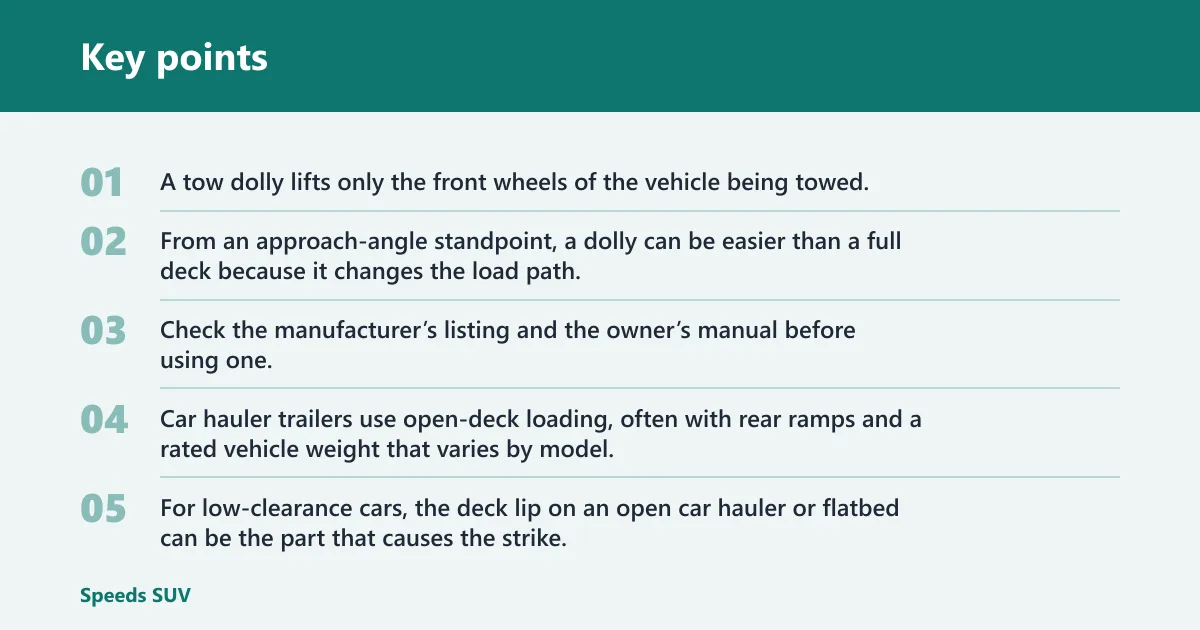
A tow dolly lifts only the front wheels of the vehicle being towed. The rear wheels stay on the ground. That makes a dolly a midway solution between rope towing and a flatbed truck, and it is lighter than full flatbeds and costs less than full flatbed rigs.
From an approach-angle standpoint, a dolly can be easier than a full deck because it changes the load path. It is often a practical fit for some front-wheel-drive vehicles, but drivetrain and maker restrictions matter for rear-wheel-drive and all-wheel-drive models. Check the manufacturer’s listing and the owner’s manual before using one.
Car haulers and flatbeds
Car hauler trailers use open-deck loading, often with rear ramps and a rated vehicle weight that varies by model. Flatbed trailers use a full deck and are often more universal for transport, but their higher deck height than lowboy-style setups can create more front-end angle at the ramp.
For low-clearance cars, the deck lip on an open car hauler or flatbed can be the part that causes the strike. The ramp itself may be usable, while the transition at the top is not.
Step decks and RGNs
Step deck trailers have two deck levels, which lowers the load height compared with a single high deck. They are used for forklift, crane, or rear-ramp loading, and the rear ramp angle still matters because the lower deck does not remove the transition problem entirely.
An RGN trailer has a neck that comes off the front, and with an RGN, the deck can sit on the ground for drive-on loading. RGNs are best for equipment that can be driven or winched on. That loading method difference makes them useful when a vehicle or machine cannot tolerate a steep ramp.
One more planning point matters for taller equipment: a legal height target of around 13’6″ applies in many states, and you should measure machine height including exhaust stacks, beacons, and cab A/C units.
Trailer loading clearance checklist

Use this checklist before the first wheel climbs the ramp. It turns the geometry into a pass/fail review by trailer type, so you can stop before the nose contacts the ramp or deck edge. If any item fails, reconfigure the load instead of forcing the angle.
| Check item | Tow dolly | Car hauler | Flatbed trailer | Step deck trailer | RGN trailer |
|---|---|---|---|---|---|
| Front overhang under 40 inches | Pass for many front-wheel-drive cars; verify maker limits | Pass if ramp and lip are long enough | Pass if deck height and lip are modest | Pass if lower deck and ramp angle are workable | Pass for drive-on or winch-on loads |
| Lowest front point 5 inches or more | Usually pass, but still check tire lift and tie-down path | Pass with longer ramps; short ramps raise scrape risk | Pass on many vehicles; lip still needs a check | Pass more often than a high flatbed deck | Pass when the deck can sit on the ground |
| Bumper, splitter, or skid plate below the ramp lip line | Fail if the nose will touch the dolly frame | Fail unless the lip is lowered or lengthened | Fail unless the transition is changed | Fail if the rear ramp creates a sharp breakover | Usually pass when loading at ground level |
| Need to winch instead of drive on | Not a normal dolly use case | Pass if winch angle stays low | Pass if the line stays straight and low | Pass for equipment that can be winched on | Pass; winch loading is a common fit |
| Rear wheels must stay on the ground | Pass; that is the design | Not applicable | Not applicable | Not applicable | Not applicable |
What to check before the first wheel climbs
- Confirm the lowest front point. Find the exact part that can touch first, then compare it to the ramp lip and deck edge. Do not assume the bumper cover is the limit.
- Verify the loading method. Decide whether the vehicle will drive on, be winched on, or ride on a dolly. Each method changes the angle and where the stress lands.
- Match the trailer to the vehicle. A low car often needs longer ramps or a lower deck. A truck or SUV may clear better, but a long nose can still fail at the lip.
- Stop at the first contact sign. If the splitter touches, the front suspension compresses hard, or the fairlead scrapes, back off and reconfigure the loading plan.
Which trailer type fits your vehicle?
Choose the trailer by the vehicle’s front geometry, not by trailer size alone. Low-clearance cars need the most careful ramp and lip check. SUVs and work trucks usually have more clearance, but long overhangs and front accessories can still create contact. Tow dollies can be easier for some front-wheel-drive vehicles, while full decks and RGNs are better when you need broader loading options.
Low-clearance cars
Low-clearance cars are the most sensitive to ramp angle, deck height, and the lip transition. If the splitter, bumper corner, or skid plate sits close to the ground, a standard car hauler ramp may fail even when the deck itself seems usable. Long ramps, a lower deck, or ground-level loading are the usual fixes.
For this group, the safest choice is often the setup with the least breakover at the lip. That may be a step deck, an RGN with the deck on the ground, or a flatbed only if the ramp and transition are long enough.
SUVs and work trucks
SUVs and work trucks usually have more front clearance than lowered cars, but they are not automatic passes. A long front overhang can still scrape on a short ramp, and a front skid plate can touch earlier than the bumper cover. Heavy front accessories can also change the stance.
For these vehicles, the main check is whether the deck edge and ramp angle stay below the vehicle’s usable clearance once the front end begins to compress. If not, use longer ramps or a lower loading point.
When a dolly is easier than a full deck
A tow dolly can be easier than a flatbed when the vehicle matches the dolly’s drivetrain and loading rules. Because only the front wheels are lifted and the rear wheels stay on the ground, the loading geometry is different from a full deck. That can reduce the need to clear a full ramp with the entire vehicle.
It is not a universal answer. Rear-wheel-drive and all-wheel-drive vehicles may have restrictions that vary by model and maker, so the owner’s manual and the dolly listing decide the final call.
Frequently asked questions
How does approach angle affect loading onto a trailer?
Approach angle affects whether the front of the vehicle clears the ramp, deck lip, or breakover before the tires climb. If the nose is too low for the loading angle, the bumper, splitter, skid plate, or tow hook area can scrape first. That is why deck height and ramp length matter together.
What approach angle is safe for a car hauler ramp?
There is no single safe angle for every car hauler ramp because the vehicle’s front overhang and lowest front point change the limit. A useful check is the vehicle’s estimated approach angle from ground clearance divided by front overhang. If the trailer’s effective angle is steeper than that, treat it as a fail and use longer ramps or a lower deck.
Will my front bumper scrape on a flatbed ramp?
It can, especially if the flatbed has a high deck and a sharp lip at the ramp transition. The bumper may clear the ramp surface but still hit the deck edge when the front suspension compresses. Check the lowest leading edge, not just the bumper cover height, before loading.
How do I know if my vehicle will clear a trailer angle?
Measure the front overhang and the lowest front point, then compare that to the ramp slope and the deck lip transition. Use the rough estimate of arctan(clearance over front overhang) for the vehicle, then leave extra margin for suspension compression. If the lip looks sharp, assume the usable angle is worse than the ramp alone suggests.
What trailer type is best for low-clearance cars?
Low-clearance cars usually do best on the setup with the lowest practical loading angle and the smoothest transition. That can be a step deck, an RGN with ground-level loading, or a trailer with longer ramps and a shallow lip. A standard high flatbed is often the hardest fit unless the ramps are long and the front overhang is modest.
Can a tow dolly be easier to load than a flatbed?
Yes, for some vehicles it can be easier because a tow dolly lifts only the front wheels and leaves the rear wheels on the ground. That changes the loading geometry and can reduce the amount of full-vehicle ramp climbing. Even so, drivetrain and maker restrictions still control whether a particular rear-wheel-drive or all-wheel-drive vehicle may use one.
What should I check before driving onto a step deck or RGN?
Check the lowest front point, the front overhang, the loading method, and the deck height. On a step deck, verify the rear ramp angle and the two deck levels. On an RGN, confirm that the neck comes off the front and that the deck can sit on the ground for drive-on or winch-on loading.